Tibet

Elements area

Taxonomy

Code

Scope note(s)

    Source note(s)

      Display note(s)

        Hierarchical terms

        Tibet

          Equivalent terms

          Tibet

            Associated terms

            Tibet

              192 Archival description results for Tibet

              192 results directly related Exclude narrower terms
              LSH/1/1/8/1/31 · Part · 1946-12-23
              Part of The Ludlow & Sherriff Collection

              SUMMARY:
              After a very cold night with snowfall, the party enjoyed clear weather and fine scenery with Sengdam La visible, noted a large flock of Grandala at Tumbabe, and observed various birds including geese and mallard (two of which were shot and retrieved). They marched from Lunang to Daú below Chunjima, remarked on Lunang ironwork, and collected plants including Notholirion hyacinthinum, a Codonopsis (seed), and a probable Primula sonchifolia.

              CONTENT:
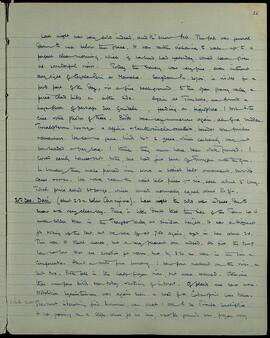
              Last night was very cold indeed, and 1/2" snow fell. The fall was general down to well below this place. It was rather sickening to wake up to a perfect clear morning, which if we had had yesterday would have given us wonderful views. Today the scenery was very fine, even without any sight of Gyala Peri or Namcha. Sengdam La, 20,700', is visible for a good part of the day, in a fine background to the open grassy valley & Picea-clad hills on either side. Again at Tumbabe, we found a huge flock of perhaps 300 Grandala, feeding on Hippophae. I took both cine & still photos of these. Birds were very numerous again, all of a sudden. Trochalopteron henrici & affinis & Ianthocincla ocellata, besides rose finches & accentors. We saw no game birds but 2 geese, which certainly were not bar-headed or grey lag. I think they must have been white fronted. I could easily have shot both, but had just sent off Tsongpen with the gun. In Lunang they make pierced iron work — waist belt ornaments, swords cases & so on. We have seen the waist belt pieces — six, each about 3" long. Total price asked 20 sangs, which would normally equal about Rs 3/-.

              21st Dec. Daú. (about 2-3 m. below Chunjima). Last night the cold was intense, due to snow & a very clear sky. There is little doubt that this side of the Temu La is much colder than in the Tsangpo valley at similar heights. It was a difficult job rolling up the tent, but we were off at 7.50 again, arrived here about 2.0. This was a short march, but a very pleasant one indeed. At first the temp was so low that we couldn't get warm, but by 9.30 we were in the sun & comfortable. About a mile from Lunang, I saw four mallard on the river, & shot two. Both fell in the half frozen river, but were rescued. Otherwise there were few birds seen today anything of interest. Of plants we saw more. Notholirion hyacinthinum was again seen & seed of a Codonopsis was taken.
              R. Hunter 12021 The most interesting find however, was what I took to be Primula sonchifolia. It was growing on a slope which got no sun, & so the ground was frozen very
              LSH/1/1/1/1/164 · Part · 1933-09-24
              Part of The Ludlow & Sherriff Collection

              SUMMARY:
              Notes describe the junction of two rivers near Luntse below Tang forming the Kuru Chu River and a long, impassable gorge cutting through the main Himalayan range. The writer remarks this prevents a direct outlet from Tibet to Bhutan without crossing a Himalayan pass. Ludlow reports only common birds observed, with nothing of particular interest.

              CONTENT:
              "Luntse" just below Tang is the junction of the 2 rivers which together form the Kuru Chu River. The junction lies in a magnificent gorge. This gorge continues for many miles below the junction forming a narrow & precipitous chasm piercing the main Himalayan range. No path traverses this gorge which is unfortunate as this would mean an outlet for Tibet to Bhutan without the obstacle of a pass across the Himalayan chain.

              Ludlow - except for pigeons, magpies Choughs & an occasional bunting or willow warbler, we saw nothing of interest.

              LSH/1/1/8/1/77 · Part · 1936-03-03
              Part of The Ludlow & Sherriff Collection

              SUMMARY:
              Cold halts with little flowering observed; the party notes the first primula in flower and red Rhododendron irroratum, investigates the place-name Makandro near the Gyala Peri range, and sends Sandup and Ramzana to try to film and collect a takin without success. Villagers repay a loan in kind, and on March 13 they move to Tongkyuk, recording a yellow Litsea and plentiful “Winter” plants.

              CONTENT:
              were here. If they went, it would be fine. I saw 10 here today, the first we have seen.

              7th March. Cloudy & cold. Disappointing day as we found nothing in the flower line at all, but luckier for a blackbird (maximus) & a thrush we have never seen before.

              8-9-10th March. Halt. This place is very cold indeed, & shrubs are not nearly so far on here as a few miles down the valley. But we have found a few things, notably the first primula in flower to be seen. This appears to be P. chungensis (12279), but might perhaps be Bulleyana or Cockburniana. The same red Rhod. Irroratum Ser. (12280) is also in flower in a valley 2m below here. I have been trying to find the name Makandro which Ward gives to the peak on the Gyala Peri range. So far I have found no one who knew the name. Here, one shikari told me there were two Makandros, one a ridge almost due South of here, & one a ridge almost due North. The fine flat topped peak which lies at 150° from here is locally called Gelung Sokpo. I asked Sandup to enquire about the name Makandro. He asked the monks, who eventually told him there were such places, but that he should not mention the name or talk about the places. I have taught Sandup how to take cine pictures, & he will go off tomorrow to try to get a picture of & one shot at a female takin. We have found pretty good supplies here - some peas, wheat, a few eggs(!), tsampa.

              11th-12th March. Halt. It is very cold here every day at midday. Sandup & Ramzana went off across the river for a drive up the nala to the South after takin. They have taken the cine camera & a small roll film camera to try to get pictures of live animals before shooting one female to make up the collection for the B.M. On our way through here in Jan we lent the headman 400 sangs to run their case against the ex Dzongpon in Lhasa. Now the whole village is repaying - in wheat, peas, tsampa, eggs, turnips, & any other commodity they can find. Headmen very helpful & a good type. Ramzana & Sandup back; saw no takin or marks.

              13th March. Tongkyuk. Rain last night & a good deal, off now today. Dull & cold, & we saw nothing at all on the way barring the yellow shrub Litsea No. 12257. Yesterday Ramzana brought back lots of Winter No. 12291 which was plentiful up the valley.

              LSH/1/1/1/1/213 · Part · 1933-10-04
              Part of The Ludlow & Sherriff Collection

              SUMMARY:
              Diary notes describe travel from Kipup to Sedonchen and Rhenock with misty weather, high passes, and tiring stone paths. The party reunites with Pinto and Danong; notes mention bird collecting, scarce Bhutan lily bulbs, and bird boxes dispatched from Yatung with one possibly near Salimapo. A glimpse of Kanchenjunga and return to a leech-prone zone are recorded.

              CONTENT:
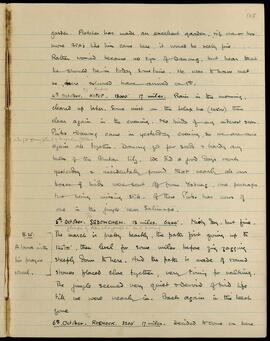
              105

              garden. Fletcher has made an excellent garden, if one or two more BIA's like him came here, it would be really fine. Rather worried because no sign of Danong, but hear that he should be in today sometime. He was to have met us, should have arrived on 1st.

              4th October. TO KIPUP. 13000' 17 miles. Rain in the morning, cleared up later. Some mist on the Jelap La (14500) then clear again in the evening. No birds of any interest seen. Pinto & Danong came in yesterday evening, so we are once again all together. (also for young plants of Magnolia Globosa) Danong got few seeds & hardly any bulbs of the Bhutan lily. We did a good day's work yesterday & incidentally found that nearly all our boxes of birds were sent off from Yatung, one perhaps two being missing still. Of these Pinto has news of one in the jungle near Salimapo.

              5th October. TO SEDONCHEN. 13 miles. 6400'. Misty day, but fine. (glimpse of Kanchenjunga in early morning) The march is pretty beastly, the path first going up to 13500', then level for some miles before zig zagging steeply down to here. And the path is made of round stones placed close together, very tiring for walking. The jungle seemed very quiet & devoid of bird life till we were nearly in. Back again in the leech zone. (B.35. A lama with his prayer wheel.)

              6th October. TO RHENOCK. 3200' 17 miles. Decided to come on here

              LSH/1/1/8/1/111 · Part · 1952-05-17
              Part of The Ludlow & Sherriff Collection

              SUMMARY:
              The party negotiates passage with an elderly Dzongpen (father of the acting official), who promises limited pony transport and sealed letters to Kome and Koto, while the diarist sends letters to Surkhang Dzasa and to Darjeeling. On 17 May at Yangtso they depart with yak transport, seen off by Pedong Dorji, and note clear views of Yala Shampo, lake birds, and herds of kyang and gazelle.

              CONTENT:
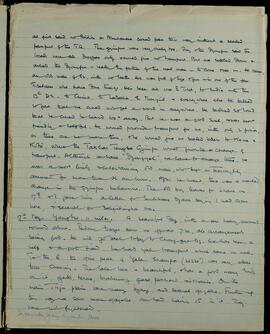
              At first, they said no British or Bhutanese could pass this way without a sealed passport of the T.G. The Dzongpens were very sticky too. The other Dzongpen said the locals were all Drokpas and only owned five, with no transport. But we settled down and asked the Dzongpen—really the father of the real man—to come see us. He came, an old man of 62, with no teeth. He was full of life and fun and is one of the few Tibetans who have done things. He's been all over East Tibet, to India with the 13th Dalai Lama, to China, to Ladakh, to Monyul, and everywhere else. He talked so fast that we could not get a word in anywhere. He talked so loud that he could be heard 100 yards away. But he was a good soul, and was most friendly and helpful. He would provide transport for us, with only 2 ponies, as there are no more there, and he would give us sealed letters to Kome and Koto, where the Takhar Tengba Dzongpen would find us a change of transport. Although we have "Dzongyel", we have to change there. He was a most lively and entertaining old man, who kept us thoroughly amused for more than half an hour. After he went, there was a marked change in the Dzongpen's behaviour. The old boy leaves for Lhasa on the 17th, and I gave him a letter for Surkhang Dzasa saying I had come here, and several for Darjeeling too.

              17th May. Yangtso. 11 miles. A beautiful day, with a few heavy showers round about. Pedong Dorji saw us off at 7:30, all arrangements being good. He will go back today to Chong-gye Dzong. He has been a help and a good friend. We had yak transport which came on well. To the east, the fine peak of Yala Shampo (20,230') was very clear this evening. The lake here is beautiful, and has a good many birds on it: gulls, terns, brahminy geese, pochard, and redshanks. On the main Triju plain were many kyang and several gazelle. Further up this way we saw more gazelle, one herd having 15 in it. They were not frightened.

              In car with young husband 17/5/52

              LSH/1/1/3/3/170 · Part · 1983-05-05
              Part of The Ludlow & Sherriff Collection

              SUMMARY:
              The diarist ascended the Na La through forest and traversed to the Pang La while traveling toward Tso Kar, searching for flowers and birds. Notes include observations of Heteroxenicus stellatus breeding among alpine rocks and a sighting of Snow Cock Pheasant (Tetraophasis szechenyii) across a wide elevational range.

              CONTENT:
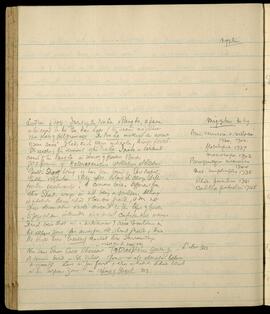
              Migyitun

              Ludlow page 104. Went up the Na La and Pang La, 2 passes Migyitun 30 August
              on the road to the Tso Kar (Lake of the sacred one) which
              is a place of pilgrimage. The Na La involved an ascent Primula verrucosa var. violacea
              of some 3000 feet and led, as its name indicates, through forest. 1734, 1742.
              On reaching the summit of the Na La I made a circuit flabellifera 1737
              round to the Pang La in search of flowers and birds. macrocarpa 1743
              Got 3 specimens of Heteroxenicus stellatus stellatus Paraquilegia anemonoides
              Gould's Short-wing which has been found in East Nepal, 1744
              Sikkim and Bhutan. This species extends its range still Meconopsis simplicifolia 1735
              further eastwards. A common bird. Different from Rhododendron pumilum 1741
              other Short-wings in not being a skulker. Although Caltha palustris 1745
              it inhabits dense rhododendron and bamboo growth, it does not
              shun observation and will ascend to the tops of bushes
              to gaze at an intruder in a most confidential manner.
              The 2 were shot in - wherever there are rocks and boulders in
              the alpine zone, far away from all shrub growth. And
              the birds were breeding amidst these surroundings.
              --- shot on the next day ---
              Also saw Snow Cock Pheasant Tetraophasis szechenyii - Ludlow 383
              A common bird in Southeast Tibet. Found at all elevations between
              11-15000 feet. Lives in fir forest and also inhabits Rhododendron scrub
              in the alpine zone. - Specimen of Szechenyii 383.

              LSH/1/1/6/1/90 · Part · 1938-07-08
              Part of The Ludlow & Sherriff Collection

              SUMMARY:
              Route description from Miling toward Nayü with directions via Pangya, Majü, and the Tum La, noting a broken bridge over the Majü Chu and multiple campable sites along the valley. Includes details on the Nayü La and Tunga La usage by Lopas, mile-by-mile terrain notes to Dümze and Sakya Kang, and barometric/temperature readings with the date.

              CONTENT:
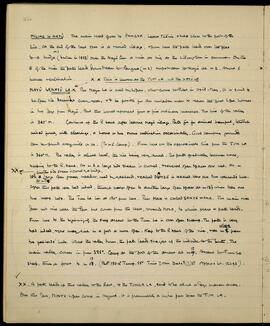
              MILING to NAYÜ

              The main road goes to PANGYA. Leave Miling creek close to the foot of the hill. At the end of the last spur is a ruined village, from here the path leads over low flats to a bridge (broken in 1938) over the Majü Chu, a river as big as the Lilung Chu in summer. On the east of the river the path leads downstream to Pangya (mile 2) and upstream to Majü at mile 2. About 6 houses and cultivation.

              This is known as the TUM LA, not the NAYÜ LA.

              NAYÜ LA. The Nayü La is used by Lopas, who come to Tibet in April-May. It is said to be open till December every year, and to be possible for an unladen man to reach the first Lopa houses in two days from Majü. But this would represent four or five ordinary marches. The line of the valley is 340° M.

              Continue up the right bank after leaving Majü village. Path fit for animal transport, through mixed forest, with clearings, a house or two and some cultivation occasionally. Good camping grounds can be found every mile or so. (To mile 5. Camp). From here on the approximate line from the TUM LA is 360° M. The valley is almost level, the rise being very small. The path gradually becomes worse, keeping to the right bank. At mile 6 a large side stream is crossed, and several open spaces are met. At mile 10½, another side stream is crossed by a bridge, and a large open grassy meadow, used by yakherds, and called DÜMZE is reached. Here are two yakherd's huts. After this the path is very bad indeed, through water often to another large open space at mile 13¾ where there are two more huts. The Tum La lies at 180° from here. This place is called SAKYA KANG. The main river does not rise near the pass but comes from the west, towards MORO, to which place a path leads. From here to the beginning of the steep ascent to the Tum La is over open swamp. The path is very bad indeed, and one may sink in a foot or more often. Keep to the right bank of the river, and at mile 15½ pass two yakherds' huts. Where the valley turns, the path leads straight up the hillside to the South. The main valley comes in from 285°. Camp at the foot of the ascent at mile 18. Ascent to Tum La steep, through forest to mile 19. (B.P. 190.4° Temp. 55° Time 7:00 am Date 8/7/38 Approx ht. 12243').

              A path leads up this valley to the East, to the TUNGA LA, said to be about a day's march away. Over this Pass, MINYU Lopas come in August. It is presumably a higher pass than the TUM LA.

              LSH/1/1/1/1/37 · Part · 1933-05-23
              Part of The Ludlow & Sherriff Collection

              SUMMARY:
              Photo notes describe a view in the Chumbi valley with mules heading to Chumbithang and a mule being pulled back onto the path near the top of the Nathu La in mist. The entry recounts small avalanches pushing mules off the path, difficult recovery of a mule using tarpaulins and numdahs, and dead mules and wool loads along the route. Reached Tsomgo at 5.15 pm and noted contrasting snow on different faces.

              CONTENT:
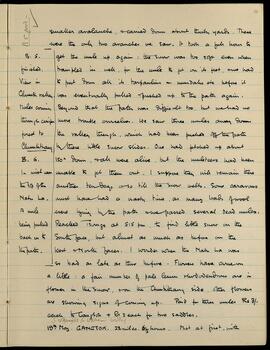
              16

              B 5 good -

              B. 5. finished. View in Chumbi valley. Mules coming through conifer forest to Chumbithang

              B. 6. In mist near the top of the Nathu La. A mule being pulled back on to the path.

              smaller avalanche, & carried down about thirty yards. These
              were the only two avalanches we saw. It took a full hour to
              get the mule up again: the snow was too soft even when
              trampled in well, for the mule to get on its feet, and had
              to put down all its tarpaulins & numdahs etc before it
              was eventually pulled & pushed up to the path again.
              Beyond that the path was difficult too, but we had no
              more trouble ourselves. We saw three mules away down
              the valley trough, which had been pushed off the path
              by these little snow slides. One had fetched up about
              150' down, & all were alive, but the muleteers had been
              unable to get them out. I suppose they will remain there
              another ten days or so till the snow melts. Some caravans
              must have had a nasty time, as many loads of wool
              were lying by the path & we passed several dead mules.
              Reached Tsomgo at 5.15 pm, to find little snow on the
              South face, but almost as much as before on the
              West & North faces. I wonder when the Nathu La was
              so bad as late as this before. Flowers have come on

              LSH/1/1/3/3/112 · Part · 1933-04-09
              Part of The Ludlow & Sherriff Collection

              SUMMARY:
              Notes from Natrampa dated April 29 list Rhododendron taxa with associated regional distributions and numbers. Several entries note possible new species (sp. nov.) alongside areas such as Yunn., S.E.T., Burm.-Tib. frontier, Assam, Sik., Bhut., Tibet, and India N.E. Frontier.

              CONTENT:
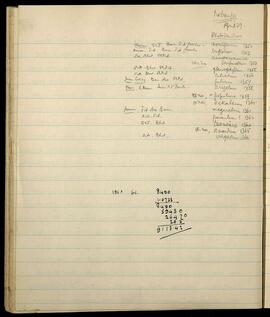
              Natrampa
              April 29.

              Rhododendrons
              Yunn. S.E.T., Burm.-Tib. frontier - neriiflorum 1352
              Assam. Tib. Burm.-Tib. frontier triflorum 1353
              Sik. Bhut. 8582b cinnabarinum var.
              Var. no. purpurellum 1354
              Sik. Bhut. 8581b. glaucophyllum 1355
              Sik. Bhut. 8582b cephalanthum 1356
              Yunn. S.E.T. Burm. Ass. 8580. fulvum 1357
              Yunn. S.E. Tibet. India N.E. Frontier. arizelum 1358
              sp. nov. - populare 1359
              sp. nov. dekatanum 1360
              Yunn. Tib. Ass. Burm. megeratum 1361
              Sik. Tib. pumilum? 1362
              S.E.T. Bhut. tsariense 1364
              sp. no. amandum 1365
              Sik. Bhut. virgatum 1366

              196.1 65. 8490
              1.0733
              8490
              59430
              26470
              265
              9113.42

              LSH/1/1/3/3/60 · Part · 1936-03-10
              Part of The Ludlow & Sherriff Collection

              SUMMARY:
              Brief note on Gunkarah Gompa, a small monastery linked by tradition to a halt by Guru Rimpooche en route to Tibet. Describes extensive burning at Selinda visible from camp with multiple fires, and records temperature and other measurements.

              CONTENT:
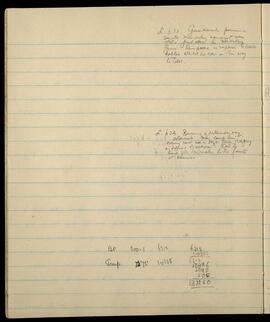
              L. p 32. Gunkarah Gompa
              Small monastery amongst some
              cliffs just above the monastery.
              Guru Rimpooche is supposed to have
              halted whilst he was on his way
              to Tibet.

              L. p 23. Burning of Selinda, very
              extensive. From camp this
              evening could see a dozen fires raging
              in different directions. Sad to
              think of the destruction to the forests
              it ensures.

              BP 200.1 6312 6312
              Temp. 72° 1.0888 1.0888
              6312
              50496
              5049
              505
              6872.50