Identity area
Reference code
Title
Date(s)
- 1938-07-01 (Creation)
Level of description
Extent and medium
1 page
Context area
Name of creator
Repository
Archival history
Immediate source of acquisition or transfer
Content and structure area
Scope and content
SUMMARY:
The diarist travels to Nayü by crossing the Tsangpo on a log raft and a kowa, meeting the Gyimpon of Nayü who assists with transport and hospitality and approves plans for visiting the Nayü La. The entry includes observations of birds, strong winds, and details of the Kongbo wooden teapot (TIBTI) made from GIUGÖ (Acer erianthum), plus notes on local familial ties among officials.
CONTENT:
Epipactis helleborine 5723, Epipactis royleana 5729
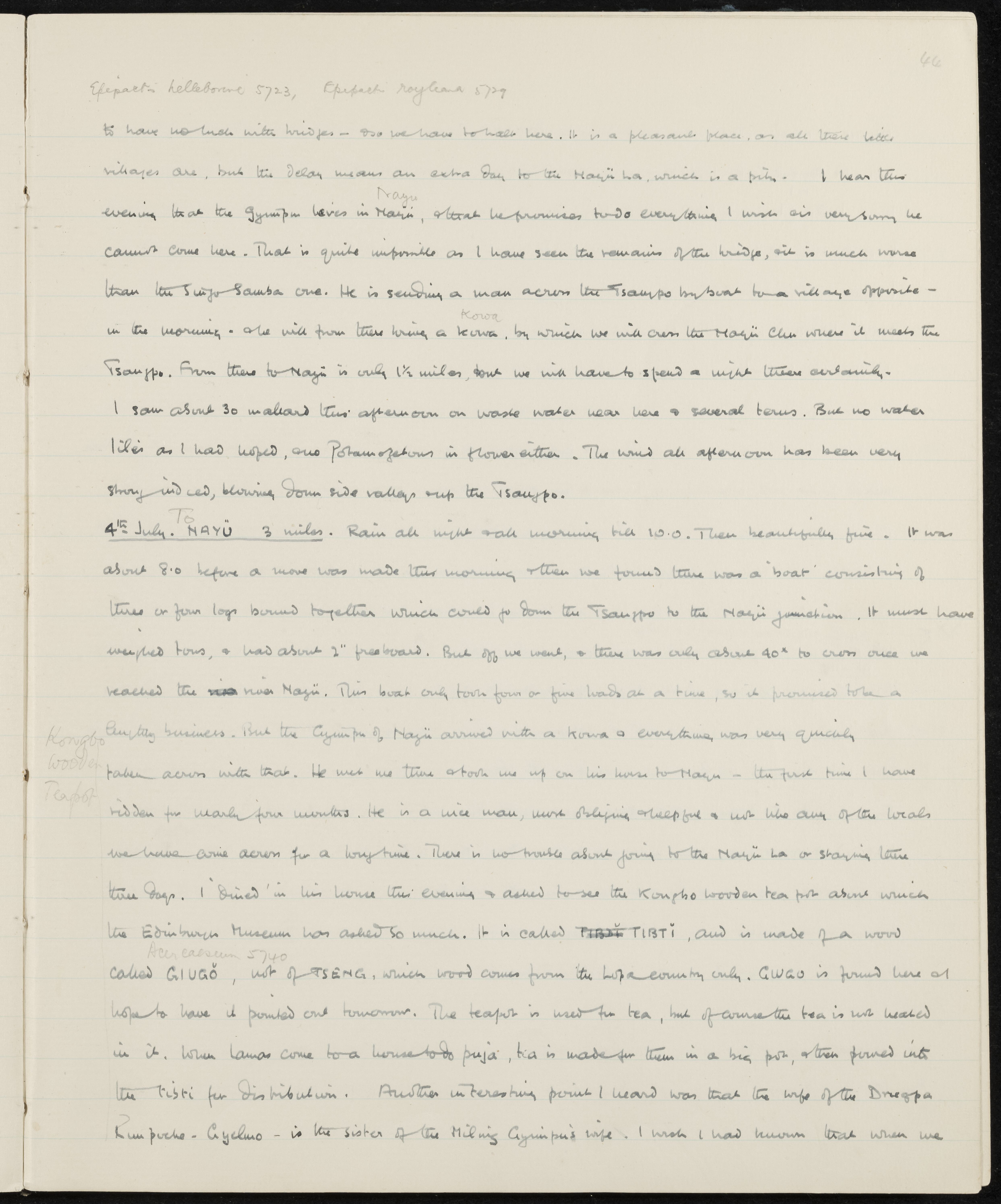
to have no luck with bridges — so we have to walk here. It is a pleasant place, as all these little villages are, but the delay means an extra day to the Nayü La, which is a pity. I hear this evening that the Gyimpon lives in Nayü, that he promises to do everything I wish and is very sorry he cannot come here. That is quite impossible as I have seen the remains of the bridge, it is much worse than the Sunjo Samba one. He is sending a man across the Tsangpo by boat to a village opposite — in the morning — who will from there bring a kowa, by which we will cross the Nayü Chu where it meets the Tsangpo. From there to Nayü is only 1 1/2 miles, but we will have to spend a night there certainly. I saw about 30 mallard this afternoon on waste water near here and several terns. But no water lilies as I had hoped, and no Potamogetons in flower either. The wind all afternoon has been very strong indeed, blowing down side valleys over the Tsangpo.
4th July. To NAYÜ 3 miles. Rain all night and morning till 10.0. Then beautifully fine. It was about 8.0 before a move was made this morning when we found there was a 'boat' consisting of three or four logs bound together which could go down the Tsangpo to the Nayü junction. It must have weighed tons, and had about 2" freeboard. But off we went, and there was only about 40 yards to cross once we reached the Nayü. This boat only took four or five loads at a time, so it promised to be a lengthy business. But the Gyimpon of Nayü arrived with a kowa and everything was very quickly taken across with that. He met me there and took me up on his horse to Nayü — the first time I have ridden for nearly four months. He is a nice man, most obliging and cheerful and not like any of the locals we have come across for a long time. There is no trouble about going to the Nayü La or staying here three days. I 'dined' in his house this evening and asked to see the Kongbo wooden tea pot about which the Edinburgh Museum has asked so much. It is called TIBTI, and is made of a wood called GIUGÖ (Acer erianthum 5740), not of TSENG, which wood comes from the Lopa country only. GIUGÖ is found here and I hope to have it pointed out tomorrow. The teapot is used for tea, but of course the tea is not heated in it. When lamas come to a house to do 'puja', tea is made for them in a big pot, then poured into the tibti for distribution. Another interesting point I heard was that the wife of the Dzogpa Rimpoche — Gyelmo — is the sister of the Miling Gyimpon's wife. I wish I had known that when we
Appraisal, destruction and scheduling
Accruals
System of arrangement
Conditions of access and use area
Conditions governing access
Conditions governing reproduction
Language of material
Script of material
Language and script notes
Physical characteristics and technical requirements
Finding aids
Allied materials area
Existence and location of originals
Existence and location of copies
Related units of description
Notes area
Alternative identifier(s)
Access points
Subject access points
Place access points
Name access points
- Gyimpon of Nayü (Subject)
- Dzogpa Rimpoche (Subject)
- Gyelmo (Subject)
- Miling Gyimpon (Subject)
- Acer erianthum (Subject)
- Epipactis helleborine (Subject)
- Epipactis royleana (Subject)
- Potamogeton (Subject)