Zona de identificação
Código de referência
Título
Data(s)
- 1933-09-19 (Produção)
Nível de descrição
Dimensão e suporte
1 page
Zona do contexto
Nome do produtor
Entidade detentora
História do arquivo
Fonte imediata de aquisição ou transferência
Zona do conteúdo e estrutura
Âmbito e conteúdo
SUMMARY:
The diarist describes taking telephoto and cinema panoramas from near the Me La and Dib La, viewing Kula Kangri, the Mago hills, Chakzam Chu, Gauri Chu, and the hills above Pinbogong, and mentions sketching a rough map and seeing a pnoepyga. The entry explains the meaning of Sangthopelri, first seen from the Cho La, and relates the tradition of Lobpön Rimpoche (Guru Rimpoche) traveling from India to Tibet via this route, noting glaciers seen at Mena and before reaching the Me La.
CONTENT:
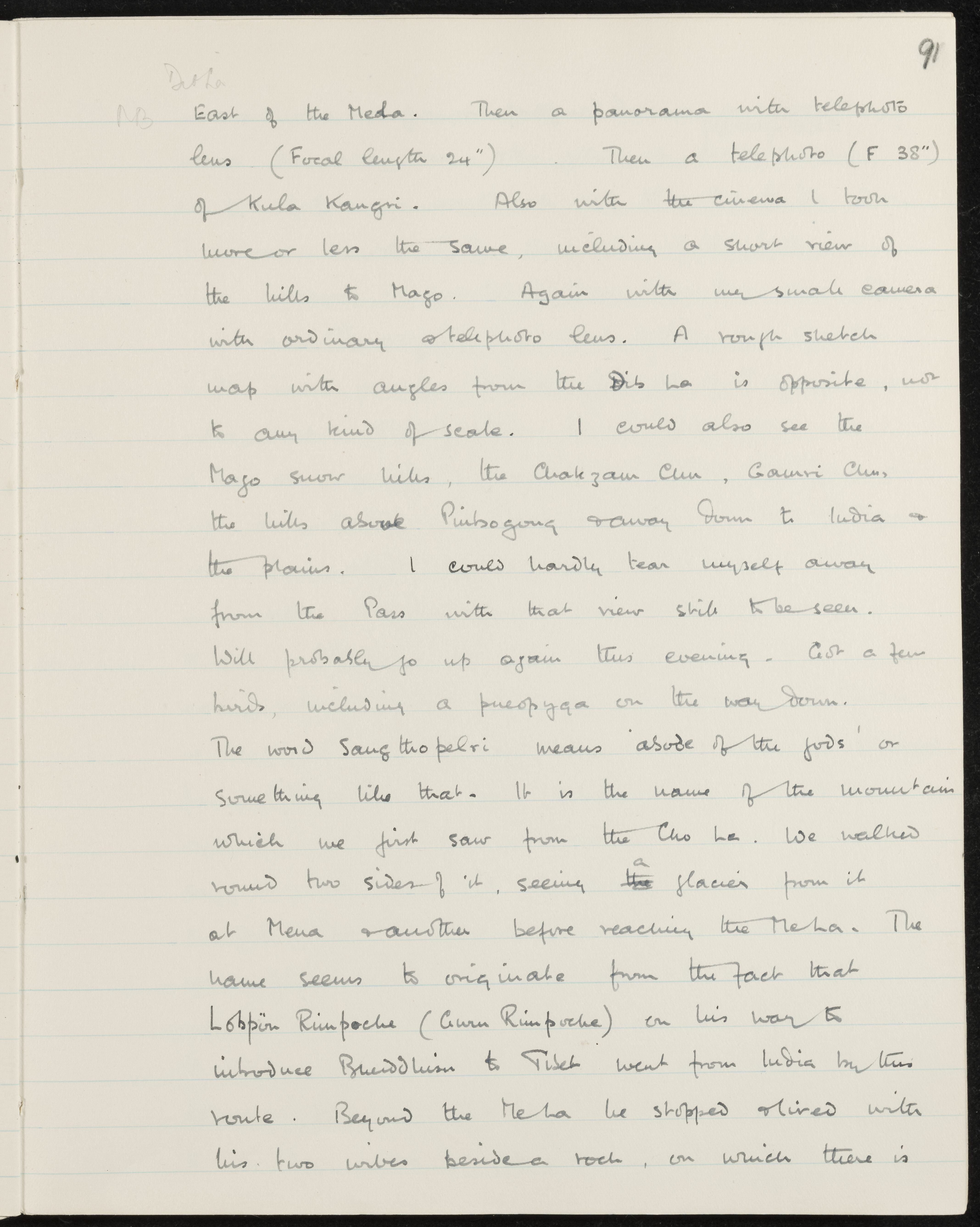
East of the Me La. Then a panorama with telephoto lens (Focal length 24"). Then a telephoto (F 38") of Kula Kangri. Also with the cinema I took more or less the same, including a short view of the hills to Mago. Again with my small camera with ordinary telephoto lens. A rough sketch map with angles from the Dib La is opposite, not to any kind of scale. I could also see the Mago snow hills, the Chakzam Chu, Gauri Chu, the hills above Pinbogong and away down to India and the plains. I could hardly tear myself away from the Pass with that view still to be seen. Will probably go up again this evening. Got a few birds, including a pnoepyga on the way down.
The word Sangthopelri means 'abode of the gods' or something like that. It is the name of the mountain which we first saw from the Cho La. We walked round two sides of it, seeing a glacier from it at Mena and another before reaching the Me La. The name seems to originate from the fact that Lobpön Rimpoche (Guru Rimpoche) on his way to introduce Buddhism to Tibet went from India by this route. Beyond the Me La he stopped and lived with his two wives beside a rock, on which there is
Avaliação, seleção e eliminação
Incorporações
Sistema de arranjo
Zona de condições de acesso e utilização
Condições de acesso
Condiçoes de reprodução
Idioma do material
Sistema de escrita do material
Notas ao idioma e script
Características físicas e requisitos técnicos
Instrumentos de descrição
Zona de documentação associada
Existência e localização de originais
Existência e localização de cópias
Unidades de descrição relacionadas
Zona das notas
Identificador(es) alternativo(s)
Pontos de acesso
Pontos de acesso - Assuntos
Pontos de acesso - Nomes
- Lobpön Rimpoche (Guru Rimpoche) (Assunto)
- Pnoepyga (Assunto)