Zona de identificação
Código de referência
Título
Data(s)
- 1933-09-01 (Produção)
Nível de descrição
Dimensão e suporte
1 page
Zona do contexto
Nome do produtor
Entidade detentora
História do arquivo
Fonte imediata de aquisição ou transferência
Zona do conteúdo e estrutura
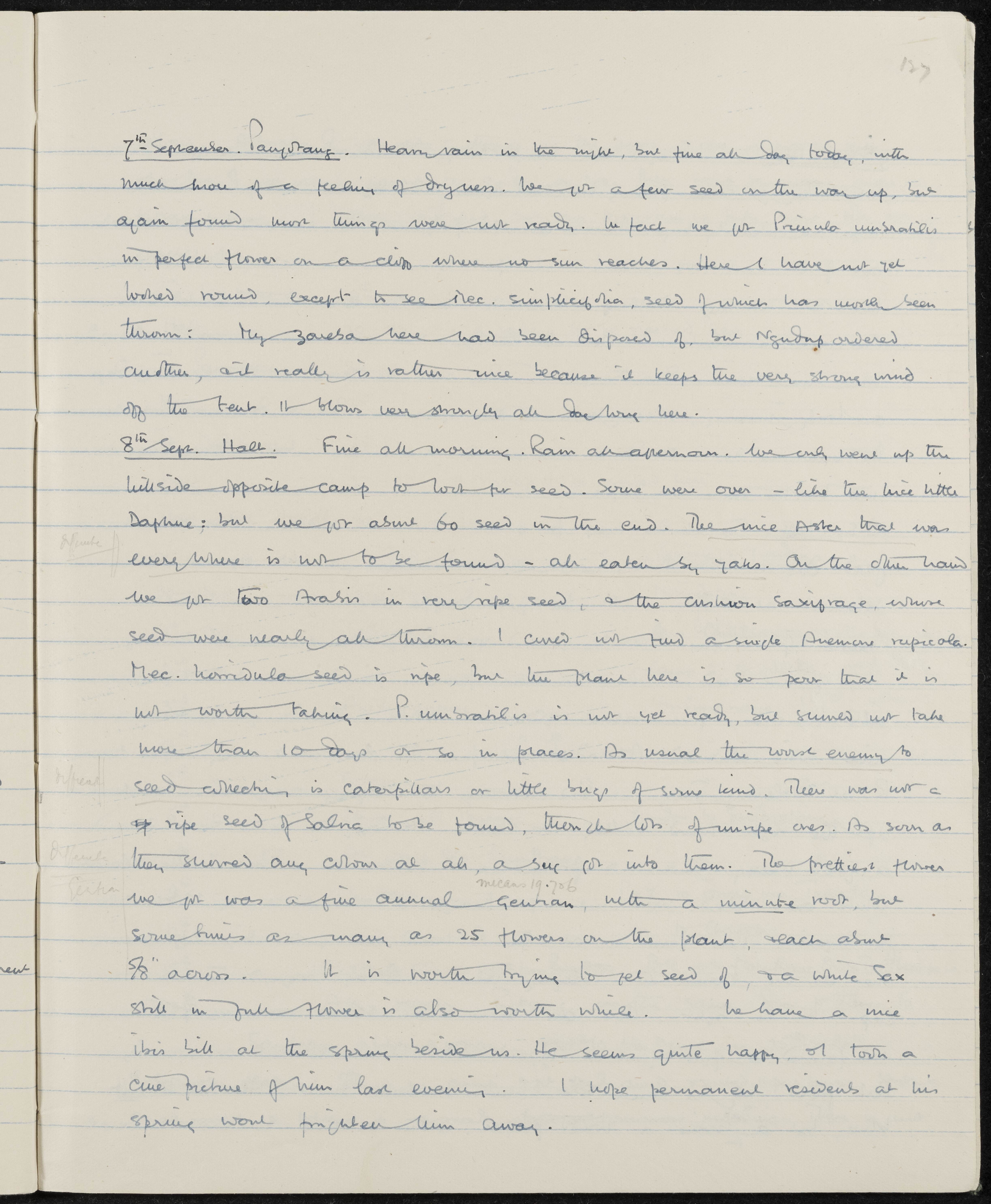
Âmbito e conteúdo
SUMMARY:
At Pangtang, the diarist reports improved weather after night rain, limited seed readiness, and observations of several plants in flower or seed, while Ngudup arranged a new zareba to shield the tent from strong winds. The following day was a halt with morning sun and afternoon rain; seed collecting yielded mixed results due to grazing and insect damage, and the diarist photographed an ibis bill at a nearby spring.
CONTENT:
7th September. Pangtang. Heavy rain in the night, but fine all day today, with much more of a feeling of dryness. We got a few seed on the way up, but again found most things were not ready. In fact we got Primula umbratilis in perfect flower on a cliff where no sun reaches. Here I have not yet looked round, except to see Mec. simplicifolia, seed of which has mostly been thrown. My zareba here had been disposed of, but Ngudup ordered another, and it really is rather nice because it keeps the very strong wind off the tent. It blows very strongly all day long here.
8th Sept. Halt. Fine all morning. Rain all afternoon. We only went up the hillside opposite camp to look for seed. Some were over - like the nice little Daphne; but we got about 60 seed in the end. The nice Aster that was everywhere is not to be found - all eaten by yaks. On the other hand we got two Arabis in very ripe seed, and the cushion saxifrage, whose seed were nearly all thrown. I could not find a single Anemone rupicola. Mec. horridula seed is ripe, but the plant here is so poor that it is not worth taking. P. umbratilis is not yet ready, but should not take more than 10 days or so in places. As usual the worst enemy to seed collecting is caterpillars or little bugs of some kind. There was not a ripe seed of Salvia to be found, though lots of unripe ones. As soon as they showed any colour at all, a bug got into them. The prettiest flower we got was a fine annual Gentian, with a minute root, but sometimes as many as 25 flowers on the plant, each about 5/8" across. It is worth trying to get seed of, and a white Sax still in full flower is also worth while. We have a nice ibis bill at the spring beside us. He seems quite happy, and I took a cute picture of him last evening. I hope permanent residents at his spring won't frighten him away.
Avaliação, seleção e eliminação
Incorporações
Sistema de arranjo
Zona de condições de acesso e utilização
Condições de acesso
Condiçoes de reprodução
Idioma do material
Sistema de escrita do material
Notas ao idioma e script
Características físicas e requisitos técnicos
Instrumentos de descrição
Zona de documentação associada
Existência e localização de originais
Existência e localização de cópias
Unidades de descrição relacionadas
Zona das notas
Identificador(es) alternativo(s)
Pontos de acesso
Pontos de acesso - Assuntos
Pontos de acesso - Locais
Pontos de acesso - Nomes
- Ngudup (Assunto)
- Anemone rupicola (Assunto)
- Arabis (Assunto)
- Aster (Assunto)
- Daphne (Assunto)
- Mec. horridula (Assunto)
- Mec. simplicifolia (Assunto)
- Primula umbratilis (Assunto)
- Salvia (Assunto)