Identity area
Reference code
Title
Date(s)
- 1937-05-22 (Creation)
Level of description
Extent and medium
1 page
Context area
Name of creator
Repository
Archival history
Immediate source of acquisition or transfer
Content and structure area
Scope and content
SUMMARY:
The diarist describes Dungshinggang (the Black Mountain), explains the local meaning of its name, notes a nearby shrine to a mountain god, and records bird sightings. On 20th May they travelled about 3½ miles to Gnüdulakh on the north side of Dungshinggang, with clearing weather, views of the Punsum peaks, photographs, and a bearing taken from camp at Wangchelakh.
CONTENT:
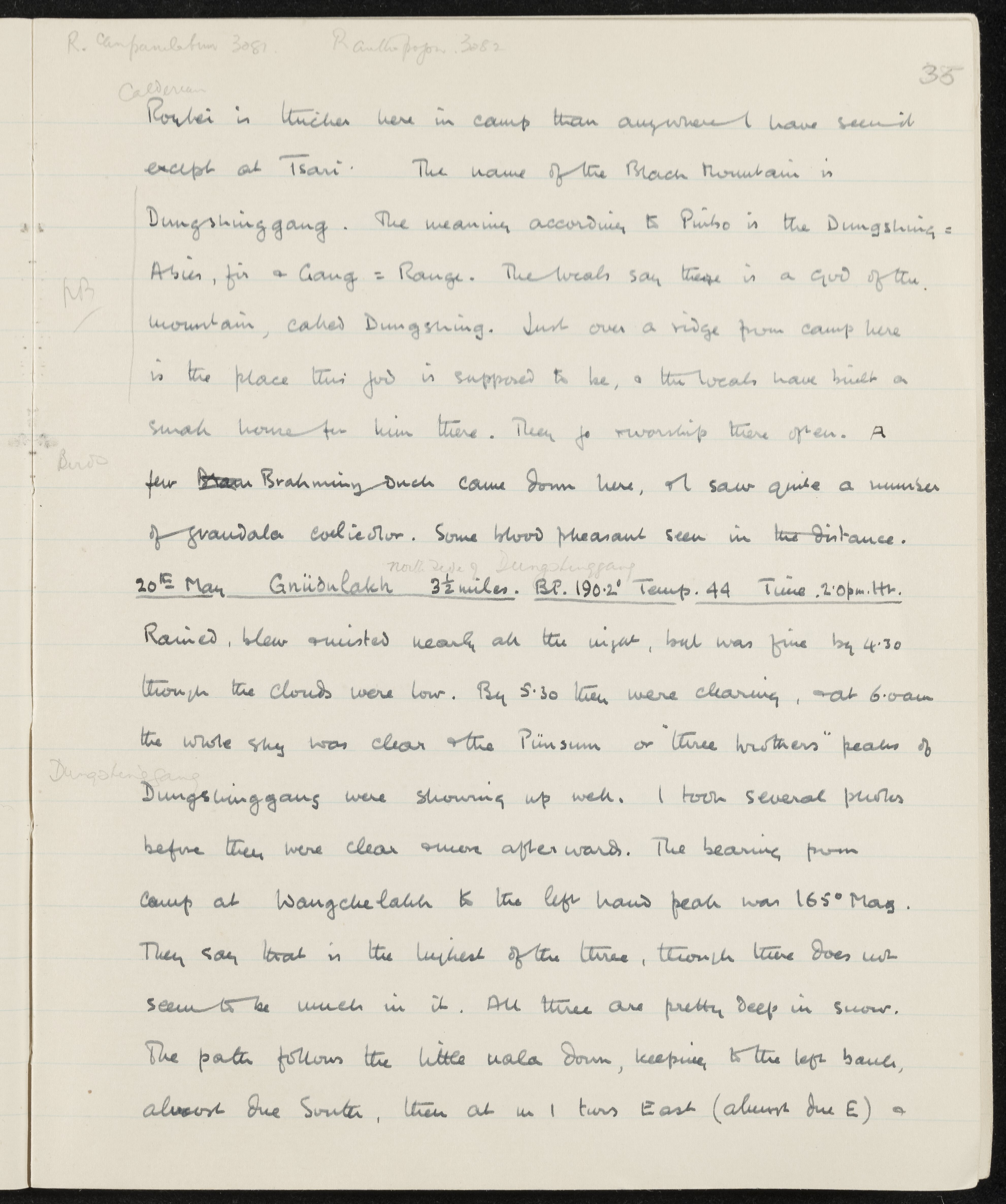
R. Campanulatum 3081 R. anthopogon 3082 35
Hookeri is thicker here in camp than anywhere I have seen it except at Tsari. The name of the Black Mountain is Dungshinggang. The meaning according to Punso is the Dungshing = Abies, fir and Gang = Range. The locals say there is a god of the mountain, called Dungshing. Just over a ridge from camp here is the place this god is supposed to be, and the locals have built a small house for him there. They go to worship there often. A few Brahminy Duck came down here, and I saw quite a number of Grandala coelicolor. Some blood pheasant seen in the distance.
20th May Gnüdulakh 3 1/2 miles. BP. 190.2' Temp. 44 Time 2.0pm. Hr.
(North side of Dungshinggang)
Rained, blew and misted nearly all the night, but was fine by 4.30 though the clouds were low. By 5.30 they were clearing, and at 6.0am the whole sky was clear and the Punsum or "three brothers" peaks of Dungshinggang were showing up well. I took several photos before they were clear and more afterwards. The bearing from camp at Wangchelakh to the left hand peak was 165° Mag. They say that is the highest of the three, though there does not seem to be much in it. All three are pretty deep in snow. The path follows the little nala down, keeping to the left bank, almost due South, then at m 1 turns East (always due E) and
Appraisal, destruction and scheduling
Accruals
System of arrangement
Conditions of access and use area
Conditions governing access
Conditions governing reproduction
Language of material
Script of material
Language and script notes
Physical characteristics and technical requirements
Finding aids
Allied materials area
Existence and location of originals
Existence and location of copies
Related units of description
Notes area
Alternative identifier(s)
Access points
Subject access points
Place access points
Name access points
- Grandala coelicolor (Subject)
- R. anthopogon (Subject)
- R. campanulatum (Subject)