Zone d'identification
Cote
Titre
Date(s)
- 1983-05-05 (Production)
Niveau de description
Étendue matérielle et support
1 page
Zone du contexte
Nom du producteur
Histoire archivistique
Source immédiate d'acquisition ou de transfert
Zone du contenu et de la structure
Portée et contenu
SUMMARY:
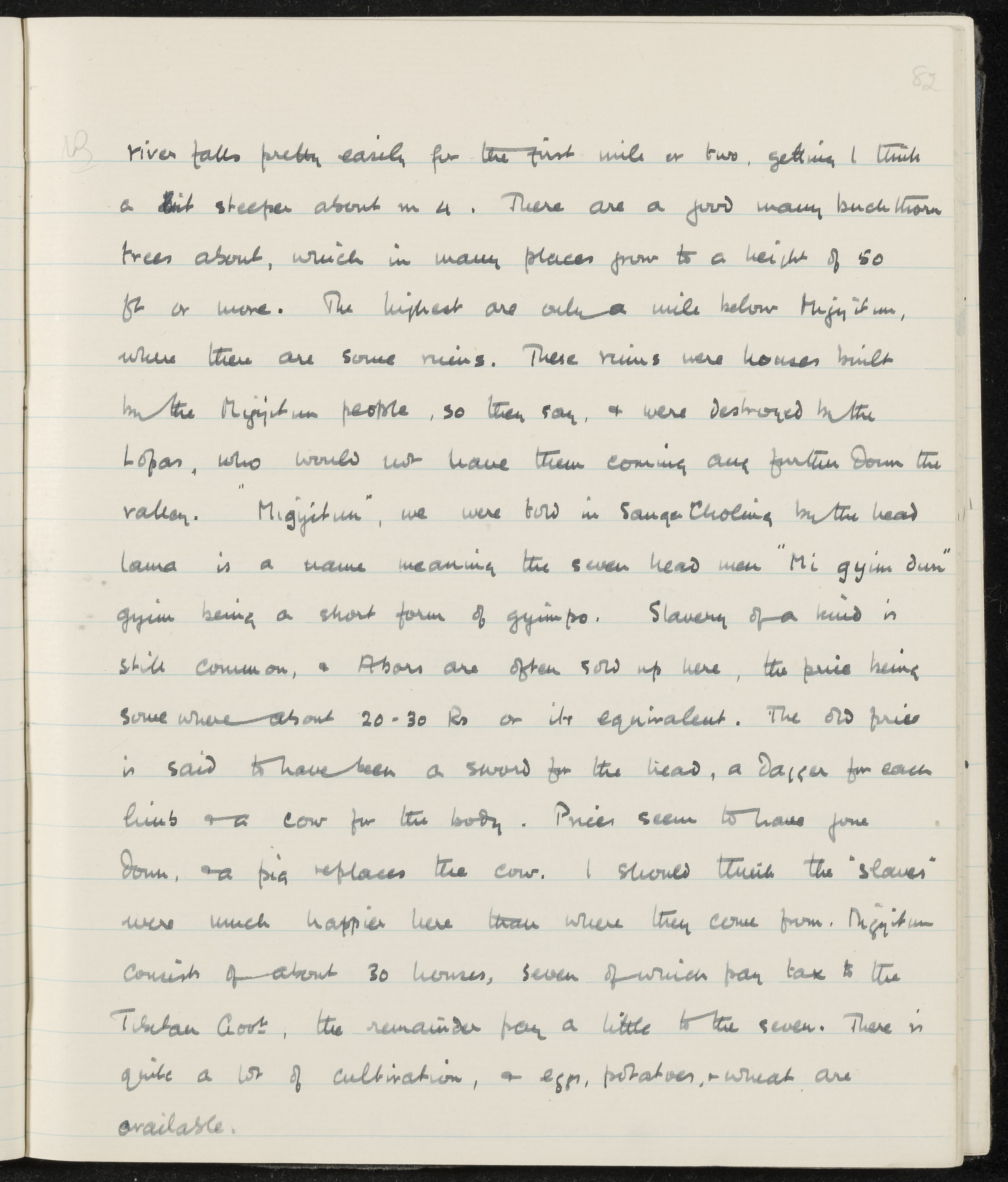
The page describes the river’s gradient, extensive buckthorn trees, and ruins near Migyitun, along with an explanation from the head lama at Sangacholing that 'Migyitun' means 'seven head men.' It also notes local slavery practices involving Abors, taxation arrangements in Migyitun, and available cultivation including eggs, potatoes, and wheat.
CONTENT:
River falls pretty easily for the first mile or two, getting I think a bit steeper about mile 4. There are a good many buckthorn trees about, which in many places grow to a height of 50 feet or more. The highest are only a mile below Migyitun, where there are some ruins. These ruins were houses built by the Migyitun people, so they say, and were destroyed by the Lopas, who would not have them coming any further down the valley. "Migyitun", we were told in Sangacholing by the head lama is a name meaning the seven head men "Mi gyim dun" gyim being a short form of gyimpo. Slavery of a kind is still common, and Abors are often sold up here, the price being somewhere about 20-30 Rs or its equivalent. The old price is said to have been a sword for the head, a dagger for each limb and a cow for the body. Prices seem to have gone down, and a pig replaces the cow. I should think the "slaves" were much happier here than where they come from. Migyitun consists of about 30 houses, seven of which pay tax to the Tibetan Government, the remainder pay a little to the seven. There is quite a lot of cultivation, and eggs, potatoes, and wheat are available.
Évaluation, élimination et calendrier de conservation
Accroissements
Mode de classement
Zone des conditions d'accès et d'utilisation
Conditions d'accès
Conditions de reproduction
Langue des documents
Écriture des documents
Notes de langue et graphie
Caractéristiques matérielle et contraintes techniques
Instruments de recherche
Zone des sources complémentaires
Existence et lieu de conservation des originaux
Existence et lieu de conservation des copies
Unités de description associées
Zone des notes
Identifiant(s) alternatif(s)
Mots-clés
Mots-clés - Sujets
Mots-clés - Lieux
Mots-clés - Noms
- head lama (Sujet)