Zona de identificação
Código de referência
Título
Data(s)
- 1933-04-14 - 1933-05-17 (Produção)
Nível de descrição
Dimensão e suporte
1 page
Zona do contexto
Nome do produtor
Entidade detentora
História do arquivo
Fonte imediata de aquisição ou transferência
Zona do conteúdo e estrutura
Âmbito e conteúdo
SUMMARY:
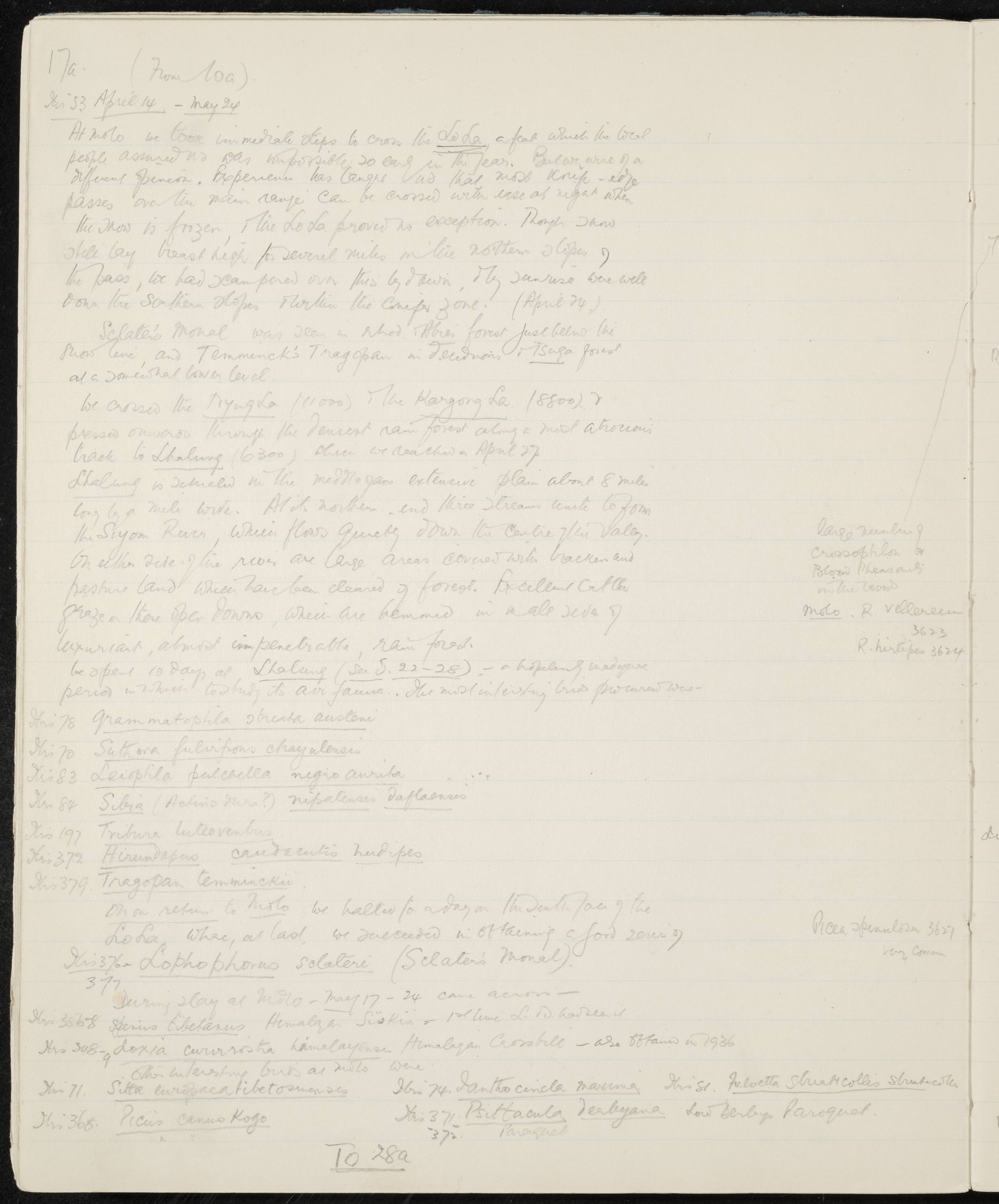
The party crossed the snow-bound Lo La at night, then traversed the Nyug La and Kargong La to reach Shalong by April 27, describing the Shalong plain and listing notable birds collected. On returning to Molo they secured Sclater's Monal on the south face of Lo La and, during May 17–24, recorded additional species, with marginal notes on pheasants and Picea spinulosa.
CONTENT:
17a. (from 16a).
'33 April 14 - May 24
At Molo we took immediate steps to cross the Lo La, a feat which the local people assured us was impossible so early in the year. But we were of a different opinion. Experience has taught us that most knife-edge passes over the main range can be crossed with ease at night when the snow is frozen. The Lo La proved no exception. Though snow still lay breast high for several miles on the northern slopes of the pass, we had scampered over this by dawn, and by sunrise were well down the southern slopes within the conifer zone. (April 24.)
Sclater's Monal was seen in rhododendron and fir forest just below the snow line, and Temminck's Tragopan in deciduous and Tsuga forest at a somewhat lower level.
We crossed the Nyug La (11,000) and the Kargong La (13,800) and pressed onwards through the densest rain forest along a most atrocious track to Shalong (6,300) which we reached on April 27.
Shalong is situated in the middle of an extensive plain about 8 miles long by a mile wide. At its northern end three streams unite to form the Siyom River, which flows quietly down the centre of the valley. On either side of the river are large areas covered with bracken and pasture land which have been cleared of forest. Excellent cattle graze on these open downs, which are hemmed in on all sides by luxuriant, almost impenetrable, rain forest.
We spent 10 days at Shalong (See p. 22-28) — a hopelessly inadequate period in which to study its avifauna. The most interesting birds procured were:
No. 78 Grammatoptila striata austeni
No. 70 Suthora fulvifrons chayulensis
No. 83 Leioptila pulchella nigroaurita
No. 84 Sibia (Actinodura?) nipalensis daflaensis
No. 197 Tribura luteoventris
No. 372 Hirundapus caudacutus nudipes
No. 379 Tragopan temminckii
[Marginal note: Large numbers of Crossoptilon or Blood Pheasants in the wood. Molo. R. vellereum 3623, R. hirtipes 3624]
On our return to Molo we halted for a day on the south face of the Lo La, where, at last, we succeeded in obtaining a good series of No. 376-377 Lophophorus sclateri (Sclater's Monal).
[Marginal note: Picea spinulosa 3627 very common]
During stay at Molo — May 17-24 came across:
No. 356-8 Spinus thibetanus Himalayan Siskin — 1st time L. D. had seen it.
No. 348-9 Loxia curvirostra himalayensis Himalayan Crossbill — also obtained in 1936.
Other interesting birds at Molo were:
No. 71. Sitta europaea tibetosinensis
No. 368. Picus canus kogo
No. 74. Ianthocincla maxima
No. 81. Fulvetta striaticollis striaticollis
No. 371. Psittacula derbyana Lord Derby's Paroquet.
No. 372. Paroquet
To 28a
Avaliação, seleção e eliminação
Incorporações
Sistema de arranjo
Zona de condições de acesso e utilização
Condições de acesso
Condiçoes de reprodução
Idioma do material
Sistema de escrita do material
Notas ao idioma e script
Características físicas e requisitos técnicos
Instrumentos de descrição
Zona de documentação associada
Existência e localização de originais
Existência e localização de cópias
Unidades de descrição relacionadas
Zona das notas
Identificador(es) alternativo(s)
Pontos de acesso
Pontos de acesso - Assuntos
Pontos de acesso - Locais
Pontos de acesso - Nomes
- L. D. (Assunto)
- Crossoptilon (Assunto)
- Fulvetta striaticollis striaticollis (Assunto)
- Grammatoptila striata austeni (Assunto)
- Hirundapus caudacutus nudipes (Assunto)
- Ianthocincla maxima (Assunto)
- Leioptila pulchella nigroaurita (Assunto)
- Lophophorus sclateri (Assunto)
- Loxia curvirostra himalayensis (Assunto)
- Picea spinulosa (Assunto)
- Picus canus kogo (Assunto)
- Psittacula derbyana (Assunto)
- R. hirtipes (Assunto)
- R. vellereum (Assunto)
- Sibia (Actinodura?) nipalensis daflaensis (Assunto)
- Sitta europaea tibetosinensis (Assunto)
- Spinus thibetanus (Assunto)
- Suthora fulvifrons chayulensis (Assunto)
- Tragopan temminckii (Assunto)
- Tribura luteoventris (Assunto)
- Tsuga (Assunto)