Área de identidad
Código de referencia
Título
Fecha(s)
- 1936-07-02 (Criação)
Nivel de descripción
Volumen y soporte
1 page
Área de contexto
Nombre del productor
Institución archivística
Historia archivística
Origen del ingreso o transferencia
Área de contenido y estructura
Alcance y contenido
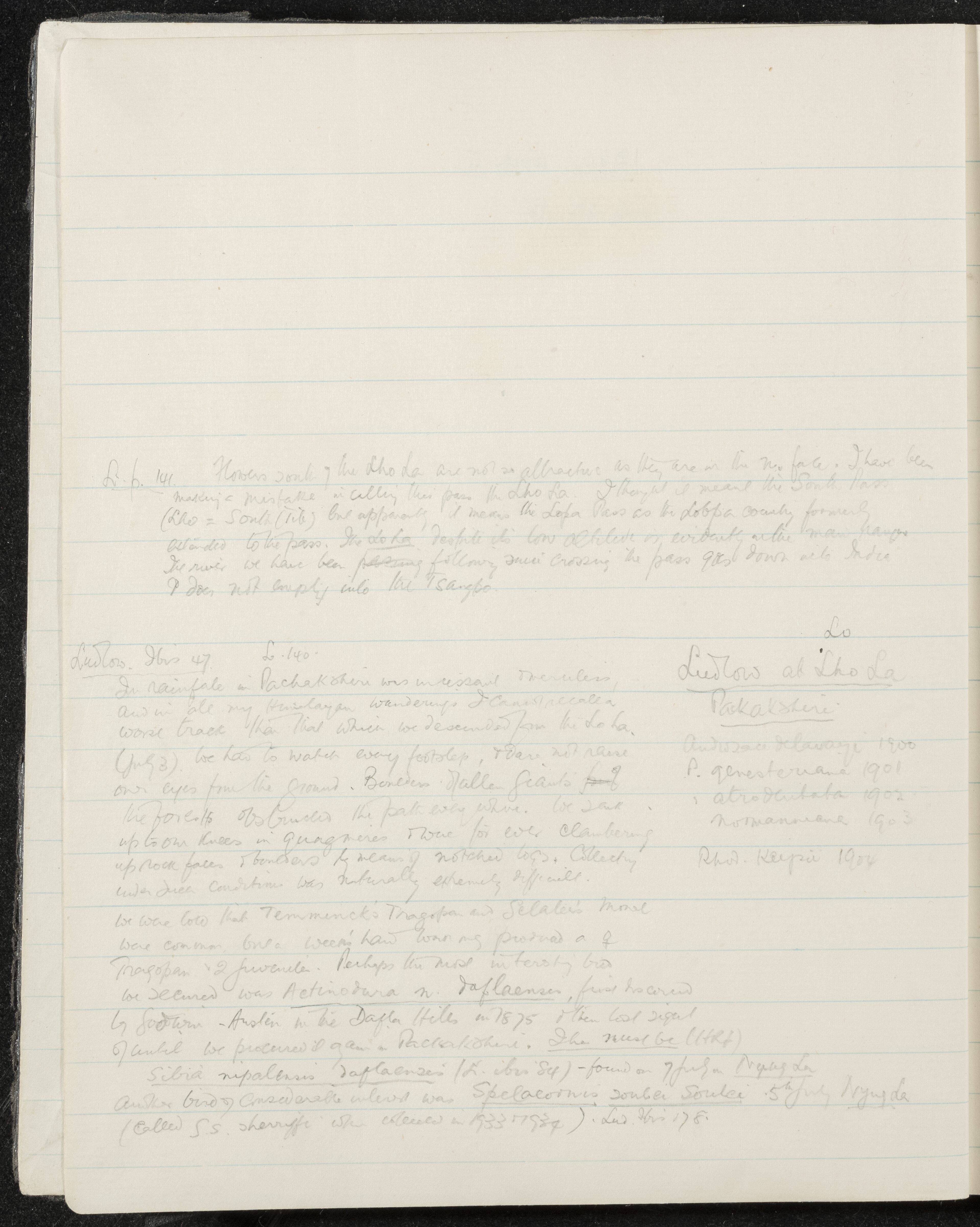
SUMMARY:
The writer clarifies the naming and geography of the Lho La, noting it lies on the main range and that the river beyond flows into India rather than the Tsangpo. They describe relentless rain and a treacherous descent to Pachakshiri that made collecting difficult. Bird notes include scarce sightings of tragopans and monals, a notable rediscovery of Actinodura daflaensis at Pachakshiri (after Godwin-Austen’s 1875 record), and mentions of Sibia nipalensis daflaensis at Ghuha Nyug La and Spelaeornis souliei souliei at Nyug La.
CONTENT:
L. p. 141. Flowers south of the Lho La are not so attractive as they are on the N. face. I have been making a mistake in calling this pass the Lho La. I thought it meant the South Pass (Lho = South (Tib)) but apparently it means the Lapa Pass as the Lobpa country formerly extended to the pass. The Lho La, despite its low altitude, is evidently on the main range. The river we have been following since crossing the pass goes down into India & does not empty into the Tsangpo.
L.s.
Ludlow. Ibis 47. L. 140. Ludlow at Lho La
The rainfall at Pachakshiri was incessant & relentless, Pachakshiri
and in all my Himalayan wanderings I cannot recall a Androsace delavayi 1900
worse track than that which we descended from the Lho La. P. geraniifolia 1901
(July 3). We had to watch every footstep, & dare not raise " atrodentata 1902
our eyes from the ground. Boulders & fallen giant forest " normanniana 1903
trees obstructed the path everywhere. We sank Rhod. kessii 1904
up to our knees in quagmires & were for ever clambering
up rock faces & boulders by means of notched logs. Collecting
under such conditions was naturally extremely difficult.
We were told that Temminck's Tragopan and Sclater's Monal
were common, but we only saw one pair of a
Tragopan & 2 juveniles. Perhaps the most interesting bird
we secured was Actinodura n. daflaensis, first discovered
by Godwin-Austen in the Dafla Hills in 1875 & then lost sight
of until we procured it again at Pachakshiri. This must be (H&S)
Sibia nipalensis daflaensis (L. ibis 54) - found on Ghuha Nyug La
Another bird of considerable interest was Spelaeornis souliei souliei. 5th July Nyug La
(called S. s. sherriffi when collected in 1933 & 1934). Lud. Ibis 178.
Valorización, destrucción y programación
Acumulaciones
Sistema de arreglo
Área de condiciones de acceso y uso
Condiciones de acceso
Condiciones
Idioma del material
Escritura del material
Notas sobre las lenguas y escrituras
Características físicas y requisitos técnicos
Instrumentos de descripción
Área de materiales relacionados
Existencia y localización de originales
Existencia y localización de copias
Unidades de descripción relacionadas
Área de notas
Identificador/es alternativo(os)
Puntos de acceso
Puntos de acceso por materia
Puntos de acceso por lugar
Puntos de acceso por autoridad
- Ludlow (Materia)
- Godwin-Austen (Materia)