Showing 16 results

Archival description
16 results with digital objects Show results with digital objects
LSH/1/1/10/1/133 · Part · 1949-09-27
Part of The Ludlow & Sherriff Collection

SUMMARY:
Page records specimen numbers with plant taxa (e.g., Primula, Gentiana, Salix, Delphinium), many annotated with dates such as 27.9, 28.9, and 30.9. Localities noted include Maren and Pangotang.

CONTENT:

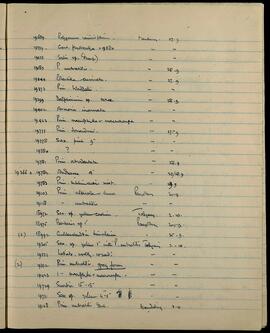
  1. Polygonum vacciniifolium. Maren. 27.9
  2. Gentiana phyllocalyx = 19380. - -
  3. Salix sp. (dwarf). - -
  4. Primula umbratilis. - 28.9
  5. Potentilla curviseta. - 27.9
  6. Primula waddellii. - -
  7. Delphinium sp. scree. - 28.9
  8. Armeria incarnata. - -
  9. Primula macrophylla var. macrocarpa. - -
  10. Primula jonarduni. - 27.9
  11. Saxifraga pink 9". - -
  12. ? - -
  13. Primula atrodentata. - 28.9
    19366 = 19782. Androsace 4". - 27/28.9
  14. Primula sikkimensis mixt. - 28.9
  15. Primula alpicola var. luna. Pangotang. 30.9
  16. Primula umbratilis. - -
    189
LSH/1/1/9/1/72 · Part · 1949-06-15
Part of The Ludlow & Sherriff Collection

SUMMARY:
Notes list seeds and plant specimens, chiefly Primula, Meconopsis, and Cypripedium, with collection numbers and brief locality notes. Localities include Kautanang, Pangotang, Waitang, and a cliff above Gormivancha. A short list at the end assigns dates to several Primula entries.

CONTENT:
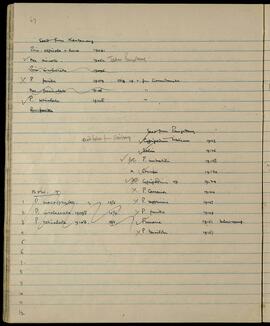
67

Seed from Kautanang.
Primula alpicola var. luna 19041
✓ Meconopsis sinuata - 19052 Taken Pangotang.
Primula involucrata 19096
X Primula pusilla 19104 cliff up v. from Gormivancha.
Meconopsis paniculata 19106 "
✓ Primula reticulata 19108 " Primula pusilla

Seed from Pangotang.
Seed taken from Waitang. ✓ Cypripedium tibeticum 19123
Salvia 19125
✓ Primula umbratilis 19128
X Crucifer 19130 X Cypripedium sp. 19134
X Primula caveana 19144
X Primula sapphirina 19147
X Primula pusilla 19149
✓ Fumaria 19151 below camp.
X Primula tenuiloba 19167

Bow. T.
1 Primula macrophylla. q. 10/6
2 Primula involucrata. 19098 10/6.
3 Primula reticulata 19108. 13/6.
4
5
6
7.
8
9
10
11
12

LSH/1/1/10/1/128 · Part · 1949-04-16
Part of The Ludlow & Sherriff Collection

SUMMARY:
Page lists Primula and other plant specimens with numbers. The 'ROOTS COLLECTED' section records species with day-month dates in September and October, notes such as 'NOT TO BE DIVIDED' and 'ONLY TWO PLANTS', and that Sorbus ursina seed was eaten by caterpillars.

CONTENT:
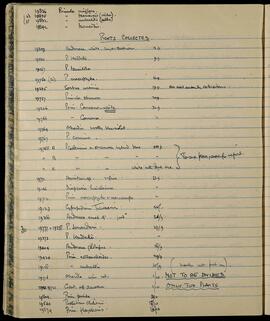
19836 Primula uniflora.
(2) 19835 " tsariensis (alba).
(3) 19832 " umbratilis (alba).
19842 " tsariensis.

ROOTS COLLECTED.

19309 Androsace white, large cushions. 13.9.
19330 P. Waddellii. 9.9.
19167 P. tenuiloba
19750 (2) P. macrophylla. 16.9.
19235 Sorbus ursina. 19.9. All seed eaten by caterpillars.
19757 Primula strumosa 20.9.
19226 Prim. Caveana white. 21.9
19766 " Caveana. "
19764 Alardia woolly blue violet. "
19767 P. concinna. "
19768 A P. Calderiana x strumosa hybrid blue 22.9 }
B " " " " " } To one place, see for report.
C " " white with dark eye " }
19771 Aconitum sp. v fine. 23.9.
19146 Diapensia himalaica "
19712 Prim. macrophylla v macrocarpa "
19123 Cypripedium tibeticum. 25.9.
19366 Androsace small 4" pink 26/9.
2 19777 = 19378 P. jonardunii. 27/9
19373 P. Waddellii. "
19404 Androsace globifera. 28/9.
19420 Prim. sonchifolia. 29/9.
19128 " umbratilis 30/9 (number not put on).
19716 Alardia wine red. 1/10. NOT TO BE DIVIDED.
19721 Gent. aff amoena 1/10 ONLY TWO PLANTS

  1. Prim. pusilla 3/10
    19544 Thalictrum chelidonii. 13/10
    19574 Prim. flagellaris. 16/10
LSH/1/1/9/1/75 · Part · 1949-06-15
Part of The Ludlow & Sherriff Collection

SUMMARY:
The diarist notes finding dormant roots of a Soldanelloid primula and discusses potential primula sightings mentioned by Pasang and Gyundon. After days of heavy rain that swelled the river and left rhododendrons mostly over, they describe trader activity, including Bhutanese and Tibetan caravans and a report about Tasho Pumbo Wangdi’s smallest son. On 14 June, during a local halt, they collected Primula umbratilis in full flower on a nearby cliff.

CONTENT:
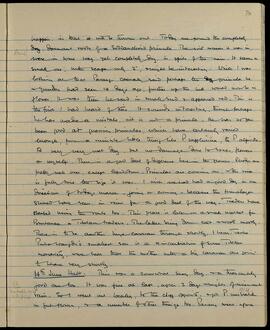
happen, is that it will be known one. Today we found the completely dry, dormant roots of a Soldanelloid primula. The soil it was in was in some way yet completely dry, in spite of the rain. It seems a small one, with scape only 2", might be interesting. While I was looking at that Pasang casually said perhaps the primula he & Gyundon had seen 14 days ago, further up the hill would now be in flower. It was then he said in small bud & appeared red. This is the first I had heard of this. It sounds interesting, though perhaps he has made a mistake, and it is not a primula. He has so far been good at guessing primulas, which have certainly varied enough, from a minute little thing like P. sapphirina, to P. alpicola.

A very very wet day, but no damage done to boxes, flowers or myself. There is a good deal of difference here in the flowers. Rhodos are pretty well over, except lepidotum. Primulas are coming on, the river is fully twice the size it was. I wish we had had a good day in one direction of today's march - going or coming - because the Himalayas should have been in view for a good deal of the way. Traders have started using the route too. This place is later on a small market for Bhutanese & Tibetan traders. The latter bring down salt & wool mostly. There is to be another huge caravan through shortly, I hear. Tasho Pumbo Wangdi's smallest son is a reincarnation from some Tibetan monastery, & we hear that the mother with a big caravan are going to Lhasa very shortly.

14th June Halt. This was a somewhat sunny day, & a thoroughly good one too. It was fine at last, after 3 days & nights of ceaseless rain. So I went out locally, to the cliff opposite, & got P. umbratilis in full flower, & a number of other things too. Pasang went up a

LSH/1/1/9/1/106 · Part · 1949-07-12
Part of The Ludlow & Sherriff Collection

SUMMARY:
List of Kodachrome and Dufaycolor photographs documenting Primula, Meconopsis, Anemone, Streptopus, Notholirion, and a thistle, with specimen numbers, habitats, and dated entries in June–July. Notes include issues with film ("25 feet stuck. wasted.") and that 12 films were sent in No. 20.

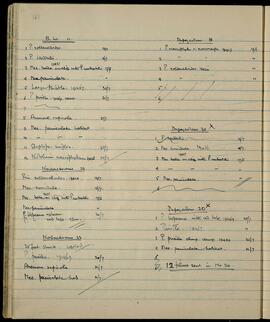
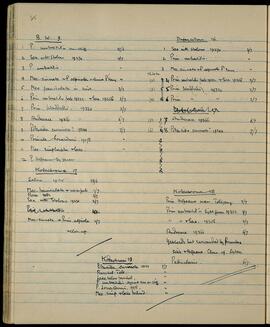
CONTENT: B. W. 11.

  1. P. soldanelloides. 13/7
  2. P. waddellii. 16/7
  3. Meconopsis bella 19437 on cliff with Primula umbratilis 17/6
  4. Meconopsis paniculata. "
  5. Large thistle. 19467. 20/7
  6. P. pusilla. 19469 camp 21/7
  7. Anemone rupicola. 21/7
  8. Meconopsis paniculata habitat "
  9. ~ ~ ~ "
  10. Streptopus simplex. 22/7
  11. Notholirion macrophyllum 19498 22/7

Kodachrome 22
Primula soldanelloides. 19420 13/7.
Meconopsis horridula. 16/7.
Meconopsis bella 19437 on cliff with Primula umbratilis 17/6
Meconopsis paniculata "
P. hopeana stream. 20/7
P. " red tube. close. "

Kodachrome 23
25 feet stuck. wasted.
P. pusilla. 19469 20/7
Anemone rupicola. 21/7
Meconopsis paniculata habitat. 21/7.

Dufaycolor 19

  1. P. macrophylla v. macrocarpa 19423 13/7
  2. " " " "
  3. P. soldanelloides. 19420 "
  4. " " "
  5. / / /
  6. / / /

Dufaycolor 20 X

  1. P. waddellii. 16/7
  2. Meconopsis horridula 19436 16/7.
  3. Meconopsis bella 19437 on cliff with Primula umbratilis 17/6
  4. " " "
  5. Meconopsis paniculata. "

Dufaycolor 20 X

  1. P. hopeana with red tube 19464 20/7
  2. Thistle. 19467 "
  3. P. pusilla clump. camp 19469 22/7
  4. Meconopsis paniculata habitat. 21/7
  5. 12 films sent in No 20.
LSH/1/1/9/1/90 · Part · 1933-06-11
Part of The Ludlow & Sherriff Collection

SUMMARY:
Page lists botanical subjects and frames for black-and-white, Dufaycolour, and Kodachrome rolls, with dates in late June to early July. Notes include Primula, Meconopsis, Saxifraga and others, with locations such as P'tang, near Tolegang, and Burkhel (including a lake and telephoto views), plus a yakherd's hut.

CONTENT:
B. W. 9.

  1. Primula umbratilis on cliff. 27/6.
  2. Saxifraga with stolons 19270 2/7
  3. Primula umbratilis. "
  4. Meconopsis sinuata var. alpicola var. luna P'tang "
  5. Meconopsis paniculata in mist. 3/7
  6. Primula umbratilis pale 19332 & Saxifraga 19306 3/7
  7. Primula waddellii. 19330 3/7
  8. Androsace 19366 6/7
  9. Potentilla curviseta? 19344 7/7
  10. Primula jonardunii. 19378 "
  11. Meconopsis simplicifolia lake. "
  12. Primula hopeana by stream.

Dufaycolour 16.

  1. Saxifraga with stolons 19270 2/7
  2. Primula umbratilis. "
  3. Meconopsis sinuata var. alpicola P'tang. "
    Slide No.
    (2) 4. Primula umbratilis pale 19332 & Saxifraga 19306 3/7
    (3) 5. Primula waddellii 19330 3/7
    (4) 6. Primula " " 3/7
    (5) 7. Androsace 19366 6/7
    (6) 8. Potentilla curviseta? 19344 7/7

Kodachrome 17
Salvia. 19125 28/6
Meconopsis paniculata & waterfall 1/7.
Rosa 19082 2/7
Saxifraga with stolons 19270 2/7
Meconopsis sinuata & Primula alpicola 2/7
close up.

Kodachrome 18
Primula hopeana near Tolegang 3/7
Primula umbratilis light form 19332 3/7
" " & Saxifraga 19306. 3/7
Androsace 19366 6/7
Yakherds hut surrounded by Primulas
Sikkim hopeana. Close up. Asters.
Pedicularis. 6/7.

Kodachrome 19
Potentilla curviseta 19344 7/7
Burkhel. Tele. "
Lake below Burkhel: "
Primula umbratilis against sun on cliff "
Primula jonardunii. 19378. "
Meconopsis simplicifolia & lake behind. "

LSH/1/1/9/1/133 · Part · 1933-09-01
Part of The Ludlow & Sherriff Collection

SUMMARY:
At Pangtang, the diarist reports improved weather after night rain, limited seed readiness, and observations of several plants in flower or seed, while Ngudup arranged a new zareba to shield the tent from strong winds. The following day was a halt with morning sun and afternoon rain; seed collecting yielded mixed results due to grazing and insect damage, and the diarist photographed an ibis bill at a nearby spring.

CONTENT:
7th September. Pangtang. Heavy rain in the night, but fine all day today, with much more of a feeling of dryness. We got a few seed on the way up, but again found most things were not ready. In fact we got Primula umbratilis in perfect flower on a cliff where no sun reaches. Here I have not yet looked round, except to see Mec. simplicifolia, seed of which has mostly been thrown. My zareba here had been disposed of, but Ngudup ordered another, and it really is rather nice because it keeps the very strong wind off the tent. It blows very strongly all day long here.

8th Sept. Halt. Fine all morning. Rain all afternoon. We only went up the hillside opposite camp to look for seed. Some were over - like the nice little Daphne; but we got about 60 seed in the end. The nice Aster that was everywhere is not to be found - all eaten by yaks. On the other hand we got two Arabis in very ripe seed, and the cushion saxifrage, whose seed were nearly all thrown. I could not find a single Anemone rupicola. Mec. horridula seed is ripe, but the plant here is so poor that it is not worth taking. P. umbratilis is not yet ready, but should not take more than 10 days or so in places. As usual the worst enemy to seed collecting is caterpillars or little bugs of some kind. There was not a ripe seed of Salvia to be found, though lots of unripe ones. As soon as they showed any colour at all, a bug got into them. The prettiest flower we got was a fine annual Gentian, with a minute root, but sometimes as many as 25 flowers on the plant, each about 5/8" across. It is worth trying to get seed of, and a white Sax still in full flower is also worth while. We have a nice ibis bill at the spring beside us. He seems quite happy, and I took a cute picture of him last evening. I hope permanent residents at his spring won't frighten him away.

LSH/1/1/9/1/103 · Part · 1949-07-12
Part of The Ludlow & Sherriff Collection

SUMMARY:
The diary describes travel over the Namda La from Kyikyi Tsum, descending past a lake to yakherds' huts in mist and rain, with notable size and color differences in Meconopsis horridula across the pass. A messenger from Ludlow (at Chachhunang) prompts letters to Ludlow and to the Sonpon’s household, as the Sonpon has gone to Tibet. On 17 July, in thick mist and rain en route to Jiutang, abundant Meconopsis bella and Primula umbratilis are observed on steep cliff faces.

CONTENT:
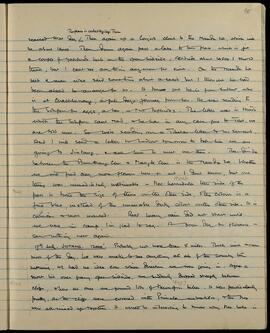
The place is called Kyikyi Tsum
reached that day. Then again up a longish climb to the Namda La, which will be about 16000'. Then down again past a lake to this place, which is just a couple of yakherds' huts on the open hillside. Altitude about 14500 I should think, but I can't see anything anywhere for mist. On the Namda La met a man who said something about a sahib, but I thought he had been ahead to arrange for us. It turns out he is from Ludlow, who is at Chachhunang, a full day's journey from here. He was sending to the Sonpon for eggs, a hen, and two taphukas. The letter was in Hindi which the Sonpon can't read, and he has in any case gone to Tibet, we are told now. So we're sending on a Tibetan letter to his servants. And I will send a letter to Ludlow tomorrow to tell him we are going to Jiutang, and ask him to meet me there. The divide between the Bumthang Chu and Mangde Chu is the Namda La. Whether we will find any more flowers here or not I don't know, but one thing was immediately noticeable — Meconopsis horridula this side of the pass is twice the size of those on the other side, and the colour is a fine blue, instead of the miserable dirty colour on the other side. It is curious and most marked. Real heavy rain did not start until we were in camp, I'm glad to say. A poor day for flowers — saw nothing new again.

17th July. JIUTANG. 12000'. Probably not more than 5 miles. Thick mist and rain most of the day. We were unable to see anything at all of the country this morning, and had no idea even which direction we were going in. After a short bit over grassy open hillside, we suddenly dropped steeply between cliffs, where at once we found lots of Meconopsis bella. It was particularly pretty, as the cliffs were covered with Primula umbratilis, and the two were all mixed up together. It would be interesting to know why Meconopsis bella is

LSH/1/1/5/1/148 · Part · 1933-07-04
Part of The Ludlow & Sherriff Collection

SUMMARY:
Field notes describe specimen 3394 of Primula umbratilis, comparing its scent, flower shape, hairiness, and colour to specimens 3384 and 3301, and noting its habitats on cliffs and open grassy slopes. The page also mentions an unnamed river referred to locally as "Mangde Chu Tributary."

CONTENT:
73a

  1. Primula umbratilis. This is, I think, the true P. umbratilis, and it would appear to be the same, or very near it, as No. 3384. They have in common, the identical scent, which is rather an unusual one. The flowers are both mainly the same shape: . This shape differs from No. 3301, which are: . Although this one 3394 was growing on cliffs, it was not on sheer rock faces, as was 3384. 3394 also was found below cliffs on open grassy hillslopes. The colour of 3301 had much more red in it. No 3394 reminds me of the colour of P. bellidifolia. The scape of 3301 is not nearly so hairy as 3394 or 3384. The latter two have on the whole, many more flowers per head than 3301.

x This river has no name. The locals merely call it "Mangde Chu Tributary".

LSH/1/1/10/1/17 · Part · 1933-10-05 - 1933-10-01
Part of The Ludlow & Sherriff Collection

SUMMARY:
The diarist receives letters from Betty and outlines plans: Hicks will arrive in Bumthang on 5 Oct, they hope to leave about the 13th and reach Tashigang on 3 Nov; the party will include Ludlow, the diarist, Betty, Virginia, Tess, and Tasho. Entries for 30 September at Pangotang and 1 October at Tolegang note wet weather, seed collecting (including Primula umbratilis), Pasang and Mundru’s work continuing until 17 October, a visit from the Sokpon who received gifts, and mail sent to HH for Kalimpong.

CONTENT:
To cheer me up today—I was feeling very miserable—a mail came in, with letters from Betty in Calcutta at last, and also from her in London. Nothing from HH at all for the first time when a mail has been sent. Hicks confirms that he will arrive in Bumthang on 5th Oct. So we should be able to leave on 13th about, and reach Tashigang on 3 Nov. Ludlow has got a passage, Betty says, and also she and I, Virginia, Tess, and Tasho. So we should have a good time, 6 of us from Bhutan.

30th September. Pangotang. It rained all night again, but was fine when Pasang and Mundru went off about 6:00 am. We were off just after them, and had a day half rain half fine, but no sun. It doesn't look yet like clearing up, but I do most sincerely hope it is fine now for four days. There is a lot to be got in Tolegang and quite a lot on the other side. After that it doesn't matter so much, except for Pasang and Mundru, whose work won't finish until 17 October. Primula umbratilis here is nearly ripe, and I got some seed, but the big Androsace is still green. This is our last of many halts in Pangotang. The Sokpon came to call and I gave him a little bottle of saffron and a torch, which is doing him very well. But we've been in his district for a long time now, ever since 23rd of May. Sent off a small mail to HH for Kalimpong. I shall only be able to send off one more after this, except for Ha.

1st October. Tolegang. Fine till 10:00 then rain and snow off and on the rest of the day. We are camped about 14,000-14,500' and it is raw and chilly. We got some seed of Primula umbratilis, the very pale form which occurs here, and a few other things. But the Phlomis (19716) I particularly wanted, is still in flower; seeds are not nearly ripe. Neither are seeds of the interesting Gentian 19721. But I took roots of