Affichage de 19 résultats

Description archivistique
19 résultats avec objets numériques Afficher les résultats avec des objets numériques
LSH/1/1/5/1/21 · Part · 1935-11-27
Fait partie de The Ludlow & Sherriff Collection

SUMMARY:
Orchids and magnolias were noted near the pass, and a snake that struck the diarist’s shoe was killed by Tsongpen. Rinso struggled with the local dialect, and the writer records route details around Nabzi, including the confluence at Nimjhong, the path to Trongsa via the Takotse La, and camp and weather notes.

CONTENT:
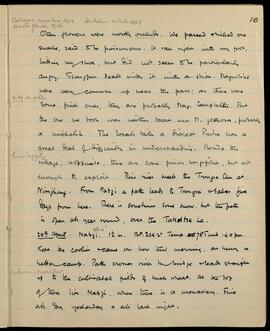
Coelogyne corymbosa 2954 Dendrobium nobile 2957 10
Phaius flavus 2956

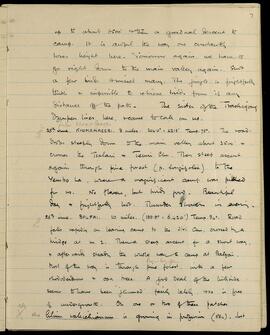
Other flowers were mostly orchids. We passed and killed one snake, said to be poisonous. It ran right into my foot, hitting my shoe, but did not seem to be particularly angry. Tsongpen dealt with it with a stick. Magnolias were very common up near the pass; as there were some pink ones, they are probably Mag. campbellii. But the one we took was neither that nor M. globosa, probably a michelia. The locals talk a dialect Rinso has a great deal of difficulty in understanding. Beside the village, opposite, there are some Pinus longifolia, but not enough to exploit. This river meets the Trongsa Chu at Nimjhong. From Nabzi a path leads to Trongsa and takes five days from here. There is sometimes some snow, but the path is open all year round, over the Takotse La.

29th April. Nabzi. 1 1/2 m. BP. 204.2° Temp 4000' 76° Time 4.0 pm.
Kept the coolies and came on here this morning, as being a better camp. Path crosses river by bridge and leads straight up to the cultivated fields of buckwheat. At the top of these lies Nabzi, where there is a monastery. Fine all day yesterday and all last night.
LSH/1/1/5/1/43 · Part · 1937-05-06
Fait partie de The Ludlow & Sherriff Collection

SUMMARY:
The party leaves Naszi, traverses along the Tirgang Chu, crosses side valleys, and turns up the Mangde (Trongsa) Chu above the river, noting oak and Pinus longifolia forests and cultivation near Nimshong. It rains intermittently, and during a halt Tendu, Trongpen, and the diarist press a fern when a serow suddenly charges past them.

CONTENT:
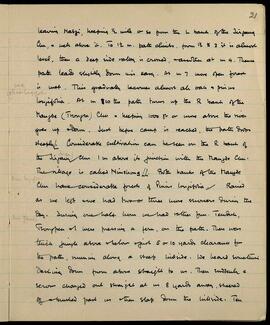
Leaving Naszi, keeping 1/2 mile or so from the left bank of the Tirgang Chu, and well above it. To 1 1/2 m. path climbs, from 1 1/2 to 3 it is almost level, then a deep side valley is crossed, and another at m 4. Thence path leads slightly down and is easy. At m 7 more open forest is met. This gradually becomes almost all oak and Pinus longifolia. At m 8 1/2 the path turns up the right bank of the Mangde (Trongsa) Chu and keeping 1000 ft or more above the river goes up stream. Just before camp is reached, the path drops steeply. Considerable cultivation can be seen on the right bank of the Tirgang Chu 1 m above its junction with the Mangde Chu. The village is called Nimshong. Both banks of the Mangde Chu have considerable forests of Pinus longifolia. Rained as we left and we had two or three more showers during the day. During one halt however we had rather fun. Tendu, Trongpen and I were pressing a fern, on the path. There was thick jungle above and below and just 5 or 10 yards clearance for the path, running along a steep hillside. We heard something dashing down from above straight to us. Then suddenly a serow charged out straight at us 8 yards away, sheered off and brushed past us then slap down the hillside. Ten

LSH/1/1/5/1/45 · Part · 1933-05-09
Fait partie de The Ludlow & Sherriff Collection

SUMMARY:
The writer describes startling wildlife encounters including partridges and a close sighting of a panther, with no time to photograph. Notes record hot, windy conditions and a route descending from Phunzor to a cantilever bridge over the Rindi Chu, then along the Mangde Chu right bank through Pinus longifolia forest with some cultivation observed.

CONTENT:
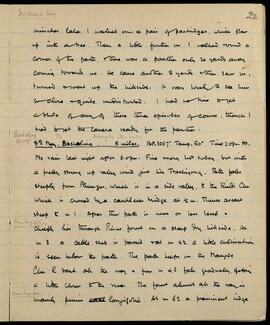
minutes later I walked on a pair of partridges, which flew up into a tree. Then a little further on I walked round a corner of the path, there was a panther only 20 yards away coming towards us. He came another 5 yards then saw us, turned and went up the hillside. It was lovely to see him so close and quite undisturbed. I had no time to get a photo of any of these three episodes of course, though I tried to get the camera ready for the panther.

9th May. Bashaling. 8 miles. BP. 105.7° Temp. 80° Time 2:00 pm. HV.

No rain last night after 6:00 pm. Fine and very hot today, but with a pretty strong up valley wind just like Trashigong. Path falls steeply from Phunzor, which is in a side valley, to the Rindi Chu which is crossed by a cantilever bridge at 1/2 m. Thence ascent steep to m 1. After this path is more or less level.

Chiefly lies through Pinus forest on a steep dry hillside. At m 3 a cattle shed is passed and at m 4 1/2 a little cultivation is seen below the path. The path keeps on the Mangde Chu R bank all the way and from m 4 1/2 falls gradually, getting a little closer to the river. The forest almost all the way is mainly Pinus longifolia. At m 6 1/2 a prominent ridge

LSH/1/1/5/1/49 · Part · 1933-05-09
Fait partie de The Ludlow & Sherriff Collection

SUMMARY:
Notes mention local talk about the Coronation and cricket scores, and describe buckwheat and rice nearing ripeness. The writer records travel along the right bank of the Mangde Chu through a gorge with Prunus forest up to m 3 where the Wochen Chu enters, and includes a specimen note (Gent. loureirii 3011, 4000 ft) and spelling confirmations for place names.

CONTENT:
is of Bashaling. Most of the talk is of course about the Coronation, but it is nice to hear cricket scores again. The crops just now are all buckwheat, which will be ripe in a week or so, with the rice.

(Gent. loureirii 3011 4000ft)
(Crops: buckwheat, rice)

I'll remove the parentheses.

One more check: "Küngo Rapten". The 'u' has an umlaut.
"Kyi La" - correct.
"kazis" - correct.
"Bashaling" - correct.
"Mangde Chu" - correct.
"Wochen Chu" - correct.
"Pinus longifolia" - correct.
"Gent. loureirii" - correct.

I'll use "Prunus" for "primus".
I'll use "yards" for "x".
I'll use "mile" for "m".

Actually, I'll keep "m 3" etc. as they are clear.

Final check of the text flow.
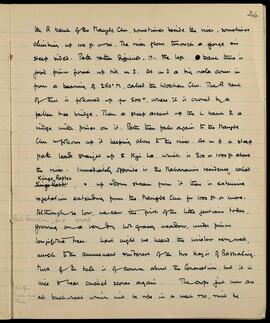
"the R bank of the Mangde Chu, sometimes beside the river, sometimes climbing up 100 ft or so. The river flows through a gorge with steep sides. Path rather difficult. On the left bank there is good Prunus forest up till m 3. At m 3 a big nala comes in from a bearing of 250° M, called the Wochen Chu. The R bank of this is followed up for

LSH/1/1/5/1/89 · Part · 1937-05-28
Fait partie de The Ludlow & Sherriff Collection

SUMMARY:
The diary describes following the Mara Chu, crossing small side streams and ridges, and reaching a camp at mile 8. It notes the village of Adao, whose inhabitants move to Phobjikha during the rains and occasionally return to tend crops, with some fever present. Observations include abundant R. Maddenii/R. Edgeworthii and a fine forest of Pinus longifolia opposite Adao.

CONTENT:
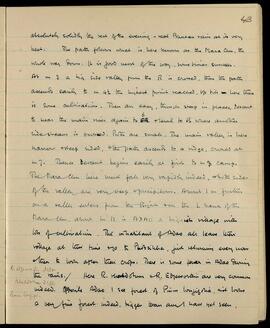
absolutely solidly the rest of the evening - real Bhutan rain at its very
best. The path follows what is here known as the Mara Chu, the
whole way down. It is good most of the way, sometimes sunken.
At m 3 a big side valley from the R is crossed, then the path
ascends easily to m 4 1/2 the highest point reached. Up till here there
is some cultivation. Then an easy, though steep in places, descent
to near the main river again to 6 level to 6 1/2 where another
sidestream is crossed. Both are small. The main valley is here
narrow and steep sided, the path ascends to a ridge, crossed at
m 7. Thence descent begins easily at first to m 8 camp.
The Mara Chu here must fall very rapidly indeed, and both sides
of the valley are very steep and precipitous. About 1 m further
on a valley enters from the Right on the L bank of the
Mara Chu, above m 11 is ADAO a biggish village with
lots of cultivation. The inhabitants of Adao all leave their
village at this time and go to Phobjikha, just returning every now
and then to look after their crops. There is some fever in Adao during
the rains. / Here R. Maddenii or R. Edgeworthii are very common
indeed. Opposite Adao I see forest of Pinus longifolia, and it looks
a very fine forest indeed, bigger than any I have yet seen,

LSH/1/1/1/1/79 · Part · 1933-07-04
Fait partie de The Ludlow & Sherriff Collection

SUMMARY:
Describes Wangdu Potrang above the Punaka river and the Tso Kang Nang, including an etymology of 'Wangdi potrang'. Records a halt at Wangdupotrang with a sighting of wild dogs, then marches to Samtengang and Ridang via Tsarza La and Tangchu in heavy rain, with notes on altitudes and plant collections.

CONTENT:
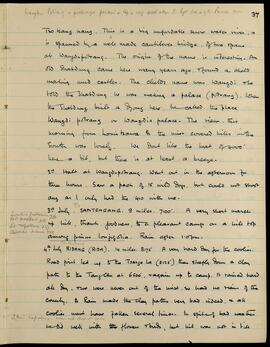
Wangdu Potrang is picturesque perched on a cliff 400' above the left bank of the Punaka river.

Tso Kang Nang. This is a big unfordable snow water river, & is spanned by a well made cantilever bridge, of two spans at Wangdupotrang. The origin of the name is interesting. An old Shabdrung came here many years ago, & found a child making mud castles. The child's name was Wangdi who told the Shabdrung he was making a palace (potrang). When the Shabdrung built a Dzong here, he called the place Wangdi potrang or Wangdi's palace. The view this morning from Lomitsawa to the mist covered hills in the South was lovely. We don't like the heat of 4000' here a bit, but there is at least a breeze.

2nd. Halt at Wangdupotrang. Went out in the afternoon for three hours. Saw a pack of 15 wild dogs, but could not shoot any as I only had the .410 with me.

3rd July. To SAMTENGANG. 8 miles. 7100'. A very short march up hill, thank goodness, to a pleasant camp on a hill top among pinus longifolia. Rain after 1.0pm.
Luculia gratissima 216
Rhod. maddenii 218
Lil. nepalense 223
Cladrastis sinensis 224

4th July. To RIDANG (RIDA). 14 miles. 8175'. A very hard day for the coolies. Road first led up to the Tsarza La (9125') then steeply down a clay path to the Tangchu at 6500', & again up to camp. It rained hard all day, & we were never out of the mist, so had no views of the country. The Rain made the clay paths very bad indeed, & all coolies must have fallen several times. In spite of bad weather we did well with the flowers & birds, but luck was not in till
Lilium nepalense. cream with blood red centre

LSH/1/1/2/1/17 · Part · 1924-06-23
Fait partie de The Ludlow & Sherriff Collection

SUMMARY:
Diary entries describe steep descents and ascents between Khomanaggri and Balfai, crossing the Tsalari, Temri Chu, and Jiri Chu, with camps at Yembo La and Balfai. Birds were shot and seen; Lilium wallichianum was abundant on recently jhumed slopes. The sister of the Trashigong Dzongpen visited the party; weather was hot with an evening thunder shower.

CONTENT:
up to about 6500' then a gradual descent to camp. It is awful the way one constantly loses height here. Tomorrow again we have to go right down to the main valley again. Shot a few birds & missed many. The jungle is frightfully thick & impossible to retrieve birds from if any distance off the path. The sister of the Trashigong Dzongpen lives here, & came to call on us.

25th June. KHOMANAGGRI. 8 miles. 204.0° = 4215' Temp. 75°. The road drops steeply down to the main valley about 3500' & crosses the Tsalari & Temri Chu. Then steep ascent again through pine forest (P. longifolia) to the Yembo La, where a magnificent camp was pitched for us. No flowers, but birds good. Beautiful day & frightfully hot. Thunder shower in evening.

26th June. BALFAI. 10 miles. (199.9° = 6,420') Temp. 84°. Road falls rapidly on leaving camp to the Jiri Chu, crossed by a bridge at m 2. Then a steep ascent for a short way, & afterwards steady the whole way to camp at Balfai. Most of the way is through pine forest (Pinus longifolia), with a few rhododendrons & oak trees. A good deal of the hillside seems to have been 'jhumed' fairly lately, & so is free of undergrowth. On one or two of these patches Lilium wallichianum is growing in profusion (564). Just

LSH/1/1/2/1/25 · Part · 1924-06-23
Fait partie de The Ludlow & Sherriff Collection

SUMMARY:
Notes describe an old dzong near a suspension bridge with traces of fortifications, said to be the oldest after Paro’s destruction, with the dzongpen planning repairs. The party marches to Rungzyung along the left bank of the Gamri Chu through hot conditions, noting conifer woodland, multiple bridges, and some rice cultivation.

CONTENT:
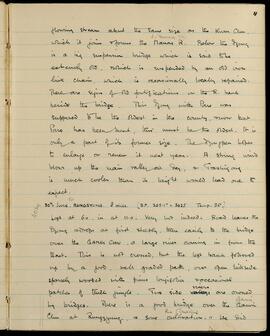
flowing stream about the same size as the Kuru Chu, which it joins and forms the Manas R. Below the dzong is a big suspension bridge which is said to be extremely old, which is suspended by an old iron link chain, which is occasionally locally repaired. There are signs of old fortifications on the right bank beside the bridge. This dzong with Paro was supposed to be the oldest in the country, and now that Paro has been burnt, this must be the oldest. It is only a part of its former size. The dzongpen hopes to enlarge or renew it next year. A strong wind blows up the main valley all day, and Trashigong is much cooler than its height would lead one to expect.

To 30th June. RUNGZYUNG. 8 miles. (B.P. 205.1" = 3625' Temp. 85°.)

Left at 6.0, in at 11.0. Very hot indeed. Road leaves the dzong and drops at first steeply, then easily to the bridge over the GAMRI CHU, a large river coming in from the East. This is not crossed, but the left bank followed up by a good, well graded path, over open hillside sparsely wooded with Pinus longifolia and occasional patches of thick jungle. Two side river valleys are crossed by bridges. There is a good bridge over the Gamri Chu at Rungzyung, and some rice cultivation. We did

LSH/1/1/3/3/21 · Part · 1936-02-09
Fait partie de The Ludlow & Sherriff Collection

SUMMARY:
At Yönpula the party marched through Pinus longifolia forest and noted Rhododendron arboreum in flower while searching near Yönpu La for a previously seen rhododendron, collecting seeds instead. Lumsden is mentioned, and several severe medical cases, including a badly burned elderly woman, were brought in for treatment at the 8000' camp.

CONTENT:
8

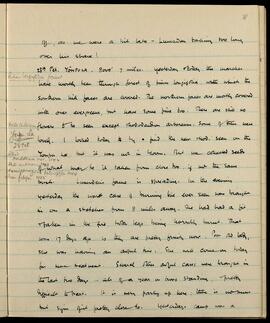
off, as we were a bit late - Lumsden taking too long
over his shave!

28th Feb. YÖNPULA. 8000' 7 miles. Yesterday & today the marches Pinus longifolia forest
have mostly been through forest of Pinus longifolia, with which the
southern hill faces are covered. The northern faces are mostly covered
with other evergreens, but have some pine too. There are still no Rhod arboreum
flowers to be seen except Rhododendron arboreum. Some of them were Yönpu La
lovely. I looked today to try & find the new rhod. seen on the 28 Feb
Yönpu La, but it was not in bloom. But we collected seeds Rhod maddenii 1141, 1142
of what may be it, taken from close to, if not the same Rhod arboreum 1143
bush. Lumsden's fame is spreading. In the evening Hemiphragma heterophylla 1144
yesterday the worst case of burning I've ever seen was brought Pieris filipes 1145
in on a stretcher from 8 miles away. She had had a fit
& fallen in the fire, both legs being horribly burnt. That
was 17 days ago so they are pretty fruity now. Poor old lady,
she was having an awful time. She will come on today
for more treatment. Several other awful cases were brought in
the last two days - all of a year or two's standing, & pretty
difficult to treat. It is very parky up here; there is no snow
but signs of it pretty close to. Yesterday's camp was a