India

Elements area

Taxonomy

Code

Scope note(s)

    Source note(s)

      Display note(s)

        Hierarchical terms

        India

          Equivalent terms

          India

            Associated terms

            India

              176 Archival description results for India

              176 results directly related Exclude narrower terms
              LSH/1/1/4/1/137 · Part · 1933-10-12
              Part of The Ludlow & Sherriff Collection

              SUMMARY:
              In camp during snow and rain, the writer collected Gentiana ornata seed, hunted kuling with Tsungpen, shot a raven for Inglis at Darjeeling, prepared bird skins, and packed divots of several Primula species. On 16th October at Nahampa, after a clear, frosty night, they noted kuling and Crossoptilon above Karutra and recorded nearby plant finds.

              CONTENT:
              conditions all day in camp - snow and rain with patches of sun. All I could collect today was some seed of Gentiana ornata, but I went out again to look for kuling with Tsungpen. First of all I shot a raven for Inglis at Darjeeling, then we came across three kuling just at the top edge of the rhododendrons, I got two of them. They are in good plumage, except for the head and nape, where moulting is not quite finished. Made flat skins of all of them, but wonder how they will travel tomorrow before being set. I made a box today, and have put in it a good many divots - two good divots of the yellow Primula petiolaris 2370, and three other divots which include two primulas, both petiolaris. One, I hope, is 2373 Primula chamaedora, a most beautiful flower, and the other is only the little white petiolaris primula Primula verrucosa we first saw at Chhachar 1614 or 1615 - a most uninteresting one. Let's hope all arrive in good condition at home. Temp in tent 20°F.

              16th October. Nahampa. 10 miles. Last night was clear after 5.0pm, and very cold, with no more snow. The morning was perfect, really clear, with a hard frost. We had some rain down here, but nothing much. Saw a number of kuling above Karutra (seen Androsace brahmaputrae 2737, Ranunculus vellereum 2738) and also Crossoptilon, but no blood pheasant.
              LSH/1/1/1/1/37 · Part · 1933-05-23
              Part of The Ludlow & Sherriff Collection

              SUMMARY:
              Photo notes describe a view in the Chumbi valley with mules heading to Chumbithang and a mule being pulled back onto the path near the top of the Nathu La in mist. The entry recounts small avalanches pushing mules off the path, difficult recovery of a mule using tarpaulins and numdahs, and dead mules and wool loads along the route. Reached Tsomgo at 5.15 pm and noted contrasting snow on different faces.

              CONTENT:
              16

              B 5 good -

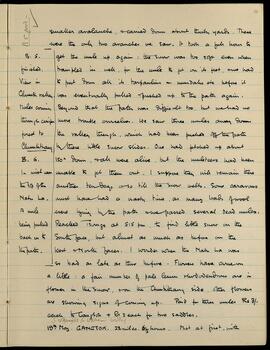
              B. 5. finished. View in Chumbi valley. Mules coming through conifer forest to Chumbithang

              B. 6. In mist near the top of the Nathu La. A mule being pulled back on to the path.

              smaller avalanche, & carried down about thirty yards. These
              were the only two avalanches we saw. It took a full hour to
              get the mule up again: the snow was too soft even when
              trampled in well, for the mule to get on its feet, and had
              to put down all its tarpaulins & numdahs etc before it
              was eventually pulled & pushed up to the path again.
              Beyond that the path was difficult too, but we had no
              more trouble ourselves. We saw three mules away down
              the valley trough, which had been pushed off the path
              by these little snow slides. One had fetched up about
              150' down, & all were alive, but the muleteers had been
              unable to get them out. I suppose they will remain there
              another ten days or so till the snow melts. Some caravans
              must have had a nasty time, as many loads of wool
              were lying by the path & we passed several dead mules.
              Reached Tsomgo at 5.15 pm, to find little snow on the
              South face, but almost as much as before on the
              West & North faces. I wonder when the Nathu La was
              so bad as late as this before. Flowers have come on

              LSH/1/1/6/1/121 · Part · 1933-07-27
              Part of The Ludlow & Sherriff Collection

              SUMMARY:
              Entries describe observations around Mira La, including Lerwa, snipe, and abundant Notholirion campanulatum, with fieldwork by the diarist alongside Tsungpen and Tendu yielding notable finds such as Meconopsis horridula var. lutea and a distinctive Saxifraga. Taylor is ill then recovers, Anna falls ill, and a Pu chu man is engaged to collect seeds for delivery to a monastery below the Dzong at Tsela Dz.; later a move north of Mira La is hampered by slow and misrouted coolies, with Chomo Dzong noted next.

              CONTENT:
              60

              Butterflies
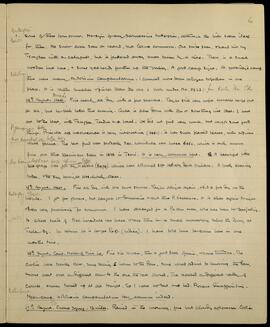
              Some of these tomorrow. No sign of any Parnassius butterflies, although the hills seem ideal
              Birds
              for them. No snow cock seen or heard, but Lerwa common. One snipe seen, nearly hit by
              Tsungpen with a catapult, but it fluttered away and was taken by a kite. There is a small
              wooden hut here, and some yakherds further up the valley. A good camp site. At yesterday's camp
              Notholirion
              there were many Notholirion campanulatum. I counted more than a dozen together in one
              place. It is rather smaller and pinker than the one I took under No. 5923: from Kulu Phu Chu.

              Mira La
              14th August. Halt. Fine nearly all day, with a few showers. Taylor still very unfit and unable to go out
              at all, but he feels better this evening. Anna is also down with flu or something like that. I went
              out to the West, with Tsungpen, Tendu and a coolie. We did not find very much, but we got some good
              P. Younghusbandii 6061
              things. Primula aff. macrocarpa is very interesting (6061): it has such flaccid leaves, with copious
              Mec. horridula var. lutea 6062
              white farina. The best find was probably Mec. horridula var. lutea 6062, which is only known
              from our three specimens seen in 1936 in Tsari. It is very common here. A beautiful little
              Sax. haematochroa 6070 sp. nov. type
              Saxifraga was found by Tendu (6070) which was coloured soft velvety dark crimson. A lovely evening
              today, the sky tonight absolutely clear.

              15th August. Halt. Fine all day, with one short shower. Taylor all right again, and did a full day on the
              Butterfly Birds
              hillside. I got few flowers, but caught 10 Parnassius and saw three P. tischelanus. It is clear again tonight
              and looks very promising for tomorrow. I have arranged for a Pu chu man, who has been to Darjeeling,
              Seeds
              to collect seeds of Mec. horridula var. lutea and take them to a small monastery below the Dzong at
              Tsela Dz. In return he is to get Rs 5/- (Indian). I have told him to come here in one
              month's time.

              16th August. Camp. North of Mira La. Fine till 11.00 am, then a good deal of rain, some thunder. The
              coolies were terribly slow, some taking 5 hours to the Pass. None would admit to knowing the Pass,
              and some went over a different one to the one the rest crossed. They reached a different valley of
              course, and never turned up at all tonight. So I have no tent and bed. Flowers disappointing.
              Notholirion
              Near camp, Notholirion campanulatum very common indeed.

              17th August. Chomo Dzong. 12 miles. Rained in the morning, fine but cloudy afternoon. Coolies

              LSH/1/1/3/3/170 · Part · 1983-05-05
              Part of The Ludlow & Sherriff Collection

              SUMMARY:
              The diarist ascended the Na La through forest and traversed to the Pang La while traveling toward Tso Kar, searching for flowers and birds. Notes include observations of Heteroxenicus stellatus breeding among alpine rocks and a sighting of Snow Cock Pheasant (Tetraophasis szechenyii) across a wide elevational range.

              CONTENT:
              Migyitun

              Ludlow page 104. Went up the Na La and Pang La, 2 passes Migyitun 30 August
              on the road to the Tso Kar (Lake of the sacred one) which
              is a place of pilgrimage. The Na La involved an ascent Primula verrucosa var. violacea
              of some 3000 feet and led, as its name indicates, through forest. 1734, 1742.
              On reaching the summit of the Na La I made a circuit flabellifera 1737
              round to the Pang La in search of flowers and birds. macrocarpa 1743
              Got 3 specimens of Heteroxenicus stellatus stellatus Paraquilegia anemonoides
              Gould's Short-wing which has been found in East Nepal, 1744
              Sikkim and Bhutan. This species extends its range still Meconopsis simplicifolia 1735
              further eastwards. A common bird. Different from Rhododendron pumilum 1741
              other Short-wings in not being a skulker. Although Caltha palustris 1745
              it inhabits dense rhododendron and bamboo growth, it does not
              shun observation and will ascend to the tops of bushes
              to gaze at an intruder in a most confidential manner.
              The 2 were shot in - wherever there are rocks and boulders in
              the alpine zone, far away from all shrub growth. And
              the birds were breeding amidst these surroundings.
              --- shot on the next day ---
              Also saw Snow Cock Pheasant Tetraophasis szechenyii - Ludlow 383
              A common bird in Southeast Tibet. Found at all elevations between
              11-15000 feet. Lives in fir forest and also inhabits Rhododendron scrub
              in the alpine zone. - Specimen of Szechenyii 383.

              LSH/1/1/2/1/7 · Part · 1934-06-14
              Part of The Ludlow & Sherriff Collection

              SUMMARY:
              Entry headed 18th June from Menoka Tea Estate notes heavy monsoon rain in Calcutta, arrival there on the 16th, breakfast at Collins’ chummery, intensive shopping including withdrawing silver rupees, and a hurried departure on the Assam Mail. The party changed trains at Parbatipur and reached Rangiya in rain, where Babu Pradhan met them.

              CONTENT:
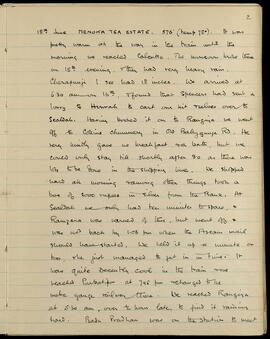
              18th June MENOKA TEA ESTATE. 576' (temp 78°). It was pretty warm all the way in the train until the morning we reached Calcutta. The monsoon broke there on 15th evening, and they had very heavy rain. Cherrapunji I see had 18 inches. We arrived at 6.30 am on 16th, and found that Spencers had sent a lorry to Howrah to cart our kit and selves over to Sealdah. Having booked it on to Rangiya we went off to Collins chummery in Old Ballygunge Rd. He very kindly gave us breakfast and a bath, but we could only stay till shortly after 9.0 as there was lots to be done in the shopping line. We shopped hard all morning and among other things took a box of 2000 rupees in silver from the Bank. At Sealdah we only had ten minutes to spare, and Ramzana was warned of this, but went off and was not back by 1.00 pm when the Assam mail should have started. We held it up a minute or two, and he just managed to get in in time. It was quite decently cool in the train and we reached Parbatipur at 7.45 pm and changed to the metre gauge railway there. We reached Rangiya at 5.30 am, over ½ hour late, to find it raining hard. Babu Pradhan was on the station to meet

              LSH/1/1/8/1/111 · Part · 1952-05-17
              Part of The Ludlow & Sherriff Collection

              SUMMARY:
              The party negotiates passage with an elderly Dzongpen (father of the acting official), who promises limited pony transport and sealed letters to Kome and Koto, while the diarist sends letters to Surkhang Dzasa and to Darjeeling. On 17 May at Yangtso they depart with yak transport, seen off by Pedong Dorji, and note clear views of Yala Shampo, lake birds, and herds of kyang and gazelle.

              CONTENT:
              At first, they said no British or Bhutanese could pass this way without a sealed passport of the T.G. The Dzongpens were very sticky too. The other Dzongpen said the locals were all Drokpas and only owned five, with no transport. But we settled down and asked the Dzongpen—really the father of the real man—to come see us. He came, an old man of 62, with no teeth. He was full of life and fun and is one of the few Tibetans who have done things. He's been all over East Tibet, to India with the 13th Dalai Lama, to China, to Ladakh, to Monyul, and everywhere else. He talked so fast that we could not get a word in anywhere. He talked so loud that he could be heard 100 yards away. But he was a good soul, and was most friendly and helpful. He would provide transport for us, with only 2 ponies, as there are no more there, and he would give us sealed letters to Kome and Koto, where the Takhar Tengba Dzongpen would find us a change of transport. Although we have "Dzongyel", we have to change there. He was a most lively and entertaining old man, who kept us thoroughly amused for more than half an hour. After he went, there was a marked change in the Dzongpen's behaviour. The old boy leaves for Lhasa on the 17th, and I gave him a letter for Surkhang Dzasa saying I had come here, and several for Darjeeling too.

              17th May. Yangtso. 11 miles. A beautiful day, with a few heavy showers round about. Pedong Dorji saw us off at 7:30, all arrangements being good. He will go back today to Chong-gye Dzong. He has been a help and a good friend. We had yak transport which came on well. To the east, the fine peak of Yala Shampo (20,230') was very clear this evening. The lake here is beautiful, and has a good many birds on it: gulls, terns, brahminy geese, pochard, and redshanks. On the main Triju plain were many kyang and several gazelle. Further up this way we saw more gazelle, one herd having 15 in it. They were not frightened.

              In car with young husband 17/5/52

              LSH/1/1/9/1/53 · Part · 1949-05-28
              Part of The Ludlow & Sherriff Collection

              SUMMARY:
              The diarist notes magpies and quail, sends mail to H.H., Kalimpong, and Betty, and dispatches a box of dried flowers to Byakar Dz. On 20th May they march about five miles to Takhung via the Tang chu and Takhung chu, note altitude observations, collect Primula geraniifolia, and describe a well-made camp near Bumthang. The entry opens the next day's move toward Shabejetang.

              CONTENT:
              There are still a number of magpies about here, so they certainly breed. Also since we were here in April, there are many quail in the standing crops. One can hear them all day. I send off a mail from here to H.H., Kalimpong and Betty via H.H.. Also tomorrow morning Lundrup will take in a box of dried flowers to go to Byakar Dz. into our other boxes.

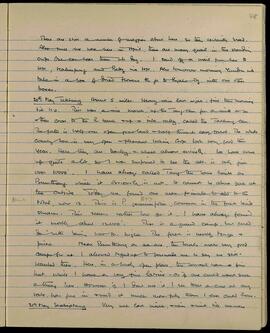
              20th May Takhung About 5 miles. Heavy rain last night, fine this morning till 11.0. This was a nice march, up the Tang chu for a mile or so then cross to the R bank and up a side valley, called the Takhung chu. The path is half over open grassland and half through easy forest. The whole country here is very open and pleasant looking. Crops look very good this year. Here they are barley and wheat almost entirely. We have come up quite a lot, so I was surprised to see the alt. is only just over 10000'. I have always called Tang the same height as Bumthang which it obviously is not. It cannot be above 9000 at the outside. Today we found one more primula to add to the total, now 13. This is P. geraniifolia 18913, common in the forest beside streams. This seems rather low for it. I have always found it mostly above 12000'. This is a grand camp, but could do with being 1000 ft. higher. The forest is mostly tsuga and picea. Near Bumthang as we are, the locals make very good camps for us. I allowed Ngudup to persuade me to say we still wanted them. Here, in a lovely open place, the servants have a fine hut, while I have a very fine latrine - as if one could want such a thing here. However, if I don't use it, I see that a cow at any rate, has gone in and used it much more fully than I ever could have.

              21st May Shabejetang Very wet last night, rain until we were

              LSH/1/1/1/1/181 · Part · 1933-09-05
              Part of The Ludlow & Sherriff Collection

              SUMMARY:
              The writers received provisions and friendly letters sent by H.H., note Dorji’s recovery and Tobgye’s imminent departure for Kalimpong, and an invitation to return to collect seeds. They describe a short, easy march up the Kuru Chu via Lalung to Munda, with bridges, ample water but scarce fuel, observed crops, and fine valley views.

              CONTENT:
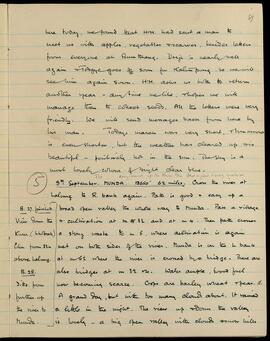
              here today, we found that H.H. had sent a man to meet us with apples, vegetables & scarves, besides letters from everyone at Bumthang. Dorji is nearly well again & Tobgye goes off soon for Kalimpong, so we won't see him again soon. H.H. asks us both to return another year - anytime we like, & hopes we will manage then to collect seeds. All the letters were very friendly. We will send messages back from here by his man. Today's march was very short, & tomorrow is even shorter, but the weather has cleared up & is beautiful - positively hot in the sun. The sky is a most lovely colour of bright clear blue.

              9th September. MUNDA. 13650' 6 1/2 miles. To easy march up the Kuru Chu past a good deal of cultivation. Cross the river at Lalung to R. bank again. Path is good & easy up a broad open valley the whole way to Munda. Pass a village & cultivation at m 3 1/2 and at m 4. Then path crosses a stony waste to m 5, where cultivation is again met on both sides of the river. Munda is on the L bank at m 6 1/2 where the river is crossed by a bridge. There are also bridges at m 3 1/2 & 4. Water ample, wood fuel now becoming scarce. Crops are barley wheat & peas.

              A grand day, but with too many clouds about. It rained a little in the night. The view up & down the valley is lovely - a big open valley with clouds & snow hills.

              B. 27. finished. View down the Kuru (Khobrak) Chu from 3 1/2 m above Lalung.
              B. 28. Ditto from further up the river to Munda.

              LSH/1/1/9/1/4 · Part · 1949-09-13
              Part of The Ludlow & Sherriff Collection

              SUMMARY:
              The party departs after intensive planning over the fate of Tashiding and Crockety, traveling by lorry and jeep to Rydak Tea Estate. Continuing via the Raidak toward Hatisar and then Kabare, they face repeated vehicle issues including getting stuck at a ford, fuel tank punctures, and delays at a ferry, turning short stages into long, difficult drives.

              CONTENT:
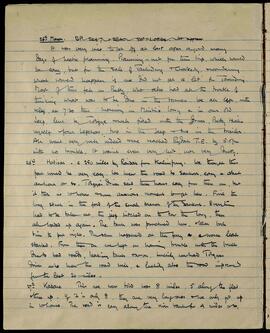
              25th March. BP 29.47 = 3840 70° = 1.0844 Ht. approx

              It was very nice to set off at last after a good many days of hectic planning. Planning - not for this trip, which would be easy, but for the sale of Tashiding and Crockety, and wondering what would happen if we did not get a 'let' for Tashiding. Most of this fell on Betty, who also had all the trouble of thinking what was to be done in the Homes. We all left, with relief, at 7.30 this morning in Mintri's lorry and in our old Jeep, lent by Tongue well filled with the driver, Betty Hicks, myself and four Lepchas, two in the Jeep and two in the trailer. All went very well indeed and we reached Rydak T.E. by 5.0 pm with no trouble. It wasn't even very hot, nor very dusty.

              26th Hatisar - c 250 miles by Raidak from Kalimpong. We thought this part would be very easy. We knew the road to Sankosh, easy and about an hour or so. Tongue's driver said three hours easy from there on, but it took us 10 hours and some anxious moments to get here. First the lorry stuck in the ford of the small branch of the Sankosh. Everything had to be taken out, the jeep hitched on to tow the lorry, then all loaded up again. The tank was punctured here, and that took time to put right. The same happened at the ferry and a worse leak started. From then on we kept on having trouble with the truck. Due to bad roads, leaking tanks and so on. Luckily we had Tongue's driver who knew the road well, and luckily also the road improved for the last 20 miles.

              27th Kabare. This we were told was 8 miles, 5 along the flat and three up. If it is only 8, they are very long ones and we only got up in 10 hours. The road is easy along the river bank for 4 miles or so,

              LSH/1/1/10/1/37 · Part · 1933-10-10
              Part of The Ludlow & Sherriff Collection

              SUMMARY:
              Expected malaria patients from Punakha did not appear, despite H.H.’s orders, leading to frustration and letters to H.H. and Tobsgye. On 20 Oct the party marched to Taluku, found the hut gone, noted a better camp at Nahila, and collected 47 bulbs of Lil. Wallichianum; on 21 Oct they reached Balimape, where the Zimpon was away in Ha.

              CONTENT:
              shrubs all the way down, but otherwise the place looks dry. We were to have had 40 malaria cases here waiting for us, from Punakha, whose blood Hicks was to make slides of to see what kind of malaria they all suffer from. H.H. ordered these men to be produced. But there was nothing here, all the Dzongpon said was "There is no fever in Punakha". If this is really so, which I very much doubt, then all our gift of 5000 Paludrine is being just thrown away now. I personally think there is a lot of fever, but that the Dzongpon is a fool who has not the energy to call in the sick people. I've written a stinker to H.H. & told Tobsgye all about it. We are both rather sick at this. It seems v. difficult to get anything done for these people. They say they want something done, but then won't do anything, when one tells them what to do.

              20th Oct. Taluku. A lovely day, with clouds in the morning, but clearing to the real cold weather dryness. This is an absurdly short march which I only arranged as there was a nice hut here, which would save trouble for the locals in making arrangements. But we got here to find the hut gone. That doesn't really matter as we have tents, but a much better camp would have been at Nahila, 4 miles on. We got 47 very fine bulbs of Lil. Wallichianum on the hillside across the valley here. Some are bigger than I have ever seen, but none has had more than 2 flowers on it, whereas in Kalimpong gardens they can have up to 5 flowers.

              21st Oct. Balimape. Again fine though mostly clouded. We got in by 2.0 but kit not till 4.0 - 5.0 pm. The Zimpon is away in Ha, so we are spared any trouble here in the way of conversation & entertainment. He is a pleasant man, but it makes things easier if he is not here.