India

Elements area

Taxonomy

Code

Scope note(s)

    Source note(s)

      Display note(s)

        Hierarchical terms

        India

          Equivalent terms

          India

            Associated terms

            India

              176 Archival description results for India

              176 results directly related Exclude narrower terms
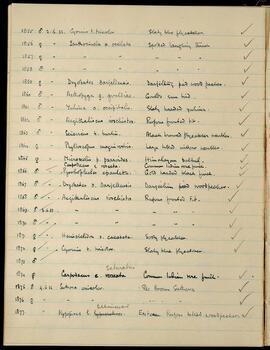
              LSH/1/1/1/1/50 · Part · 1933-06-02 - 1933-06-04
              Part of The Ludlow & Sherriff Collection

              SUMMARY:
              Page lists bird specimens with sex and identifications, recorded across 2–4 June 1933. Entries include species such as the Slaty blue flycatcher, Spotted laughing thrush, Darjeeling pied woodpecker, Gould's sun bird, Himalayan bulbul, and the Brown Suthora.

              CONTENT:
              1855 ♂ 2. 6. 33. Cyornis t. tricolor Slaty blue flycatcher. ✓
              1856 ♀ " Ianthocincla o. ocellata Spotted laughing thrush ✓
              1857 ♀ " " " " " " ✓
              1858 ♂ " " " " " " ✓
              1859 ♀ " Dryobates darjellensis. Darjeeling pied woodpecker. ✓
              1860 ♂ " Aethopyga g. gouldiae. Gould's sun bird. ✓
              1861 ♂ " Yuhina o. occipitalis. Slaty headed yuhina. ✓
              1862 ♂ " Aegithaliscus ioschistos. Rufous fronted tit. ✓
              1863 ♂ " Seicercus b. burkii. Black browed flycatcher warbler. ✓
              1864 ♀ " Phylloscopus magnirostris. Large billed willow warbler. ✓
              1865 ♀ " Microscelis p. psaroides. Himalayan bulbul. ✓
              Carpodacus e. roseata. Common Indian rose finch. ✓
              1866 ♂ " Pyrrhoplectes epauletta. Gold headed black finch. ✓
              1867 ♂ " Dryobates d. darjellensis Darjeeling pied woodpecker. ✓
              1868 ♂ " Aegithaliscus ioschistos Rufous fronted tit. ✓
              1869 ♂ 3.6.33 " " " " ✓
              1870 ♂ " " " " " " ✓
              1871 ♀ " Hemichelidon s. cacabata. Sooty flycatcher. ✓
              1872 ♀ " Cyornis t. tricolor. Slaty blue flycatcher. ✓
              1873 ♂ " " " " " " ✓
              1874 ♀ " Carpodacus e. saturatus roseata Common Indian rose finch. ✓
              1875 ♂ 4.6.33 Suthora unicolor. The Brown Suthora ✓
              1876 ♀ " " " " " " ✓
              1877 - Hypopicus h. sikkimensis hyperythrus. Eastern Rufous bellied Woodpecker. ✓

              LSH/1/1/1/1/30 · Part · 1933-05-14 - 1933-05-15
              Part of The Ludlow & Sherriff Collection

              SUMMARY:
              List of bird specimens numbered 1754–1768 with sexes and species names, dated 14 and 15 May 1933. Common names include Blue-fronted redstart, Darjeeling Pied woodpecker, and Hodgson's Fulvetta, with place names Sikkim and Darjeeling mentioned.

              CONTENT:
              1754 14.5.33 ♀ Phoenicurus frontalis Blue-fronted redstart.
              1755 " ♂ Lophophanes d. dichrous Brown crested tit.
              1756 " ♀ " beavani Sikkim black tit.
              1757 " ♂ Phylloscopus t. trochiloides lugubris Dull green willow warbler.
              1758 " ♂ " " " " " "
              1759 " ♂ Cettia c. rufilata
              1760 " ♂ Horeites b. brunneifrons
              1761 15.5.33 ♂ Dryobates darjellensis Darjeeling Pied woodpecker.
              1762 " ♀ " " " " "
              1763 " ♂ Seicercus b. burkii Black-browed flycatcher warbler.
              1764 " ♂ " " " " " "
              1765 " ♂ Phylloscopus p. pulcher Orange-barred willow warbler.
              1766 " ♀ Yuhina o. occipitalis Slaty-headed Yuhina.
              1767 " ♂ Fulvetta v. vinipecta Hodgson's Fulvetta.
              1768 " ♂ " " " "

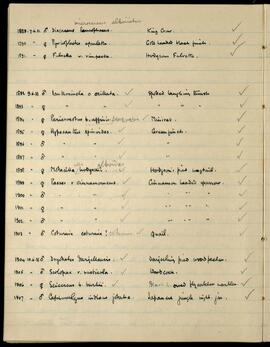
              LSH/1/1/1/1/54 · Part · 1931-06-07 - 1933-06-10
              Part of The Ludlow & Sherriff Collection

              SUMMARY:
              Page lists bird specimens with catalog numbers 1889–1907, noting sex and species (e.g., Dicrurus leucophaeus, Ianthocincla o. ocellata, Dryobates darjellensis) on dates 7 June 1931 and 9–10 June 1933. Common names include Hodgson's Fulvetta, Hodgson's pied wagtail, and Darjeeling pied woodpecker.

              CONTENT:
              Microcichla scouleri

              1889 7.6.31 ♂ Dicrurus leucophaeus. King Crow.
              1890 - ♀ Pyrrhoplectes epauletta. Gold headed black finch.
              1891 - ♀ Fulvetta v. vinipecta. Hodgson's Fulvetta.

              1892 9.6.33 ♂ Ianthocincla o. ocellata. Spotted laughing thrush
              1893 - ♀ " " " "
              1894 - ♀ Pericrocotus b. affinis. Minivet.
              1895 - ♀ Hypacanthis spinoides. Greenfinch.
              1896 - ♂ " " " "
              1897 - ♂ " " " "
              1898 - ♀ Motacilla alba hodgsoni. Hodgson's pied wagtail.
              1899 - ♀ Passer r. cinnamomeus. Cinnamon headed sparrow.
              1900 - ♂ " " " "
              1901 - ♀ " " " "
              1902 - ♂ " " " "
              1903 - ♂ Coturnix coturnix ? coturnix Quail.

              1904 10.6.33 ♂ Dryobates darjellensis. Darjeeling pied woodpecker.
              1905 - ♂ Scolopax r. rusticola. Woodcock.
              1906 - ♀ Seicercus b. burkii. Black browed flycatcher warbler.
              1907 - ♂ Caprimulgus indicus jotaka. Japanese jungle night-jar.

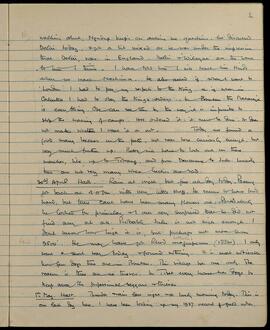
              LSH/1/1/9/1/12 · Part · 1949-07-30
              Part of The Ludlow & Sherriff Collection

              SUMMARY:
              Notes discussions with H.H. on a new treaty affecting Bhutan, mention of Tasho Jigme’s freedom to travel, and soldiers sent up the Bumthang road to collect flowers including Prim. bracteosa, a Magnolia, and a Daphne. On 8th April they watched Bhutanese dancers and later hosted H.H. for a long session reminiscing about Calcutta and P.O.'s Gould, Williamson, Bailey, and Bell; letters from Kalimpong reported Ludlow’s departure and Norman’s sale of Glenulli.

              CONTENT:
              almost 300." I hope something may be done, because certainly already many lakhs of rupees worth of damage has been done in the last 30 years or so. H.H. was undoubtedly interested, & doubly so as the new Treaty, although it promises 5 lakhs of cash annually to Bhutan, also says this may be stopped at any time if the Treaty is not kept. This sounds like a convenient loophole. We also talked about Tasho Jigme, & H.H. said that he could travel where he liked in Bhutan. I still hope to have further talks, as H.H. seems to like it. H.H. sent three soldiers up the Bumthang road to see what flowers they could get, & they brought back Prim. bracteosa, a Magnolia & a Daphne that were interesting.

              8th April. Our time here has not all been lazy. H.H. has entertained us fully & we have entertained him too. We were down on 6th to watch Bhutanese dancers, male & female, & the next day we had H.H. up for a good long session, 1.0pm till 5.30. He was then in great form reminiscing, mostly about his Calcutta visit & various doings of P.O.'s Gould, Williamson, Bailey or Bell. Mostly he talks of Bailey, of whom he certainly has the highest opinion. He would very much like to see Bailey again, & thinks he may come here sometime yet. I know Bailey is anxious to come, & if he does, he will get a welcome. We have not bothered much about flowers, but took a few more yesterday from round about, including Albizzia Sherriffii (18657), which is a fine tree. Tobgye sent a few letters on from Kalimpong, which arrived yesterday. No special news, except that Ludlow got off alright, & that Norman had sold Glenulli.

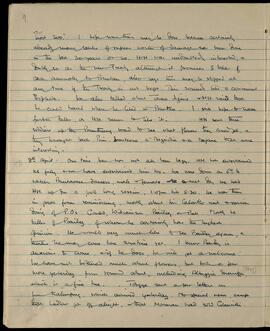
              LSH/1/1/9/1/35 · Part · 1949-05-06
              Part of The Ludlow & Sherriff Collection

              SUMMARY:
              The diarist walks alone while Ngundup asks about Delhi, London, and the King; the writer reflects on the Maharaja’s authority in Bhutan and warns of leeches on routes toward Tobrang and between Denchume and Jula. During halts on 30 April and 1 May near Sulu, Pasang returns with few specimens (no primulas) and a possible Rhododendron magnificum, and the diarist notes the scarcity of dogs and consults 1937 field notes.

              CONTENT:
              Walking alone, Ngundup keeps on asking me questions. We discussed Delhi today, and got a bit mixed as he was under the impression that Delhi was in England. Delhi and 'Wilayat' are the same to him I think. I have told him I will teach him Hindi when we reach Nashima. He also asked if when I went to 'London' I had to pay my respects to the King, and if when in Calcutta I had to obey the King's orders. In Bhutan the Maharaja is everything. One can see this by the way it is impossible to stop the making of camps. H.H. ordered it: it must be done. It does not matter whether I want it or not. Today we found a good many leeches on the path, not near here curiously enough, but very much further up. Betty will have to look out on these marches, like up to Tobrang, and from Denchume to Jula. Luckily there are not very many where leeches are bad.

              30th April Halt. Rain at night, but fine all day today. Pasang got back at 4.0 pm, with very little stuff. He seems to have tried hard, but there can't have been many flowers out. Particularly he looked for primulas, and I am very surprised that he did not find any at all. Probably Sulu is not high enough. I don't know how high it is, but perhaps not more than 9500'. He may have got Rhod. magnificum (18801). I only went a short way today, and found nothing. It is most noticeable how few dogs there are in Bhutan. This village has one only. The reason is there are no thieves. In Tibet every house has dogs to keep away the professional beggars and thieves.

              1st May. Halt. Thunder and rain last night, a lovely morning today. This is our last day here. I have been looking up my 1937 record of field notes,

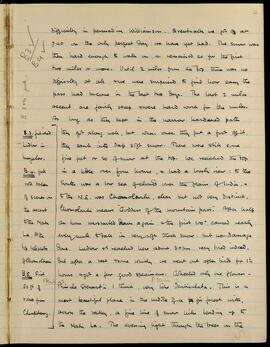
              LSH/1/1/1/1/29 · Part · 1933-05-13
              Part of The Ludlow & Sherriff Collection

              SUMMARY:
              Notes on film rolls B.3–B.5 record scenes from the ascent to the Natu La, including a telephoto of Chomolhari and views from Chumpitang. The entry describes setting out after persuading Williamson, traversing deep snow to the pass with views over the plains of India, then returning to collect birds and one flower (Primula Stewartii) in a fir forest.

              CONTENT:
              B3 / B4
              B 3 & 4 good -
              B.3. finished: Ludlow in bungalow.
              B.4. full roll taken of scenes on the ascent to the Natu La. At the top. telephoto of Chomolhari
              B.5. First 50 ft of views from Chumpitang.

              difficulty in persuading Williamson. Eventually we got off at 7.40 on the only perfect day we have yet had. The snow was then hard enough to walk on, & remained so for the first two miles or more. Until 2 miles from the top there was no difficulty at all, & we were surprised to find how easy the pass had become in the last two days. The last 2 miles ascent are fairly steep & were hard work for the mules. As long as they kept in the narrow hardened path they got along well, but when once they put a foot off it, they sank into deep soft snow. There were still some five feet or so of snow at the top. We reached the top in a little over four hours, & had a lovely view: to the South was a low sea of clouds over the plains of India, & to the N.E. was Chomolhari, clear but not very distinct. Chomolhari means "Goddess of the mountain pass". After half an hour we started down again & the first 100 yds caused nearly every mule to fall in very soft thick snow: but no damage done. Ludlow & I reached here about 3.0 pm. very tired indeed. But after a rest & some whisky we went out after birds for 1 1/2 hours, & got a few good specimens. Collected only one flower - Primula Stewartii I think, very like Denticulata. This is a most beautiful place in the middle of a fir forest with, across the valley, a fine line of snow hills leading up to the Natu La. The evening light through the trees on the

              LSH/1/1/2/1/23 · Part · 1924-06-23
              Part of The Ludlow & Sherriff Collection

              SUMMARY:
              The party stays in the Dzongpen’s guest quarters, sends presents to Bumthang, and arranges future mail to India via Neoli instead of Dewangiri to avoid the wet march to Darrang Mela; the Dzongpen is very hospitable and even takes up shooting sparrows. On 29 June they make a short, mostly downhill march to Trashigong with the Jongpen, passing cultivated hills near Pinhogong (Rongtung) and noting the Dangme Chu (Trashiyangsi Chu) below.

              CONTENT:
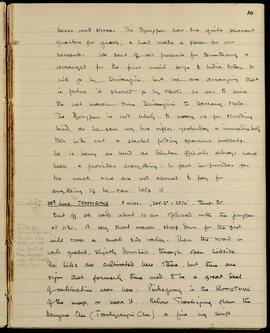
              boxes and stores. The Dzongpen has two quite pleasant quarters for guests, and had made a place for our servants. We sent off all presents for Bumthang and arranged for the first mail to go to India today. It will go by Dewangiri, but we are arranging that in future it should go by Neoli, so as to miss the wet march from Dewangiri to Darrang Mela. The Dzongpen is not likely to worry us for shooting birds, as he saw my two rifles yesterday and immediately took both out and started potting sparrows himself. He is being as kind as Bhutan officials always have been, and provides everything. In fact he provides far too much, and we are not allowed to pay for anything if he can help it.

              29th June TO TRASHIGONG 5 miles. (205.2° = 3574'. Temp. 81°.

              Sent off all loads about 10 am and followed with the Jongpen at 11.30. A very short march, steep down for the first mile over a small side valley. Then the road is well graded, slightly downhill, through open hillside. The hills are cultivated here and there, but there are signs that formerly there used to be a great deal of cultivation near here. Pinhogong is the RONGTUNG of the map, or near it. Below Trashigong flows the Dangme Chu (Trashiyangsi Chu) a fine big swift

              LSH/1/1/4/1/43 · Part · 1936-04-28
              Part of The Ludlow & Sherriff Collection

              SUMMARY:
              Notes common primula, iris, and emerging gentians, with a few Parnassius butterflies at camp; praises local butter and mentions a local man paid in food and clothing who sells to buy an ornament for his wife. Sends for coolies to leave for Changu on the 21st; on 21 July at Drötang (11700') reports mist then sun near Karutra, parched conditions, no pheasants or larks, and shooting a rubythroat while declining to skin an aegithaliscus.

              CONTENT:
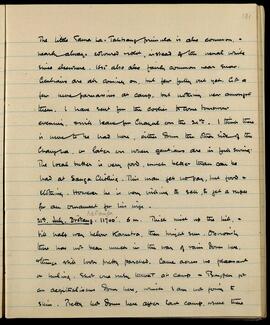
              The little Tama La-Tahtsang primula is also common, nearly always coloured violet, instead of the usual white seen elsewhere. Iris also fairly common near snow. Gentians are all coming on, but few fully out yet. Got a few more parnassius at camp, but nothing new amongst them. I have sent for the coolies to come tomorrow evening, will leave for Changu on the 21st. I think there is more to be had here, either down the other side of the Chayha, or later on when gentians are in full swing. The local butter is very good, much better than can be had at Sanga Choling. This man gets no pay, but food & clothing. However he is very willing to sell, to get a rupee for an ornament for his wife.

              21st. July. Drötang. 11700'. 6 m. Thick mist up the hill, till half way below Karutra, then bright sun. Obviously there has not been much in the way of rain down here, things still look pretty parched. Came across no pheasant or larking. Shot one ruby throat at camp - Bunged for an aegithaliscus down here, which I am not going to skin. Pretty hot down here after last camp, where there

              LSH/1/1/6/1/180 · Part · 1938-11-24
              Part of The Ludlow & Sherriff Collection

              SUMMARY:
              Itemized expenses for supplies and freight from Calcutta and R'Pindi to Kalimpong, including purchases from Spencers and Harrods. Records advances and payments for mule transport from Phari to Gyantse, Tuna, Dochen, Kala, and Samoda.

              CONTENT:
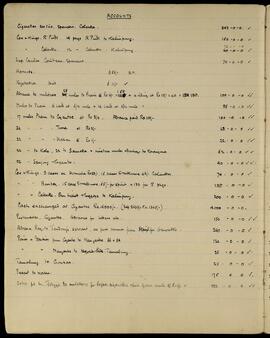
              ACCOUNTS.

              Cigarettes 200 tins. Spencers. Calcutta. 243 - 0 - 0. ✓
              Cox & Kings. R'Pindi 14 pkgs R'Pindi to Kalimpong. 150 - 0 - 0 ✓
              " Calcutta. 12 " Calcutta - Kalimpong. 76 - 1 - 0
              Soap. Candles. Cointreau. Spencers. 70 - 0 - 0 ✓
              Harrods. £ 53/- B.M.
              Vegetables. Dried £ 11/- ✓
              Advance to muleteers 25 mules to Phari @ Rs 6/- = 150 + 4 riding at Rs 10/- = 40 = 190. 100 - 0 - 0 ✓✓
              Mules to Phari 16 loads at 6/12 mule & 14 loads at 5/12 mule : 95 - 0 - 0 ✓✓
              17 mules Phari to Gyantse at Rs 8/4. Advance paid Rs. 100/- 100 - 0 - 0 ✓✓
              24 " " Tuna at Rs 2/- 48 - 0 - 0 ✓✓
              22 " " Dochen @ Rs 1/- 22 - 0 - 0 ✓✓
              22 " to Kala, 22 to Samoda + mixture mules

              LSH/1/1/1/1/75 · Part · 1933-06-30
              Part of The Ludlow & Sherriff Collection

              SUMMARY:
              Notes on the death of the Thimbu penlop and Tobgye’s sending of English medicine, causing concern with the Maharaja. On 30th June Ludlow and the author travelled to Lomi-Tsa-wa via Do Kyong La in clearing weather, collecting flowers including Magnolia globosa and observing that vegetation in the Trashi-cho-dzong valley and at the pass resembled Sikkim.

              CONTENT:
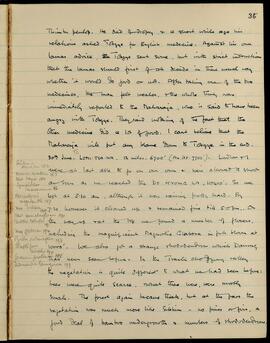
              35

              Thimbu penlop. He died of dropsy & a short while ago his
              relations asked Tobgye for English medicine. Against his own
              lamas advice, Tobgye sent some, but with strict instructions
              that the lamas should first of all decide in their usual way
              whether it would do good or not. After taking one of the two
              medicines, the man felt weaker, & the whole thing was
              immediately reported to the Maharaja, who is said to have been
              angry with Tobgye. They said nothing of the fact that the
              other medicine did a lot of good. I can't believe that the
              Maharaja will put any blame down to Tobgye in the end.

              30th June. TO LOMI-TSA-WA. 12 miles - 6700' (An. Ht. 7700'). Ludlow & I
              Embelia oleracea 182
              Anemone rivularis 183 were at last able to go on our own & were allowed to shoot
              Rhod. Keysii 184
              Symplocos ramosissima 186 as soon as we reached the DO KYONG LA, 10410'. So we
              Pedicularis megalantha 187
              left at 5.30 am, although it was raining pretty hard. By
              Meconopsis villosa 189
              Rhod. camelliaeflorum 190 7.30 however it cleared up & remained fine till 5.0 pm. On
              Berberis celestina 191
              the way up & at the top we found a number of flowers,
              Mag. globosa 192
              Pyrola rotundifolia 193 including the magnificent Magnolia Globosa in full bloom at
              Streptopus simplex 194
              10000'. We also got a strange rhododendron which Dawang
              Geranium pratense 198
              Didissandra lanuginosa 199 has never seen before. In the Trashi-cho-dzong valley
              the vegetation is quite different to what we had seen before:
              trees were quite scarce, & what there were, were mostly
              small. The forest again became thick, but at the pass the
              vegetation was much more like Sikkim - no pines or firs, a
              good deal of bamboo undergrowth & numbers of rhododendrons.