Zona de identificação
Código de referência
Título
Data(s)
- 1940-05-24 (Produção)
Nível de descrição
Dimensão e suporte
1 page
Zona do contexto
Nome do produtor
Entidade detentora
História do arquivo
Fonte imediata de aquisição ou transferência
Zona do conteúdo e estrutura
Âmbito e conteúdo
SUMMARY:
The writer describes difficult access near a Himalayan pass, noting most rhododendrons were over, while several primulas remained in flower, including a new species later named P. tsangpoensis. After retreating to the drier Tsangpo valley, they explored a nearby spur called Go ngi re, recording diverse alpine plants and collecting seed with the help of a hopa.
CONTENT:
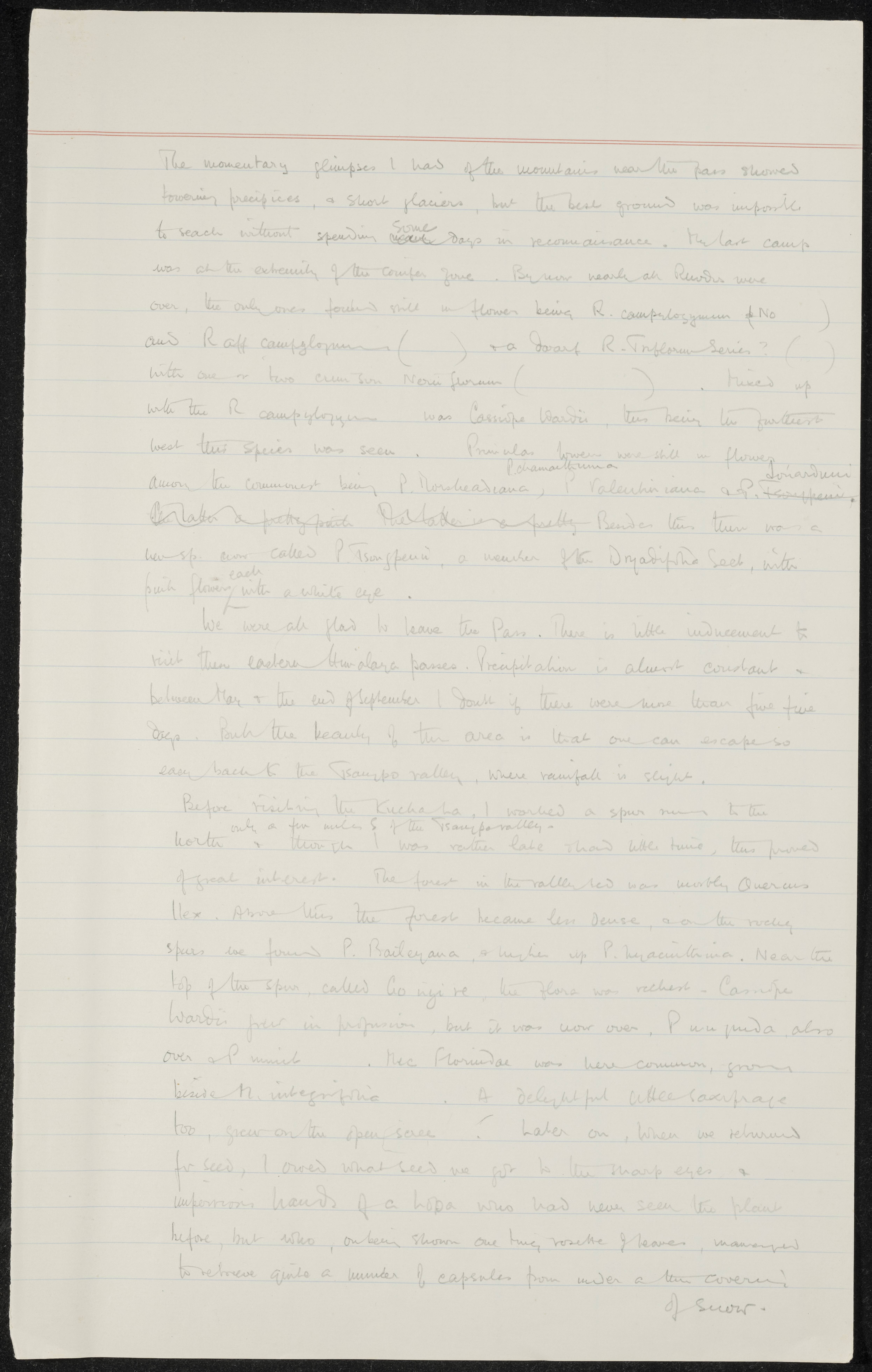
The momentary glimpses I had of the mountains near the pass showed towering precipices and short glaciers, but the best ground was impossible to reach without spending some days in reconnaissance. The last camp was at the extremity of the conifer zone. By now nearly all Rhodos were over, the only ones found still in flower being R. campylogynum (No. ) and R. aff. campylogynum ( ) and a dwarf R. Triflorum series? ( ) with one or two crimson neriiflorum ( ). Mixed up with the R. campylogynum was Cassiope wardii, this being the furthest west this species was seen. Primulas however were still in flower, among the commonest being P. morsheadiana, P. chamaethauma, P. valentiniana and P. tsariensis. Besides this there was a new sp. now called P. tsangpoensis, a member of the Dryadifolia section, with pink flowers each with a white eye.
We were all glad to leave the Pass. There is little inducement to visit these eastern Himalayan passes. Precipitation is almost constant between May and the end of September; I doubt if there were more than five fine days. But the beauty of the area is that one can escape so easily back to the Tsangpo valley, where rainfall is slight.
Before visiting the Kucha La, I worked a spur only a few miles N. of the Tsangpo valley. Though I was rather late and had little time, this proved of great interest. The forest in the valley bed was mostly Quercus ilex. Above this the forest became less dense, and on the rocky spurs we found P. baileyana, and higher up P. hyacinthina. Near the top of the spur, called Go ngi re, the flora was richest. Cassiope wardii grew in profusion, but it was now over, P. unijuga also over and of merit. Meconopsis florindae was here common, growing beside M. integrifolia. A delightful little saxifrage too, grew on the open scree. Later on, when we returned for seed, I owed what seed we got to the sharp eyes and unwearying hands of a hopa who had never seen the plant before, but who, on being shown one tiny rosette of leaves, managed to retrieve quite a number of capsules from under a thin covering of snow.
Avaliação, seleção e eliminação
Incorporações
Sistema de arranjo
Zona de condições de acesso e utilização
Condições de acesso
Condiçoes de reprodução
Idioma do material
Sistema de escrita do material
Notas ao idioma e script
Características físicas e requisitos técnicos
Instrumentos de descrição
Zona de documentação associada
Existência e localização de originais
Existência e localização de cópias
Unidades de descrição relacionadas
Zona das notas
Identificador(es) alternativo(s)
Pontos de acesso
Pontos de acesso - Assuntos
Pontos de acesso - Locais
Pontos de acesso - Nomes
- Hopa (Assunto)
- Cassiope wardii (Assunto)
- M. integrifolia (Assunto)
- Meconopsis florindae (Assunto)
- P. baileyana (Assunto)
- P. chamaethauma (Assunto)
- P. hyacinthina (Assunto)
- P. morsheadiana (Assunto)
- P. tsangpoensis (Assunto)
- P. tsariensis (Assunto)
- P. unijuga (Assunto)
- P. valentiniana (Assunto)
- Quercus ilex (Assunto)
- R. aff. campylogynum (Assunto)
- R. campylogynum (Assunto)