Identity area
Reference code
Title
Date(s)
- 1933-07-18 (Creation)
Level of description
Extent and medium
1 page
Context area
Name of creator
Repository
Archival history
Immediate source of acquisition or transfer
Content and structure area
Scope and content
SUMMARY:
The diarist records finding three beautiful primulas growing under overhanging rocks near the CHO LA/Tulung La and photographing them despite late-afternoon mist. The route is said not to have been previously travelled by Europeans and is famed as the path by which Lobpön Rimpoché entered Tibet from India, with a note that CHO LA should likely be written as CHÖ.
CONTENT:
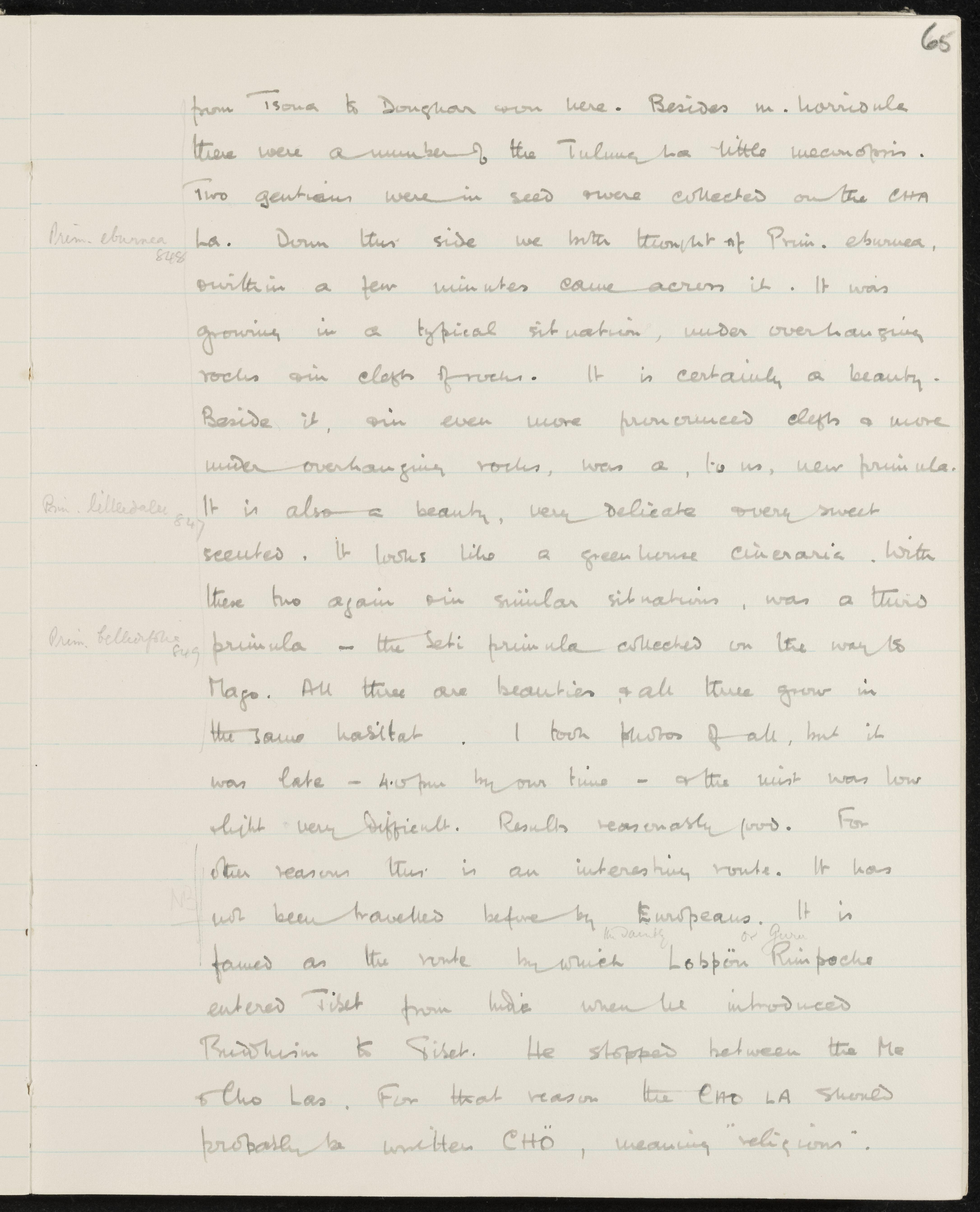
from Tsona to Dongkar were here. Besides M. horridula there were a number of the Tulung La little meconopsis. Two gentians were in seed and were collected on the CHO LA. Down this side we both thought of Prim. eburnea, and within a few minutes came across it. It was growing in a typical situation, under overhanging rocks and in clefts of rocks. It is certainly a beauty. Beside it, in even more pronounced clefts and more under overhanging rocks, was a, to us, new primula. It is also a beauty, very delicate and very sweet scented. It looks like a greenhouse cineraria. With these two again in similar situations, was a third primula — the Seti primula collected on the way to Mago. All three are beauties and all three grow in the same habitat. I took photos of all, but it was late — 4:00 pm by our time — and the mist was low which was very difficult. Results reasonably good.
For other reasons this is an interesting route. It has not been travelled before by Europeans. It is famed as the route by which Lobpön Rimpoché entered Tibet from India when he introduced Buddhism to Tibet. He stopped between the CHO LAs. For that reason the CHO LA should probably be written CHÖ, meaning "religious".
Appraisal, destruction and scheduling
Accruals
System of arrangement
Conditions of access and use area
Conditions governing access
Conditions governing reproduction
Language of material
Script of material
Language and script notes
Physical characteristics and technical requirements
Finding aids
Allied materials area
Existence and location of originals
Existence and location of copies
Related units of description
Notes area
Alternative identifier(s)
Access points
Subject access points
Name access points
- Lobpön Rimpoche (Subject)
- M. horridula (Subject)
- Prim. eburnea (Subject)