Mostrar 6828 resultados

Descrição arquivística
2091 resultados com objetos digitais Mostrar resultados com objetos digitais
LSH/1/1/10/1/14 · Part · 1949-09-27
Parte de The Ludlow & Sherriff Collection

SUMMARY:
The writer notes a woman's injury has healed and mentions the drokpas marking the first frost. On 27 Sept. they halt in misty weather, collecting good seed of several plants and observing Polygonum vaccinifolium, with plans to take roots. On 28 Sept. heavy continuous rain makes it difficult to dry collected seeds.

CONTENT:
see that it has healed well, she can use it perfectly. I must confess I am also very surprised, because the splinting I did was not good. There was some white frost on the ground this morning, which the drokpas seemed pleased about, because their calendar said this would be the first day of frost.

27th Sept. Halt. This evening one would think we were in the middle of the worst part of the rains. It dawned sparklingly bright, yet within two hours we were in thick mist, & we haven't seen the sun since. A most disappointing day. But we got what we wanted, good seed of P. tenardinii, sapphirina & Waddellii, & one or two other things. I should think there will be a good deal of snow high up tonight. Many plants have no ripe seed yet, notably P. unistabilis, which is not nearly ready yet. There is quite a lot of Polygonum vaccinifolium up here, which I never suspected before, but it is not in profusion as it is on the Hala-Kyu la, in Sikkim, near Changu. What a beautiful thing it is though, why doesn't one see more of it at home I wonder. We have managed to get a few - very few - seed, & if we can get more will take roots for the Hala.

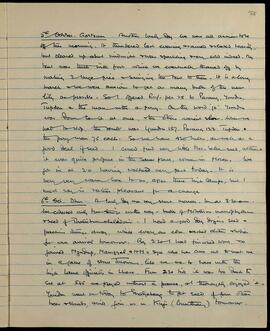
28th Sept. Halt. Heavy rain all night, & rain without a stop today, much to our disgust. It is very hard to get seeds dry in this atmosphere. Anything we take is naturally soaking. I
LSH/1/1/10/1/15 · Part · 1949-09-27
Parte de The Ludlow & Sherriff Collection

SUMMARY:
Notes on high-altitude collecting near Maruthang, including marked Primula uniflora, and concern over snow making work difficult. The writer reports that Ludlow has given up hopes of visiting Tibet and booked passage home, while at Haat heavy rain and snow are foretold by 'Lerwa' calls and a local drogpa’s warning.

CONTENT:
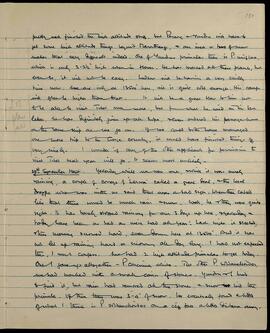
pretty well finished the high altitude stuff, but Pasang and Mundru will have to get some high altitude things beyond Maruthang, and an inch or two of snow makes that very difficult indeed. One of Mundru's primulas there is P. uniflora, which is only 2-2½" high when in flower. He has marked all these plants, but even so, it will not be easy. Ludlow will be having a very chilly time now. We are only at 13500' here, air is quite cold enough. His camps will often be higher than that. It will be a great blow to him not to be able to visit Tibet once more, but from what he said in his last letter, he has definitely given up all hope, and even ordered his passage home on the same ship as we go on. If we could both have managed one more trip to the Gorge country, it would have finished things off very nicely. I wonder if any of the other applicants for permission to visit Tibet next year will go. It seems most unlikely.

29th September Haat. Yesterday while we were out, and while it was merely raining, a couple of coveys of 'Lerwa' called a great deal, and the local drogpa who was with us said that was a bad sign. When they called like that there would be much rain and snow. Well, he and they were quite right. It has barely stopped raining for our 3 days up here, and yesterday and today have been as bad as we've had all year. Last

LSH/1/1/10/1/16 · Part · 1949-09-27
Parte de The Ludlow & Sherriff Collection

SUMMARY:
Page lists black-and-white, Dufaycolor, and Kodachrome photographs with subjects, specimen numbers, and dates from late September to early October. Locations include Marlung, Tolegang La, Larko La, and Jin La, with scenes of alpine flora, yaks, and views. A companion named Tupden is noted collecting seed and climbing a cliff.

CONTENT:
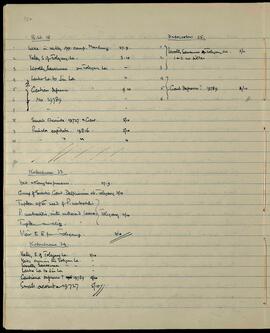
B.W. 15

  1. Lake in valley opp. camp Marlung. 27.9.
  2. Valley S. of Tolegang La. 3.10
  3. Woolly Saussurea on Tolegang La. "
  4. Larko La to Jin La "
  5. Gentian depressa 4.10
  6. No 19789 "
    • "
  7. Small Aconite 19727 & Gent. 5/10
  8. Primula capitata 19816. 5/10
  9. " " "

Dufaycolor 25.

  1. Woolly Saussurea on Tolegang La. 3/10
  2. 1 + 2 no filter
  3. Gent. depressa? 19789 4/10
  4. //

Kodachrome 33
Yak at Kangkarpunsum. 27.9.
Group of Swertia, Gent., Delphinium etc. Tolegang 2/10
Tupden after seed of P. umbratilis }
P. umbratilis, with withered leaves, Tolegang 2/10
Tupden on cliff. }
View to E from Tolegang. 2/10 //

Kodachrome 34.
Valley S. of Tolegang La. 3/10
Yaks crossing the Tolegang La. "
Woolly Saussurea "
Larko La to Jin La "
Gentiana depressa? 19789 4/10
Small aconite 19727 5/10 //

LSH/1/1/10/1/17 · Part · 1933-10-05 - 1933-10-01
Parte de The Ludlow & Sherriff Collection

SUMMARY:
The diarist receives letters from Betty and outlines plans: Hicks will arrive in Bumthang on 5 Oct, they hope to leave about the 13th and reach Tashigang on 3 Nov; the party will include Ludlow, the diarist, Betty, Virginia, Tess, and Tasho. Entries for 30 September at Pangotang and 1 October at Tolegang note wet weather, seed collecting (including Primula umbratilis), Pasang and Mundru’s work continuing until 17 October, a visit from the Sokpon who received gifts, and mail sent to HH for Kalimpong.

CONTENT:
To cheer me up today—I was feeling very miserable—a mail came in, with letters from Betty in Calcutta at last, and also from her in London. Nothing from HH at all for the first time when a mail has been sent. Hicks confirms that he will arrive in Bumthang on 5th Oct. So we should be able to leave on 13th about, and reach Tashigang on 3 Nov. Ludlow has got a passage, Betty says, and also she and I, Virginia, Tess, and Tasho. So we should have a good time, 6 of us from Bhutan.

30th September. Pangotang. It rained all night again, but was fine when Pasang and Mundru went off about 6:00 am. We were off just after them, and had a day half rain half fine, but no sun. It doesn't look yet like clearing up, but I do most sincerely hope it is fine now for four days. There is a lot to be got in Tolegang and quite a lot on the other side. After that it doesn't matter so much, except for Pasang and Mundru, whose work won't finish until 17 October. Primula umbratilis here is nearly ripe, and I got some seed, but the big Androsace is still green. This is our last of many halts in Pangotang. The Sokpon came to call and I gave him a little bottle of saffron and a torch, which is doing him very well. But we've been in his district for a long time now, ever since 23rd of May. Sent off a small mail to HH for Kalimpong. I shall only be able to send off one more after this, except for Ha.

1st October. Tolegang. Fine till 10:00 then rain and snow off and on the rest of the day. We are camped about 14,000-14,500' and it is raw and chilly. We got some seed of Primula umbratilis, the very pale form which occurs here, and a few other things. But the Phlomis (19716) I particularly wanted, is still in flower; seeds are not nearly ripe. Neither are seeds of the interesting Gentian 19721. But I took roots of

LSH/1/1/10/1/18 · Part · 1933-10-01
Parte de The Ludlow & Sherriff Collection

SUMMARY:
The diarist reports severe infestation of P. umbratilis seed capsules by caterpillars, difficulty finding other seeds, snow melted up to about 15,500 ft, and the drogpas leaving the high pastures. On 2nd October at Ha-chu, after clear frosty weather, they observed a large herd of burhel, finished work in the Tsampa area (Bumthang Chu watershed), planned to cross to the Dhur Chu to meet Pasang and Yundon, and reflected on concluding Himalayan trips first planned with Ludlow in 1929 at Kashgar.

CONTENT:
From among the seeds of P. umbratilis which I collected today, I extracted 67 caterpillars, which shows the difficulty with seed. Practically every capsule I take now has worms or caterpillars. I can't find any seed of a big Swertia. All capsules have 3-4 red worms in them. None of the aconites were ready yet, and I have had to take roots of some. Snow is not now lying here. It has all melted up to 15500' or so. The drogpas have all gone down from these high grazing grounds, I am surprised to see. They come in the 5th month (July) and leave in the 7th or 8th (Sept). It is a very short season. I sympathize with them going down now, but I think they should come up much earlier, when the grass is good.

2nd October. Ha-chu. This is the best day we have had. There was rain and some snow last night, but it cleared up to a beautiful morning and there was hard frost. Up till midday today there was lovely bright sun, and then huge clouds collected, but it has not snowed, and I should think we will now have several similar days. I got a little more of the same seed today, but nothing special. We walked onto a huge herd of 58 burhel on our way back. And now we have finished with the area called Tsampa, which includes the watershed of the Bumthang Chu, but not the Dhur Chu. Tomorrow we cross to the head of the Dhur Chu, and there meet Pasang and Yundon. It is difficult now to think that we have practically finished our work this year, and that there are now but 5 more days left. In a month I will be in Sikkim. And this is the last of our Himalayan trips, which Ludlow and I started planning in 1929, sitting in front of the fire in the drawing room of the Consulate General in Kashgar.

LSH/1/1/10/1/19 · Part · 1933-10-01
Parte de The Ludlow & Sherriff Collection

SUMMARY:
Clear, frosty day at Amelungnang with notes on Hicks needing to cross the Rudo La in Bhutan. The writer reflects that the Dhur Chu area would have yielded better flowers than Waitang, noting climatic differences after crossing the Tolegang La; Pasang and Yundru arrived later with a good haul of seed despite a foot of snow on boulder scree, and there was disappointment regarding Mec. bella near the Sin La.

CONTENT:
probably, after having a lonely duck swoosh up and down the Tumen Su in a temperature of about 10° F.

Hicks will be glad of the change in weather. He will have the Rudo La to cross, and he will be lucky to find a good day to get over that. It must be one of the wetter passes in Bhutan, on the east side.

3rd October. Amelungnang. Misty, with a hard frost in the early morning, but soon cleared up to a perfect day - the first with no rain at all. Clouds formed soon but never looked wet. It was an interesting march, too, and I now have much more of an idea of the country. I just wish that we had chosen the area of the Dhur Chu instead of Waitang. We would have got many more flowers and of much greater interest. Partly this is due to the area not being overrun by yaks, but there is something else climatic as well. As soon as we crossed the Tolegang La, this was evident. But it can't be helped now. Pasang and Yundru came on later than us with their haul of seed. They have done well, and got quite a good lot of things. They were unable to go the way we meant them to, owing to the snow being a foot thick. That on boulder scree, is really impossible. It made no real difference to the seed gathering, which way they went. One disappointment was Mec. bella. We saw so very much of it all along N of the Sin La, that I expected

List of place names, passes (La), and rivers (Chu)
LSH/1/1/10/1/20 · Part · 1933-10-01
Parte de The Ludlow & Sherriff Collection

SUMMARY:
This page presents a list of place names, including several passes (La) and rivers (Chu). It appears to be an itinerary or index of locations such as Marlung, Namda La, and Mangde Chu.

CONTENT:
156

Drohua
Skoni
La
Waihang

Marlung

Darchutsen Juntang
Namratu
Namda La
Dar Pangtang
Chutsen
Gortang La Tolegang

Tolegang
La Bumtang
Chu
Mangde Chu
Jin La
Sumitong
Amlungnang Lamprang Marlung
Larkola

Koule Chu Waspe
Shabrang

Gortsum

LSH/1/1/10/1/21 · Part · 1933-10-01
Parte de The Ludlow & Sherriff Collection

SUMMARY:
Describes a frosty halt day, continued collection of Gentiana (lacunulata), and praise for the seed collector Tupden. Notes comparisons of the Dhu Chu area with the Bumthang Chu, reports a letter from HH about upcoming arrivals (Hicks, MK, Tasho Drunyer), tallies seed and plant collections, and mentions confirmations by Ludlow and Taylor regarding Mec. Sherriffii.

CONTENT:
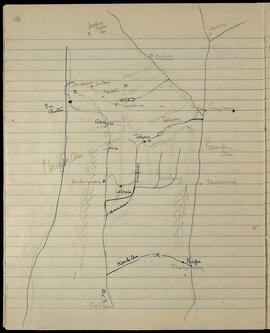
with Mec. paniculata, simplicifolia & horridula, all of which are in cultivation at home. Tupden is one of the best seed collectors there could be. He takes great pains & always goes on till called away. I wished to have had him from the beginning. Now I know him, I find him very good indeed. He is a Khampa, probably a runaway murderer or something like that, from Markham. The area of the Dhu Chu is something like shown opposite.

4th October Halt. Another lovely day, & very cold hard frost last night. The tents each night now are covered with frost inside & out, & this makes them very heavy. Nothing special happened today. I went out to look for more of yesterday's Gentiana (lacunulata) 19789, & after a while we found a lot of it. It reminds me of G. amplicrata which we first found at Zimsati near Sangacholing in Takpo. I don't think it is G. depressa, & certainly isn't G. amoena. The more I see of this area, the better it looks. It holds much more than the Bumthang Chu valley, although this is a tributary of the Bumthang Chu. It must be more than just not so many yaks here, although there is no doubt that many yaks, & sheep too, in a valley, make a very great difference to the flora. A letter came in from HH to say Tasho Drunyer will arrive on 6th. So with Hicks on 5th, MK on 6th & us on 7th, there will be some activity in Bumthang this week. The main seed collection is now over, & I have about 130 gatherings of seed now, besides the 40-50 taken before & some 25 rooted plants & a number of bulbs & tubers & corms & so on. Ludlow tells me he has 5 lbs. of seed of Mec. Sherriffii! That shows how common it is when it does occur. Taylor has confirmed that it is Mec. Sherriffii, but a very fine form of it.

Examination of island ruins and ancient maritime use
LSH/1/1/10/1/22 · Part · 1933-10-01
Parte de The Ludlow & Sherriff Collection

SUMMARY:
The writer describes an uninhabited island with later-period ruins, including a probable temple on the highest point, a harbor, and many houses. While finding no evidence for a large city as described by Plato, they conclude the island served as a station for Phoenician, Greek, and Roman fleets. The examination is complete and the writer plans to return to the mainland.

CONTENT:
with the possible exception of the work on the southern side
of the island. There is, as yet, no evidence of the existence
of a large city such as that described by Plato. On the
other hand, now I have seen the ruins which remain
on the island, it is impossible to doubt that the
Phoenicians, the Greeks, and the Romans, all in their
turn, made use of the island as a station for their
fleets.

The ruins are, however, for the most part, of a much later date
than the period of the Phoenician occupation. The
most important of these ruins is that of a large
building, which was probably a temple. It is built of
large blocks of stone, and is situated on the
highest point of the island. From this point a
fine view of the sea can be obtained. On the
other side of the island, there are the remains of
a large harbor, which was probably used by the
Phoenician fleets. There are also the remains of
a large number of houses, which were probably
occupied by the inhabitants of the island.

The island is now uninhabited, and is only
visited by fishermen. It is a very lonely place,
and it is difficult to believe that it was once
the scene of so much activity.

I have now completed my examination of the
island, and I am about to return to the mainland.
I hope that the information which I have
obtained will be of some value to those who
are interested in the history of the

LSH/1/1/10/1/23 · Part · 1933-10-01
Parte de The Ludlow & Sherriff Collection

SUMMARY:
Entries describe leaving frost-bound Gortsum after a storm, incentivizing the team to dig a large haul of lily bulbs (430 total) with little Meconopsis bella seed found, and reaching camp early. The next day at Dhur was a short march with collection of Notholirion macrophyllum bulbs and Thalictrum chelidonii seed, seed-drying and packing, games with companions, and Yundon sent to Shasjetang to collect more seed before rejoining at Kuji (Bumthang).

CONTENT:
5th October. Gortsum. Another lovely day. We were all anxious to be off this morning. It thundered last evening and rained and sleeted heavily, but cleared up about midnight and was sparkling and very cold indeed. My tent was thick with frost which we eventually thawed off by making 3 large fires and bringing the tent to them. It is a long march and we were anxious to get as many bulbs of the new lily as possible. So I offered Rs 1/- per 25 to Pasang, Yundru, Tupden and the man with a pony. On the word 'go' Yundru was down to it at once, the others were slower. When we had to stop, the result was Yundru 157, Pasang 123, Tupden and the pony man 75 each. So we have 430 bulbs, as well as a good deal of seed. I could find very little Mec. bella seed, although it was quite profuse in the same place, when in flower. We got in at 2.0 having walked very fast today. It is very very warm here to us, after those high camps, but I must say is rather pleasant for a change.

6th Oct. Dhur. A lovely day and a very short march. In at 8.30 am. We collected only two things on the way - bulbs of Notholirion macrophyllum and seed of Thalictrum chelidonii. I had a good day drying seed and packing things away, while everyone else washed clothes and bodies for our arrival tomorrow. By 2.30 I had finished work, so joined Ngudup, Namgyal, and HH's syce who had come out to meet me in a game of stone throwing, like we used to have with the high lama officials in Lhasa. From 2.30 till it was too dark to see at 5.45 we played without a pause, and thoroughly enjoyed it. Yundon went on today to Shasjetang to get seed of four other trees and shrubs, and will join us in Kuji (Bumthang) tomorrow.