Showing 6828 results

Archival description
2091 results with digital objects Show results with digital objects
Richardson, John
GB 235 RIC · Item · 1841

•Letter from Richardson to unknown 2 Sep 1841, describing a meeting of the British Association regarding a grant for preparing maps for illustration of the geographical distribution of plants & animals, which had lapsed, due to inconsistencies

Richardson, John
LSH/1/1/9/1/27 · Part · 1949-05-06
Part of The Ludlow & Sherriff Collection

SUMMARY:
The diarist spent the morning near the Rip La, viewed the Khoma Chu, and planned to reach Dengchu in three days for a week. They recorded Primula Normaniana as a new Bhutan record and observed Rhod. Lindleyi and Poryocarpum himalaicum in flower, photographed them, and from above the Ripla saw mountains near Sinchi Dzong and toward Tomtom; locals reported no road to Bumthang from Tomtom.

CONTENT:
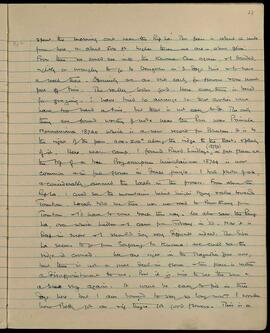
Spent the morning out near the Rip La. The pass is about a mile
from here, and about 500 feet higher than we are - about 9600'.
From there we could see into the Khoma Chu again, and decided,
rightly or wrongly, to go to Dengchu in three days' time and to have
a week there. Obviously we are still early for flowers and one must
put off time. The valley looks good. Here everything is bared
for grazing. I have tried to arrange so that coolies won't
have too hard a time, but that is not easy to do. The only
thing we found worthy of note near the pass was Primula
Normaniana 18740 which is a new record for Bhutan. It is to
the right of the pass, 400-500x along the ridge to the East, and plenty
of it. Here, near camp, I found Rhod. Lindleyi (18739) in full flower at
the top of a tree. Poryocarpum himalaicum 18744 is now
common and in full flower in dense jungle. I took photos of all,
and considerably amused the locals in the process. From above the
Ripla, I could see the mountains behind Sinchi Dzong and also towards
Tomtom. Locals told me there was no road to Bumthang from
Tomtom, and I'd have to come back this way. We also saw the Pang

LSH/1/1/2/1/11 · Part · 1934-06-14
Part of The Ludlow & Sherriff Collection

SUMMARY:
The party attempted to ford a river multiple times, but after four mules were washed downstream they returned to the bungalow to avoid damaging cameras and equipment. In humid heat they note locals wearing large bamboo hats, people fishing in fields with triangular pleated baskets by stamping the ground, and a caged mynah expertly imitating coughs; it poured with rain during the night.

CONTENT:
even non-existent. But we found it fairly full at 10:00. It has to be forded 10 or 12 times and we managed the first four times easily. But then four mules were washed downstream. We had to stop, as that kind of thing would ruin our cameras and other kit. Finally we returned to the bungalow at 4:30 pm. We hope now to start again tomorrow, if there is no rain at night. The temperature here is only 78° but we sit here dripping with sweat, the atmosphere being quite sodden. Many of the locals here wear a most excellent form of hat made of bamboo strips. It is about three feet across, quite light, and as good as any umbrella. But why wear such a hat when you are otherwise naked? We saw a number of people 'fishing' in the fields. They catch little minnows an inch or a little more long. A triangular pleated bamboo basket is used and the wielder stamps on the sloppy ground, to drive in any fish there may be. There is a mynah in a cage here, a most amusing bird. He jabbers all day long mostly unintelligible stuff. His best imitation by far is a cough, which is absolutely true to life. If any of us cough, he starts off at once.

19th June. Last night it poured with rain. In the

LSH/1/1/6/1/89 · Part · 1938-07-01
Part of The Ludlow & Sherriff Collection

SUMMARY:
The diarist travels to Nayü by crossing the Tsangpo on a log raft and a kowa, meeting the Gyimpon of Nayü who assists with transport and hospitality and approves plans for visiting the Nayü La. The entry includes observations of birds, strong winds, and details of the Kongbo wooden teapot (TIBTI) made from GIUGÖ (Acer erianthum), plus notes on local familial ties among officials.

CONTENT:
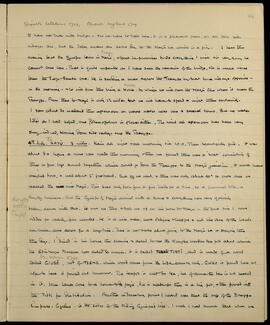
Epipactis helleborine 5723, Epipactis royleana 5729

to have no luck with bridges — so we have to walk here. It is a pleasant place, as all these little villages are, but the delay means an extra day to the Nayü La, which is a pity. I hear this evening that the Gyimpon lives in Nayü, that he promises to do everything I wish and is very sorry he cannot come here. That is quite impossible as I have seen the remains of the bridge, it is much worse than the Sunjo Samba one. He is sending a man across the Tsangpo by boat to a village opposite — in the morning — who will from there bring a kowa, by which we will cross the Nayü Chu where it meets the Tsangpo. From there to Nayü is only 1 1/2 miles, but we will have to spend a night there certainly. I saw about 30 mallard this afternoon on waste water near here and several terns. But no water lilies as I had hoped, and no Potamogetons in flower either. The wind all afternoon has been very strong indeed, blowing down side valleys over the Tsangpo.

4th July. To NAYÜ 3 miles. Rain all night and morning till 10.0. Then beautifully fine. It was about 8.0 before a move was made this morning when we found there was a 'boat' consisting of three or four logs bound together which could go down the Tsangpo to the Nayü junction. It must have weighed tons, and had about 2" freeboard. But off we went, and there was only about 40 yards to cross once we reached the Nayü. This boat only took four or five loads at a time, so it promised to be a lengthy business. But the Gyimpon of Nayü arrived with a kowa and everything was very quickly taken across with that. He met me there and took me up on his horse to Nayü — the first time I have ridden for nearly four months. He is a nice man, most obliging and cheerful and not like any of the locals we have come across for a long time. There is no trouble about going to the Nayü La or staying here three days. I 'dined' in his house this evening and asked to see the Kongbo wooden tea pot about which the Edinburgh Museum has asked so much. It is called TIBTI, and is made of a wood called GIUGÖ (Acer erianthum 5740), not of TSENG, which wood comes from the Lopa country only. GIUGÖ is found here and I hope to have it pointed out tomorrow. The teapot is used for tea, but of course the tea is not heated in it. When lamas come to a house to do 'puja', tea is made for them in a big pot, then poured into the tibti for distribution. Another interesting point I heard was that the wife of the Dzogpa Rimpoche — Gyelmo — is the sister of the Miling Gyimpon's wife. I wish I had known that when we

LSH/1/1/8/1/11 · Part · 1946-11-14
Part of The Ludlow & Sherriff Collection

SUMMARY:
The diarist records a multi-day river journey from Chitishio via Nyanga to Tsetang, noting departure/arrival times, difficult and deceptive channels, and comparisons with fuller water than in 1938. They observe large flocks of geese, cranes, ducks and Brahminy, receive help from the chanzo of Wobok Estate, and later call on a friendly Dzongpen at Tsetang; winds are described as upstream early and stronger downstream later in the day.

CONTENT:
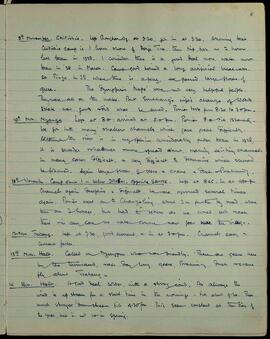
9th November, Chitishio. Left Gunchardz at 9:30, got in at 3:30. Showing that Chitishio camp is 1 hour short of Dorje Tra, this trip took us 2 hours less than in 1938. I consider there is a good deal more water now than in '38 in March. Camp fixed behind a long artificial breakwater. At Pinza, m 3 1/2, where there is a ferry, we passed large flocks of geese. The Dzongpen's 'traps' were not very helpful people. They were all on the make. But Sunhang's wife's chanzo of Wobok Estate was good and did what he could. Ponies took from 8:30 to 3:00 pm.

10th Nov. Nyanga. Left at 8:00; arrived at 5:00 pm. Ponies 8:00 till 12:30 only. We got into many shallow channels which gave great difficulty. Although the river is in my opinion considerably fuller than in 1938, it is broader, shallower and more spread about, making existing channels in many cases difficult, and very difficult to determine which should be followed. Again large flocks of geese, crane, duck and Brahminy.

11th November. Camp about 1 m below DROSHI, opposite SAMYE. Left at 8:45; in at 4:30 pm. Channels again deceptive and difficult. We were aground several times again. Ponies went on to Chanzoling, about 3 m further by road, where there are 3 houses, but had to return as we could not reach there; in any case no water course now goes near the village.

12 Nov. Tsetang. Left at 7:30, good current, and in at 3:00 pm. Channels easy and current faster.

13th Nov. Halt. Called on Dzongpen who was friendly. There are geese here by the thousand; all day long geese, Brahminy, duck and crane fly above Tsetang.

14 Nov. Halt. A good deal colder, with a strong wind. As always the wind is upstream for a short time in the morning—till about 9:30. Then much stronger downstream till 4:30 pm. This seems constant at this time of the year, but is not so in spring.

R.J. Murphy to M. Gibby
GB 235 GBY/1/1/276/7 · Item · 20 May 2003
Part of Professor Mary Gibby Collection

1 page letter. Handwritten. Fern fronds enclosed in newspaper with label data (3 fronds mounted across 2 sheets). Photocopy of an article entitled: "The Killarney Fern in Yorkshire) by FJ Rumsey, AD Headly, DR Farar, And E Sheffield, nd. (2 pages)

Attached to 7 other letters.

Murphy, R.J.
LSH/1/1/2/1/9 · Part · 1934-06-14
Part of The Ludlow & Sherriff Collection

SUMMARY:
After a difficult muddy road journey with a borrowed lorry, buffalo carts, and a bogged car from Neoli, the party reached the Menoka Tea Estate and stayed in the manager’s bungalow, where S.M. Lemarchand had arranged generous hospitality. Mules sent by the Trashigong Dzongpen arrived, and the group set off in heavy rain toward Dewangiri.

CONTENT:
3

[Marginalia: C.I. 0-80. Lorry and car on road between Rangiya and Menoka. Local form of tiddler fishing -]

us. She gave us an enormous amount of help. He had borrowed the Menoka Tea Estate manager's lorry and had tried to bring his own car from Neoli. But it had been bogged on the road. Most of our stuff was loaded in buffalo carts, while we went with some kit in the lorry. Maximum speed was about 6 mph, and we took nearly 10 1/4 hours (6.45 to 5.0 pm) to do the 23 miles here. The road is nowhere metalled, although there are many fine bridges along it, and as soon as rain falls it becomes impassable. The lorry had to be dug out several times, and it was a wonder that it ever arrived here at all. We stay here in the manager's bungalow. S.M. Lemarchand is away just now, but has left orders apparently that we are to be treated to real planter's hospitality. The whole bungalow is at our disposal — his servants and his drinks also. The assistant manager, a Bengali, spends a long time saying how "your goodselves" may make whatever use you like of everything he can think of. We arrived here yesterday, the 17th, and intended to go on to Dewangiri today. Mules have been sent here by the Trashigong Dzongpen and we were off — in pouring rain at 9.30 this morning. But the route lies up a valley. The river in this is normally a trickle or

GB 235 GAL · File · 1870 - 1930

Galloway, Robert (Secretary to Royal Scottish Arboricultural Society) Correspondence filed in “Balfour, I. Bayley” papers under “Arboricultural Society”

Galloway, Robert
Robert Moyes Adam Papers
GB 235 RBG/2/RMA · Collection · 1903 - 1949
Part of Royal Botanic Garden Edinburgh Institutional Archives

various photographs and illustrations
series of papers donated in February 1978 by Mary Noble including a leaflet for a Scottish Arts Council Exhibition in Charlote Square, March 1970; photocopy of his obituary in The Scotsman in 1967 and two excerpts from the Scots Magazine, September and October 1954 containing two parts of an article about Adam and his photography.

Adam, Robert Moyes