Showing 6828 results

Archival description
2091 results with digital objects Show results with digital objects
GB 235 CAV/2/4/2 · Item
Part of George H. Cave Collection

Descriptive information relating to the castes or tribes of Nepal, 1910. Information presented as a spreadsheet with the headings, 'Caste', 'Language', 'Religion', and 'Remarks'.

There are a few corrections in blue ink to the names and spellings of certain indigenous groups.

Published - A. Earle. Deputy Commissioner, Deputy Commissioner's Office, Darjeeling, 24th July, 1900.

GB 235 GLE · Collection · 1927 - 2009

1 Jenner's shoe box containing:

  • 11 jotters of pressed wildflowers made when Catherine was 14 years old in 1927/28 for the Girls' Guildry (now the Girls' Brigade) Edinburgh 17th Coy.
  • list of the flowers in the 11 jotters
  • 2 letters:
    --7th September 1945, Roland Edgar Cooper to Miss C.F. Glen - thank you for sending sprays of heather - RBGE hoping to propagate and name them - shorthand writing on the reverse, and the envelope has been kept.
    --6th September 1948, Roland Edgar Cooper to Miss Glen acknowledging receipt of her 'very fine contribution ' of heather on the 31st August 1948.
  • modern photograph showing Catherine Glen in old age.
Glen, Catherine F.
GB 235 MZC · Collection · 1708 - 1841

The Castle Menzies Collection comprises of accounts, bills and general receipts for the running of the Castle Menzies estate and a few pieces of correspondence with gardeners and the Baronet of the day. There are complete Head Gardener’s Journals and tool inventories for the early 1800s, seed lists from different periods and proposed plans for two different walled gardens. It also includes weather data for the late 1790s.

Listings:

MZC/1 – Accounts
Folder 1: Weekly State Proceedings at the Farm, Castle Menzies from Jan-Nov 1830, including names, work and wages. Inventory of Garden Tools for 1804 + 1805; Gardeners Journals for 1803 +1804; Weekly State of Proceedings at Garden May 1828; Nov + Dec 1832 part record; May-Nov 1833 with list of names, work and wages in each list: Wages and general receipts for 1803-1810: Receipts for agricultural machinery 1801-1841: Vegetable seed, fruit tree lists for 1800s: Plan of proposed walled garden 1838: Document in response to advice given by Sir John Sinclair about growing potatoes 1841.
Folder 2: Sir Robert Menzies “His Book” accounts for the Castle from 1805-1809, including stock sales, crop details etc. Labourers Accounts from 1803-1811 (incomplete)
Folder 3: Copy of Rules and Articles for the Improvement of Highland Farms 1774: Labour Accounts from 1790-1795 (not all complete): Seed receipts and list for 1700s and 1 plant list for 1800s: Receipts for Trees and Wood sales for 1782, 1783, 1790-1806, 1807:Receipts for peat + heather for burning in lime kilns for 1763s-1831s: General and wages receipts for 1708-1753 : Plan of proposed walled garden 1790.

MZC/2 – Weather Reports: Menzies Castle Collection – Weather records
1774- incomplete record – only parts exist for Sept, Oct, Nov and Dec.
1790- only Nov and Dec exist
1791- complete record except for 17th -28th April and 16th June -16th July
1792- Jan complete, 1st -15th Feb complete; Dec complete. Rest of year missing
1793- Jan to 16th May complete; 17th May to 30th June missing; 1st July to 31st Dec complete
1794- Jan to 16th Oct complete; 17th Oct-15th Nov missing; 16th Nov -31st Dec complete
1795- complete except for 17th Dec-31st Dec.

Menzies, Sir Robert
LSH/1/1/6/1/47 · Part · 1933-05-01 - 1933-05-02
Part of The Ludlow & Sherriff Collection

SUMMARY:
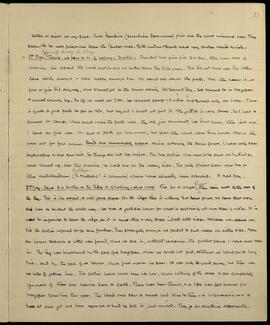
Entries for 1–2 May describe moving a short distance up the spur/ridge north of Lhalung through extremely dense forest, requiring continuous path-cutting and resulting in a foul camp with little water. Coolies were unreliable or refused to proceed, two men promised by Pintso did not arrive, and birds were scarce though tragopan and serow were heard; Ludlow and David suffered swollen hands from biting flies while Sherriff was away.

CONTENT:
seven or eight on my feet. But damdim (Simulium damnosum) flies are the worst nuisance here. They seem to be more poisonous than the Bantan ones. Both Ludlow & David have very swollen hands & wrists.
Sherriff away for 6 days.

1st May. Camp up spur to N. of Lhalung. 3 miles. Clouded but fine till 3.0 pm, then rain rest of evening. I'm afraid the local coolies are no better than the Moio ones. Two did not turn up. The others came early enough & were happy enough too. We asked all about the path. Yes, they knew it, or four or five did anyway, & we should get to the snow easily the second day. We should be in tragopan & monal country too. So off we went at 7.30. We reached camp - 3 miles and 2000 ft only at 1.0 pm. There is quite a good path as far as this, but beyond I could not find it, the jungle is very dense. So I had to consent to camp. When asked where the path was, then all just answered, 'We don't know, there isn't one'. I sent on five men, to cut a path for tomorrow, but fear they won't have done much, though they were out for four hours. Birds are remarkably scarce, since entering the dense forest, I have only seen phylloscopus & one sunbird. So things are not too bright. The two coolies who were to be sent on by Pintso, never turned up, even this evening, so loads are on the heavy side. The only flowers seen were two or three rhododendrons (R. nuttallii? lindleyi is common) which have already been collected. A bad day.

2nd May. Camp 2 m further up the Ridge N. of Lhalung. about 11000' Fine for a couple of hours, then rain most of the rest of the day. This is, I'm afraid, a wild goose chase. On the ridge there is nothing but dense forest, so dense that every step has to be cut the whole way. We took a good six hours for what is certainly not more than 2 miles. It is next to impossible to leave the ridge, as it is knife edge & very steep indeed both sides. However we came on, till the coolies refused to go any further. Then strangely enough we failed to find water on either side. After an hour's search a little was found, there we are in, without exception, the foulest camp I have ever been in. The day was brightened by the call of a tragopan, which we could not find, although we looked for a long time: and by the call of a serow, whose fresh marks we saw. He was only 50 yards away, but there was no hope of getting him. The coolies have never been up here, know nothing of the area & are completely ignorant of there ever having been a path. There has been though, & a Lopa has set snares for tragopan sometime this year. The Lpah once saw a small bird close to them - a Heteroxenicus - & two at once got out bow & arrows & tried to pot it, but missed. They go for anything apparently.

LSH/1/1/6/1/101 · Part · 1933-07-05
Part of The Ludlow & Sherriff Collection

SUMMARY:
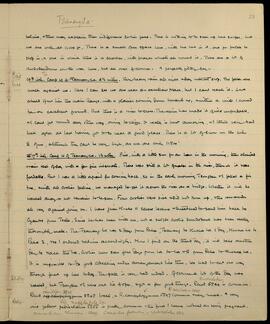
The diarist camps west of Tsanang La amid continuous heavy rain, blocked by an unfordable river despite promising ground nearby. On 17 July, with Tsongpen and the coolies, they fell a fir to make a bridge, contend with sick porters and poor arrangements by Kusho (threatened with being sent back to Gyantse), note route timings between passes, and record several plant collections.

CONTENT:
Tsanang La

believe, others may explain their indifference to his face. There is nothing to be seen up here so far, but we are only at 11,000 ft. There is a small open space here, with two huts in it, one for people to stop in and one in which there is a chorten, with prayer wheels all round it. There are a lot of rhododendrons on the way here, but all over of course. A perfectly filthy day—

16th July. Camp W of Tsanang La. 4 1/2 miles. Very heavy rain all night and day without stop. The fates are much against us. Here I can see we are near an excellent place, but I can't reach it. Just ahead of us lies the main range, with a glacier coming down towards us, and within a mile I could be on excellent ground. But there is a river to cross. The rain has made it quite unfordable, and I can't get round any other way, owing to cliffs. It really is most annoying, and I think very bad luck after at last having got so near a good place. There is a lot of snow on the hills to the E of us, although they can't be very high, as we are only 11,800'.

17th July. Camp W of Tsanang La. 1 1/2 miles. Fine, with a little sun for an hour in the morning, then clouded and rain rest of day with a few fine intervals. There was still a lot of water in the river, though it was fordable. But I was a little afraid for coming back, so in the early morning Tsongpen and I felled a fir tree, and with all coolies pulling, we managed to get it across the river as a bridge. Whether it will be washed away or not remains to be seen. Four coolies were sick and did not turn up, the remainder all very against going on. I have given Kusho a severe lecture and threatened to send him back to Gyantse from Tsola. Since he has been with me, not a single coolie bundobast has been really thoroughly made. The Tsanang La was 2 days from Paha, Tsanang to Kucha La 1 day, Kucha La to Paha 2, so I ordered rations accordingly. Now I find on the third day, it will take another day to reach the La. Coolies now say four days from La to La and 5 from Paha to Kucha La. It is impossible to do good collecting under arrangements like this. We had to cut our way through forest up here today. The path is very bad indeed. Of course a lot of the day was wasted, but Tsongpen and I were out till 4.0 pm, and got a few good things. Rhod 5844 (trichocladum) is common. Rhod aff charitope 5848 local, and R. campylogynum 5847 (R. calostrotum 3855) common very small. A very nice yellow Pedicularis 5858 (Ped. megalochila La) is pretty common—the first I have noticed as being fragrant. Cremanthodium thomsonii 5809. Cremanthod. palmatum v. rhodocephalum 5852.

LSH/1/1/8/1/49 · Part · 1947-01-13
Part of The Ludlow & Sherriff Collection

SUMMARY:
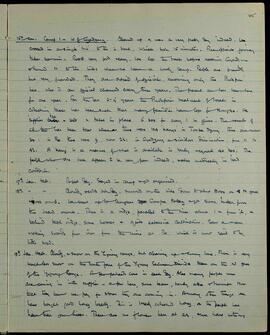
The party camps 1 mile west of Gyadzong after crossing to the left bank and reports friendly but guarded locals fearful of the Phokpon official. Notes describe exploitative tax practices leading to depopulation and poverty in nearby areas. Subsequent entries record a halt day for organization and cold, cloudy weather with snow on the 18th.

CONTENT:
16th Jan. Camp 1 m W of Gyadzong. Cleared up & was a very pretty day indeed. We crossed in a single trip to the L bank, which took 15 minutes. Rear opposite journey takes 20 min. Road very bad ready. We left the track before reaching Gyadzong & turned N to the links where we have a lovely camp. People are friendly but very guarded. They are afraid of officials, knowing only the 'Phokpon' here, who is an official changed every three years. The present one has been here for one year. For the last 3-4 years the Phokpon's treatment of locals in collecting taxes has been such that many families have left for Kongbo. He supplies tea, butter & salt & takes in place 6 bos for every 1 he gives. The result of all this has been that whereas there were 104 'kangs' in Tembe Dzong, there are now 34: in Be there were 9, now 2 1/2: in Gyadzong a similar diminution, from 11 to 4 1/2. A kang is a measure of what is available in barley & equals 40 bos. The people who are here appear to be very poor indeed, & also medically in bad condition.

17th Jan. Halt. Perfect day. Stayed in camp & got organized.

18th Jan. Cloudy & cold all day: snowed on the links down to about 8000 on the N

LSH/1/1/6/1/40 · Part · 1933-05-17
Part of The Ludlow & Sherriff Collection

SUMMARY:
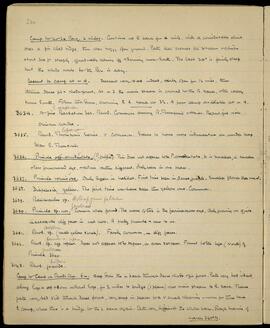
Route notes describe the march from camp to Lola Pass and a very steep descent, followed by a difficult traverse to a camp on the Chudi Chu with multiple stream crossings. Botanical collections 3634–3643 are listed, including several rhododendrons and primulas with habitat and diagnostic notes.

CONTENT:
20a

Camp to Lola Pass. 2 miles. Continue up R bank for a mile, with a considerable climb over a fir clad ridge, then over boggy open ground. Path then crosses the stream & climbs about 300 ft steeply, gradually easing off & turning more South. The last 300' is fairly steep but the whole route to the Pass is easy.

Descent to camp at m 4. Descent very steep indeed, fairly open for 1/2 mile, then through dense fir & rhodo forest. At m 3 the main stream is crossed to the R bank, & the valley turns South. Follow this down, crossing to L bank at 3 1/2. A poor camp available at m 4.

  1. R. exasperatum. A fine Barbatum Ser. Rhod. Common among R. Thomsonii & Abies. Beautiful rich crimson corolla.

  2. Rhod. lopangense Thomsonii Series. Very common. Seems to have more indumentum on under leaf than R. Thomsonii.

  3. Primula aff. atrodentata. (P. crispa?) This does not appear to be P. atrodentata. It is smaller, a smaller less pronounced eye, colour rather different. Only seen in one place.

  4. Primula vernicosa. Only differs in habitat. First time seen in dense jungle. Smaller flower than usual.

  5. Diapensia yellow. The first time we have seen this yellow one. Common.

  6. Asteropyrum peltatum. Ranunculus sp.

  7. Primula geraldinae sp. nov. Common where found. The mark of this is the farinaceous eye. Only growing on quite inaccessible cliff faces in wet moss. A pretty primula & new to us.

  8. Rhod. sulphureum sp. (small yellow shrub). Fairly common, on cliff faces.

  9. Rhod. forrestii var repens sp. aff repens. Does not appear to be repens, or even serpens. Found to the left (North) of Primula geraldinae 3640.

  10. Rhod. hodgsonii grande.

Camp to Camp on Chudi Chu. 6m. Keep down the L bank through dense rhodo & fir forest. Path very bad indeed, along logs & up & down notched logs, for 2 miles to bridge (1 plank) over main stream to R. bank. Thence path very bad still through dense forest, very steep in places to a very small clearing - room for three tents to camp, where there is a bridge to the L bank again. Path very difficult the whole way. Rough bearing of march 340° M.