Showing 6828 results

Archival description
2091 results with digital objects Show results with digital objects
GB 235 GBY/7/6/12 · Item
Part of Professor Mary Gibby Collection

Mary Gibby's comments for the paper: Bakker et al. - Phylogenetic relationships within Pelargonium sect. Peristera (Geraniaceae) inferred from nrDNA and cpDNA sequence comparisons.


Paper published and available at: Bakker, Freek T., et al. “Phylogenetic Relationships within Pelargonium Sect. Peristera (Geraniaceae) Inferred from nrDNA and cpDNA Sequence Comparisons.” Plant Systematics and Evolution, vol. 211, no. 3/4, 1998, pp. 273–87. JSTOR, http://www.jstor.org/stable/23643192

Gibby, Professor Mary
GB 235 CHF · File · 1925 - 1927

1 folder with information on an expeditions to the Andes (1925/1926/1927)

Comber, Harold Frederick
GB 235 CEJ · Collection · 1878 - 1939

1 box of general correspondence, photographs, floral diagrams and correspondence between Darlington, Hall and B.L. Burtt about Collin’s material.
1 box of drawings and descriptions of crocus

Collins, Ernest Jacob (1878-1939)
GB 235 LCH · Collection · 1854 - 1998

1 box containing book of lichen dyed samples and list 'Native Plants used as Dyes in Tweed Making'

  • file: 'The Dyeing Properties of some Scottish Lichens and of a few other materials' Pattern Book by T.S. Patterson D.Sc. Ph.D University of Glasgow
  • report: Report on the Frequency of Occurrence of Dye-Producing Lichens in Scotland by Edward Stewart. M.A., B.Sc. Fellow of the Botanical Society of Edinburgh.
  • list: Native Plants used as Dyes in Tweed Making, includes extracts from papers describing experiments on the dyeing property of lichens by W. Lauder Lindsay, M.D., Assistant Physician, Crichton Royal Institution, Dumfries, 1854-1855, and list of lichens which yield dyes based on Les Lichens Utiles by F. Henneguy, Paris, 1883, and Further list of Highland Native Dyes from Occasional Papers by R.C. Maclagan pp. n.d. Paper on 'Highland Dyeing' read before Royal Scottish Society of Arts, 1898 [various versions of these lists - will need sorting before proper listing and cataloguing]
  • report: 'Notes on Occurrence and Distribution in Scotland of Dye-Producing Lichens, Supplementary to report on Occurrence of Lecanora tartarea Ach. by E.J.A. Stewart, M.A., B.Sc.
  • report: 'The Dyeing Properties of some Scottish Lichens and of a few other materials' by T.S. Paterson, D.Sc. Ph.D., University of Glasgow
  • documentation showing that Brian Coppins bought this batch of material from an Antiquarian Booksellers in 1998.
Patterson, T.S.
LSH/1/1/4/1/131 · Part · 1933-10-12
Part of The Ludlow & Sherriff Collection

SUMMARY:
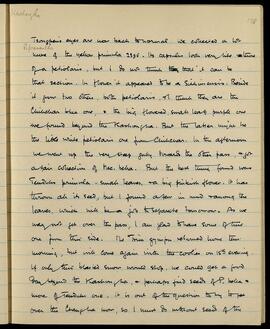
Tsongpen's eyes have recovered as the party collects more yellow primula 2396, compares it with petiolaris and Sikkimensis, gathers Meconopsis bella, and secures a few seeds of Tendu's primula for cleaning next day. Persistent snow hinders plans to go beyond the Kashongha and makes crossing the Changha out of the question. The Trum gyimpu returned home but is expected back with coolies on the 15th evening.

CONTENT:
Tsongpen's eyes are now back to normal. We collected a lot more of the yellow primula 2396. Its capsules look very like those of a petiolaris, but I do not think that it can be that section. In flower it appeared to be a Sikkimensis. Beside it grow two others, both petiolaris, I think they are the Chunchar blue one, and the big flowered, small leaf purple one we found beyond the Kashongha. But the latter might be the little white petiolaris one from Chunchar. In the afternoon we went up the very steep gully towards the other pass, and got a fair collection of Mec. bella. But the best thing found was Tendu's primula - small leaves, and a big pinkish flower. It has thrown all its seed, but I found a few in mud and among the leaves, which will be a job to separate tomorrow. As we may not get over the pass, I am glad to have some of this one from this side. The Trum gyimpu returned home this morning, but will come again with the coolies on 15th evening.

If only this blasted snow would stop, we could get a good day beyond the Kashongha, and perhaps find seeds of P. bella and more of Tendu's one. It is out of the question to try to get over the Changha now, so I must do without seed of the

LSH/1/1/10/1/8 · Part · 1949-09-14
Part of The Ludlow & Sherriff Collection

SUMMARY:
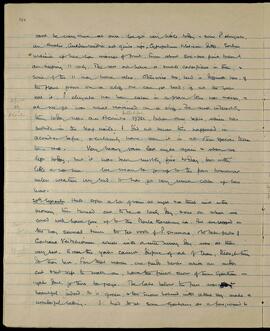
Seed collecting was limited by pests and grazing yaks; noted species include P. elongata, Arabis, Gueldenstaedtia, Cypripedium tibeticum, Sorbus ursina, and an Aconite bulbifera with bulbils in leaf axils. After rain and colder weather, the party planned to go to the pass; on 20th September they halted, dug roots of P. strumosa, photographed Gentiana veitchiorum, and admired a green lake below the pass with snowy peaks.

CONTENT:
can be everywhere at once. We got very little today - some P. elongata, an Arabis, Gueldenstaedtia not quite ripe, Cypripedium tibeticum ditto. Sorbus ursina up here has masses of fruit. From about 500-600 fruit taken I am keeping 11 only. The rest all have a small caterpillar in them, & some of the 11 may have also. Otherwise too, seed is difficult here. If the plant grows on a cliff, one can get seed; if not the yaks eat it. P. elongata has been eaten in a place there was masses, & all we got was what remained on a cliff. The most interesting thing today was an Aconite bulbifera 19752, taken once before, which has bulbils in the leaf axils. I did not know this happened in aconites before, & certainly have seen it in no other species than this one. Very heavy rain last night again & when we left today, but it has been mostly fine today, but with little or no sun. We mean to go up to the pass tomorrow unless weather very bad. It has got very much colder up here now.

20th September. Halt. After a lot of rain at night & a thick mist in the morning, this turned out to be a lovely day, one on which we could well have gone up to the Mula Karchung La. But we stopped on the way several times to get roots of P. strumosa, & to take photos of Gentiana Veitchiorum, which with a nice sunny day, were at their very best. Even the yaks cannot dispose of all of them, though they do their best. For that reason, one finds banks which are undercut and safe to walk on, have the finest show of this Gentian - yaks don't go there to graze. The lake below the pass was beautiful indeed. It is green, & the snows behind with a blue sky make a wonderful setting. I tried to get some Gentians as a foreground to

LSH/1/1/2/1/146 · Part · 1933-07-18
Part of The Ludlow & Sherriff Collection

SUMMARY:
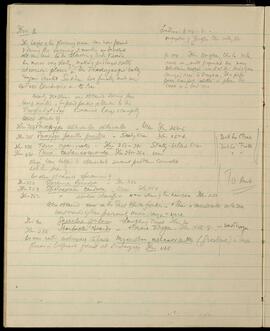
After the flowering season, the party spent three months collecting birds and seeds, moving slowly through the Trashiyangsi valley, revisiting Sakden, and exiting via Dewangiri on 15 Nov. Around 750 skins were obtained, with emphasis on Troglodytidae and other notable species, including range extensions from the East Bhutan frontier and large flocks of grosbeaks at Dewangiri. Notes include a reference to a description of the Yongbon Chu valley and remarks on the Dongkar–Cho La–Me La route used by Bhutanese coolies from the Tawang area.

CONTENT:
Ibis 16

The height of the flowering season was now passed and during the ensuing 3 months we devoted all our time to the collecting of birds and seeds. We moved very slowly, making prolonged halts at various places in the Trashiyangsi valley and again visited Sakden. We finally made our exit via Dewangiri on 15 Nov.

Nearly 750 skins were obtained during these last 3 months. We paid particular attention to the Troglodytidae and secured large and carefully sexed series of

Ibis 254 Pnoepyga albiventer albiventer - Wren Ibis 254-5
Ibis 255 Pnoepyga pusilla pusilla - Scaly Wren Ibis 255-6
Ibis 256 Tesia cyaniventer - Ibis 256-261. Slaty-bellied Wren
Ibis 261 Tesia castaneocoronata Ibis 261-262 Wren

which have helped to elucidate several problems connected with the family.

We also obtained specimens of
Ibis 252 Elachura formosa - Ibis 252
Ibis 253 Spelaeornis caudata - Wren Ibis 253
Ibis 253 " souliei sherriffi - 4 more skins of this new race Ibis 253

Also obtained on the East Bhutan frontier - thus a considerable extension westward of their previous known range - were

Ibis 30. Garrulax gularis - Laughing Thrush Ibis 30.
Ibis 488 Harpactes wardi - a rare Trogon - Ibis 488-9. - Ward's Trogon

We were rather astonished to find Mycerobas melanozanthos (Grosbeak) in large flocks in tropical forest at Dewangiri Ibis 468.

Ludlow. p 102-3. -
description of Yongbon Chu valley etc.

p 104. The Dongkar, Cho La, Me La route is well frequented and many Bhutanese coolies use it on their way from Tawang area to Dongkar. It is fit for pack transport although in places the track is a bad one.

Deb La Trash
Deb La Trash
" "

To end