Showing 6828 results

Archival description
2091 results with digital objects Show results with digital objects
Cystopteris dickeana
GB 235 GBY/8/2/1 · Item · 1847
Part of Professor Mary Gibby Collection

Contains a historic plant specimen collected in 1847 & a letter.

Letter from Robert Sim to Robert Scott, Chatsworth gardener. Letter with frond believed to have been taken by R. Scott to Calcutta when he became curator. The specimen was sent to R. Sim by George Dickie (Prof. of Botany at Aberdeen University)


Sim described Cystopteris dickieana in Gardeners’ and Farmers’ Journal, series 2, 2: 308. 1848. This appears to be a rare publication, with no online version currently available.


Envelope annotated by Christopher Fraser-Jenkins (c 2005) and sent to Dr Mary Gibby.

[FROM ENVELOPE: For E herbarium. Letter from R. Sim (Nursery) to Robert Scott, Calcutta Bot Gard. in 1847 sending a Cystopteris fragilis subsp. dickieana that he was sent by Dickie (rescued from pile of dumped old papers, thrown out for burning, at Calcutta in an outhouse)]


[Transcription of Letter by H. Nolte]

10th Novr. 1847

Dear Sir,

I have this day again forwarded my bill to Mr Paxton hoping he will think of it.

I shall herein inclose a priced list of my Lady ferns, according to your request.

Many thanks for your trouble respecting foreign Lichens &c. Mr Gibson’s promised ones will be truly acceptable.

Enclosed in this you will find specimens of a new British Cistopteris (Dickiana) forwarded to me by the discoverer Dr Dickie of Aberdeen, & which I consider to be very distinct.

I remain Dear Sir

Very sincerely yours

Robt. Sim

Mr R. Scott

[END]

Address mainly concealed but presumably reads [Mr R Scott, Chatsworth Gard]ens, Chesterfield, Derbyshire. Foots Cray postmark and Penny Brown stamp

[END]

Docketed on verso: Cistopteris Dickiana. Postmarks for [illeg] and Chesterfield

Sim, Robert
LSH/1/1/8/1/109 · Part · 1947-05-06
Part of The Ludlow & Sherriff Collection

SUMMARY:
Describes a route from Cuny up a forked valley with irises, roses, and berberis, passing villages toward the Samu La, noting carved dorings and that the area is the 5th D.L.'s birthplace. On 16th May at Triju Dzong, details the ascent over a ridge with views of Triju Tso (apparently drying), descent past Drokpa tents to Teachee, and lodging in the butter tax collector’s house, noting local officials and yak herders.

CONTENT:
a picturesque place, more so when the whole fort, plastered onto a hillside beside the Dzong, is seen. Here also are monasteries, all because the place is the 5th D.L.'s birthplace. On the plain are two "dorings", about 15 ft high and carved. They appear very old. There is no writing on them. We crossed the main valley at Cuny and to the right bank, and went up a valley which is a fork of the main one. This valley is a nicer one, with a small stream in it, some [Iris laeter 12448] shrubs - roses and berberis - among irises, with lingkas at most of the small villages or gompas. About mile 7 1/2 this valley is left for one which comes in from the left or SE. is followed up to this village, the last on the way up to the Samu La. There is cultivation up to here, and a group of 5-6 homes together. Turdus merula maxima is common here; there are a good many snowcocks high up. T. henrici is common as far as this.

16th May Triju Dzong. A cold dismal morning, clearing up by 10.0, with occasional hail showers round about, and some heavy storms too. Left at 6.15 in at 1.30 pm. Kit in at 4.30 pm. The road is good nearly throughout, but from what I hear, this is an area where storms are common and there is a heavy snow and rainfall. Path ascends the same valley easily till the valley peters out at mile 5. There is a pass leading down here to the Yaktsang Chu, but our path keeps right-handed (west) and continues to climb to about mile 7 when a ridge is crossed. From here the Triju Tso is visible but not Triju Dzong. Now the lake consists of deepish water of about 1/2 mile at the N. end, 1/2 mile wide and then marshy shallow looking water further south. There is I believe much more water in summer; but the lake appears to be drying up. The descent is easy, with one or two ups and downs. A few Drokpa tents are passed but no pukka buildings till the stony ones here in Teachee. There must be 50 houses here, and I suppose they contain people who mostly look after yaks. We stayed in a house kept for the butter tax collector - quite good and convenient. There are 4 headmen. The Dzongpon.

Cunningham, Robert
GB 235 CUR · File · 1920 - 1938

1 folder containing correspondence and papers regarding Tatsienlu, West China (1920-38)

Cunningham, Robert
GB 235 CSS · Collection · 1875 - 1937

1 box containing constitution, reports, field reports of the Botanical Society of Edinburgh Cryptogamic SectionCryptogamic Society of Scotland (1875 - 1935) (incorporated into the Botanical Society of Edinburgh in 1935).
1 box containing laws, lists of members, conference reports (1903-1937) and photographs

Cryptogamic Society of Scotland
LSH/1/1/9/1/54 · Part · 1933-05-22
Part of The Ludlow & Sherriff Collection

SUMMARY:
The party crossed Peipe La early but found little of interest due to dense bamboo, then moved into a more promising valley around 10,000 feet. H.H. sent multiple loads of provisions, and Yundun returned after depositing boxes; a local note explains that 'Smasietang' refers to Guru Rimpoche’s footprint kept in the Lhakhang. Weather was wet at night but mostly fine during the halt day.

CONTENT:
Rhod. xanthocodon 18521.
Campylotropis 18522.

89
Perpida

over the Peipe La, at 6.30. We started at 5.0 and in about 10.0 am going very slow. The pass was a disappointment, and we saw nothing of interest at all. There is a great deal of dense small bamboo, and nothing else much could grow in that. But there were some nice looking cliffs, which I scanned carefully through binoculars, hoping for P. Hazeharii or some other primula. But I could see nothing at all. Now we've got to our second choice of valley, and it is much nicer and more promising looking. Here the valley floor is almost 10,000', and I should think we rise about 1000 ft per day. I'm sorry we must stay tomorrow, but that is as arranged. H.H. has not forgotten us. He has sent in all 3 loads of rice, a load of meat and a load of other foodstuffs. That should see us through a month or two. Yundun also returned, having left our box of dried flowers with our other boxes.

22nd May Halt. Wet at night, fine nearly all day. "Smasietang" refers to Guru Rimpoche's foot, (honorific) which he put on a stone here, and the mark is in the local Lhakhang. Pasang and Yundun went out at

LSH/1/1/7/1/21 · Part · 1940-04-22
Part of The Ludlow & Sherriff Collection

SUMMARY:
After a snowfall delay, the party crossed the Lo La on April 24 and descended the steep south side into the Rhododendron–Abies forest. Along the Chudi Chu they observed numerous Rhododendron and Primula species, including the new Primula P. chionogenes and another unnamed Primula on an inaccessible cliff.

CONTENT:
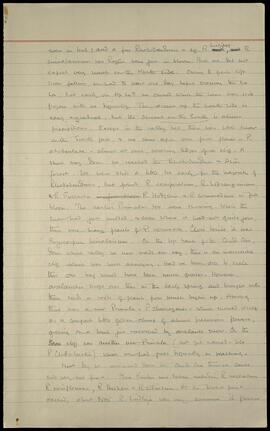
were in bud, and a few Rhododendrons - e.g. R. hirtipes, and R. cinnabarinum var. roylei were just in bloom. But we did not expect very much on the North side. Owing to fresh soft snow falling, we had to wait one day before crossing the Lo La, but early on April 24th we crossed while the snow was still frozen with no difficulty. The ascent up the North side is easy and gradual, but the descent on the South is almost precipitous. Except in the valley bed, there was little snow on the South face, and we came upon our first flower - P. atrodentata - almost at once, covering ledges of a cliff. A short way down we reached the Rhododendron - Abies forest. We were still a little too early for the majority of Rhododendrons, but found R. exasperatum, R. lopsangianum, R. forrestii, R. hodgsonii, and R. commodum in full bloom. The earlier Primulas too were showing. Where the snow had just melted, and even where it had not quite gone, there were many plants of P. vernicosa. Close beside it was Bryocarpum himalaicum. On the left bank of the Chudi Chu, down which valley we now made our way, there is an inaccessible cliff which was most annoying. Had we been able to scale this our bag would have been much greater. However, avalanches swept over this in the early spring and brought with them seeds or roots of plants from much higher up. Among these was a new Primula - P. chionogenes - which showed itself as a compact little golden clump of almost precocious flowers, growing on a bank just uncovered by avalanche snow. On the cliff was another new Primula (not yet named - like P. clutterbuckii) which we had great difficulty in reaching.

Next day we continued down the Chudi Chu through dense and very wet forest. More Rhodos were taken, including R. uvariifolium, R. neriiflorum, R. hookeri and R. ciliatum. At the lowest point reached, about 8500', R. lindleyi was very common in flower.