
4 folders containing Donald Pigott's notes and photos relating to his research on Tilia:
1: Photographs of living Tilia; folder of labelled photographs of living trees taken by Donald Pigott
2: China 1993, 1995; folder of notes on Donald Pigott's China trips in 1993 and 1995
3: Chinese Visit; folder detailing further Chinese trips taken by Pigott, includes 1993 and 1995.
4: Tilia Types, China; a folder containing good images / copies of Tilia type herbarium specimens from China.
1 folder of original drawings by Professor Donald Pigott; A collection of drawings, both in pencil and ink, of leaves and flowering parts of different species of Tilia, the subject of his monograph (Lime-trees and Basswoods; A Biological Monograph of the Genus Tilia; Donald Pigott, Cambridge University Press, 2012, ISBN 978-0-521-84054-5)
Letter thanking the Council of the Botanical Society of Edinburgh for giving him a copy of the Third Annual Report of Proceedings (November 3, 1840)
Don, David (1799-1841)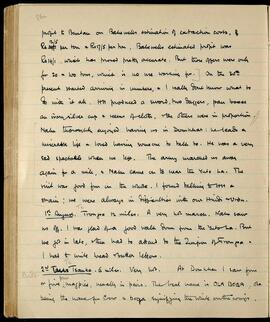
SUMMARY:
The diarist reviews profit estimates for Bhutan based on Bakewell’s calculations and rejects small extraction offers, then receives numerous presents from H.H. before departing Domkhar, with Naku accompanying toward the Yuto La. The party marches in hot weather to Trongsa and then Tsanka, meets the Zimpon of Trongsa, and notes local magpies called OLA BOGA.
CONTENT:
profit to Buntan on Bakewell's estimation of extraction costs, and Rs 12/5 per ton and Rs 17/5 per ton. Bakewell's estimated profit was Rs 14/1, which has proved pretty accurate. But these offers were only for 20 or 100 tons, which is no use working for. On the 30th presents started arriving in numbers, and I really don't know what to do with it all. H.H. produced a sword, two daggers, pan boxes, an ivory silver cup and reams of cloth, the others were in proportion. Naku thoroughly enjoyed having us in Domkhar: he leads a miserable life and loved having someone to talk to. He was a very sad spectacle when we left. The army marched us away again for a mile, and Naku came on to near the Yuto La. The visit was good fun on the whole. I found talking to him a strain; we were always in difficulties with our Hindi and Urdu.
1st August. To Trongsa 12 miles. A very hot march. Naku saw us off. I was glad of a good walk down from the Yuto La. But we got in late, then had to attend to the Zimpon of Trongsa. I had to write bread and butter letters.
2nd To Tsanka. 6 miles. Very hot. At Domkhar I saw four or five pairs of magpies, usually in pairs. The local name is OLA BOGA, ola being the name for crow and boga signifying the white on the wings.
SUMMARY:
The diarist arrives near a new palace and is lodged in a specially prepared house, meets Nahu, and pays a visit to HH with the Maharani and young Jigme. From 24–31 July they halt at Domkhar with much social activity; Wangmo is at Lama Gomp and Pedmadechen at Wangcholing.
CONTENT:
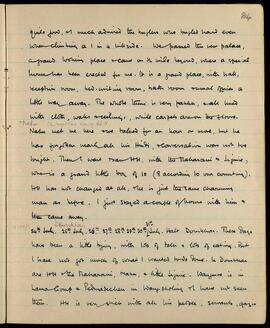
quite good, and much admired the buglers who bugled hard even when climbing a 1 in 4 hillside. We passed the new palace, a grand looking place and came on 1/2 mile beyond, where a special house has been erected for me. It is a grand place, with hall, reception room, bed-writing room, bath room and usual offices a little way away. The whole thing is very pukka, all lined with cloth, walls and ceilings, while carpets are on the floors.
Nahu met me here and we talked for an hour or more, but he has forgotten nearly all his Hindi, and conversation was not too bright. Then I went to see HH, with the Maharani and Jigme, who is a grand little boy of 10 (8 according to our counting). HH has not changed at all, and is just the same charming man as before. I just stayed a couple of hours with him and then came away.
24th July, 25th July, 26th, 27th, 28th, 29th, 30th, 31st July. Halt Domkhar. These days have been a little trying, with lots of talk and lots of eating. But I have not got much of what I wanted to do done. In Domkhar are HH and the Maharani, Nahu, and little Jigme. Wangmo is in Lama Gomp and Pedmadechen in Wangcholing so I have not seen them. HH is very strict with all his people,
Documents found inside a copy of Gerarde's Herbal (1633) bought at auction of Captain Henry Trotter of Mortoun Hall's Library on February 10 1947, alongside an extract from a letter presumably sent to RBGE with the documents.
• TRO/1: 'Hardy Tree Seeds of Plants from America for Season 1760': List of seeds and plants imported from America in 1760 and sold by Mrs Drummond, Seed Merchant, Lawnmarket, Edinburgh
• TRO/2: 'A List of the Different kinds of Fruit Trees wanted for the different aspects of the Wall round the new Kitchen Garden at Mortounhall 1772': List of fruit required for Mortonhall, 1772.
• TRO/3: Abstract from Mrs J.W. Hely-Hutchinson’s letter, 26 February 1947: 'The Gerarde's Herbal in which the papers were found is dated 1633 and was bought at Christie's from the sale of the library of Captain Henry Trotter of Mortoun Hall on Feb. 10th, 1947.'
30 pages
SUMMARY:
The writer reports hearing a Doctor suggest that medical services should visit homes across the reservation to care for poor patients who cannot travel to the hospital or his office. The note emphasizes repeated calls for home visits to assist those too sick to walk.
CONTENT:
I think I heard the Doctor say that some
medical services should visit the various on the
reservation to see to the poor people who cannot walk
long distance to come to visit Doctor in the Hospital
instead of wait for some person who is too sick
to walk to visit him in his office because
some of the sick people are too sick to walk
long distance to visit him in his office
and some of the people who are too sick to
walk to visit him in his office so that he can
see to them in their homes so that he can
see to them in their homes so that he can
see to them in their homes so that he can
see to them in their homes so that he can
Ludrasal Dewangeri
see to them in their homes so that he can
see to them in their homes so that he can
see to them in their homes so that he can
see to them in their homes so that he can
see to them in their homes so that he can
see to them in their homes so that he can
see to them in their homes so that he can
see to them in their homes so that he can
see to them in their homes so that he can
see to them in their homes so that he can
see to them in their homes so that he can
SUMMARY:
Accounts of travel and weather around Dochen, Tuna, and Phari, including a storm, cold winds, and changing visibility. Wildlife noted includes gazelle, kiang, geese, a snipe, and golden plover; photography was done near the lake. A mail delivery arrived from Yatung.
CONTENT:
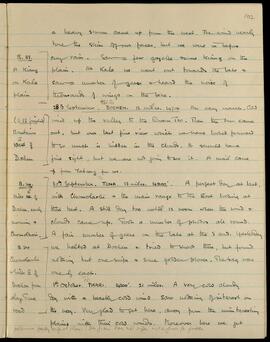
102
A heavy storm came up from the west. The wind nearly tore the skin off our faces, but we were in before any rain. Saw a few gazelle and some kiang on the plain. At Kala we went out towards the lake and saw a number of geese and heard the noise of thousands of wings on the lake.
28th September. Halted DOCHEN. 12 miles. 14,700'. An easy march. Cold wind up the valley to the Rham Tso. Then the sun came out, but our last fine view which we have looked forward to so much is hidden in the clouds. It should be a fine sight, but we are not going to see it. A mail came up from Yatung for us.
30th September. TO TUNA. 13 miles. 14,900'. A perfect day at last, with Chumolhari and the main range to the East looking at their best. A still day too until 12 noon when the wind and clouds came up. Took a number of photos all round. A fair number of geese on the lake at the south end. Yesterday we halted at Dochen and tried to shoot there, but found nothing but one snipe and some golden plover. The bag was one of each.
1st October. TO PHARI. 14,300'. 21 miles. A very cold cloudy day with a beastly cold wind. Saw nothing of interest on the way. Very glad to get here, away from the un
•Correspondence Dobbie & Co. to I. B. Balfour filed under “Balfour, I. B.” papers under” Cuthbertson, W.” – individual folder
Dobbie & Co.