Showing 6828 results

Archival description
2091 results with digital objects Show results with digital objects
LSH/1/1/3/3/81 · Part · 1936-03-10
Part of The Ludlow & Sherriff Collection

SUMMARY:
At Lepo the party halted for two days; Danong explored a stream from Chio Tso and found masses of Primula, while the diarist noted rhododendrons, firs and larch, and prepared mail. Rain limited finds the next day, though P. Boothii was abundant at waterfalls, and Lumsden took a shot at pintail ducks.

CONTENT:
38

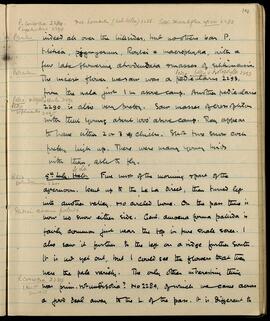
7th April. Halt. Lepo. A lovely morning, fine up till about 4.0 p.m. Danong went up the nala coming from the Chio Tso, found there Primula 1186 in masses; also some unopened specimens of P. Boothii (?) & another primula only in leaf. I went up pretty high opposite camp, but only found the same denticulata-like primula with the white eye. There are a number of rhododendrons out, mostly barbatum & Thomsonii, & some others behind camp which are not yet in bloom. The hills are well covered with a mixture of fir & pine & rhododendron. The fir is a fine one 1286, growing to 100 ft or more. Mail will be sent off in the morning.

8th April. Halt. Lepo. Rain again nearly all day. I spent the morning out, but found nothing of any interest, nor did Danong. P. Boothii is in masses at most waterfalls; it is a fine sight when bunched together in big patches as it is beside water which always splashes it. I took a very fine specimen, 1292. There is a good deal of larch about just coming out now. Saw a few pintail duck & Lumsden had a shot at them. There are

Marginal Notes:
P. atrodentata 1290
P. Whitei 1186, 1291
P. macrophylla 1287
gracilipes 1292
Rh. barbatum
Rh. Thomsonii
Rh. Baileyi 1285
Picea spinulosa
P. gracilipes
P. gracilipes 1292
Larix griffithiana 1295
LSH/1/1/4/1/9 · Part · 1936-07-02
Part of The Ludlow & Sherriff Collection

SUMMARY:
Notes abundant Primula species on hillsides and highlights several Pedicularis specimens from a nala above camp. Observes eremophila with young and shoots two snowcock, then walks to the Le La and into another valley, noting Gentiana amoena forma pallida on shale scree near the pass, not yet in flower.

CONTENT:
144

P. consocia 2284. Mec. horridula (white bella) 2286. Sax. sessiliflora 2288.
P. hyacinthina 2294

Primulas indeed all over the hillsides, but no others bar P. tsariensis, pygmaeorum, roylei & macrophylla, with a few late flowering atrodentata & masses of sikkimensis.

The nicest flower we saw was a Pedicularis 2293 (Pedic. bella v. holophylla 2293), from the nala just 1 m above camp. Another Pedicularis 2290 (Pedic. megalocheila 2290) is also very pretty (Pedic. zephanantha 2295). Saw masses of eremophila with their young about 400' above camp. They appear to have either 2 or 3 chicks. Shot two snowcock pretty high up. There were many young birds with them, able to fly.

5th July. Halt. Le La. Fine most of the morning & part of the afternoon. Went up to the Le La direct, then turned left into another valley, so circled home. On the pass there is now no snow either side. Gentiana amoena forma pallida is fairly common just near the top in pure shale scree. I also saw it further to the left on a ridge further south. It is not yet out, but I could see the flowers that they were

LSH/1/1/2/1/81 · Part · 1933-07-18
Part of The Ludlow & Sherriff Collection

SUMMARY:
The party halts at Dyuri, noting cool springs, poor grazing except higher up, and very small villages with limited supplies such as eggs, butter, and yak milk. A fair day is spent photographing helpful locals and carrying out tasks like drying birds and plants, while learning that potatoes are secretly grown in the jungle due to fear of Darrang people and that houses lack windows because of fear of Lopas (Abors) from the Dirang direction.

CONTENT:
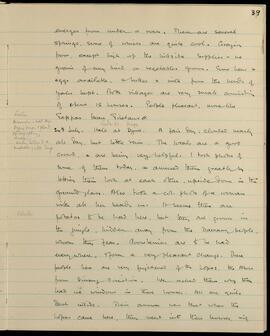
emerges from under a rock. There are several springs, some of which are quite cool. Grazing poor, except high up the hillside. Supplies - no grain of any kind or vegetables grown. Some hens and eggs available, and butter and milk from the herds of yaks kept. Both villages are very small consisting of about 15 houses. People pleasant, more like Takpas than Tibetans //.

Lists.
Museum - half day.
Drying birds and plants.
Photography,
developing,
writing letters and a
multitude of little things.

24th July. Halt at Dyuri. A fair day: clouded nearly all day, but little rain. The locals are a good crowd, and are being very helpful. I took photos of some of them today, and amused them greatly by letting them look at each other, upside down in the ground glass. Also took a color photo of a woman with all her beads on.

Potatoes.
It seems there are potatoes to be had here, but they are grown in the jungle, hidden away from the Darrang people, whom they fear. Gooseberries are to be had everywhere, and form a very pleasant change. These people here are very frightened of the Lopas, the Abors from Dirang direction. We asked them why they had no windows in their house. All are quite dark inside. Their answer was that when the Lopas came here, they went into their houses, as if

LSH/1/1/2/1/109 · Part · 1933-07-18
Part of The Ludlow & Sherriff Collection

SUMMARY:
The writer arranges for a Bhutanese married lama to collect seeds of Thalictrum chelidonii, planning to send a man from Sahden in October to obtain them. A Maharaja’s sepoy mistakenly traveled via Dirang Dzong–Poshing La–Tse La instead of the Luguthang route, causing delay; on 7 August at Dyuri (Mago) the party had fine weather, collected a few birds, wrote to Bumthang, prepared to return to Tsona, and encountered Abors who dropped their loads.

CONTENT:
It is only ignorance and conservatism. I am trying to make arrangements here for a married lama (!) — a Bhutanese — to collect seeds of the beautiful Thalictrum chelidonii for me. He will be bribed with butter and tankhas, and I will send a man in October from Sahden for the seeds from him. At first I thought of his taking them to Sahden, but being married, he will of course not put in an appearance that way again. The Maharaja's sepoy who came yesterday was told in Sahden not to go by the high road but the 'low'. By that was meant presumably not by Tsona but by Luguthang. But not knowing the country, the poor man went not by Luguthang, but by Dirang Dzong — Poshing La — Tse La. And so he took eleven days from Sahden instead of three!

7th August. Halt at Dyuri (Mago). Probably the finest day we have had since leaving Lahore. With the exception of a half hour's shower at 4.0 pm, no rain all day to 6.0 pm, and bright sun nearly the whole time. Collected a few birds, wrote letters to Bumthang and prepared for the return to Tsona tomorrow. This evening some Abors arrived, seeing our camp, dropped their loads. We have ordered them to appear.

LSH/1/1/9/1/46 · Part · 1933-05-07
Part of The Ludlow & Sherriff Collection

SUMMARY:
The diarist halts at Dungkar, plans to cross the Rudo La, and writes to HH, Wangmoo, and Lhuntse about arrangements. Botanical notes mention a primula (18846) from Tim resembling earlier Lo La material and a likely Cochlearia (18847) previously seen in 1937 at Tang Chu, Central Bhutan. Yundru, servant of the Nyerchen Trepa, arrives from forced labour at Sam Choling monastery and is taken on permanently for the journey to Tomtem.

CONTENT:
I must now write to HH & give him the new programme, & to Wangmoo to say I will see her on the way, & to Lhuntse to say I want transport.

11th May. Halt Dungkar. Another fine day after rain at night, but only a little. It is nice to think that, all being well, we should be over the Rudo La before having to halt again. It would be nice to halt on the pass itself, but coolie difficulty makes that out of the question. Now there are five days to get through as best we may before anything of interest is likely to be seen. At Tim we got one interesting primula 18846, which will no doubt be put down as P. atrodentata, but which is more like one of the ones put aside last year for discussion, & which is like my 3636 from the Lo La. With the primula was one other plant 18847, which I have only seen once before, & that in Bhutan. I think it was number 3209, taken in Cent. Bhutan, Tang Chu, in 1937. I rather think that was probably a sp. nov. of Cochlearia but has not yet been named. Unfortunately there was but one specimen here to be found, & it, like the primula, had come down from a good deal higher, near 13-14000'.

Today the Nyerchen Trepa's servant, Yundru, arrived. He was one of the many forced labourers at Sam Choling monastery, the new monastery being built by Ashe Wangmoo where Tasho Haku died. One man per household from this area has to go, & has been there for months. I got him leave to get away from that, so as to come to Tomtem with me. Now we are in fact there, I have not been sure what to do, but decided to take him with us as permanent.

LSH/1/1/2/1/127 · Part · 1933-07-18
Part of The Ludlow & Sherriff Collection

SUMMARY:
The party halts at Dongkar amid showers, hosts the Tsona Dzongpon who enjoys cigarettes and Cointreau, and arranges to send him a Rhoorki chair from Calcutta. Notes mention Bhutanese traders from Trashiyangsi, glacier views near the Gorpa La with a route to Gor, and botanical finds including a notable gentian (Lomatogonium spathulatum) and other species.

CONTENT:
62

number of Bhutanese here from Trashiyangsi today - trading.

Note. The glaciers on the hills to the north of the Gorpa La are extensive, and certainly show from Dongkar through an angle of 68° Mag to 98° Mag. There is a route down the valley from the Gorpa La to the village of Gor. A few peas are grown in Dongkar.

17th August. Halt at Dongkar. A good day with some showers, but lovely in between. We had some pretty heavy rain in the night, and a good deal came in through the tent, which is otherwise magnificent. The Tsona Dzongpon called and stayed an hour. He was given a tin of cigarettes on the quiet and was very pleased with them. Later on he asked for a drink of something warming! And he a lama. He was given a glass of Cointreau, and judging by the noise made, thoroughly enjoyed it. He sat in my Rhoorki chair and was so pleased with that too, that we are going to send one from the Army & Navy in Calcutta. Found a few flowers, but only one of interest, a fine gentian growing in very dry stony ground. (834). It must be near that found on the Thuka La by Dansey near Lingmathang, though the habitat is so entirely...

[Margin Notes:]
Donkhar 17/Aug
Lomatogonium spathulatum sp. nov. 834
Potentilla 835.
Adenophora smithii 836
Pedicularis rhinanthoides var. labellata 837
Primula sikkimensis 838
Picris spinulosa 839

Lomatogonium spathulatum sp. nov. 834

LSH/1/1/2/1/103 · Part · 1933-07-18
Part of The Ludlow & Sherriff Collection

SUMMARY:
The diarist describes three routes from Mago to Tsona and spends a halt day at Chigupnaga conducting a northward hill climb, photographing flowers, and collecting primulas. Wet weather persists; two monals are missed, one bird is shot and skinned by Guba, and a distant gorge is noted as not being the Tsona Chu.

CONTENT:
has one of these fits. I have to skin the birds, or else shoot none: besides this there are flowers to be changed, or have to find both flowers & birds. I now find that there are definitely three routes from Mago to Tsona - one the way we came, one through here to Shao, three days good road & bridges, with yak herds here & there & one from our camp N of Nyuri through the hills to Tsona in three nights. The latter seems good - firewood all nights except one.

4th August. Halt at Chigupnaga. Not quite such a wet day. Left at 7.0 & got back at 12.15. Climbed the hills to the North of the small ravine N of camp. Nothing till the top was reached, where there were masses of P. congestifolia (762) (Prim. atrodentata subsp. oreodoxa). On the way down found a new primula, but flowers were withered, probably pink (763) (Prim. juncundana (Diyatfolia)). When I returned the sun shone fitfully for ½ hour, then heavy rain & mist. Took a few photos of flowers in situ & close up. Although still raining at 6.0pm, I can for the first time see the outline of the hills to the west beyond a gorge, which they say is not the Tsona Chu, but which must be of considerable size. Saw two monals at the top of today's climb, & missed them. Shot one bird, the same as I sent to Ludlow yesterday. Guba skinned it reasonably well. It was

LSH/1/1/2/1/99 · Part · 1933-07-18
Part of The Ludlow & Sherriff Collection

SUMMARY:
The diarist halts at CHIGUPNAGA on the frequently used road toward Fu Shao, enduring heavy rain and mist with few flowers or birds observed. Kurhip is down with fever likely from damp cold; despite warnings at BULUNG about lack of supplies and water, fresh butter and milk are found, and two snipe are seen during a brief excursion.

CONTENT:
from it. This also seems to be on a good
fairly often used road to Fu Shao, which is
reached in 3 days. I have not been up
far from camp yet, but from what I can see,
there is not likely to be much in the way of
flowers here, or birds. Kurhip is down with a
touch of fever. I think it is likely brought on
by the damp cold, which last night and today
was very trying. Butter was said to be
quite unprocurable here, but I find ample
fresh butter and milk too. The whole affair is
strange. I was supposed to have halted at
BULUNG, and there all professed complete
ignorance of everything. When I insisted on going
on here - or somewhere further on, there was a
unanimous shout of "You can't do that; there is no
water, no wood at all." All apparently knew the
road well. Blast them, they are most annoying -
yet likeable people too.

3rd August. Halt at CHIGUPNAGA. Another foul day with
heavy rain and mist all morning, and rain and mist all
the rest of the day. Went out to the N.W. for the
morning, but found little of any interest in the
flower line. Saw two snipe, solitary or wood I

LSH/1/1/4/1/115 · Part · 1933-09-24
Part of The Ludlow & Sherriff Collection

SUMMARY:
Notes mention fruit drying in Charme and Bhutanese support to Sangacholing, including a Bhutan lama. Lumsden is withdrawn and his night-time injection missed a vein, causing his patient fever. On a halt day at Charme, the diarist walked toward Dayul, observed migrant birds from the north, shot a Button quail at notable elevation, and collected seeds (crab apple, jasmine, cotoneaster).

CONTENT:
L.S. 188 Peaches were ripe in Charme. Many stacks of them lay on the flat roofs of the houses, drying in the sun; walnuts are also ripe. 170

Nang Drug and Chindrug, the Maharaja of Bhutan sends a lot of money and presents to Sangacholing. He also supports a Bhutan lama who lives up the valley a short way. That lama sticks to religion, whereas the S.C. ones most certainly do not.

Lumsden still very un-gay today, will hardly talk a word to anyone. He gave another injection in his woman patient's arm the other night, and again waited till dark to do it. The result was he missed the vein and the woman had fever and a rotten time for a night and a day.

28th September. Halt. Charme. A fine day, but clouded over a good deal. Went downstream to the first village of Dayul, along a good path. There are a good many migrant birds about now, saw for a pipit which is on its way down from Siberia, also a swallow from the north. I shot a small Button quail too - Turnix suscitator suscitator, which does not seem to be recorded above 6000' previously. Collected a few odd seeds too - a crab apple, Creut tibetica, a jasmine and a cotoneaster 2709, which I had collected before in flower, when it looks nothing at all. But now its branches are covered with a mass of scarlet berries and it really is a

LSH/1/1/3/3/177 · Part · 1983-05-05
Part of The Ludlow & Sherriff Collection

SUMMARY:
Notes record primulas found near a rocky nala and two Blood Pheasants shot at high elevations. During two halt days, letters were written and mail sent; the mail runner was dismissed and replaced by a 'tapion'. Dawong and Tsompen collected new primulas west of the Bimbi La while the author surveyed the hillside near camp.

CONTENT:
rocky nala, which the path crosses. Here we found three (P. caveana 1768, P. macrocarpa 1769) primulas. Two in flower, both I think new 1768 and 1769. The first is certainly new to us, and a beauty with a very fine scent. I think it must be near to P. rotundifolia, with its colour and scent. The third was not collected as it was not yet in flower, and very little was seen. Shot two Blood pheasant, Kuseri, one at about 14500 and the other close to camp at 12500.

4th June. Halt. Stayed in camp, wrote letters all day long, a very tiring thing to do. Packed up mail and sent it off, or rather gave it to go next morning.

5th June. Halt. Dismissed our mail runner for general inefficiency and grousing, and sent off the 'tapion' in his place. He will get Rs 13 a month and has been paid everything up to date. He is a thoroughly good lad. Dawong and Tsompen went up the valley to the W of the Bimbi La and brought back a new primula (P. macrophylla macrocarpa), lilac and very pretty, No 1778. Also a yellow one 1780 (P. jucunda var ponticola). I went up the hillside below camp to the E. Saw masses of Roylei, macrophylla, glabra and atrodentata.