Showing 6828 results

Archival description
2091 results with digital objects Show results with digital objects
LSH/1/1/9/1/137 · Part · 1933-09-01
Part of The Ludlow & Sherriff Collection

SUMMARY:
Plans are made for visits to Kantanang, Tolgang, and the Chachhu La route while hoping for improving weather. On 12th Sept. they halt in camp; mail arrives from H.H. along with his cook Namgye, whom the writer reluctantly keeps, and letters from T. Bagge and Betty report on Betty’s arm x-rays and her safe arrival in Calcutta, while a hoped-for house falls through.

CONTENT:
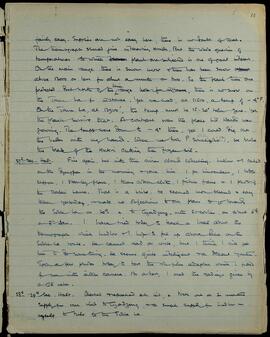
very much now that we can do. The later we wait for seed the better. I will send the lads off to Kantanang on 14-15 or 16th, and all I feel I must do before we go to Waitang is to go to Tolgang again on 14th and the Chachhu La route on 18th - or perhaps 16th. It was just fine or just not fine most of the day. Cold but never heavy rain and never any sun. I fear it is getting more like rain each day though. It would be nice to get it over now and have our fine weather from 20th on. We always used to find that the real sparkling weather only started on Oct. 18th - a very depressing thought. That has been true on a good many years to our knowledge, refers to high up near the main Range.

12th Sept. Halt. Stayed in camp. The lads went up the valley to the E beyond the Serpens hut. Tried to be fine but failed, but still shows signs of the end of the rains, except that we have no thunderstorms and sparkling weather, which really mean fine weather coming. I wish we could have more sun and clear skies, as these are what ripen seed quickly. At about 10.30 a mail arrived from H.H. and with it Namgye, H.H.'s cook, whom H.H. insists I must keep with me. I don't want him at all, would very much rather just have the man I have. But after arranging to return him at once, I agreed to keep him. He has been sent with full rations nevertheless and I fear H.H. would only be worried, or annoyed, if I sent him back. It is only for 3 weeks anyway. With the mail came many letters from T. Bagge and 2 from Betty with news of the first x-rays, which show the arm broken in 2 places, but well mended, it seems. T. Bagge's latest news was that Betty had reached Calcutta safely on 26th afternoon. So far all was to plan. But the second house we had hoped we might get, was also 'off' - it had already been sold. It did not take long to go either. We are advised not to be in a hurry, but with Tinnie and
LSH/1/1/9/1/59 · Part · 1949-06-01
Part of The Ludlow & Sherriff Collection

SUMMARY:
The diarist describes promising terrain at the forest–grassland edge ('shing sam pang sam'), nearby lakes, and a retreating glacier beyond the head of the Trongsa Chu, with reports of takin in that area. On a rainy halt day, companions went far afield and returned with Mec. simplicifolia; later the writer found many near the tent and mentions Sherriff.

CONTENT:
Coming into flower. Maybe they don't grow here. I hope I haven't come to a poor primula, as they are the best things in my mind, to find. Every place where the forest ends & the grassy hillside begins, is called 'shing sam pang sam' which just means the edge of forest & grass. It is there we intend to go later on, & must say the country there & beyond looks good. To the south, about 1000 ft up, are several lakes, & I always think the slopes above them seem specially good. Away beyond, is a retreating glacier, & somewhere beyond that, I was told, is the head of the Trongsa Chu. It is here, the locals say that takin are to be found in quantity. Locally they are called them and Drong guinsi, which is the Bhutanese word. Drogpas come over from that direction soon, if they see any we will be able to find out. It was lovely open up there, & made one want to go on & on. I could cheerfully have gone on all afternoon, but would have failed to get back had I done so.

28th May. Halt. Mostly rainy, but with nice sunny patches. I stayed in camp to rest after yesterday. The lads went out a long way, & had a bad day. They brought in Mec. simplicifolia though, from miles away. In the evening I went 50 yds from my tent, & found about 100 of them! Today I took some of the dormant Sherriff's

LSH/1/1/8/1/37 · Part · 1933-12-24
Part of The Ludlow & Sherriff Collection

SUMMARY:
Notes on extreme temperatures and plant survival are followed by a halt during which the diarist and Ludlow visit the Dzongpon with gifts to secure cooperation for travel plans. They plan routes to the Sobhe La and Gyadzong, attempt to train a local to use a thermograph, test photographic equipment, and repack supplies.

CONTENT:
fairly easy. Supplies are not easy here, there is no doubt of that. The thermograph showed fine interesting results. But the whole question of temperatures to which plants are subjected is one of great interest. On the main range there is snow now; there has been snow above 13,000 or less for about a month or two. So the plants there are protected. But north of the Himalayan range for instance, there is no snow on the Tamu La for instance. Yet we had, at 11,500, a temp of -4°F. On the Tamu La, at 13,900', the temp must be 15-20° below zero. Yet the plants survive that. A contrast was the place Lil. Wardii was growing. The temps were down to -4° there, yet I could dig out the bulbs with my hand. Where we took P. sonchifolia(?), we broke the blade of the kukri cutting the frozen soil.

27th Dec. Halt. Fine again, but with thin cirrus cloud collecting. Ludlow and I called on the Dzongpon in the morning and gave him 1 pair of binoculars, 1 bottle of saffron, 1 Stanley flask, 1 than of cotton cloth, 1 picture frame and 1 photo of the Dalai Lama. That is a bribe. He seemed more pleased and easy than yesterday, and made no objections to our plans to go towards the Sobhe La on the 30th and to Gyadzong, with 50 coolies, on about the 6th or 8th of Jan. I have tried today to teach a local about the thermograph which Ludlow and I hope to put up above Laha on the Sobhe La route. He cannot read or write, but I think I will get him to do something. He seems quite intelligent and a decent youth. Took a few photos today to test the roll film adaptor which I fitted for use with either camera. As a test, I used the readings given by a GE meter.

28th - 29th Dec. Halt. Checked and repacked all kit, and took out a 2 months' supply for our visit to Gyadzong and a small supply for Ludlow and myself to take to the Sobhe La.

LSH/1/1/2/1/183 · Part · 1933-09-18 - 1933-09-19
Part of The Ludlow & Sherriff Collection

SUMMARY:
After heavy rain, 18 September was almost perfect, allowing bedding and clothes to dry and clear views of Kula Kangri, though no noteworthy birds were obtained. On 19 September the diarist climbed to the Dib La at dawn, enjoying a magnificent panorama and taking photographs from Donga La past Kula Kangri to Sangdo Pheri.

CONTENT:
a stellatus and some more good birds. By 11 the rain was heavy again. In the evening we both noticed a wind from the north and it is much cooler.

18th Sept. Halt. At last a perfect day. By midnight the sky was clear and the morning broke sparklingly clear. We could see Kula Kangri away to the N. West very clearly. Camp is barely high enough for us to get a good view. I intend to do that tomorrow from the Dib La above. Birds were as pleased as we were, and were busy feeding out at the edge of the forest. What a difference a good day like this makes. We have at last got our beds, bedding and clothes etc. all dry in the sun. In the evening it clouded over a little, but on the whole has been almost a perfect day. But we failed in the evening to get a single bird of any interest. We heard absolutely nothing in the jungle.

19th Sept. Halt. Another perfect day. I left camp at 5.0 am and climbed to the Dib La, where I was rewarded with a most magnificent panorama right round the compass. The air was beautifully clear and not a cloud was to be seen till I left at 7.0 am. I took a series of photos firstly from the Donga La round past Kula Kangri to Sangdo Pheri and the hills to the

LSH/1/1/9/1/69 · Part · 1949-06-15
Part of The Ludlow & Sherriff Collection

SUMMARY:
The author remarks on a prominent peak remembered from Dumpshinggang, sights two Lerwa and skins one, and records several alpine plants on and below the pass as snow rapidly melts. On 9–10 June, during halts, the assistants return few specimens despite instructions; the party makes a short excursion up a western valley before rain, and the author laments the absence of Tsongpen while criticizing Ngudup and considering sending him back to H.H.

CONTENT:
sign of it, it is obvious that one can't see it from anywhere near the Pass. But the other peak is a fine one, which I well remember seeing from Dumpshinggang. On our way back I saw two Lerwa. At least that is what I think they are, but it is so many years since I've seen them, that they appeared nearer Kuling to me, though that seems impossible. In case they are, I skinned one of them. We found on the pass, P. glabra, & lower down masses of Anemone narcissiflora, Lloydia serotina, one Nomocharis nana & many Prim. pusilla about 1" high in bud. So things are moving, there is no doubt they are. I have noticed how very quickly the snow is melting now; each day shows marked changes, that means flowers will be on the move too. I wish these two lads knew something of flowers. They go out & look at many cliffs, but unless they see a flower, they can tell me nothing.

9th June Halt - Another fine day, but no flowers. The two boys came back with only 15 specimens for their three days down the valley. They must have left many flowers behind, but neither knows what to do really, & I suppose I cannot expect them to bring much. But they even did not bring flowers I particularly asked for. A disappointing day, when I had expected a good deal. How I miss Tsongpen now, when I can't get about so much.

10th June Halt. Another good day until 2.0, when we got back. There was heavy rain then, but we were in in time. We all went up the valley to the west of here & had quite a good day. Ngudup is the one who is most disappointing always now. Everything is an effort to him, & I often think of returning him to H.H. to be

LSH/1/1/3/3/181 · Part · 1983-05-05
Part of The Ludlow & Sherriff Collection

SUMMARY:
Stores were divided as Ludlow and Sherriff prepared to leave for Kyindong Dzong or Chutchar; Tendu was injured catching butterflies but remained cheerful. The party made a halt-day excursion to the Bimbi La with fine views but few new plants, and later the writer found a primula in bloom near camp, hoped to be P. cawdoriana. Departure was planned for the 12th amid variable weather.

CONTENT:
except to take some photos in the morning. The rest of the day spent in dividing stores once more, as Ludlow & Sherriff go off in three days to Kyindong Dzong or to Chutchar. Poor Tendu fell catching butterflies & cut his knee badly, having to have a stitch in it. He seems happy as usual though. We sent a man down today to call up the coolies, & plan to leave on the 12th.

9th June. Halt. A perfect day till 2.0 pm when there was heavy rain for a while, clearing up later. We all went to the Bimbi La & returned about 4.30 pm. Had fine views of snow hills but for little of interest in the flower line, the only new flower being a myosotis.

10th June. Halt. Another fine day, spent a good deal in looking pretty close to camp, where nothing much was seen.

11th June. Halt. Fine most of the day. Went up to the E. of camp, & at last found some specimens of a primula I have been watching for ages, in bloom. Only two seen fully out. The calyx is large, the leaves small, & one expects a very small flower. But it is really a beauty & the colour very pretty (2113). I hope it proves to be P. Cawdoriana.

LSH/1/1/3/3/103 · Part · 1933-04-09
Part of The Ludlow & Sherriff Collection

SUMMARY:
The party halts, receives a visit from the local Dzongpen and returns the call, deciding to go down to Lung for several days. Locals mention Kingdon Ward’s visit the previous year, and the diarist notes peach blossom fading, irises emerging, and abundant willow, poplar, and buckthorn; the following halt day includes weather readings and packing flowers.

CONTENT:
signs of wetter zone are apparent. Owing to coming on so far we were rather late in arriving, but found a good camp, whose dust is the only drawback.

22nd April Halt. Another grand day. The Dzongpen called on us, and we returned the call later on. He is a pleasant young lama, and out to help. We have decided to go on down to Lung and have four days or so there. One would think here, that there could be nothing down the valley, but it seems there is. All mention Kingdon Ward's visit last year. He seems to have some trouble wherever he goes, and so we have heard both here and at E. Jora. Peach blossom almost over here, and irises coming up well. Otherwise there is not much. The trees are mostly willow and poplar, with a great deal of buckthorn, which grows to big trees with a girth of 6 ft. The peaches also have huge girths up to 10 or 12 ft, were mostly pollarded.

23rd Halt. B.P. 192.3° Temp. 66° Time 1130. Approx alt. 11387'
Another fine day: spent mostly in packing up flowers and

LSH/1/1/5/1/135 · Part · 1936-06-27
Part of The Ludlow & Sherriff Collection

SUMMARY:
The diarist halts for two days, then travels via Chendebi toward Bumthang, noting persistent rain and brief clear periods. They collect a little seed of P. Boothii and discuss an uncertain Primula (specimen 3052), comparing it with P. tenella and noting that seed is not yet ripe.

CONTENT:
be back just in time. I will now have two days halt here, do some photos, write a mail and then go off via Chendebi to the north for a few days before going on to Bumthang.

28th June. Halt. Rained all afternoon and a good deal last night. Fine this morning till 10:30, then heavy rain.

29th June Halt. Rained at night, and all afternoon and evening.

30th June. Chendebi. Rained up till 7:00, then fine till 2:30 pm and rain all evening. We found a few things on the way down here, got a little seed of P. Boothii, but nearly all has been thrown.

I had hoped to collect seed of 3052 the primula thought to be new, just near here. But I find it still in flower. A good deal is over, but much still remains. I cannot make this primula out. It appears to be very near P. tenella, but we were finding that up to 15,000 ft and this is only 8,000. Also P. tenella as seen by us at its best about 12,500 ft (top end of abies zone) had only one flower, whereas this has two in about 50% of cases. Seed of these flowers we saw on 14th May are not yet ripe. Beside it grows a great deal of Notholirion hy

LSH/1/1/10/1/14 · Part · 1949-09-27
Part of The Ludlow & Sherriff Collection

SUMMARY:
The writer notes a woman's injury has healed and mentions the drokpas marking the first frost. On 27 Sept. they halt in misty weather, collecting good seed of several plants and observing Polygonum vaccinifolium, with plans to take roots. On 28 Sept. heavy continuous rain makes it difficult to dry collected seeds.

CONTENT:
see that it has healed well, she can use it perfectly. I must confess I am also very surprised, because the splinting I did was not good. There was some white frost on the ground this morning, which the drokpas seemed pleased about, because their calendar said this would be the first day of frost.

27th Sept. Halt. This evening one would think we were in the middle of the worst part of the rains. It dawned sparklingly bright, yet within two hours we were in thick mist, & we haven't seen the sun since. A most disappointing day. But we got what we wanted, good seed of P. tenardinii, sapphirina & Waddellii, & one or two other things. I should think there will be a good deal of snow high up tonight. Many plants have no ripe seed yet, notably P. unistabilis, which is not nearly ready yet. There is quite a lot of Polygonum vaccinifolium up here, which I never suspected before, but it is not in profusion as it is on the Hala-Kyu la, in Sikkim, near Changu. What a beautiful thing it is though, why doesn't one see more of it at home I wonder. We have managed to get a few - very few - seed, & if we can get more will take roots for the Hala.

28th Sept. Halt. Heavy rain all night, & rain without a stop today, much to our disgust. It is very hard to get seeds dry in this atmosphere. Anything we take is naturally soaking. I

LSH/1/1/9/1/97 · Part · 1933-07-03
Part of The Ludlow & Sherriff Collection

SUMMARY:
The diarist describes persistent mist, heavy afternoon rain, and receiving food that lifted spirits, wishing Betty had crossed the pass to halt in Tibrang. They discuss difficulties getting route information from Ngudup and the need for five days’ notice for coolies from Kantanang; on 9 July, after fresh snow, they set out late toward the intended pass and returned very tired.

CONTENT:
Changing mist. It was never clear altogether. I went up the opposite bank and awaited, but the mist eventually got thicker and hid it altogether. But we've had real food sent up here today, which has been very nice indeed, to dry things and cheer us up. I wonder if we could have a second clear day. I just wish that Betty had gone over the Pass today and had a day's halt in Tibrang. In the afternoon again we had very heavy rain, but also some thunder, so I hope again for a good day tomorrow, at least for a while. I've been asking Ngudup about crossing the range to the West, but can get nothing from him. But we must move somewhere. No one seems to know anything about paths or passes. We have to give 5 days notice, as coolies come from as far away as Kantanang I'm told. With difficulty I could fill in another 5 days here, but we won't get very far in these days.

9th July. Halt. A sparkling morning, with fresh snow down to about 15000' up the valley. I decided to go to the pass we hope to cross eventually, but could not get off till 6.25. I think Ngudup now holds everything up in the mornings. Anyway we were off at 8.15, and we were only back by 5.45 pm, very tired indeed. I will add to this in the morning, as I can't manage now. A lovely day, but hardly