Showing 6828 results

Archival description
2091 results with digital objects Show results with digital objects
LSH/1/1/8/1/10 · Part · 1946-11-14
Part of The Ludlow & Sherriff Collection

SUMMARY:
Notes list Kodachrome slide subjects and routes, seeds dispatched from Tsetang via Lhasa to G.T. on 14 November 1946, and kowa transport costs from Gongkar Dz to Tsetang. Minimum temperatures are recorded for Gongkar, Chitishio, Camp, and Tsetang from 8–14 November 1946, with additional place references noted.

CONTENT:
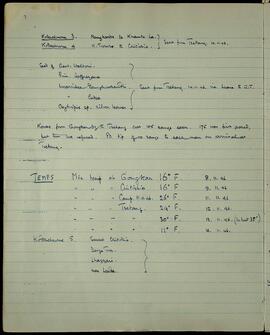
7

Kodachrome 3. Nangkartse to Khamka La. } Sent from Tsetang. 14.11.46.
Kodachrome 4 K. Trombo to Chitishio. }

Seed of Gent. Waltoni.
Prim. Jaffreyana
Incarvillea Younghusbandii. Sent from Tsetang 14.11.46. via Lhasa to G.T.
Incarvillea Lutea
Oxytropis sp. - silver leaves

Kowas from Gongkar Dz to Tsetang cost 105 sangs each. 175 was first asked, but this we refused. Paid tip of 10 sangs to each man on arrival at Tsetang.

TEMPS
Min temp at Gongkar 16° F. 8.11.46
Min temp at Chitishio 16° F 9.11.46
Min temp at Camp. 11.11.46. 26° F. 11.11.46
Min temp at Tsetang. 24° F. 12.11.46.
Min temp at Tsetang. 30° F. 13.11.46. (In tent 35°)
Min temp at Tsetang. 11° F. 14.11.46.

Kodachrome 5. Sunset Chitishio.
Darya Tra.
Lhashari.
near Lenda.

LSH/1/1/8/1/27 · Part · 1946-12-11
Part of The Ludlow & Sherriff Collection

SUMMARY:
The diarist negotiates transport with the Dzongpon, notes low rates, and plans to cross by ferry near Chamna and go over the Temu La, with observations on weather and local birds. On 18 Dec at Dzeng, Betty and the diarist travel with a small party, crossing the river by ferry opposite Chamna, where the headman recalls their 1938 visit.

CONTENT:
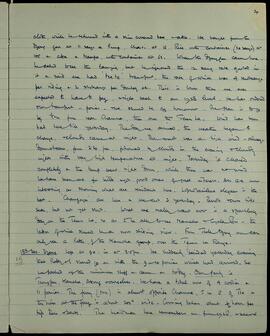
cloth, while he returned with a skin covered box - atta. We bought from the Dzongpon at 11 sangs a lump, chari at 15. Rice with container (30 sangs) at 105 - atta & tsampa, with container at 63. When the Dzongpon came here, he asked to see the lamyig, but he ignored the 12 sang rate quoted in it & said we had 'tse te' transport, the rate of which was 4 shokangs per riding & 2 shokangs per donkey etc. This is lower than we ever expected to have to pay, right back to our 1938 level. He has ordered our transport - ponies - they should be off tomorrow. The plan is to go by tru from near Chamna, then over the Temu La. Wind has been bad here till yesterday. The day we arrived, the weather began to change, & clouds came at night. The result was a high wind - always downstream, from 2.30 pm, followed by clouds in the evening & cloudy nights with very high temperature at night. Yesterday it cleared completely & the temp went right down, while there was no wind. We have been out for birds & got good ones of great interest. All are now interesting as showing what are residents here. Lophobasileus elegans is the best. 'Chang-tsai' are here & we shot 3 yesterday. Parrots & crossbills seen, but not yet shot. What we really want now is a sparkling day on the Temu La, so as to be able to see Namcha & Gyala Peri - the latter of which should be a more striking view. From Tsela Dzong one can only see a little of the Namcha group, over the Temu La Range.

18th Dec. Dzeng. Left at 9.0: in at 3.0 pm. We suddenly decided yesterday evening that Betty & I should go on with the goro ponies which had arrived. So we packed up the minimum stuff & came on today. Our party is Tsongpon, Kancha, Akong & ourselves. We have a total now of 4 coolies & 11 ponies. The ferry (tru) is almost opposite Chamna, 5 m. E. of Tse & the river at the ferry is about 200 yds wide. Crossing takes about 1/2 hour per trip there & back. The headman here remembers us from 1938, & seems

LSH/1/1/3/3/153 · Part · 1983-05-05
Part of The Ludlow & Sherriff Collection

SUMMARY:
The party marches down the Tsari valley, noting profuse P. calderianum on grassy flats and in forest glades near Yarap, crossing a three-span bridge to a good campsite; Pinto is ill with pain and fever. On 19th May they halt, observe typical weather, split up to mark flowers including a fritillaria (No. 1611) and a rhododendron (No. 1612).

CONTENT:
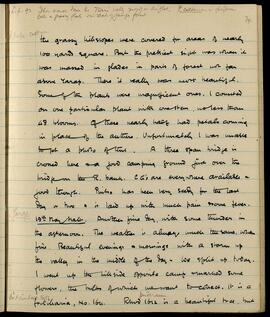
L.p. 92 This march down the Tsari valley mostly on level flats. P. calderianum in profusion both on grassy flats and in shade of Juniper forest.

The grassy hillslopes were covered for areas of nearly 100 yards square. But the prettiest sight was when it was massed in glades in parts of forest not far above Yarap. There it really was most beautiful. Some of the plants were magnificent ones. I counted on one particular plant with one stem, no less than 48 blooms. Of these nearly half had petals coming in place of the anthers. Unfortunately I was unable to get a photo of this. A three span bridge is crossed here and a good camping ground just over the bridge on the R. bank. C.G.'s are everywhere available and good though. Pinto has been very seedy for the last day or two and is laid up with much pain and some fever.

19th May Halt. Another fine day, with some thunder in the afternoon. The weather is always much the same, when fine. Beautiful evenings and mornings with a storm up the valley in the middle of the day. We split up today. I went up the hillside opposite camp and marked some flowers, the bulbs of which we want to collect. It is a fritillaria, No. 1611. Rhod 1612 (pudorosum) is a beautiful tree, but...

LSH/1/1/6/1/146 · Part · 1936-10-02
Part of The Ludlow & Sherriff Collection

SUMMARY:
Entries for 13 and 14 October describe wet, misty conditions around Trashidzung and Langong, limited success collecting rhododendron seed, and a pressing of P. chamaethauma, with coolies assisting and seeds dried for packing. News from Ludlow reports delays and rerouting due to the Lilung bridge collapse, with casualties and mail issues, and mentions movements via Lhacha, Tsela Dzong, and toward Kyindong/Sangachöling.

CONTENT:
74a
Oct. 13 Tsari Sama
seeds of P. chamaethauma 6603, P. morsheadiana 6604,
P. sikkimensis 6606, P. vernicosa 6607,
Swertia kantelu 6605.

far as from Trashidzung here: & that the third stage is much the same. He gives two names as on the preceding page. He also says that the path never enters Loque, but it must go very close to it.

Tsari Sama
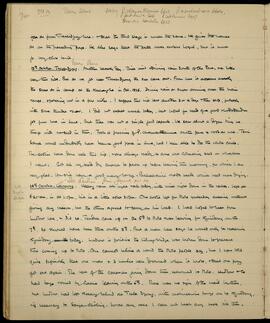
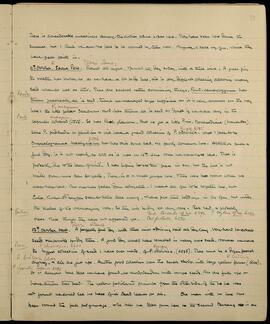
13th October. Trashidzung. Another beastly day. Thick mist & driving rain south of the Pass, & little on this side. But as we got near Trashidzung the sun came out. From here it appears exactly the same as in camp at the Kashong La in Oct. 1936. Driving rain or snow coming over the main range, petering out in a few miles. I suppose this will last another 3 or 4 days then stop, probably with some thunder snow. I did not expect much today, but hoped for seed of a good rhododendron got from here in June. But there was not a single good capsule. We saw about a dozen tiny wee things with no seed in them. Took a pressing of P. chamaethauma on the pass & root as well. Tsari Sama would undoubtedly have been a good place in June, had I been able to do the whole circle. The coolies have done well this trip, & are always ready to come out collecting seed or whatever I want. Got all my seeds dry enough to pack up before leaving this morning, for which I am very glad. We still have a good many Lo-La - Pachakshiri rhodo seeds which need more drying.
See Ludlow's diary - Kew Journal XII 14.

14th October. Langong. Heavy rain all night & all today, with mist right down in the valley. Left at 8.30 am, in at 1.0 pm, kit in a little after 3.0 pm. One coolie left for Molo yesterday evening without giving any reason, but the others agreed to carry on his load. I had hoped to hear from Ludlow here, & did so. Tendup came up on the 5th to Molo & was leaving for Kyindong on the 7th, so should have been there on the 9th. But a man here says he would only be reaching Kyindong today. Ludlow is positive the Lilung bridge was broken down to prevent their coming up to Molo. One cannot believe a word the Molo people say, but I was told quite definitely that one man & 3 mules were drowned when it broke, & that one pony got out again. The rest of the caravan going down then, returned to Molo. Ludlow & Co had to go round by Lhacha leaving on the 5th. There was no sign of the mail between, but Ludlow had left Kesang behind at Tsela Dzong, with instructions to go on to Kyindong, if necessary to Sangachöling. So at any rate I can not hear any more till then.

LSH/1/1/6/1/78 · Part · 1938-06-17
Part of The Ludlow & Sherriff Collection

SUMMARY:
Page lists plant taxa with collection numbers and brief locality descriptors around Tsari Sama, including sites beyond Trashi La near a lake, beside a bridge, over a second pass, the shore of Shacho Psho, and around Chubumbu La and Lo La. A note mentions an 'Explanation of Corke trouble.'

CONTENT:
39a Tsari Sama

Lilium
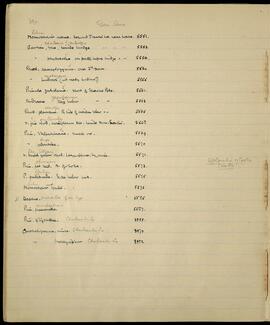
Nomocharis nana. beyond Trashi La near Lake. 5551.
nanloensis f. caulescens
Gentian, blue, beside bridge .. .. .. 5553.

  • phyllocalyx on path before bridge - .. 5554.
    Rhod. campylogynum. over 2nd pass. 5560
    mekongense
    " ludlowii (not really ludlowii?) 5555
    Primula globularia. shore of Shacho Psho. 5561.
    gagnepainiana
    Androsace Cliff below .. .. 5563
    charitopes
    Rhod. R side of maidan below -- 5565
    erythrocalyx
    v. fine Rhod. neriiflorum ser. beside Nom. souliei. 5568
    Prim. valentiniana. small one. 5569.
    kingii
    " odontica. 5570
    Rho. lepidotum
    v. small yellow Rhod. large flower. in moss. 5571.
    chionogenes
    Prim. pet sect. N. of Lo La. 5573.
    flexilipes
    P. pudibunda. Slope below huts. 5575
    Lilium
    Nomocharis souliei. . 5576
    X Daphne macrantha forms type 5585
    morsheadiana
    Prim. prenantha. 5587.
    Prim. elizabethae. Chubumbu La 3965.
    Omphalogramma minus. Chubumbu La 3970
  • brachysiphon. Chubumbu La 3982

    Explanation of Corke trouble

LSH/1/1/7/1/7 · Part · 1940-05-24
Part of The Ludlow & Sherriff Collection

SUMMARY:
The diarist notes bodies with bows left beside them and observes alpine flora on nearby snow slopes and streambeds. Accompanied by Langong coolies, they visit the Tsari Sama (Sarpa) pilgrimage area, finding it rich in Primula, Rhododendron, and a new white-flowered Daphne near the pass to Lopa territory. Trashiyang is mentioned as the starting and finishing point of the pilgrimage.

CONTENT:
Beside each body, the owner's bow had been stuck in the ground. All arrows had been taken away, but all their other possessions seemed to have been left intact, even to their meagre rations of food. Near here, at the top of the snow slopes, were vertical cliffs. Tucked away in dust-dry pockets, completely sheltered from rain, were fine clumps of P. littledalei.

A little lower down, at 14,000', the first Meconopsis simplicifolia were coming into flower. Beside this, P. chamaethauma was in flower, and on a steep bank just above this, a little creeping Lonicera, only an inch or two off the ground, showed its yellow flowers. Some of the open swampy flats held masses of a fine Allium (No. ). On stony beds beside streams grow P. macrophylla v. macrocarpa.

There remained, near Langong, one area to visit, that was Tsari Sama. This is a place of pilgrimage, called Tsari Sama or Sarpa—the new Tsari—to distinguish it from the better-known, more important Tsari Chikchar. The Langong coolies were not anxious to go round the pilgrimage, for which I could not blame them. However, they took me, and it was a most interesting trip. As at the Lo La, there is in Tsari Sama a fairly extensive, reasonably open flat bit of country, just north of the immediate Himalayas, gradually rising to a steep rocky ridge. The whole of this area was very rich in flora. This, to a certain extent, can, I think, be put down to the fact that no yaks are kept here in the summer. None of the dwarf rhodos were now in flower, and R. campylogynum (5560), R. trichocladum (5555), R. glaucum (5565). Also 5568.

A Primula not seen elsewhere, P. Kingii covered acres of open ground with its deep wine-coloured blooms, P. laeta, a glorified form of P. Roylei. Primula, P. gracilipes.

Perhaps the most interesting Rhododendron was 5571 (yellow, red spots). Growing among rocks just below the ridge before reaching the pass to Lopa territory, we came across a fine large, white-flowered new Daphne. No seeds.

At Trashiyang, the starting and finishing point of the pilgrimage,

LSH/1/1/6/1/76 · Part · 1938-06-16 - 1938-06-17
Part of The Ludlow & Sherriff Collection

SUMMARY:
Field notes at Tsari Sama record a Monal sighting and comparative observations of several Primula species, including uncertainties in identification and notes on flowering and rooting characteristics. The page also describes the main valley’s bearings, the Lo La pass toward Lopa territory, and a route from Shacho Tsukang via the Gai La to Trashiying with conditions and height noted.

CONTENT:
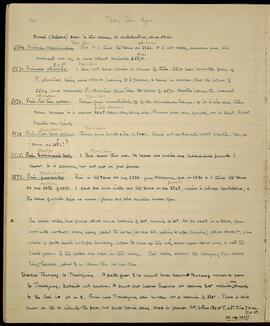
38a Tsari Sama. 16 June

Monal (Sclateri) seen in this valley, in rhododendron, above abies.

5569 Primula pelenteneum Tsari Sama. This is I think the same as 3953. It is not really common here, is swamped out by a more robust primula Kingii 5570.

5570 Primula Kingii Tsari Sama. I am not sure which is which of these. 5570 has more the form of P. odontica, being more robust, having 3-5 flowers, & being in masses. But the colour of 5569 more resembles P. odontica than does the colour of 5570. Neither have the marked Chionogenes.

  1. Prim. Chionogenes Tsari Sama. Taken from immediately N of the Himalayan Range. If it is like any others taken, perhaps it is nearer fudoka-chionogenes 3698 than anything else. Flowers over very quickly, as in 3648. Rooted together very tightly.

5579 Prim. Chionogenes Tsari Sama. Taken from South side of Pass. Plants not so densely rooted together. Have same as 3983? y.

  1. Prim. floribunda Tsari Sama. I don't know this one. Its leaves are unlike any sikkimensis primula I know. It is common, but not yet in full flower.

  2. Prim. morsheadiana Tsari Sama. This is the same as my 2396 from Kashmir in 1936 & I think the same as No 3986 of 1938. I can't see how either are the same as No 3848 prevalis, which is always Candelabra, & the leaves of which differ so much: flowers are also smaller & never open.

X. The main valley here flows about on a bearing of 40°, turning to 30°. At its head is a pass, open now with no snow, very easy, called the Lo La (as are all leading to Lopa country), about 14000 ft., over which a path leads to Lopa territory. Lopas do come up this way each year about now, & raid the locals' yaks - if the latter are kept in this valley. This valley enters the Langong Chu above Singo Samba, about 2 m. above the Lo La Chu.

Shacho Tsukang to Trashiying. A path goes S.W round to a second tsukang & over a pass very to Trashiying. Details not known. A short cut leaves Shacho at bearing 300° & climbs steeply to the Gai La at m 2. From here Trashiying can be seen at a bearing of 330°. There is still snow on the N side of the pass, but path fairly easy, steep in places. B.P. of Pass 186.0° T. 45°. Time 7.0 am.
17.6.38.
Ht. app. 14537'.

LSH/1/1/6/1/145 · Part · 1936-10-02
Part of The Ludlow & Sherriff Collection

SUMMARY:
The diarist reports uneasiness about leopards and persistent heavy rain and mist that make seed collecting difficult around Tsari Sama and Sacua Pebo. Despite the weather, they gather significant Primula and Rhododendron seeds, note hut damage, and record that team members Cunha, Kuku, and Souypen choose to sleep under an overhanging rock.

CONTENT:
There is considerable uneasiness among the coolies about Leopards here. They have been here during the summer, but I think we are too late to be worried by them now. Anyway I take my gun, which they have great faith in.

To Tsari Sama:
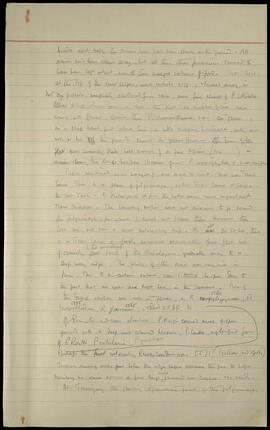
11th October. Sacua Pebo. Rained all night, poured all day today, with a thick mist. A great pity the weather has broken so, as we have a lot to do here, and it is very difficult collecting, collecting many seed when so wet as this. There are several rather astonishing things. Rhod. campylogynum has thrown practically all its seed, though we managed to get sufficient as it is very common on the way here: the little yellow deciduous rhod. (R. mckenziana) has thrown all its seed and I doubt if we have any in the capsules collected (5555). So has Rhod. faucium. But we got a little Prim. morsheadiana (menantra), some P. pudibunda or flexilipes and will have a grand collection of P. odoritica (Kinga 6595). What I take to be Omphalogramma brachysiphon (6596) too has still some seed, is fairly common here. Although such a foul day, it is not nearly so cold as it was on 15th June when we were here last. That is probably due to the lack of wind. I was hoping to see the place in sun, but the hut is not visible from more than 40 yards. There is a v. small gompa here, there were two rooms when we were here last. But one has fallen down altogether. I meant all of us to be together here, but Cunha, Kuku & Souypen seem to think that wrong, and have put their bedding in the open, but under the shelter of the overhanging rock. So they will be dry at any rate. Rats bad, and probably fleas though they have not appeared yet. (Gent. lancantha sp. nov 6592, P. taylorii sp. nov 6593, Sax. probata 6594).

Tsari Sama
12th October. Halt. A perfectly fine day, with thick mist and driving rain all day long. Very hard to collect seeds and impossible to dry them. A good day would have resulted in many more seed. However we have the biggest collection of seed I have ever made, of P. odoritica, (6595) (P. chionogenes 6601). There must be a dozen packets anyway, and all are just ripe. Another good collection was the small rhodo. with large yellow flower (R. ludlowii 6600). (R. forestii repens 6598).

It is curious here that we have found no rhododendron with unripe seeds. All are fully ripe or have thrown their seed. The yellow petioled primula from the other side of the Lo La was not found: we could see no trace of its dead leaves at all. One man with us here has been round the full pilgrimage, and he tells me that from here to the second Tsukang is as

LSH/1/1/3/3/158 · Part · 1983-05-05
Part of The Ludlow & Sherriff Collection

SUMMARY:
Notes describe the Tsari river dropping rapidly like a cataract, with estimates of 500–600 ft per mile after leaving camp. A plant list is recorded at Podzo Sumdo (22 May), and observations at Migyitun note cultivation and a nearby holy lake Tso Kar, with black currants often epiphytic and biting insects common between there and Chick Kar.

CONTENT:
192.4
53

10033
1.0466
10033
40132
60198
1049451

L. p. 96. Killing of newly born calves?
(offspring of "Dzos")

Tsari river falling at a tremendous pace.
For over a mile it was nothing but a
cataract confined to a narrow boulder
strewn bed.

Podzo Sumdo
22 May
Diapensia himalaica 1640
P. atrodentata 1641
spru. "tsariensis 1650
dictyoneura 1654
praealta 1658
glabra 1642
Lloydia tibetica 1645
Pedicularis roylei 1646
Rhod. tsangpoense var.
pruniflorum 1647

  • Calostrotum 1649
  • lopsangianum 1631
    Anthopogon 1653
    Caloxanthum 1656
    Vaccinium sikkimense 1644
    " nummularia 1655
    Sax. granulata 1659

    9205.
    1.0599
    9205
    46025
    82845
    8284
    9757.379

L. p. 98 I think the Tsari river must be dropping
500-600 ft per mile for the first mile after leaving camp.

At Migyitun the valley opens out & there is quite a lot of cultivation including barley, potatoes,
turnips etc. Half the inhabitants here are either pure Lobas or have Loba blood in them.
A large stream comes in from the North & 2 marches distant is a holy lake "Tso Kar".
Black currants abound between here & Chick Kar. A curious feature about the bushes
is that they are frequently epiphytic.
Biting midges, ticks, fleas, & of course a louse or two.