Showing 6 results

Archival description
6 results with digital objects Show results with digital objects
LSH/1/1/8/1/39 · Part · 1947-02-23
Part of The Ludlow & Sherriff Collection

SUMMARY:
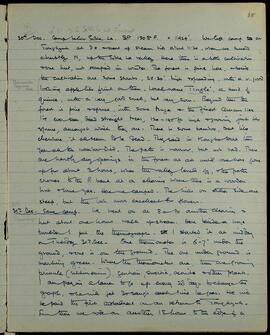
Travel from Tongkyuk up the Sobshe La valley to a camp below the pass, with notes on pine, spruce, Tsuga, Quercus ilex, and a quince-like shrub locally called 'Tingle' (Chaenomeles lagenaria). Reports widespread bamboo die-off mentioned in Kongbo and camping near a clearing with a wooden hut and yak.

CONTENT:
35

L.D. 96 to Sobshe La with thermograph

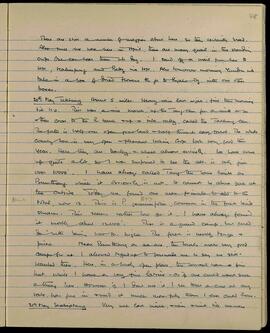
30th Dec. Camp below Sobshe La. B.P. 190.8° F. = 11424'. We left camp at Tongkyuk at 9.0 and went up stream till about 11.30, when we turned abruptly N, up the Sobshe La valley. Here there is a little cultivation, some huts, not occupied in winter. The forest is pine here, and beside the cultivation are some shrubs, 25-30' high spreading, with a very good looking apple-like fruit on them. Local name 'Tingle' (Chaenomeles lagenaria 12061), a kind of quince, with a very good smell, but very sour. Beyond this the forest is pine & spruce, with some Tsuga & the finest Quercus ilex I've ever seen, dead straight trees, 120-140 ft high & growing just like spruce, amongst which they are. There is some bamboo, but like elsewhere, it all seems to be dead. They said in Kongbo that last year all the bamboo died. The path is narrow, but not bad. There are hardly any openings in the forest at all until one has gone up for about 3 hours, when the valley levels off, the path crosses to the R bank at a clearing where there is a wooden hut & some yak. Here we camped. The hills on either side are steep, but

LSH/1/1/8/1/65 · Part · 1947-02-20
Part of The Ludlow & Sherriff Collection

SUMMARY:
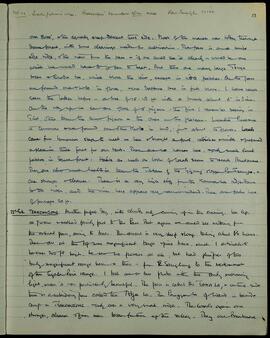
Steep ascents and descents through dense forest with limited views due to Tsuga and rhododendrons; a Daphne tree in full bloom and a flock of pigeons are noted. Locals bring a fowl, radishes, and milk and prepare a camp; the party crosses TANA LA and HOJA LA to TSAKCHUGONG with glimpses from R. Sanglung to the Gyala Peri range, and the locals are described as Bhutanese and healthier than upper Po-Tsangpo Tibetans.

CONTENT:
Feb. 22. Luculia pinceana 12240. Brassaiopsis karmelane sp. nov. 12244 Rhod. tanastylum 12246. 59

over 8000', then equally steep descent this side. Most of the march was today through dense forest, with some clearings made for cultivation. The pass is on a knife edge ridge, the view from the pass - if one could see it clearly - would be one which we would have to go far to beat. But there are many large Tsuga trees & Rhodos too, which block the view, except in little patches. On the pass we found one Rhodo in flower, one Daphne tree in full bloom. I have never seen the latter before - a tree of 15-18 ft with a trunk about 6" in diam. On the way up we saw one flock of 6 pigeons - the first I remember seeing in Tibet, other than the snow pigeons & the ones on the plateau. Luculia pinceana is common & we found one other Rhodo in bud, just about to flower. Locals came from tomorrow's stage to meet us here & brought a fowl, radishes & milk & prepared a place in thick forest for our tents. There are no houses here, only small level patches in dense forest. Habits as well as looks of locals seem to recall Bhutanese. They are also much healthier than the Tibetans of the Kigong upper Po-Tsangpo, & are stronger & cleaner. There is a very high cliff from the Karmala ridge down to the river, and the river here appears very narrow indeed. There are falls here of perhaps 20 ft.

23rd Feb. TSAKCHUGONG. Another perfect day, with clouds only coming up in the evening. We left at 7.00 am & walked fairly fast to the Pass. But again we could see nothing from the actual pass, owing to trees. The ascent is very steep & long taking about 1 1/2 hours. There are at the top some magnificent Tsuga & pine trees, which I estimate to be over 200 ft high. We saw no flowers at all, but had glimpses of the truly magnificent range here & there - from R. Sanglung to the westernmost of the Gyala Peri range. I took one or two photos with the early morning light, when it was particularly beautiful. The pass is called the TANA LA, & on this side there is a subsidiary pass called the HOJA LA. The Pangyuta of Ward is beside camp in TSAKCHUGONG only over a very small ridge. The locals again are stronger, cleaner & finer men than further up the valley. They are Bhutanese.

LSH/1/1/9/1/15 · Part · 1949-07-30
Part of The Ludlow & Sherriff Collection

SUMMARY:
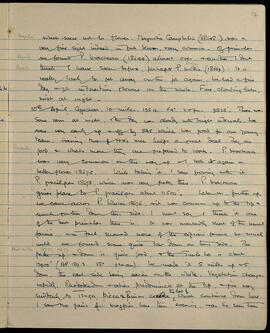
Field notes from Gyechar describe an early start aided by two of H.H.'s men and an ascent to Tunk La, with observations of primulas (including P. bracteosa, P. gracilipes, and P. whitei) and changing vegetation with altitude. Weather was fine to cloudy with mist at night, elevations ranged from about 9525' to ~12900', and magpies were seen in the evening.

CONTENT:
which were not in flower. Magnolia campbellii (18648) was a very fine sight indeed, in full bloom, very common. Of primulas we found P. bracteosa (18644) almost over, another I don't think I have seen before, perhaps P. listeri (18669). It is really lovely to get away on the job again. We had a fine day with interesting flowers on the whole. Fine, clouding later, mist at night.

10th April. Gyechar. 10 miles. 195.4. 64°. 2.0 pm. 9525'. There was some rain at night, the day was cloudy with bright intervals. We were very early up & off by 5.45 which was good for our young team. Having two of H.H.'s men helps a great deal. They are good & what's more they are prepared to work. P. bracteosa was very common on the way up, & I took it again in better flower 18675. While taking it, I saw growing with it P. gracilipes 18673, which was very pretty there. P. bracteosa gives place to P. gracilipes above 11500'. Later on, further up, we came across P. whitei 18676, and was common up to the top & much further down this side. I must say I think it one of the best primulas there is. It was markedly short of the usual farina, in fact showed none of the copious farina so usual until we found some quite low down on this side. The path up & down is quite good, & the Tunk La is about 12900' (BP 189.3. 58°. 9.30 am). We made it 5 miles up & 5 down, the east side being easier on the whole. Vegetation changes rapidly. Rhododendron species predominate at the top, & give way suddenly to Tsuga, Picea & Pinus excelsa, the last of which continue down here. I saw two pairs of magpies here this evening, as I've seen them

LSH/1/1/6/1/34 · Part · 1933-04-14 - 1933-05-17
Part of The Ludlow & Sherriff Collection

SUMMARY:
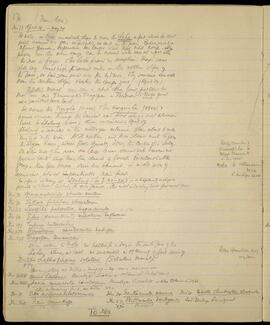
The party crossed the snow-bound Lo La at night, then traversed the Nyug La and Kargong La to reach Shalong by April 27, describing the Shalong plain and listing notable birds collected. On returning to Molo they secured Sclater's Monal on the south face of Lo La and, during May 17–24, recorded additional species, with marginal notes on pheasants and Picea spinulosa.

CONTENT:
17a. (from 16a).
'33 April 14 - May 24

At Molo we took immediate steps to cross the Lo La, a feat which the local people assured us was impossible so early in the year. But we were of a different opinion. Experience has taught us that most knife-edge passes over the main range can be crossed with ease at night when the snow is frozen. The Lo La proved no exception. Though snow still lay breast high for several miles on the northern slopes of the pass, we had scampered over this by dawn, and by sunrise were well down the southern slopes within the conifer zone. (April 24.)

Sclater's Monal was seen in rhododendron and fir forest just below the snow line, and Temminck's Tragopan in deciduous and Tsuga forest at a somewhat lower level.

We crossed the Nyug La (11,000) and the Kargong La (13,800) and pressed onwards through the densest rain forest along a most atrocious track to Shalong (6,300) which we reached on April 27.

Shalong is situated in the middle of an extensive plain about 8 miles long by a mile wide. At its northern end three streams unite to form the Siyom River, which flows quietly down the centre of the valley. On either side of the river are large areas covered with bracken and pasture land which have been cleared of forest. Excellent cattle graze on these open downs, which are hemmed in on all sides by luxuriant, almost impenetrable, rain forest.

We spent 10 days at Shalong (See p. 22-28) — a hopelessly inadequate period in which to study its avifauna. The most interesting birds procured were:

No. 78 Grammatoptila striata austeni
No. 70 Suthora fulvifrons chayulensis
No. 83 Leioptila pulchella nigroaurita
No. 84 Sibia (Actinodura?) nipalensis daflaensis
No. 197 Tribura luteoventris
No. 372 Hirundapus caudacutus nudipes
No. 379 Tragopan temminckii

[Marginal note: Large numbers of Crossoptilon or Blood Pheasants in the wood. Molo. R. vellereum 3623, R. hirtipes 3624]

On our return to Molo we halted for a day on the south face of the Lo La, where, at last, we succeeded in obtaining a good series of No. 376-377 Lophophorus sclateri (Sclater's Monal).

[Marginal note: Picea spinulosa 3627 very common]

During stay at Molo — May 17-24 came across:
No. 356-8 Spinus thibetanus Himalayan Siskin — 1st time L. D. had seen it.
No. 348-9 Loxia curvirostra himalayensis Himalayan Crossbill — also obtained in 1936.

Other interesting birds at Molo were:
No. 71. Sitta europaea tibetosinensis
No. 368. Picus canus kogo
No. 74. Ianthocincla maxima
No. 81. Fulvetta striaticollis striaticollis
No. 371. Psittacula derbyana Lord Derby's Paroquet.
No. 372. Paroquet

To 28a

LSH/1/1/9/1/53 · Part · 1949-05-28
Part of The Ludlow & Sherriff Collection

SUMMARY:
The diarist notes magpies and quail, sends mail to H.H., Kalimpong, and Betty, and dispatches a box of dried flowers to Byakar Dz. On 20th May they march about five miles to Takhung via the Tang chu and Takhung chu, note altitude observations, collect Primula geraniifolia, and describe a well-made camp near Bumthang. The entry opens the next day's move toward Shabejetang.

CONTENT:
There are still a number of magpies about here, so they certainly breed. Also since we were here in April, there are many quail in the standing crops. One can hear them all day. I send off a mail from here to H.H., Kalimpong and Betty via H.H.. Also tomorrow morning Lundrup will take in a box of dried flowers to go to Byakar Dz. into our other boxes.

20th May Takhung About 5 miles. Heavy rain last night, fine this morning till 11.0. This was a nice march, up the Tang chu for a mile or so then cross to the R bank and up a side valley, called the Takhung chu. The path is half over open grassland and half through easy forest. The whole country here is very open and pleasant looking. Crops look very good this year. Here they are barley and wheat almost entirely. We have come up quite a lot, so I was surprised to see the alt. is only just over 10000'. I have always called Tang the same height as Bumthang which it obviously is not. It cannot be above 9000 at the outside. Today we found one more primula to add to the total, now 13. This is P. geraniifolia 18913, common in the forest beside streams. This seems rather low for it. I have always found it mostly above 12000'. This is a grand camp, but could do with being 1000 ft. higher. The forest is mostly tsuga and picea. Near Bumthang as we are, the locals make very good camps for us. I allowed Ngudup to persuade me to say we still wanted them. Here, in a lovely open place, the servants have a fine hut, while I have a very fine latrine - as if one could want such a thing here. However, if I don't use it, I see that a cow at any rate, has gone in and used it much more fully than I ever could have.

21st May Shabejetang Very wet last night, rain until we were

LSH/1/1/9/1/55 · Part · 1933-05-22
Part of The Ludlow & Sherriff Collection

SUMMARY:
Notes on supplies being sent to Betty, followed by travel from Shimitang to Pangotang with excellent weather and a favorable campsite under Tsuga trees. The party observed a river gorge and collected several Primula species on the Pudo La.

CONTENT:
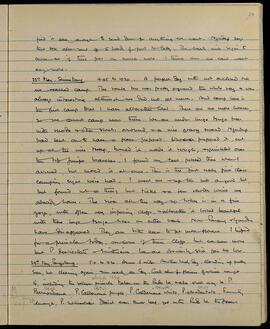
find it easy enough to send down for anything we want. Ngudup says
that H.H. also sent off 5 loads of food to Betty. The bears will begin to
curse us if this goes on much more. I think now we can't want
any more.

23rd May. Shimitang. 4.45 to 10.30. A perfect day with not a cloud till
we reached camp. The route too was pretty grand the whole way & was
always interesting, although we did not see much. And camp here is
the first camp that I have altogether liked. There are no more houses,
so we cannot camp near them. We are under huge Tsuga trees,
with rhodo & other shrubs around & a nice grassy sward. Ngudup
had sent on to have a place prepared. Whoever prepared it, cut
up all the nice turf, turned it, made it rough, & sprinkled over
the top juniper branches. I found my tent pitched there when I
arrived, but moved it at once. This is the first really first class
camping site we've had. I went out up the hill a good bit,
but found not a thing but ticks & a few rhodos which we
already have. The river all the way up today is in a fine
gorge, with often very imposing cliffs, & altogether it looked beautiful
with these huge Tsuga trees on either bank. Now Pasang & Nyundru
have disappeared. They are both keen to see more flowers. I hoped
for a primula today, on some of these cliffs, but we saw none
but P. denticulata & Smithiana. We are obviously still far too low.

24th May. Pangotang. 5.0 to 9.30. About 6 miles. Another lovely day, clouding up pretty
soon, but clearing again, sun nearly all day. Good also for flowers of which we got
16, including the yellow primula elongata (18946) taken on the Pudo La, & also what may be P.
Barnardiana (18946). P. Calderiana purple (18947), P. Calderiana white (18954), P. atrodentata (18957). Funny
enough, P. sikkimensis doesn't even show leaf yet on the Pudo La the flowers

NB
Concerning
seeds