Showing 16 results

Archival description
16 results with digital objects Show results with digital objects
LSH/1/1/9/1/91 · Part · 1933-07-01 - 1933-07-03
Part of The Ludlow & Sherriff Collection

SUMMARY:
The diarist records plant collections and observations, noting poor weather but good flowers, and a promising valley toward the Chachu La with yak shelters and a large lake. While halted in camp, they receive mail from Betty via Wangmo’s servant to Bumthang and send replies; they also collect the first seeds of the year. On 3rd July they make a long day trip to Tolegang, pressing 18 specimens including Primula waddellii.

CONTENT:
1st July: Saxifraga brunoniana 19270.
Rhod. calderianum 19277.
Streptopus simplex 19280.
Cardiocrinum giganteum 19284.

...for a few nice things, the best being what I think is a Buddleia, but if so, it's a much bigger flower than B. colvilei (19272) which it somewhat resembles. Lil. giganteum is also common down the valley, and Briggsia (B. muscicola 19266), on a tree, is rather nice. A miserable day for weather, but a good day for flowers.

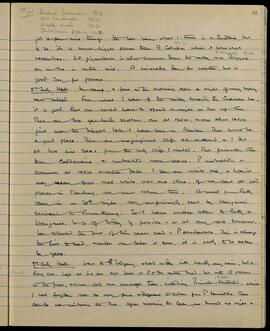
2nd July. Halt. In camp, and fine in the morning after a night of very heavy rain indeed. From what I saw of the valley towards the Chachu La, it is good. But one would have to spend a night or two up there. There are two yak herds' shelters, one at 13500, and one above 14500 just near the biggest lake I have seen in Bhutan. That would be a good place. There are magnificent cliffs all around, and I did get two nice saxs from the only cliffs I visited. But primulas, other than calderiana and umbratilis were scarce. P. umbratilis is common at 14500 and rather paler. I saw one white one, and hope it may mean that real white ones are close. If we can't get good places in Haubung, we must return there. A mail from Betty came in on 30th night, very surprisingly, sent by Wangmo's servant to Bumthang. So I have written letters to Betty and Wangmo, to go off today if possible — or at any rate tomorrow. We collected the first of this year's seed — P. atrodentata. This is always the first to seed, and unless one takes it soon, it is likely to be eaten by yaks.

3rd July. Halt. Went to Tolegang, and had a day with hardly any rain, but a long one. Left at 6.0 am and back at 5.0 pm rather tired, but with 18 flowers (19330) in the press, some good ones amongst them, including Primula waddellii, which I had forgotten was so very pink and different in colour from P. tenuiloba. There can be no mistaking the two. After reaching the lake, we turned up right...
LSH/1/1/9/1/84 · Part · 1949-06-18 - 1949-06-30
Part of The Ludlow & Sherriff Collection

SUMMARY:
List of plants noted and photographed in mid–late June, including Primula, Meconopsis, Diapensia, Sorbus, Cypripedium, with brief habitat notes (near pass, lake at pass, on cliff). Entries detail frames on Dufaycolor 15–16 and Kodachrome 16, with shipments of Dufaycolor 13–15 and Kodachrome 14–16 sent on 30/06/1949.

CONTENT:
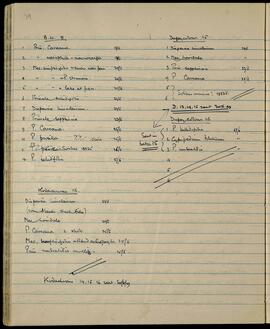
79

B.W. 8.
1 Primula caveana. 18/6
2 " macrophylla & macrocarpa 18/6
3 Meconopsis simplicifolia & snows near pass 20/6
4 " " sp. strumosa. 20/6
5 " " & lake at pass. 20/6
6 Primula bellidifolia 21/6
7 Diapensia himalaicum. 22/6
8 Primula sapphirina 23/6
9 Primula caveana. 25/6
10 Primula pusilla ?? close 25/6
11 Sorbus 19235 26/6
12 Primula bellidifolia 27/6

Dufaycolor 15
1 Diapensia himalaicum 22/6
2 Meconopsis horridula "
3 Primula sapphirina 23/6
4 Primula caveana 25/6
5 } Sorbus urania? 19235.
6 }

D. 13, 14, 15 sent 30.6.49

Dufaycolor 16
1 Primula bellidifolia 27/6
2 Cypripedium tibeticum "
3 Primula umbratilis "
(Sent in batch 15)
4
5
6

Kodachrome 16.
Diapensia himalaicum. 22/6
(some blanks, stuck film)
Meconopsis horridula 22/6
Primula caveana 2 shots 25/6
Meconopsis simplicifolia & Rhododendron anthopogon 25/6
Primula umbratilis on cliff. 27/6

Kodachrome 14, 15, 16 sent 30.6.49

LSH/1/1/5/1/149 · Part · 1933-07-04
Part of The Ludlow & Sherriff Collection

SUMMARY:
The diarist records alpine plant finds along a high, windy ridge, including Diapensia, several Primula, Paraquilegia anemonoides, Rhododendron anthopogon, and a Meconopsis bella with a 56-inch taproot. On reaching Camp Changsethang, they note rain, brief sunshine, a steep drop past Thampe Tso into forest, and encountering an unfordable river.

CONTENT:
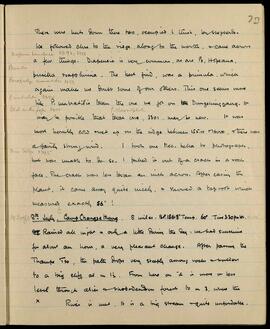
73

There were huts down there too, occupied I think, by shepherds.

We followed close to the ridge, along to the north, and came across a few things. Diapensia (Diapensia himalaica 3392, 3398) is very common, as are Primula hopeana, P. pusilla and P. sapphirina. The best find was a primula (Paraquilegia anemonoides 3399), which again makes me doubt some of our others. This one seems more like P. umbratilis (3394) than the one we got on the Dungshinggang. It (Rhododendron anthopogon 3400) may be possible that that one, P. chasmophila (3301), may be new. It was most horribly cold right up on the ridge between 15,500 and 16,000; there was a fairly strong wind. I took one Meconopsis bella (3395) to photograph, but was unable to do so. I pulled it out of a crack in a rock face. The crack was less than an inch across. After easing the plant, it came away quite nicely, and showed a taproot which measured exactly 56"!

(14,200 ft.) 8th July. Camp Changsethang. 8 miles. B.P. 186.8° Temp. 60° Time 3:30 p.m.

Rained all night and only a little during the day: we had sunshine for about an hour, a very pleasant change. After passing the Thampe Tso, the path drops very steeply among rocks and boulders to a big cliff at mile 1 1/2. From here on it is more or less level through Abies and Rhododendron forest to mile 3, where the river is met. It is a big stream and quite unfordable.

LSH/1/1/5/1/129 · Part · 1933-06-21
Part of The Ludlow & Sherriff Collection

SUMMARY:
A long trek over bleak ground near Dungshinggang yielded additional primulas (including P. umbratilis 3301 and a full collection of nivalis under 3310), views of the 'Door to Dungshinggang,' several small lakes including Yum Tso (Yu Tso), and a Grandala nest. Tsongpen developed a fever when rain began around noon and by 5 pm was unable to bring in specimens.

CONTENT:
Descriptive Black No.

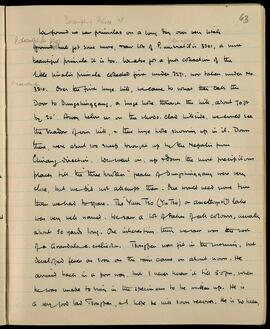
We found no new primulas on a long day over very bleak ground, but got some more, saw lots of P. umbratilis 3301, a most beautiful primula it is too. We also got a full collection of the little nivalis primula collected first under 3271, now taken under No. 3310. Over the first huge hill, we came to what they call the Door to Dungshinggang, a huge hole through the hill, about 70 ft by 20'. Away below us on the rhodo-clad hillside, we could see the shadow of our hill, - this huge hole showing up in it. Down there, were about 100 sheep brought up by the Nepalis from Chirang direction. We went on, up and down the most precipitous places, till the "three brother" peaks of Dungshinggang were very close, but we did not attempt them. One would need more time than we had to spare. The "Yum Tso" (Yu Tso) or amethyst(?) lake was very well named. We saw a lot of lakes of all colours, usually about 50 yards long. One interesting thing we saw was the nest of a Grandala c. coelicolor. Tsongpen was fit in the morning, but developed fever as soon as the rain came on about noon. He arrived back in a poor way, but I never knew it till 5.0 pm, when he was unable to bring in the specimens to be written up. He is a very good lad Tsongpen, and I hope he will soon recover. He is so keen,

LSH/1/1/5/1/117 · Part · 1870-03-15
Part of The Ludlow & Sherriff Collection

SUMMARY:
The diarist records abundant Primula species near camp between two passes on the way to Wangchelabh, noting P. stirtoniana (No. 3258), P. obliqua (3257), and others, with P. umbratilis not yet flowering and a small nivalis primula of special interest. During a halt at Tsophu and Dungchewang they experienced rain and thunder with brief views of snow mountains toward Tibet.

CONTENT:
Rhododendron Primulas 57

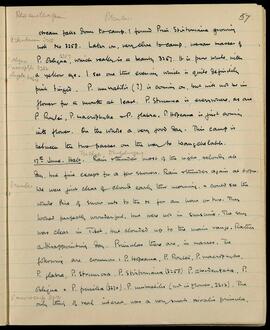
...stream falls down to camp. I found Primula stirtoniana growing well No. 3258. Later on, very close to camp, we saw masses of P. obliqua, which really is a beauty 3257. It is pure white, with a yellow eye. I see one this evening which is quite definitely pink tinged. P. umbratilis (?) is coming on, but will not be in flower for a month at least. P. strumosa is everywhere, as are P. roylei, P. macrophylla and P. glabra. P. hopeana is just coming into flower. On the whole a very good day. This camp is between the two passes on the way to Wangchelabh.

17th June. Halt. Tsophu. Dungchewang. Rain and thunder most of the night, and cloudy all day, but fine except for a few showers. Rain and thunder again at 6:00 pm. We were just clear of clouds early this morning, and could see the white line of snow mountains to the N for an hour or two. They looked perfectly wonderful, but were not in sunshine. The sky was clear in Tibet, but clouded up to the main range. Rather a disappointing day. Primulas there are, in masses. The following are common: P. hopeana, P. roylei, P. macrophylla, P. glabra, P. strumosa, P. stirtoniana (3258), P. atrodentata, P. obliqua and P. pusilla (3270). P. umbratilis (not in flower, 3213). The only thing of real interest, was a very small nivalis primula,

LSH/1/1/9/1/66 · Part · 1949-06-07 - 1949-06-15
Part of The Ludlow & Sherriff Collection

SUMMARY:
Notes of photographic shots on Kodachrome and Dufaycolor reels record subjects including blood pheasant, monal, and various Primula, Meconopsis, and Cypripedium, with locations such as Lobsang la, Kanta punsum, Gormotangha monastery, and Samptang. One shot mentions Ngudup with drokpas in the foreground. Reels 11–13 were sent on 15/06/1949.

CONTENT:
Kodachrome 12 Dufaycolor 11
Shots at ♀ blood pheasant. 7/6 1 Prim. alpicola v. luna. 4/6
P. calderiana yaks. 8/6 2 - - - "
Lobsang la to Kanta punsum 8/6 3 Rhod. thomsonii 19046 "
Chomby ditto telephoto " 4 Gormotangha monastery 5/6
Ditto with Ngudup & drokpas in foreground. " 5 Mec. sinuata "
Anemone narcissiflora. 8/6 6 - - - "
Lloydia serotina. "

Dufaycolor 12
1 Primula glabra. Lobsang la 8/6
2 " macrophylla. no filter 10/6
3 " " " 10/6
4 P. reticulata. 19108 13/6
5 Cypripedium tibeticum 19123 14/6
6 P. umbratilis 19128 14/6

Kodachrome 13 Dufaycolor 13
Primula macrophylla by stream 10/6 1
Mec. simplicifolia. (ov.) 10/6 2
Blood pheasant. telephoto 10/6 3 Dufay 11 & 12
Monal ♂'s 2 shots. (tele.) 12/6 4 Sent 15/6/49
Cypripedium tibeticum. 19123 14/6 5
Up valley from Samptang. 6
5 ft. lens.

11.12.13.
Sent. 15-6-49

LSH/1/1/10/1/17 · Part · 1933-10-05 - 1933-10-01
Part of The Ludlow & Sherriff Collection

SUMMARY:
The diarist receives letters from Betty and outlines plans: Hicks will arrive in Bumthang on 5 Oct, they hope to leave about the 13th and reach Tashigang on 3 Nov; the party will include Ludlow, the diarist, Betty, Virginia, Tess, and Tasho. Entries for 30 September at Pangotang and 1 October at Tolegang note wet weather, seed collecting (including Primula umbratilis), Pasang and Mundru’s work continuing until 17 October, a visit from the Sokpon who received gifts, and mail sent to HH for Kalimpong.

CONTENT:
To cheer me up today—I was feeling very miserable—a mail came in, with letters from Betty in Calcutta at last, and also from her in London. Nothing from HH at all for the first time when a mail has been sent. Hicks confirms that he will arrive in Bumthang on 5th Oct. So we should be able to leave on 13th about, and reach Tashigang on 3 Nov. Ludlow has got a passage, Betty says, and also she and I, Virginia, Tess, and Tasho. So we should have a good time, 6 of us from Bhutan.

30th September. Pangotang. It rained all night again, but was fine when Pasang and Mundru went off about 6:00 am. We were off just after them, and had a day half rain half fine, but no sun. It doesn't look yet like clearing up, but I do most sincerely hope it is fine now for four days. There is a lot to be got in Tolegang and quite a lot on the other side. After that it doesn't matter so much, except for Pasang and Mundru, whose work won't finish until 17 October. Primula umbratilis here is nearly ripe, and I got some seed, but the big Androsace is still green. This is our last of many halts in Pangotang. The Sokpon came to call and I gave him a little bottle of saffron and a torch, which is doing him very well. But we've been in his district for a long time now, ever since 23rd of May. Sent off a small mail to HH for Kalimpong. I shall only be able to send off one more after this, except for Ha.

1st October. Tolegang. Fine till 10:00 then rain and snow off and on the rest of the day. We are camped about 14,000-14,500' and it is raw and chilly. We got some seed of Primula umbratilis, the very pale form which occurs here, and a few other things. But the Phlomis (19716) I particularly wanted, is still in flower; seeds are not nearly ripe. Neither are seeds of the interesting Gentian 19721. But I took roots of

LSH/1/1/5/1/148 · Part · 1933-07-04
Part of The Ludlow & Sherriff Collection

SUMMARY:
Field notes describe specimen 3394 of Primula umbratilis, comparing its scent, flower shape, hairiness, and colour to specimens 3384 and 3301, and noting its habitats on cliffs and open grassy slopes. The page also mentions an unnamed river referred to locally as "Mangde Chu Tributary."

CONTENT:
73a

  1. Primula umbratilis. This is, I think, the true P. umbratilis, and it would appear to be the same, or very near it, as No. 3384. They have in common, the identical scent, which is rather an unusual one. The flowers are both mainly the same shape: . This shape differs from No. 3301, which are: . Although this one 3394 was growing on cliffs, it was not on sheer rock faces, as was 3384. 3394 also was found below cliffs on open grassy hillslopes. The colour of 3301 had much more red in it. No 3394 reminds me of the colour of P. bellidifolia. The scape of 3301 is not nearly so hairy as 3394 or 3384. The latter two have on the whole, many more flowers per head than 3301.

x This river has no name. The locals merely call it "Mangde Chu Tributary".

LSH/1/1/9/1/103 · Part · 1949-07-12
Part of The Ludlow & Sherriff Collection

SUMMARY:
The diary describes travel over the Namda La from Kyikyi Tsum, descending past a lake to yakherds' huts in mist and rain, with notable size and color differences in Meconopsis horridula across the pass. A messenger from Ludlow (at Chachhunang) prompts letters to Ludlow and to the Sonpon’s household, as the Sonpon has gone to Tibet. On 17 July, in thick mist and rain en route to Jiutang, abundant Meconopsis bella and Primula umbratilis are observed on steep cliff faces.

CONTENT:
The place is called Kyikyi Tsum
reached that day. Then again up a longish climb to the Namda La, which will be about 16000'. Then down again past a lake to this place, which is just a couple of yakherds' huts on the open hillside. Altitude about 14500 I should think, but I can't see anything anywhere for mist. On the Namda La met a man who said something about a sahib, but I thought he had been ahead to arrange for us. It turns out he is from Ludlow, who is at Chachhunang, a full day's journey from here. He was sending to the Sonpon for eggs, a hen, and two taphukas. The letter was in Hindi which the Sonpon can't read, and he has in any case gone to Tibet, we are told now. So we're sending on a Tibetan letter to his servants. And I will send a letter to Ludlow tomorrow to tell him we are going to Jiutang, and ask him to meet me there. The divide between the Bumthang Chu and Mangde Chu is the Namda La. Whether we will find any more flowers here or not I don't know, but one thing was immediately noticeable — Meconopsis horridula this side of the pass is twice the size of those on the other side, and the colour is a fine blue, instead of the miserable dirty colour on the other side. It is curious and most marked. Real heavy rain did not start until we were in camp, I'm glad to say. A poor day for flowers — saw nothing new again.

17th July. JIUTANG. 12000'. Probably not more than 5 miles. Thick mist and rain most of the day. We were unable to see anything at all of the country this morning, and had no idea even which direction we were going in. After a short bit over grassy open hillside, we suddenly dropped steeply between cliffs, where at once we found lots of Meconopsis bella. It was particularly pretty, as the cliffs were covered with Primula umbratilis, and the two were all mixed up together. It would be interesting to know why Meconopsis bella is

LSH/1/1/9/1/133 · Part · 1933-09-01
Part of The Ludlow & Sherriff Collection

SUMMARY:
At Pangtang, the diarist reports improved weather after night rain, limited seed readiness, and observations of several plants in flower or seed, while Ngudup arranged a new zareba to shield the tent from strong winds. The following day was a halt with morning sun and afternoon rain; seed collecting yielded mixed results due to grazing and insect damage, and the diarist photographed an ibis bill at a nearby spring.

CONTENT:
7th September. Pangtang. Heavy rain in the night, but fine all day today, with much more of a feeling of dryness. We got a few seed on the way up, but again found most things were not ready. In fact we got Primula umbratilis in perfect flower on a cliff where no sun reaches. Here I have not yet looked round, except to see Mec. simplicifolia, seed of which has mostly been thrown. My zareba here had been disposed of, but Ngudup ordered another, and it really is rather nice because it keeps the very strong wind off the tent. It blows very strongly all day long here.

8th Sept. Halt. Fine all morning. Rain all afternoon. We only went up the hillside opposite camp to look for seed. Some were over - like the nice little Daphne; but we got about 60 seed in the end. The nice Aster that was everywhere is not to be found - all eaten by yaks. On the other hand we got two Arabis in very ripe seed, and the cushion saxifrage, whose seed were nearly all thrown. I could not find a single Anemone rupicola. Mec. horridula seed is ripe, but the plant here is so poor that it is not worth taking. P. umbratilis is not yet ready, but should not take more than 10 days or so in places. As usual the worst enemy to seed collecting is caterpillars or little bugs of some kind. There was not a ripe seed of Salvia to be found, though lots of unripe ones. As soon as they showed any colour at all, a bug got into them. The prettiest flower we got was a fine annual Gentian, with a minute root, but sometimes as many as 25 flowers on the plant, each about 5/8" across. It is worth trying to get seed of, and a white Sax still in full flower is also worth while. We have a nice ibis bill at the spring beside us. He seems quite happy, and I took a cute picture of him last evening. I hope permanent residents at his spring won't frighten him away.