Showing 6 results

Archival description
6 results with digital objects Show results with digital objects
LSH/1/1/3/3/109 · Part · 1933-04-09
Part of The Ludlow & Sherriff Collection

SUMMARY:
Describes a riverside march with bridges and a near-vertical ladder en route to Trum, comparing the terrain to Baltistan and noting local trees and flowering plants. Records a subsequent march to Natrampa with fine conditions, noted as interesting for Ludlow and the writer.

CONTENT:
narrow cantilever bridge to the left bank. The bridge is a little higher up than it was in Bailey's time, and avoids the 400' ascent and descent he mentions. Cross the bridge at mile 4 and down left bank for 1/2 mile where a gorge comes in. Here there is a 30 ft ladder, almost vertical, perched on a column of stones, well built and strong. The path winds up a little above this, and gradually down to the river side. Cross to right bank by a bridge, often washed away, at mile 6. Proceed close to the river through shrubbery and cultivation to Trum, a small village at mile 7. An interesting march, which reminds one very much of Baltistan with the path on jaharies and with ladders. Gorges of the river are pretty narrow, and the side valleys come through absolute slits, only a few feet wide. Above us the hillside is covered with pine 1344 (Pinus tabulaeformis) and fir 1345 (Picea spinulosa), with a good deal of juniper. Nothing much yet in the way of flowers, but a rhododendron 1342 (Rhododendron vellereum) and some interesting ferns, especially 1340 (Pteris dactylina). Gooseberries are here in plenty, just over the flowering stage. Trees are mostly peach, willow and poplar, with buckthorn and other scrub.

26th April. To Natrampa. 7 miles. BP 19.47 Temp. 52 Time 4.30 Approx height 10247'.
Fine. A most interesting day for both Ludlow and myself.
LSH/1/1/9/1/21 · Part · 1949-04-21
Part of The Ludlow & Sherriff Collection

SUMMARY:
The page describes conifer- and rhododendron-dominated terrain and extensive cultivation in the Tang valley, contrasting land use practices with those near Kalimpong. On 15th April, the party traveled from Pimi over the RUDO LA in persistent snow, observed few flowers, and received wine and food sent by Asha Wangmoo at the pass.

CONTENT:
On the way up is Pinus excelsa. Up here there is nothing but conifers & rhododendron. The pines have given place to Spruce (Picea spinulosa 18702) (Bashing), Tsuga (dumosa 18701) (Seshing), Fir (Dungshing) & some Larix (Sasuing) (Rhod. thomsonii 18697). We saw some very nice P. gracilipes — also (15699) Bryocarpum himalaicum just coming into flower. There is a great deal of cultivation in the Tang valley, not only low down in the valley bed, but right up close to where we are here, over 11,000 ft. Our people were amused when we asked the locals about fields which we saw had had buckwheat in them last year. "Would they lie fallow this year?" we asked. "Oh they won't be used for at least 12 years again!" was the answer. The owner just goes to another bit of land. This to anyone near Kalimpong, where land can hardly be got, often at Rs 600/- an acre, was wonderful.

15th April. PIMI. over the RUDO LA (9690, 12600). 5 1/2 hours, 11 miles. A beastly day when we hoped so much for a fine one. It was snowing gently as we left at 5:45 this morning. After a slight ascent, the path is almost level till 4 when a steep ascent brings one to the Rudo La at 11:30. We had a glimpse of blue sky suddenly, & a small patch of sun, but that was all, it snowed all the way otherwise. The wind was cold on top. Our mules were back from there. This side descent very easy for an hour or so, then suddenly the path goes downstairs, & continues downstairs for more than an hour before easing off. The ridge is followed all the way, & for that reason no flowers were seen, except one Rhod. (Rhod. arboreum 18703), & P. Calderiana in fat bud, covered in farina, smelling its usual bad smell. Asha Wangmoo sent wine & food for us to meet us on the pass. Here a great place has been prepared again, against our visit.

LSH/1/1/3/3/123 · Part · 1933-04-09
Part of The Ludlow & Sherriff Collection

SUMMARY:
Notes on flowering rhododendrons, a yellow peony, tsuga, and firs; Danong and Tenduk scout south towards the Karhongla, sending back rhododendron and Primula roylei specimens. The diarist struggles with photography, and Pimbo injures his leg and needs a stitch.

CONTENT:
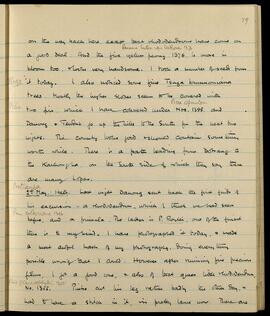
on the way back here, except that rhododendrons have come on a good deal. And the fine yellow peony (Paeonia lutea var. ludlowii) 1376, is more in bloom too, shows very handsome. I took a number of seeds from it today. I also noticed some fine Tsuga brunoniana trees. Mostly the higher slopes seem to be covered with two firs (Picea spinulosa), which I have collected under Nos. 1395 and

Danong & Tenduk go up the hills to the South for the next two nights. The country looks good & should contain something worth while. There is a path leading from Dotrang to the Karhongla, on the South side of which they say there are many Lopas.

Natrampa. 2nd May. Halt. Last night Danong sent back the first fruits of his excursion - a rhododendron, which I think we had seen before, and a primula (Primula calderiana 1396). The latter is P. Roylei, one of the finest there is to my mind. I have photographed it today, & made a most awful hash of my photographs, doing everything possible wrong that I could. However after ruining five precious films, I got a good one, & also of that queer little rhododendron, No. 1355 (Rhododendron glaucophyllum). Pimbo cut his leg rather badly the other day, & had to have a stitch in it, is pretty lame now. There are

LSH/1/1/6/1/85 · Part · 1938-06-22
Part of The Ludlow & Sherriff Collection

SUMMARY:
Travel and halts around Molo with heavy rain, abundant flowering noted, and a letter from Ludlow reporting good flower prospects and route constraints. Reports of the Singo Samba bridge being destroyed prompt local officials to plan repairs, and ponies are arranged by the Bharang Shiga Agent for the move to a camp on the Lilung Chu. Wireless news is heard during halts, with little collecting success on some days.

CONTENT:
To 24th June. Molo 7 miles. Fine in the morning, then heavy rain from 10.0 am on. Kucho had gone ahead yesterday to arrange transport at Pämse, so we did not have to wait this morning.

There is a great change here, and flowers abound. The hillside, south face, is covered with the big Androsace strigillosa var. canescens, and P. jaffreyana is out too, but only near Molo—it does not appear further up, until one gets a good long way above Pämse. Iris decora is common the whole way down from Pämse, and mixes with another here. A letter is here from Ludlow—from Tse 6th June. He seems to think that flowers will be extremely good down that way; already they have a fine lot of things, much better I fear than I have. I am very glad to get his news from there. The Tsela Dzongpen is alright but does not want them to go to Pemakö, only as far as the Doshong La. He also mentions how he thinks June is the month for rhododendrons and July and August for primulas. So we are not too late, but should walk into good stuff as soon as we leave Lilung. It all sounds very good, and most cheering to me, as I have been rather depressed about flowers this year. I cannot hear much about the Singo Samba bridge, but the locals here in Bharang Shiga say that the Langong people have destroyed it. The Pachakshiri gyinpon is here, and is determined the bridge shall be repaired, as he has to get back to Lalung.

25th and 26th June. Halt. Molo. Both days rainy, with some fine intervals, but no sun. I put up the wireless the evening I came here, and heard the news tolerably well. I also heard the 2nd Test match score, and to my surprise found I am a day out in my reckoning. Today should be the 27th and not the 26th. The mistake was probably made the day I left Molo, which should have been 25th May not 24th. It does not matter, and I will change the date on leaving here. We went down the R. bank today and got some quite good things, including Semiaquilegia ecalcarata. This afternoon I have tried to pack, but cannot get things to fit in anyhow.

27th June. Halt. Molo. Rain on and off all day. Found nothing of any interest.

To 29th June. Camp on Lilung Chu 9 miles. Heavy showers followed by bright intervals—mostly fair. The Bharang Shiga Agent produced his 12 ponies as promised yesterday evening, and three men from Molo with them, and we were all off at 8.0 and came along well, reaching here at 1.0 pm. The path is Picea spinulosa tree forest common in the side valley leading down to the Tsangpo river.

LSH/1/1/6/1/34 · Part · 1933-04-14 - 1933-05-17
Part of The Ludlow & Sherriff Collection

SUMMARY:
The party crossed the snow-bound Lo La at night, then traversed the Nyug La and Kargong La to reach Shalong by April 27, describing the Shalong plain and listing notable birds collected. On returning to Molo they secured Sclater's Monal on the south face of Lo La and, during May 17–24, recorded additional species, with marginal notes on pheasants and Picea spinulosa.

CONTENT:
17a. (from 16a).
'33 April 14 - May 24

At Molo we took immediate steps to cross the Lo La, a feat which the local people assured us was impossible so early in the year. But we were of a different opinion. Experience has taught us that most knife-edge passes over the main range can be crossed with ease at night when the snow is frozen. The Lo La proved no exception. Though snow still lay breast high for several miles on the northern slopes of the pass, we had scampered over this by dawn, and by sunrise were well down the southern slopes within the conifer zone. (April 24.)

Sclater's Monal was seen in rhododendron and fir forest just below the snow line, and Temminck's Tragopan in deciduous and Tsuga forest at a somewhat lower level.

We crossed the Nyug La (11,000) and the Kargong La (13,800) and pressed onwards through the densest rain forest along a most atrocious track to Shalong (6,300) which we reached on April 27.

Shalong is situated in the middle of an extensive plain about 8 miles long by a mile wide. At its northern end three streams unite to form the Siyom River, which flows quietly down the centre of the valley. On either side of the river are large areas covered with bracken and pasture land which have been cleared of forest. Excellent cattle graze on these open downs, which are hemmed in on all sides by luxuriant, almost impenetrable, rain forest.

We spent 10 days at Shalong (See p. 22-28) — a hopelessly inadequate period in which to study its avifauna. The most interesting birds procured were:

No. 78 Grammatoptila striata austeni
No. 70 Suthora fulvifrons chayulensis
No. 83 Leioptila pulchella nigroaurita
No. 84 Sibia (Actinodura?) nipalensis daflaensis
No. 197 Tribura luteoventris
No. 372 Hirundapus caudacutus nudipes
No. 379 Tragopan temminckii

[Marginal note: Large numbers of Crossoptilon or Blood Pheasants in the wood. Molo. R. vellereum 3623, R. hirtipes 3624]

On our return to Molo we halted for a day on the south face of the Lo La, where, at last, we succeeded in obtaining a good series of No. 376-377 Lophophorus sclateri (Sclater's Monal).

[Marginal note: Picea spinulosa 3627 very common]

During stay at Molo — May 17-24 came across:
No. 356-8 Spinus thibetanus Himalayan Siskin — 1st time L. D. had seen it.
No. 348-9 Loxia curvirostra himalayensis Himalayan Crossbill — also obtained in 1936.

Other interesting birds at Molo were:
No. 71. Sitta europaea tibetosinensis
No. 368. Picus canus kogo
No. 74. Ianthocincla maxima
No. 81. Fulvetta striaticollis striaticollis
No. 371. Psittacula derbyana Lord Derby's Paroquet.
No. 372. Paroquet

To 28a

LSH/1/1/3/3/81 · Part · 1936-03-10
Part of The Ludlow & Sherriff Collection

SUMMARY:
At Lepo the party halted for two days; Danong explored a stream from Chio Tso and found masses of Primula, while the diarist noted rhododendrons, firs and larch, and prepared mail. Rain limited finds the next day, though P. Boothii was abundant at waterfalls, and Lumsden took a shot at pintail ducks.

CONTENT:
38

7th April. Halt. Lepo. A lovely morning, fine up till about 4.0 p.m. Danong went up the nala coming from the Chio Tso, found there Primula 1186 in masses; also some unopened specimens of P. Boothii (?) & another primula only in leaf. I went up pretty high opposite camp, but only found the same denticulata-like primula with the white eye. There are a number of rhododendrons out, mostly barbatum & Thomsonii, & some others behind camp which are not yet in bloom. The hills are well covered with a mixture of fir & pine & rhododendron. The fir is a fine one 1286, growing to 100 ft or more. Mail will be sent off in the morning.

8th April. Halt. Lepo. Rain again nearly all day. I spent the morning out, but found nothing of any interest, nor did Danong. P. Boothii is in masses at most waterfalls; it is a fine sight when bunched together in big patches as it is beside water which always splashes it. I took a very fine specimen, 1292. There is a good deal of larch about just coming out now. Saw a few pintail duck & Lumsden had a shot at them. There are

Marginal Notes:
P. atrodentata 1290
P. Whitei 1186, 1291
P. macrophylla 1287
gracilipes 1292
Rh. barbatum
Rh. Thomsonii
Rh. Baileyi 1285
Picea spinulosa
P. gracilipes
P. gracilipes 1292
Larix griffithiana 1295