Showing 12 results

Archival description
12 results with digital objects Show results with digital objects
Trip to Chiniung La
LSH/1/1/6/1/81 · Part · 1938-06-20
Part of The Ludlow & Sherriff Collection

SUMMARY:
During a halt at Langong, two local men reconnoitred the Chiniung La, encountering deep snow, a half-frozen lake to the south, remains of Lopas on the pass, and few flowers, while the diarist records plant notes and a long circuit over the main range. That evening the gyimpon described local customs regarding Lopas and claimed that “Highburn Pk” near Tso Kar is the real Takpa Shiri; the writer wished to hear the account through Pintso but struggled to understand Kusho, who had been drinking chang. The party then moved to a camp south of the Tse La in heavy rain.

CONTENT:
Chiniung La
Trip to Chiniung La

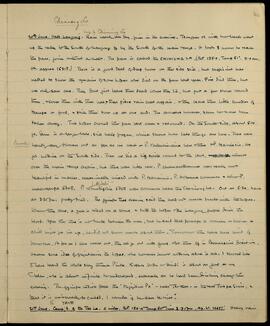
20th June. Halt Langong. Rain nearly all day, finer in the evening. Trompen or rather two locals went up the valley to the South of Langong to try the South of the main range. It took 3 hours to reach the pass, going without a halt. The pass is called the CHINIUNG LA, (BP. 185.0, Temp 51°. 9.0 am, Ht. approx 15318.) There is a good deal of deep snow on this side still, but sufficient has melted to show the remains of some Lopas who died on the pass last year. Five died there, but we only saw one. They don't just leave their dead where they lie, but put a few stones round them, cover them with their hats & their fibre rain coat affair, then leave them little bundles of tsampa or food, & stick their bow up at one end. The arrows however, seem to have been taken away. Two Lopas crossed this pass last week & returned. On the South side, about 500 ft. down is a large lake, still half frozen, which shows how late things are here. There were hardly any flowers out as far as we went - P. Valentiniana near others of P. tsariensis. We got nothing on the South side. Then we did a big circle round to the left, over the main range again, but there was little new. P. chamaethamna was really more beautiful in masses, occasionally mixed with P. tsariensis. P. Hobsonii common & also P. macrophylla 5608. P. rotundifolia 5606 was common near the Chiniung La. Out at 5.30, back at 3.30 pm. pretty tired. The gyimpon this evening said they had not much trouble with the Lopas. When they come, a yak is killed on a stone & both the Lopas & the Langong people drink the blood. After this there is no trouble between the men, but he said that perhaps a woman or two or a child might get hit up, he did not know much about them. Tomorrow they have some kind of tamasha. As far as I can make out, they all go out with guns & let them off in Pachakshiri direction. It seems some idea of frightening the Lopas, who however know nothing about it all. I should like to have heard the whole story through Pintso. Kushos Urdu or Hindi is about as good as my Tibetan, & he is almost impossible to understand, especially as he had been drinking chang this evening. The gyimpon insists that the "Highburn Pk" - near Tso Kar - is the real Takpa Shiri, & that it is universally so called. I wonder if he can be right?

21st June. Camp S. of the Tse La. 6 miles. BP. 186.4° Temp. 50° Time 3.30 pm. Ap. ht. 14457'. Heavy rain
LSH/1/1/6/1/75 · Part · 1938-06-15
Part of The Ludlow & Sherriff Collection

SUMMARY:
Notes on the Kyag Chu spring’s seasonal flow, a halt at Trashiying with poor weather, and a wet march to the Tsokang at Shacho Pebo in Tsari Sama. The diarist describes logistical issues with coolies and rations, and records abundant Primula and Rhododendron, including vast masses of P. valentiniana; blood pheasant chicks are noted.

CONTENT:
'Kyag Chu' or Indian spring. During the winter it does not flow - but is said to flow to India. On the 10th of the 4th Tibetan month it begins to flow here again. All the coolies washed in it as soon as they arrived.

14th June. Halt. Trashiying. Cloudy & rainy nearly all day. I went up the hillside E of camp for about 2000 ft or more, but the mist was very thick & decided not to traverse on to the head of the valley, which abounds in cliffs & has a good deal of snow still lying. We went over the ridge to the next valley & returned by the Trashi La. Very little seen of any interest. P. tsariensis everywhere, but no P. valentiniana. Mec. simplicifolia very common & good colour. Blood pheasant now have their chicks hatched out - one or two days old.

15th June. The Tsokang at Shacho Pebo, Tsari Sama. 7 1/2 miles. BP. 187.7°. Temp. 46°. Time 3.30 pm. Ht. app. 13576'.
A wet night last night, & a terrific downpour all day today, without a pause, with a strong wind. Yesterday evening one of my four coolies returned - with no rations - but with a chit to say the coolies were to return to Langong. This was not from the gyunpa but from his underling. He added that the Trashiying people would take me round Tsari, but ignored the fact that there are only five people there. Tsoupon-Kusho did some good work & for some rations - to be repaid in kind - from the locals, & my coolies - now 14 - agreed to come with me. It was raining hard at 4 am & has not yet stopped. I have seldom had such a bad day for weather, as there is a high wind with it all. We had hoped to cross to the South of the Himalayas, but this pilgrimage apparently keeps to the North. At first there was nothing at all to be found. Then we got into good country, & here it is very good, must be like the Lo La N. side, only a little higher. Of flowers, there is masses of P. Roylei (calcareum) - a very fine form - P. tsariensis, P. valentiniana, P. kongboensis, P. prenantha, P. pudibunda, P. elizabethae & others, besides one new to me - P. subularia 5561. Rhododendrons too are good, very interesting ones seen today, there are R. ludlowii 5555, & R. campylogynum (mekongense) 5560. Another nice one is one of the Glaucum Ser. (charitopes) No. 5565. The finest sight of all, is certainly P. valentiniana, which is in masses. We can see, when the mist rises a little, vast areas, coloured a deep wine red. I went this afternoon to have a look at it, & was amazed at how much there is. Beside it & among it are Rhodo. ludlowii (mekongense) & P. elizabethae. We reached here about 12 noon, all soaked to the skin. The

LSH/1/1/6/1/67 · Part · 1937-06-05
Part of The Ludlow & Sherriff Collection

SUMMARY:
The diarist describes views toward Pa La and Lanyong, debates whether the seen pass is Pa La or Lingtsangha La on the route to Migyitun, and notes a prominent peak likely the Migyitun Peak. Camping north of Chubumbu La, they record weather, altitudes, and fieldwork with Thompson, including bird specimens and several Primula and Omphalogramma finds, with a halt day spent revisiting the Chubumbu La.

CONTENT:
about 2 miles from here. From there we could see the Pa La & Lanyong. The Pa La lies at a bearing of 266° & Lanyong at 47°. I should say that the Pa La was further than Lanyong but not much. Again failed to find flowers, though P. tsariensis is in masses everywhere, P. dryadifolia common to the N. of the pass, some P. Valentiniana a mile South. This valley is said to lead to Migyitun, but we could not see how it does so. Shokakuling was bloody pleasant on the way up, but with bare patches. They must be sitting, but we could find no nests. Also collected two more Phylloscopus tibetanus & a flycatcher with eggs c/3. There is obviously nothing yet, this side of the main Range. There is a fine peak to the S. of the Pa La. Can it be the Pk. to the E of Migyitun - (N.E.?). I have heard that the Pass we saw today is not the Pa La but the Lingtsangha La, viz on the road to Migyitun. In that case the peak is almost certainly the Migyitun Peak. It is almost impossible to get information that one can rely on though. - Chubumbu La - see June 2.

6th June. Camp 2m N of Chubumbu La. B.P. 189.8° Temp 35° Time 3.0pm. Ht. approx. 12596'. Rained in the night up to 7.0am, then cleared & was a fine day with a good deal of sun till 3.0pm. Then mist & some rain, clearing up later. Some thunder yesterday evening & again this evening. Thompson & I went direct South from camp over the hills, but ran into a lot of mist, & so to get down to the valley we had a series of cliffs to negotiate. A valley comes in from the SW just above here, up it we went. The only real find was Omphalogramma minus 3970, which is fairly common on the edge of the last bit of abies forest. P. Valentiniana & P. Pauliana & P. tsariensis are coming everywhere. A nice little dwarf rhododendron was No. 3975, common about here, but nowhere else. Although reports of the Chubumbu La are not a bit favourable, we go over it tomorrow & hope for a fine day.

7th June. Halt. Misty, but fine nearly all day: some showers. Went up to the Chubumbu La, at mile 2. B.P. 187.2° Temp. 45° Time 7.30 am. Ht. approx 13900'. A good day on the whole. On our way up to the pass we came across a lot of what I had thought to be a new primula collected beyond the Lo La under No. 3762. At that time I could not make it out, but now I see it

LSH/1/1/9/1/143 · Part · 1933-09-01
Part of The Ludlow & Sherriff Collection

SUMMARY:
Notes reconsidering identifications of Primula specimens, suggesting 1937 L+S mixtures (3433–3437) are P. strumosa × P. calderiana hybrids rather than tsariensis, and discussing affinities among P. Barnardoana, elongata, involucrata, and alpicola. Mentions observations at Lussing La and references comments by Fletcher and a possible need to await Prof. Brown.

CONTENT:
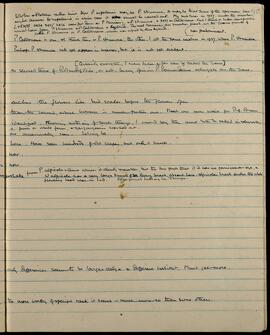
Words of Fletcher rather hint that P. nepalensis may be P. strumosa. It may be that some of the specimens here which answer to nepalensis, in which case it should be washed out. My mixtures in 1937, under the numbers L+S 3433, 3434, 3435, 3436 were put down as P. tsariensis, & P. strumosa, & 3437 as Calderiana. But I think a better identification would have been P. strumosa & P. Calderiana hybrids. The real tsariensis are smaller plants, and the coarse growth of either P. strumosa or P. Calderiana, which was copied in these hybrids, was predominant. P. Calderiana is one, I think this is P. strumosa, the other. I got the same mixture in 1937, where P. strumosa
Perhaps P. strumosa will yet appear in masses, but it is not yet evident.

[Certainly everything I have taken so far can be called the same]
as showed those of Rotundifoliae, or not. In my opinion P. Barnardoana & elongata are the same.

enclose the flowers like bud scales before the flowers open.
than the second, which however is much further on. Must one now wait for Prof. Brown
identified. Knowing nothing of such things, I would say they must both be called involucrata,
a pink or white form, or any orangeing washed out.
are occasionally seen. Lussing La.

here. Have seen hundreds of old scapes, but only 1 bunch.
now.
now.

unshakable from P. alpicola v. luna which it closely resembles, but the two facts that i) it has no farinaceous eye, &
ii) alpicola has a very large bunch of leafy bracts, absent here. alpicola bracts enclose the whole
flowering head when in bud. Also found Lussing La. Tsampa.

only differences seem to be larger calyx & different habitat. Must get more.

the more worthy of specific rank it seems - much more so than some others.

LSH/1/1/3/3/159 · Part · 1983-05-05
Part of The Ludlow & Sherriff Collection

SUMMARY:
A wet halt at Pang-Sunda where the diarist scouted the valley while Danang and Tsung-pen explored rocky slopes, collecting multiple Primula taxa and noting promising sites. Notes mention Rhododendron campylocarpum, Viburnum cordifolium, and Paraquilegia anemonoides. The next day they moved to Migitun via steep paths through mixed forest, recording conditions and elevations.

CONTENT:
77

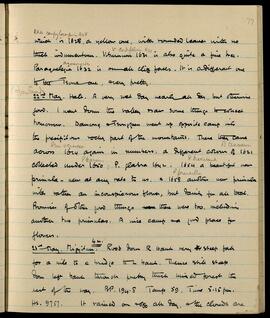
Rhod. campylocarpum 1628, which is 1628, a yellow one, with rounded leaves with no thick indumentum. Viburnum (V. cordifolium) 1631 is also quite a fine tree. Paraquilegia (anemonoides) 1632 is on all cliff faces. It is a different one to the Tsang one, very pretty.

Pang-Sunda
22nd May. Halt. A very wet day nearly all day, but otherwise good. I went down the valley and saw some things to collect tomorrow. Danang and Tsung-pen went up opposite camp into the precipitous rocky part of the mountains. There they came across 1614 (Prim. vernicosa) again in numbers: a different colour of 1621 (P. tsariensis) collected under 1650 (P. barnesii); P. glabra 1642 (P. dickieana). 1654 a beautiful new primula - new at any rate to us. And 1658 (P. prenantha) another new primula with rather an inconspicuous flower, but dainty for all that. Promises of other good things there were too, including another two primulas. A nice camp and a good place for flowers.

23rd May. Migitun. 4 m. Road down right bank, very steep path for a mile to a bridge to left bank. Thence still steep down left bank through pretty thick mixed forest the rest of the way. BP. 194.8 Temp 59. Time 5.15 pm. Ht. 9757. It rained on and off all day, and the clouds are

LSH/1/1/10/1/13 · Part · 1949-09-27
Part of The Ludlow & Sherriff Collection

SUMMARY:
Notes the arrangement of numbered plant specimens in bottom, middle, and top layers, with plans to add several Primula species. Describes a shift from mist to thunder and heavy rain, followed by a clear day on 26 September at Marlung, colder than Waitang, with yaks, dzopas, and mention of a local boy who had previously broken his arm.

CONTENT:
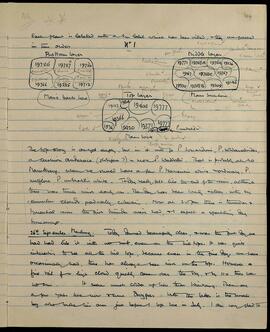
Each plant is labelled with a tin label which has been oiled, they are packed in this order.
No. 1

Bottom layer
19750 19757 19750
19766 19235 19712
Maus back here

Middle layer
19771 19768A 19764 19226
19167 19768C 19767
19330 19768B 19309 19146
Maus back here

Top layer
19123 19804 19404 19777
19366
19716 19420 19373 19722
Maus back

The top story is as yet empty, but in it will go P. tsariensis, P. soldanelloides, a cushion androsace (globifera?) - more P. Waddellii. That is probably all the Marlung, when we should have a few P. tsariensis white ordinary, P. uniflora, P. umbratilis white. Today really felt like the end of the rain, although there was much mist early on. The day has been lovely and clear, with big cumulus clouds gradually collecting. Now at 3.0 pm there is thunder and torrential rain, the first thunder we've had, and I expect a sparkling day tomorrow.

26th September. Marlung. Today dawned beautifully clear, and was the first day we had had like it with no mist, even on the hill tops. It was quite interesting to see all the hill tops, because even in the fine days we have occasionally had, there has always been mist on the tops. However a fine veil of high cloud quickly came over the sky, and by 11.0 there was no sun. It seems much colder up here than Waitang. There are a few yaks here now and some dzopas: with the latter is the small boy who broke his arm just before I left here in July. I am very glad to

LSH/1/1/6/1/141 · Part · 1936-10-02
Part of The Ludlow & Sherriff Collection

SUMMARY:
At Lo La, the diarist collected Primula and Rhododendron specimens around a small lake amid frost, snow, and sun, noting Jill’s reluctance to collect seeds and the coolies’ hardiness. On October 8 a halt was made; a circuit to the southwest of the lakes yielded a few bulbs, and Tsongpen arrived reporting difficulties obtaining ripe seed, fears of Lhopas on the route, and a theft problem with a dismissed man.

CONTENT:
Lo La. Oct 7. P. chamaethauma 6551, P. calderiana 6552, P. subularia 6553, tsangpoensis 6554.
Oct 8. Gent. hamberxii f. caulibaccans 6555, Rh. pumilum 6556, R. concatenans 6560.
Rh. lopsangianum 6561, 6567 R. lindleyi 6562, R. xeriflorum 6563, R. haysii 6565.
R. elatum 6568, R. brachyanthum v. hypolepidotum 6576, R. sulphureum 6580.
abrivale 6558, normaniana 6574.
laccata 6575, Omph. minor 6585.

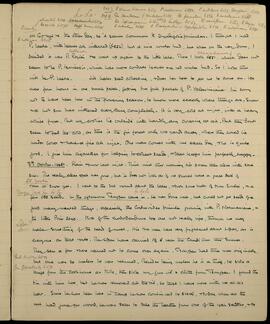
On Gonyi-re the other day, so it seems common to Omphalifolia primulas. I thought I had P. laeta, with leaves all withered (6552), but a nice winter bud, but when on the way down, I decided it was P. calderiana so went up again to the little lake. There I took 6551, which does not seem to be P. tsariensis, which has more cordate leaves & a red winter bud. So I hope this will be P. laeta. Jill hates seed collecting, & does her best to get me to come on. We were four hours in one small patch, getting two full packets of P. valentiniana. I'm sorry not to have been here in the flowering season, to know more exactly where things are. Snow & a hot sun has withered everything completely. It is very cold at night, with a heavy white frost. But my coolies lie outside with hardly any covering at all. But they don't seem to feel the cold, as there is the fir forest only 100 yards away, where they could lie under cover & have a fire all night. One man comes into me each day, this is quite good. I give him cigarettes for helping to collect seeds, & that keeps him perfectly happy.

8th October. Halt. Rain & snow last night. Thick mist this morning till 9.00 am then clear with some sun. The really clear spell has gone, but it does not look as if we should have a great deal of rain or snow yet. I went to the SW round about the lakes, & took some bulbs of Nom. souliei, & a few odd seeds. In the afternoon Tsongpen came in. He has done well, but could not get seeds of a good many wanted things, especially the Cortusoides primula growing with P. normaniana, & the little Prim 3640. Most of the rhododendrons too are not really ripe, though we may make something of the seeds of most. His two men were very frightened about Lhopas, as is everyone on that route. The Lhopas have carried off 5 near the Chudi-Cun this summer. They saw a few & were warned not to come over again. Tsongpen had three men originally, but one was so useless he was returned. Besides being useless he is a thief. He stole a knife from the cookhouse at Molo, then stole my gun oil & cloth from Tsongpen. I found the tin with him here, but he has removed all the oil, so that I have none with me at all now. Since he has been here in camp he has continued to steal, & today when all the rest had gone for wood, he was seen to take the leather from one of the yak saddles, & to...

LSH/1/1/9/1/129 · Part · 1933-09-01
Part of The Ludlow & Sherriff Collection

SUMMARY:
The diarist manages specimens and arranges penicillin injections for Danang in hospital, while noting a letter from Ludlow via Yundu confirming successful plant finds. Plans are made for travel to meet Ludlow at Pasu Sefu and for Pasang and Mundrup to collect primulas via Tumle La, Tongsa, Chendesi, and Ritang, with mention of a hoped-for bridge over the Tang Chu.

CONTENT:
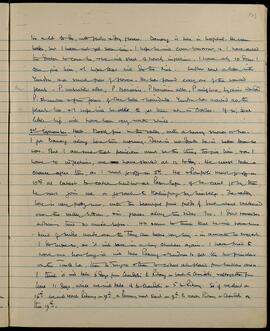
I've a lot to do, with photos and dry flowers. Danang is here in hospital. He seems better, but I have not yet seen him. I hope he will come tomorrow, as I have asked the doctor to come too, and will start 4 hourly injections. I have only 10 doses I can give him, and hope that will do the trick. Ludlow sent a letter with Yundu, and a small press of flowers. He has found every one of the wanted plants - P. umbratilis alba, P. tsariensis, P. tsariensis alba, P. uniflora, Lychnis Wardii, P. strumosa and fine forms of Meconopsis horridula. Yundu has marked all the plants too, and I hope will be able to get them all in October. If so, that little trip will have been very worth while.

2nd September. Haat. Mostly fine in the valley, with a heavy shower or two. I got Danang along here this morning. There is no doubt he is better than he was. But I am sure that penicillin must be the thing to give him, as I have 10 injections, we have started at 12 today. He must take a chance after this, as I must go off on 5th. He and Sompoli must go off on 10th at latest to catch Ludlow at Pasu Sefu. If he can't go by then, he must join me or go back to Kalimpong by himself. The valley here is very pretty now, with the beautiful pink fields of buckwheat scattered over the valley bottom, and in places along the sides too. I don't remember noticing this so much before. HH seems to think that he will have some kind of bridge made over the Tang Chu before very long - in a month he suggests. I do hope so, as it will save us a long chukker again. I have tried to work out how long it will take Pasang and Mundrup to get the two primulas on the Tumle La, then to Tongsa and then to collect all plants from Ludlow's area. I think it will take 6 days from Chendesi to Ritang or back to Chendesi, and altogether from here 11 days, which will take 4 to Chendesi or 5 to Ritang. So if we start on 15th we will reach Ritang on 19th, and Pasang must start on 9th to reach Ritang or Chendesi on the 19th.

LSH/1/1/7/1/13 · Part · 1940-05-24
Part of The Ludlow & Sherriff Collection

SUMMARY:
The writer describes difficult access near a Himalayan pass, noting most rhododendrons were over, while several primulas remained in flower, including a new species later named P. tsangpoensis. After retreating to the drier Tsangpo valley, they explored a nearby spur called Go ngi re, recording diverse alpine plants and collecting seed with the help of a hopa.

CONTENT:
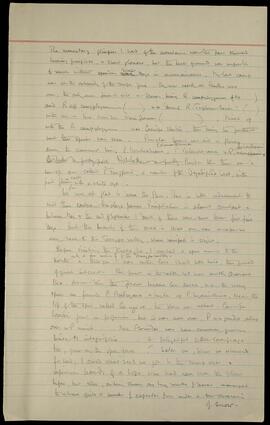
The momentary glimpses I had of the mountains near the pass showed towering precipices and short glaciers, but the best ground was impossible to reach without spending some days in reconnaissance. The last camp was at the extremity of the conifer zone. By now nearly all Rhodos were over, the only ones found still in flower being R. campylogynum (No. ) and R. aff. campylogynum ( ) and a dwarf R. Triflorum series? ( ) with one or two crimson neriiflorum ( ). Mixed up with the R. campylogynum was Cassiope wardii, this being the furthest west this species was seen. Primulas however were still in flower, among the commonest being P. morsheadiana, P. chamaethauma, P. valentiniana and P. tsariensis. Besides this there was a new sp. now called P. tsangpoensis, a member of the Dryadifolia section, with pink flowers each with a white eye.

We were all glad to leave the Pass. There is little inducement to visit these eastern Himalayan passes. Precipitation is almost constant between May and the end of September; I doubt if there were more than five fine days. But the beauty of the area is that one can escape so easily back to the Tsangpo valley, where rainfall is slight.

Before visiting the Kucha La, I worked a spur only a few miles N. of the Tsangpo valley. Though I was rather late and had little time, this proved of great interest. The forest in the valley bed was mostly Quercus ilex. Above this the forest became less dense, and on the rocky spurs we found P. baileyana, and higher up P. hyacinthina. Near the top of the spur, called Go ngi re, the flora was richest. Cassiope wardii grew in profusion, but it was now over, P. unijuga also over and of merit. Meconopsis florindae was here common, growing beside M. integrifolia. A delightful little saxifrage too, grew on the open scree. Later on, when we returned for seed, I owed what seed we got to the sharp eyes and unwearying hands of a hopa who had never seen the plant before, but who, on being shown one tiny rosette of leaves, managed to retrieve quite a number of capsules from under a thin covering of snow.

LSH/1/1/9/1/64 · Part · 1949-06-01
Part of The Ludlow & Sherriff Collection

SUMMARY:
The party contoured the hillside from the fir forest up to Lussing La, then entered the Panggetangka valley toward the Rufo Zam, finding only three small plant specimens and considering a stay due to transport being requisitioned. The writer rode a yak cautiously. A letter from Betty reports two primulas that Tsangpo does not remember, and Ludlow mentions a curious Petiolarid.

CONTENT:
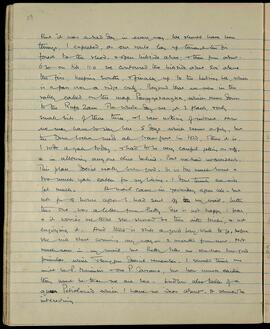
But it was a sad day in every way. We should have seen things, I expected, as our route lay up through the fir forest to the rhod. & open hillside above, & then from above. 6.30 am till 11.0 we contoured the hillside about 500' above the firs, keeping south, & finally up to the Lussing La, which is a pass over a ridge only. Beyond that we were in the valley called on the map Panggetangka, which runs down to the Rufo Zam. The whole day we got 3 plants, only small bits of these three, & saw nothing of interest. Now we may have to stay here 5 days, which seems a pity, but the Druk Locha needs all transport in tow, & there it is. I rode a yak today, & had to be very careful getting on & off, & in allowing anyone close behind. But we had no accidents.

This place doesn't really look good. It is too much scrub & too much yak-eaten for my liking. I don't think we will get much. A mail came in yesterday after all - but not for 4 hours after I had sent off my mail. With this one was a letter from Betty. She is not happy I fear, & it worries me that she should be there with Hicks, & not enjoying it. And there is still a good long while to go, before she will start coming my way - 2 months from now. Not much news in my mail, but Betty tells me she has two good primulas, which Tsangpo doesn't remember. I should think one might be P. tsariensis & one P. caveana, but how much earlier they must be than we are here. Ludlow also talks of a queer Petiolarid which I have no ideas about. It should be interesting.