
Mostrando 3 resultados

Descripción archivística
3 resultados con objetos digitales Muestra los resultados con objetos digitales
LSH/1/1/3/3/201 · Part · 1996-06-18
Parte de The Ludlow & Sherriff Collection

SUMMARY:
Notes from Shagam La (next to Tame La) describe heavy snow and a difficult descent, with several primulas and gentians collected (nos. 2184–2189), including Meconopsis var. lutea noted as from Mipa rather than the Tawang district. Mentions a previous sighting of Pyrrhocorax at 16,000 ft and that a 'big bug' from Lhasa is expected tomorrow.

CONTENT:
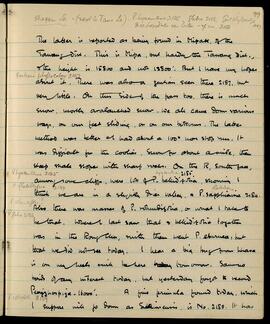
Shagam La - (next to Tame La). P. hyacinthina 2185, Glabra 2186, Gent. phyllocalyx 2187
Meconopsis var. lutea - of no. 2188

The latter is reported as being found in Mipak, of the Tawang dist. This is Mipa, but hardly the Tawang dist., the height is 15800 and not 13800'. But I have my hopes about it. There was also a gentian seen there 2187, but very little. On this side of the pass too, there is much snow, mostly avalanched snow. We all came down various ways, on our feet sliding, or on our bottoms. The latter method was better and had about a 100' non stop run. It was difficult for the coolies. Snow for about a mile, then steep shale slopes with sharp rocks. On the R, South face, among some cliffs, were lots of P. bellidifolia, showing I think we are in a slightly drier valley, a P. sapphirina 2184.

Also there were masses of P. rotundifolia, or what I take to be that. Where I last saw that & bellidifolia together was in the Rong Chu, with them went P. eburnea, but that we did not see today. I hear a big bug from Lhasa is on my heels and will be here tomorrow. Saw no birds of any interest today, but yesterday forgot to record Pyrrhocorax - 16000'. A fine primula found today, which I suppose will go down as sikkimensis, is No. 2189. It has...
LSH/1/1/7/1/13 · Part · 1940-05-24
Parte de The Ludlow & Sherriff Collection

SUMMARY:
The writer describes difficult access near a Himalayan pass, noting most rhododendrons were over, while several primulas remained in flower, including a new species later named P. tsangpoensis. After retreating to the drier Tsangpo valley, they explored a nearby spur called Go ngi re, recording diverse alpine plants and collecting seed with the help of a hopa.

CONTENT:
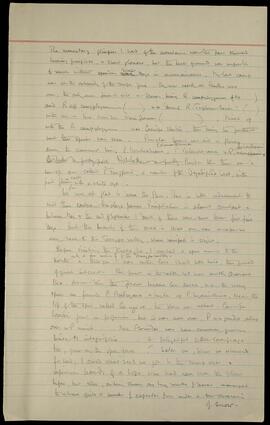
The momentary glimpses I had of the mountains near the pass showed towering precipices and short glaciers, but the best ground was impossible to reach without spending some days in reconnaissance. The last camp was at the extremity of the conifer zone. By now nearly all Rhodos were over, the only ones found still in flower being R. campylogynum (No. ) and R. aff. campylogynum ( ) and a dwarf R. Triflorum series? ( ) with one or two crimson neriiflorum ( ). Mixed up with the R. campylogynum was Cassiope wardii, this being the furthest west this species was seen. Primulas however were still in flower, among the commonest being P. morsheadiana, P. chamaethauma, P. valentiniana and P. tsariensis. Besides this there was a new sp. now called P. tsangpoensis, a member of the Dryadifolia section, with pink flowers each with a white eye.

We were all glad to leave the Pass. There is little inducement to visit these eastern Himalayan passes. Precipitation is almost constant between May and the end of September; I doubt if there were more than five fine days. But the beauty of the area is that one can escape so easily back to the Tsangpo valley, where rainfall is slight.

Before visiting the Kucha La, I worked a spur only a few miles N. of the Tsangpo valley. Though I was rather late and had little time, this proved of great interest. The forest in the valley bed was mostly Quercus ilex. Above this the forest became less dense, and on the rocky spurs we found P. baileyana, and higher up P. hyacinthina. Near the top of the spur, called Go ngi re, the flora was richest. Cassiope wardii grew in profusion, but it was now over, P. unijuga also over and of merit. Meconopsis florindae was here common, growing beside M. integrifolia. A delightful little saxifrage too, grew on the open scree. Later on, when we returned for seed, I owed what seed we got to the sharp eyes and unwearying hands of a hopa who had never seen the plant before, but who, on being shown one tiny rosette of leaves, managed to retrieve quite a number of capsules from under a thin covering of snow.

LSH/1/1/4/1/7 · Part · 1936-07-02
Parte de The Ludlow & Sherriff Collection

SUMMARY:
Field observations around Kyimpu noting numerous flowering plants and seed collections, including Roscoea alpina, Deutzia hookeriana, Stellera chamaejasme, and Meconopsis bella. A supposed crane’s eggs find proved to be partridge; later, the party halted with rain, bought a sheep, and walked toward the Le La. The locals are described as friendly.

CONTENT:
Kyimpu July 3. Roscoea alpina 2275. Onosma hookeri 2276, Stellera chamaejasme 2277 (113
Deutzia hookeriana 2279, Pedic. longiflora var tubiformis 2282, Mec. bella 2283

...a crane's eggs, but when he brought them, they turned out only to be those of a partridge, a great disappointment. There were four in the nest, of which he broke one.

A good many flowers on the way up, lots of the Primula jeffreyana 2257, of walshii 2256 just below Kyimpu 2258. Also of the Incarvillea lutea 2252 of which I took some of last year's seeds, which appear to be good. P. atrodentata is in seed too, of which I took a lot of that. Mec. bella 2283 is in flower here, others up here. There is a nice little Deutzia hookeriana 2279 in the rocky gorge between the two bridges, which is both fragrant and pretty. And the Stellera 2277 is a nice little thing, looking prettiest when it is half out—red in the centre of the buds, contrasting with white of the open corolla all around. I think we should do well up here. The locals are all a friendly lot for anything as far as I can see.

4th July. Halt. More or less fine till 1130, then heavy rain most of the day. Bought a sheep for Rs 3/-. We all went up towards the Le La, turning off right before reaching it. P. hyacinthina 2294 is very common.