Mostrar 3 resultados

Descrição arquivística
3 resultados com objetos digitais Mostrar resultados com objetos digitais
Camp above Mirando-Gompa, 13 August
LSH/1/1/6/1/119 · Part · 1933-07-27
Parte de The Ludlow & Sherriff Collection

SUMMARY:
At a camp about half a mile above Mirando-Gompa, the party experienced fine weather until heavy afternoon showers, with coolies arriving very late. They met pilgrims, recorded several alpine plants including Meconopsis florindae, Cyananthus lobatus var. insignis, and Notholirion campanulatum, and planned three days to work nearby hills before turning toward the Mria La.

CONTENT:
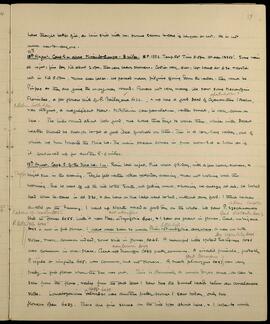
have thought better of it, as he is still with us. No-one seems to care if he goes or not. He is not much use to anyone.

13th August. Camp 1/2 m above Mirando-Gompa. 8 miles. B.P. 18.82. Temp. 50° Time 6.0 p.m. Ht app. 13350'. Some rain at night: fine day till about 2.0 p.m., then very heavy showers. Coolies very slow; left camp at 6.30 and coolies not in till 5.0 p.m., some even later. We passed many pilgrims going down the valley: they must be Ponpas as they are going the wrong way round. Flowers not very many. We saw some Meconopsis florindae, a few flowers still of P. baileyana 6034, and up here a good deal of Cyananthus lobatus var. insignis, a magnificent plant. Notholirion campanulatum, rather small, is very common here. The hills round about look good, we have three days to work them, which with decent weather should be enough to get a good idea of what's on them. This is a very long valley, out of which we turn toward the Mria La. The main stream comes in from more S and looks as if it continued up for another 5-6 miles.

13th August. Camp S. of the M
Flora near Kucha La and Tsangpo valley spur (Go ngi re)
LSH/1/1/7/1/13 · Part · 1940-05-24
Parte de The Ludlow & Sherriff Collection

SUMMARY:
The writer describes difficult access near a Himalayan pass, noting most rhododendrons were over, while several primulas remained in flower, including a new species later named P. tsangpoensis. After retreating to the drier Tsangpo valley, they explored a nearby spur called Go ngi re, recording diverse alpine plants and collecting seed with the help of a hopa.

CONTENT:
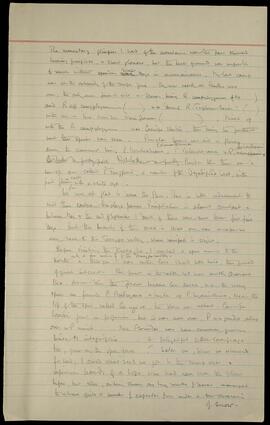
The momentary glimpses I had of the mountains near the pass showed towering precipices and short glaciers, but the best ground was impossible to reach without spending some days in reconnaissance. The last camp was at the extremity of the conifer zone. By now nearly all Rhodos were over, the only ones found still in flower being R. campylogynum (No. ) and R. aff. campylogynum ( ) and a dwarf R. Triflorum series? ( ) with one or two crimson neriiflorum ( ). Mixed up with the R. campylogynum was Cassiope wardii, this being the furthest west this species was seen. Primulas however were still in flower, among the commonest being P. morsheadiana, P. chamaethauma, P. valentiniana and P. tsariensis. Besides this there was a new sp. now called P. tsangpoensis, a member of the Dryadifolia section, with pink flowers each with a white eye.

We were all glad to leave the Pass. There is little inducement to visit these eastern Himalayan passes. Precipitation is almost constant between May and the end of September; I doubt if there were more than five fine days. But the beauty of the area is that one can escape so easily back to the Tsangpo valley, where rainfall is slight.

Before visiting the Kucha La, I worked a spur only a few miles N. of the Tsangpo valley. Though I was rather late and had little time, this proved of great interest. The forest in the valley bed was mostly Quercus ilex. Above this the forest became less dense, and on the rocky spurs we found P. baileyana, and higher up P. hyacinthina. Near the top of the spur, called Go ngi re, the flora was richest. Cassiope wardii grew in profusion, but it was now over, P. unijuga also over and of merit. Meconopsis florindae was here common, growing beside M. integrifolia. A delightful little saxifrage too, grew on the open scree. Later on, when we returned for seed, I owed what seed we got to the sharp eyes and unwearying hands of a hopa who had never seen the plant before, but who, on being shown one tiny rosette of leaves, managed to retrieve quite a number of capsules from under a thin covering of snow.

LSH/1/1/7/1/15 · Part · 1940-05-24
Parte de The Ludlow & Sherriff Collection

SUMMARY:
The diarist describes a first view of the Gyamda Chu joining the Tsangpo near Tsela Dzong and a trip via the Kulu Phu Chu to Kuchala before going to Tse. With transport arranged by the Dzongpen of Tsela Dz, Ludlow went alone toward Pasum La and Tongyuk Dzong in Pome while the diarist and Taylor explored west of the Gyamda Chu, camping near the Shura La and noting several gentians and other alpine plants.

CONTENT:
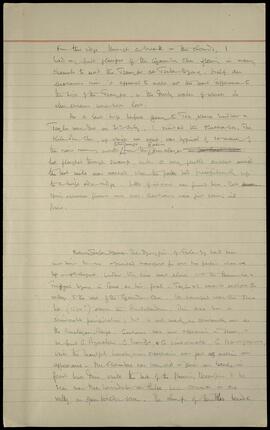
From this ridge, through a break in the clouds, I had my first glimpse of the Gyamda Chu, flowing in many channels to meet the Tsangpo at Tsela Dzong. Half an enormous river, it appeared to make not the least difference to the size of the Tsangpo, in the dirty water of which its clear streams were soon lost.

As a last trip before going to Tse, where Ludlow & Taylor were due on 31st July, I visited the Kuchala. The Kulu Phu Chu, up which we went, was typical of so many of the rivers running north to the Tsangpo from the Eastern Himalayas. We ploughed through swamp, with a very gentle ascent until the last mile was reached when the path led precipitously up to a knife edge ridge. Little of interest was found here. Most spring & summer flowers were over: Gentians were just coming into flower.

The Dzongpen of Tsela Dz had been most kind to us & provided transport for our two parties when we left on 10th August. Ludlow this time went alone with the Pasum La & Tongyuk Dzong in Pome as his goal. Taylor & I were to explore the valleys to the west of the Gyamda Chu. We camped near the Shura La (15,700?) above the Rhododendrons. This area has a considerable precipitation, but is not nearly so constantly wet as the Himalayan Range. Gentians were now appearing in flower, & we found G. przewalskii, G. sherriffii & G. sino-ornata, G. tsarongensis, while the beautiful Lomatogonium oreocharis was just making an appearance. Meconopsis florindae was seen still in flower on banks in forest lower down, while the last of the flowering Meconopsis to be seen was M. horridula var. lutea, here common in one valley, on open boulder scree. The clumps of thistles beside