
Showing 4 results

Archival description
4 results with digital objects Show results with digital objects
LSH/1/1/6/1/143 · Part · 1936-10-02
Part of The Ludlow & Sherriff Collection

SUMMARY:
The diarist reports from Singo Samba and then Trashidzong/Tsari Sama, noting misty and rainy weather, limited finds of rhododendrons and primulas, and heavy grazing by yaks that destroyed desired Meconopsis and Primula stands. Plans are made to leave kit with one man and proceed lightly with eight coolies around Tsari Sama, while noting Ludlow and Taylor’s move from Kyimdong toward the Bimbi La to target several Meconopsis species; the pilgrim season at Sacha Peso appears over.

CONTENT:
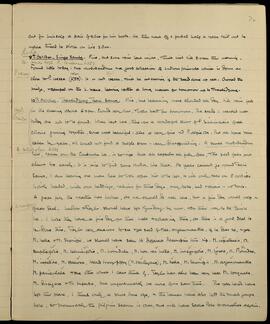
cut for himself a pair of soles for his boots. He then went off & pulled half a yak's tail out to make thread to stitch on his soles.

9th October. Singo Samba. Fine, but some rain last night, thick mist till 8.00am this morning. Found little today: two rhododendrons & a good collection of Ludlow's primula which is down as close to P. ioessa (3789). It is not ioessa, will be interesting if the seed come up well. Crossed the ridge, recamped on the L. bank, leaving rather a long march for tomorrow up to Trashidzong.

10th October. Trashidzong, Tsari Sama. Fine, but becoming more clouded all day, till rain fell in the evening about 5.0pm. Clouds very low, looks bad for tomorrow. The seeds I wanted most today are not to be found. When last here, there was a wonderful show of P. sikkimensis of all colours growing together, some most beautiful: also a very fine red P. alpicola. But all have been eaten by yaks, or dried up - not find a single stem - very disappointing. A small rhododendron here, taken on the Chumbumbu La, is so ripe that all capsules are fully open, the seed falls out almost too easily. It is nice to find some rhodos. like that. As yaks cannot go round Tsari Sama, I am leaving one man here to look after kit to be left, & will only take on 8 coolies lightly loaded, with our beddings, rations for three days, camp table, bed & chair - no tents.

A great pity the weather has broken, as we should do well here, but a fine day would help a great deal. Ludlow & Taylor should have left Kyimdong by now, for their way to the Bimbi La. I hope they have a fine day for their halt & collecting there, as there is a good deal to be done there. Taylor very anxious to see & get seed of Meconopsis argemonantha. If he does so, & gets M. bella & M. sherriffii, we should have seen 16 different Meconopsis this trip. M. nepalensis, M. simplicifolia, M. betonicifolia, M. horridula, M. hor. var lutea, M. integrifolia, M. lyrata, M. florindae, M. impedita, M. speciosa, Ward's ivory poppy (M. harleyana), M. bella, M. sherriffii, M. argemonantha, M. paniculata & one other which I can't think of. Taylor has also been very near M. torquata, M. discigera & M. superba, but unfortunately we none of us saw them. The yak herds have left this place, I think only a short time ago, & the lamas have also left the small gompa here, so presumably the pilgrim season is over, & we will have Sacha Peso to ourselves again.
LSH/1/1/3/3/199 · Part · 1996-06-18
Part of The Ludlow & Sherriff Collection

SUMMARY:
Field notes record Primula species near Mipa, a description of the Mipa valley, a pilgrim with a goat and a sheep, and another Anthus nest with three eggs. On 20 June at Tama La (via Shagam La), the party found P. dryadifolia on cliffs and a yellow Meconopsis (2188), likely M. horridula var. lutea.

CONTENT:
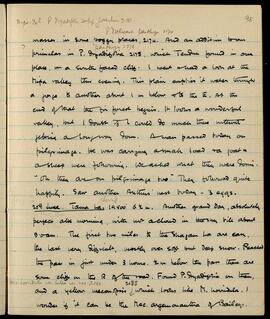
Mipa - 20th. P. dryadifolia subsp. jonarduni 2181.
P. dickieana pantlingii 2174

masses in some boggy places, 2174. And an addition to our primulas in P. dryadifolia 2178 (pantlingii 2178), which Tendrup found in one place, on a south-faced cliff. I went and had a look at the Mipa valley this evening. This plain empties its water through a gorge to another about 1 m below it to the E. At the end of that the fir forest begins. It looks a wonderful valley, but I doubt if I could do much there without getting a long way down. A man passed today on pilgrimage. He was carrying a small load and a goat and a sheep were following. We asked what they were doing. "Oh they are on pilgrimage too." They followed quite happily. Saw another Anthus' (Sherriff) nest today - 3 eggs.

20th June. Tama La. 14500' 6 ½ m. Another grand day, absolutely perfect all morning, with not a cloud in the sky till about 9.00 am. The first two miles to the Shagam La are easy, the last very difficult, mostly over soft but deep snow. Reached the pass in just under 3 hours. ½ m below the pass there are some cliffs on the R of the road. Found P. dryadifolia on them, and a yellow meconopsis (2188) which looks like M. horridula. I wonder if it can be the Mec. argemonantha of Bailey.

(Mec. horridula var. lutea var. nov. 2188)

LSH/1/1/8/1/19 · Part · 1946-11-14
Part of The Ludlow & Sherriff Collection

SUMMARY:
The diary records movements from the east side of Kongbo-nga La via Mye to Shu, with delayed coolies and negotiations for transport. It notes forest and plant observations near the pass, attempts to contact Gyantse and Ford by wireless, strong winds, and halts on 1–2 Dec due to uncertain transport.

CONTENT:
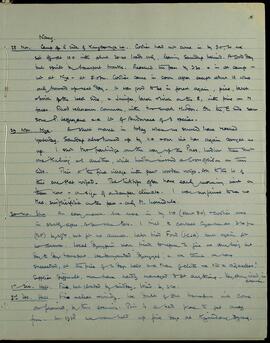
Nang.

28 Nov. Camp on E side of Kongbo-nga La. Coolies had not come in by 9.0, so we set off at 10.0 with about 30-40 loads only, leaving Samdup behind. A good day but spoilt by transport trouble. Reached the pass by 2.30 & in at camp - not at Nye - at 5.0pm. Coolies came in soon after except about 15 who only turned up next day. It was good to be in forest again, pine, larch & birch on the west side, & juniper, larch & birch on the E, with pine on N faces. Rhod. vellereum common, with two small Rhodos. On the E side saw some P. jaffreyana & a lot of Androsace of 3 species.

29 Nov. Mye. A short march in today where we should have reached yesterday. Samdup also turned up by 11.0 & our kit has again caught us up. I saw two partridge on the way up the Pass. Ludlow then saw one 'Kuling' & another, while Ludlow missed a Crossoptilon on this side. This is the first village with pent wooden roofs. All to the W of this are flat roofed. The hilltops often have early morning mist on them now - a sign of a damper climate. I was surprised to see no Mec. simplicifolia on the pass - only M. horridula.

30 Nov. Shu. An easy march. We were in by 1.0 (start 8.0) & coolies were in shortly after. A few were late. I tried to contact Gyantse at 3.30 pm (BT) by W/T, but got no answer. Later tried Ford (TASA) but again got no answer. Local Dzongpon's man tried to refuse to give us anything but day to day transport. We demanded 'Dzongyel', & we think we have succeeded, at the price of 2 days halt & a than of cloth & ten cigarettes! Supplies difficult, & we have hardly managed to get anything. Very strong wind in evening.

1st Dec. Halt. Fine, but clouded by midday. Wind by 2.30.

2nd Dec. Halt. Fine & clear & windy. We doubt if our transport will come as promised, by this evening. This is a bad place to get away from - in 1938 we were held up five days at Kyimdong Dzong.

LSH/1/1/2/1/133 · Part · 1933-07-18
Part of The Ludlow & Sherriff Collection

SUMMARY:
The diarist records finding three beautiful primulas growing under overhanging rocks near the CHO LA/Tulung La and photographing them despite late-afternoon mist. The route is said not to have been previously travelled by Europeans and is famed as the path by which Lobpön Rimpoché entered Tibet from India, with a note that CHO LA should likely be written as CHÖ.

CONTENT:
from Tsona to Dongkar were here. Besides M. horridula there were a number of the Tulung La little meconopsis. Two gentians were in seed and were collected on the CHO LA. Down this side we both thought of Prim. eburnea, and within a few minutes came across it. It was growing in a typical situation, under overhanging rocks and in clefts of rocks. It is certainly a beauty. Beside it, in even more pronounced clefts and more under overhanging rocks, was a, to us, new primula. It is also a beauty, very delicate and very sweet scented. It looks like a greenhouse cineraria. With these two again in similar situations, was a third primula — the Seti primula collected on the way to Mago. All three are beauties and all three grow in the same habitat. I took photos of all, but it was late — 4:00 pm by our time — and the mist was low which was very difficult. Results reasonably good.

For other reasons this is an interesting route. It has not been travelled before by Europeans. It is famed as the route by which Lobpön Rimpoché entered Tibet from India when he introduced Buddhism to Tibet. He stopped between the CHO LAs. For that reason the CHO LA should probably be written CHÖ, meaning "religious".