Showing 9 results

Archival description
9 results with digital objects Show results with digital objects
LSH/1/1/9/1/12 · Part · 1949-07-30
Part of The Ludlow & Sherriff Collection

SUMMARY:
Notes discussions with H.H. on a new treaty affecting Bhutan, mention of Tasho Jigme’s freedom to travel, and soldiers sent up the Bumthang road to collect flowers including Prim. bracteosa, a Magnolia, and a Daphne. On 8th April they watched Bhutanese dancers and later hosted H.H. for a long session reminiscing about Calcutta and P.O.'s Gould, Williamson, Bailey, and Bell; letters from Kalimpong reported Ludlow’s departure and Norman’s sale of Glenulli.

CONTENT:
almost 300." I hope something may be done, because certainly already many lakhs of rupees worth of damage has been done in the last 30 years or so. H.H. was undoubtedly interested, & doubly so as the new Treaty, although it promises 5 lakhs of cash annually to Bhutan, also says this may be stopped at any time if the Treaty is not kept. This sounds like a convenient loophole. We also talked about Tasho Jigme, & H.H. said that he could travel where he liked in Bhutan. I still hope to have further talks, as H.H. seems to like it. H.H. sent three soldiers up the Bumthang road to see what flowers they could get, & they brought back Prim. bracteosa, a Magnolia & a Daphne that were interesting.

8th April. Our time here has not all been lazy. H.H. has entertained us fully & we have entertained him too. We were down on 6th to watch Bhutanese dancers, male & female, & the next day we had H.H. up for a good long session, 1.0pm till 5.30. He was then in great form reminiscing, mostly about his Calcutta visit & various doings of P.O.'s Gould, Williamson, Bailey or Bell. Mostly he talks of Bailey, of whom he certainly has the highest opinion. He would very much like to see Bailey again, & thinks he may come here sometime yet. I know Bailey is anxious to come, & if he does, he will get a welcome. We have not bothered much about flowers, but took a few more yesterday from round about, including Albizzia Sherriffii (18657), which is a fine tree. Tobgye sent a few letters on from Kalimpong, which arrived yesterday. No special news, except that Ludlow got off alright, & that Norman had sold Glenulli.
LSH/1/1/8/1/65 · Part · 1947-02-20
Part of The Ludlow & Sherriff Collection

SUMMARY:
Steep ascents and descents through dense forest with limited views due to Tsuga and rhododendrons; a Daphne tree in full bloom and a flock of pigeons are noted. Locals bring a fowl, radishes, and milk and prepare a camp; the party crosses TANA LA and HOJA LA to TSAKCHUGONG with glimpses from R. Sanglung to the Gyala Peri range, and the locals are described as Bhutanese and healthier than upper Po-Tsangpo Tibetans.

CONTENT:
Feb. 22. Luculia pinceana 12240. Brassaiopsis karmelane sp. nov. 12244 Rhod. tanastylum 12246. 59

over 8000', then equally steep descent this side. Most of the march was today through dense forest, with some clearings made for cultivation. The pass is on a knife edge ridge, the view from the pass - if one could see it clearly - would be one which we would have to go far to beat. But there are many large Tsuga trees & Rhodos too, which block the view, except in little patches. On the pass we found one Rhodo in flower, one Daphne tree in full bloom. I have never seen the latter before - a tree of 15-18 ft with a trunk about 6" in diam. On the way up we saw one flock of 6 pigeons - the first I remember seeing in Tibet, other than the snow pigeons & the ones on the plateau. Luculia pinceana is common & we found one other Rhodo in bud, just about to flower. Locals came from tomorrow's stage to meet us here & brought a fowl, radishes & milk & prepared a place in thick forest for our tents. There are no houses here, only small level patches in dense forest. Habits as well as looks of locals seem to recall Bhutanese. They are also much healthier than the Tibetans of the Kigong upper Po-Tsangpo, & are stronger & cleaner. There is a very high cliff from the Karmala ridge down to the river, and the river here appears very narrow indeed. There are falls here of perhaps 20 ft.

23rd Feb. TSAKCHUGONG. Another perfect day, with clouds only coming up in the evening. We left at 7.00 am & walked fairly fast to the Pass. But again we could see nothing from the actual pass, owing to trees. The ascent is very steep & long taking about 1 1/2 hours. There are at the top some magnificent Tsuga & pine trees, which I estimate to be over 200 ft high. We saw no flowers at all, but had glimpses of the truly magnificent range here & there - from R. Sanglung to the westernmost of the Gyala Peri range. I took one or two photos with the early morning light, when it was particularly beautiful. The pass is called the TANA LA, & on this side there is a subsidiary pass called the HOJA LA. The Pangyuta of Ward is beside camp in TSAKCHUGONG only over a very small ridge. The locals again are stronger, cleaner & finer men than further up the valley. They are Bhutanese.

LSH/1/1/9/1/133 · Part · 1933-09-01
Part of The Ludlow & Sherriff Collection

SUMMARY:
At Pangtang, the diarist reports improved weather after night rain, limited seed readiness, and observations of several plants in flower or seed, while Ngudup arranged a new zareba to shield the tent from strong winds. The following day was a halt with morning sun and afternoon rain; seed collecting yielded mixed results due to grazing and insect damage, and the diarist photographed an ibis bill at a nearby spring.

CONTENT:
7th September. Pangtang. Heavy rain in the night, but fine all day today, with much more of a feeling of dryness. We got a few seed on the way up, but again found most things were not ready. In fact we got Primula umbratilis in perfect flower on a cliff where no sun reaches. Here I have not yet looked round, except to see Mec. simplicifolia, seed of which has mostly been thrown. My zareba here had been disposed of, but Ngudup ordered another, and it really is rather nice because it keeps the very strong wind off the tent. It blows very strongly all day long here.

8th Sept. Halt. Fine all morning. Rain all afternoon. We only went up the hillside opposite camp to look for seed. Some were over - like the nice little Daphne; but we got about 60 seed in the end. The nice Aster that was everywhere is not to be found - all eaten by yaks. On the other hand we got two Arabis in very ripe seed, and the cushion saxifrage, whose seed were nearly all thrown. I could not find a single Anemone rupicola. Mec. horridula seed is ripe, but the plant here is so poor that it is not worth taking. P. umbratilis is not yet ready, but should not take more than 10 days or so in places. As usual the worst enemy to seed collecting is caterpillars or little bugs of some kind. There was not a ripe seed of Salvia to be found, though lots of unripe ones. As soon as they showed any colour at all, a bug got into them. The prettiest flower we got was a fine annual Gentian, with a minute root, but sometimes as many as 25 flowers on the plant, each about 5/8" across. It is worth trying to get seed of, and a white Sax still in full flower is also worth while. We have a nice ibis bill at the spring beside us. He seems quite happy, and I took a cute picture of him last evening. I hope permanent residents at his spring won't frighten him away.

LSH/1/1/7/1/4 · Part · 1940-05-24
Part of The Ludlow & Sherriff Collection

SUMMARY:
Page lists plant notes: Lonicera (dwarf yellow), Lonicera hispida var. setulosa (seeds), Paraquilegia, 'Nom Soulei', Rhod. 5544, Primulas 5537-41, and Daphne. Also notes the height of the conifer zone.

CONTENT:
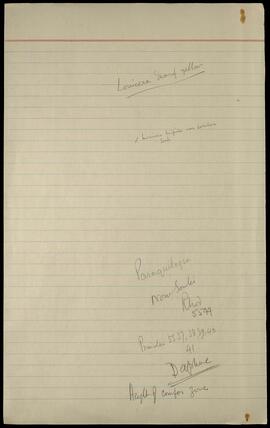
Lonicera dwarf yellow

/ Lonicera hispida var. setulosa
Seeds

Paraquilegia
Nom Soulei
Rhod.
5544

Primulas 5537, 38, 39, 40
41

Daphne

Height of conifer zone

LSH/1/1/9/1/60 · Part · 1949-06-01
Part of The Ludlow & Sherriff Collection

SUMMARY:
List of plants to collect seed from in the Pangotang area, with specimen numbers and locality notes such as cliffs opposite camp, beyond the fir zone, and near Tolegang and the first drogpa. Mentions taxa including Primula, Cypripedium, Saxifraga, Androsace, Meconopsis, Salvia, Potentilla, and others.

CONTENT:
55

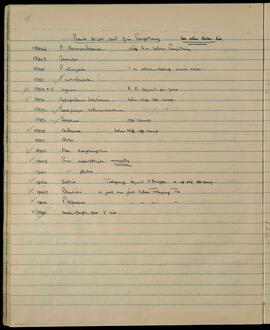
Plants to get seed from Pangotang See also later list.

18946 P. barnardiana. cliff 1/2 m below Pangotang
18948 Cassiope
18955 P. elongata. 1 m above camp main river
18957 P. atrodentata
X 18963-5 Legume. to E beyond fir zone
V 18970 Cypripedium tibeticum. below cliff opp. camp.
18972 Saxifraga yellow cushion below cliff opp. camp.
18973 Daphne opp. camp.
V 18974 Androsace below cliff opp camp.
18977 Aster.
V 18995 Meconopsis simplicifolia
V 19009 Primula macrophylla roots.
19011 Primula glabra
V 19021 Salvia Tolegang beyond 1st drogpa & up cliff opp camp.
X 19027 Potentilla. a good one just before Tolegang 150
19030 P. hopeana a good one just before Tolegang
V 18992 small purple pea 2" high.

LSH/1/1/7/1/17 · Part · 1940-05-24
Part of The Ludlow & Sherriff Collection

SUMMARY:
Botanical observations near camp included Cremanthodium, P. littledalei, Meconopsis integrifolia, and saxifrages. After leaving the Thira La, Taylor returned to the Gyanda Chu and the party halted at Chomo Dzong to collect coracles and cross the river, observing barley harvesting and local papermaking, before abandoning a planned route from Kyakden to the Rong Chu and proceeding to Dzeng on the Tsangpo, where Primula and Gentiana waltoni were noted.

CONTENT:
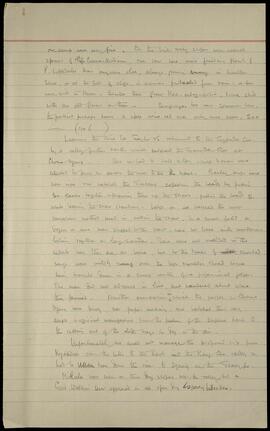
Near our camp were very fine. On the high rocky slopes were several species of Cremanthodium, we saw here more fruiting plants of P. littledalei than anywhere else, always growing among boulder scree, or at the foot of cliffs, in crevices protected from rain: a few were still in flower. Beside them grew Meconopsis integrifolia, some still with an odd flower on them. Saxifrages too were common here, the prettiest perhaps being a little wine red one only once seen, Saxifraga (No. 6).

Leaving the Thira La, Taylor returned to the Gyanda Chu, by a valley further North which entered the Gyanda Chu at Chomo Dzong. Here we had to halt a day while coracles were collected to ferry us across the river to the right bank. Barley crops were now ripe and we watched the Tibetans collecting the heads by putting two canes together and drawing them up the straws, pulling the heads off, while leaving the straw standing. Later on we watched the more dangerous method used in cutting the straw. In a small field a dozen or more men stripped to the waist, were let loose with murderous looking scythes on long handles. These were not wielded in the sedate way they are at home, but to the tunes of shouted songs were wildly swung over the left shoulder and head before being brought down in a sweep worthy of a professional golfer. The men did not advance in line, but wandered about where they fancied. Another occupation in which the people of Chomo Dzong were busy, was paper making, we watched this very simple and efficient manufacture from the peeling of the Daphne bark to the setting out of the cloth trays to dry in the air.

Unfortunately we could not manage the proposed trip from Kyakden over the hills to the East into the Rong Chu valley and had to turn down the river to Dzeng on the Tsangpo. Primula was seen on these dry slopes near the valley bed and Gentiana waltoni now appeared on an open dry hillside.

LSH/1/1/1/1/15 · Part · 1933-05-06
Part of The Ludlow & Sherriff Collection

SUMMARY:
Notes on departure with mule transport, observations of conifers, magnolias and daphnes, and a dispute over extra pony rations. Ludlow indicates the route to Changu, Sikkim; arrival at TSOMGO (10 miles, 12,400') with snow starting at 12:30. Cine film B.1 taken between Kalimpong and near Lagyap La.

CONTENT:
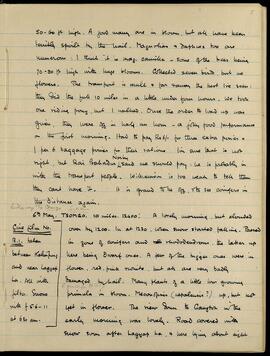
50-60 ft high. A good many are in bloom, but all have been terribly spoilt by the hail. Magnolias & daphnes too are numerous: I think it is mag. campbellii - some of the trees being 70-90 ft high with huge blooms. Collected seven birds but no flowers. The transport is mule & far away the best I've seen: they did the full 10 miles in a little under four hours. We took one riding pony, but I walked. Once the order to load up was given, they were off in half an hour - a jolly good performance on the first morning. Had to pay Rs 6/- for three extra ponies = 1 per 6 baggage ponies for their rations. I'm sure that is not right, but Rai Bahadur Norbu said we should pay: he is probably in with the transport people. Williamson is too weak to tell them they can't have it. It is grand to be off, & to see conifers in the distance again.

Ludlow says "To Changu Sikkim"
6th May. TSOMGO. 10 miles. 12400'. A lovely morning, but clouded

Cine film No.
B.1. taken between Kalimpong and near Lagyap La. All with filter. Snows with f 5.6-11 at 6.30 am.

over by 1200. In at 1230, when snow started falling. Passed in zone of conifers and rhododend

LSH/1/1/2/1/219 · Part · 1934-10-14
Part of The Ludlow & Sherriff Collection

SUMMARY:
The author reports that missing mail appears irretrievable after a visit from the cheerful Dzongpon, and notes differing beliefs among companions about a mantra causing a Tibetan companion’s illness. On 15 October they travel to Rungzyung in persistent rain, carrying the ailing Tibetan by stretcher, while also listing several collected plants.

CONTENT:
lost mail is not to be found. I'm afraid it must be regarded as a complete loss, not to be traced anywhere. The Dzongpon was very cheerful and kind, though he took up a lot of our time, when we wanted to read our mail soon. But he's a good soul. The poor Tibetan is in a bad way again. He has quite recovered from the original abscess in the shoulder, but now has an even worse one near the artery in the thigh. We will carry him by stretcher with us and hope the thing will come to a head soon. Poor man he has had a rotten time. He says, as usual, that someone has put a mantra on him and is rather fatalistic. Purbo & Co rather favour that idea. They all believe in it, even Pinto, educated though he is.

Trashigang
Strobilanthes glutinosus 1061
Leptodermis 1062
" steppiana 1063
Oxyspora paniculata 1064
Daphne Shillong 1065

15th October. To RUNGZYUNG. 8 m. 4050'. Rained all day. The foul weather has again come just as we start up to a collecting area, as usual. Carried the Tibetan on a stretcher, much to the locals' astonishment. His new abscess will I think come to a head tomorrow evening. It's pretty bad now. The air is simply soaking wet here - all day, in or out

LSH/1/1/7/1/7 · Part · 1940-05-24
Part of The Ludlow & Sherriff Collection

SUMMARY:
The diarist notes bodies with bows left beside them and observes alpine flora on nearby snow slopes and streambeds. Accompanied by Langong coolies, they visit the Tsari Sama (Sarpa) pilgrimage area, finding it rich in Primula, Rhododendron, and a new white-flowered Daphne near the pass to Lopa territory. Trashiyang is mentioned as the starting and finishing point of the pilgrimage.

CONTENT:
Beside each body, the owner's bow had been stuck in the ground. All arrows had been taken away, but all their other possessions seemed to have been left intact, even to their meagre rations of food. Near here, at the top of the snow slopes, were vertical cliffs. Tucked away in dust-dry pockets, completely sheltered from rain, were fine clumps of P. littledalei.

A little lower down, at 14,000', the first Meconopsis simplicifolia were coming into flower. Beside this, P. chamaethauma was in flower, and on a steep bank just above this, a little creeping Lonicera, only an inch or two off the ground, showed its yellow flowers. Some of the open swampy flats held masses of a fine Allium (No. ). On stony beds beside streams grow P. macrophylla v. macrocarpa.

There remained, near Langong, one area to visit, that was Tsari Sama. This is a place of pilgrimage, called Tsari Sama or Sarpa—the new Tsari—to distinguish it from the better-known, more important Tsari Chikchar. The Langong coolies were not anxious to go round the pilgrimage, for which I could not blame them. However, they took me, and it was a most interesting trip. As at the Lo La, there is in Tsari Sama a fairly extensive, reasonably open flat bit of country, just north of the immediate Himalayas, gradually rising to a steep rocky ridge. The whole of this area was very rich in flora. This, to a certain extent, can, I think, be put down to the fact that no yaks are kept here in the summer. None of the dwarf rhodos were now in flower, and R. campylogynum (5560), R. trichocladum (5555), R. glaucum (5565). Also 5568.

A Primula not seen elsewhere, P. Kingii covered acres of open ground with its deep wine-coloured blooms, P. laeta, a glorified form of P. Roylei. Primula, P. gracilipes.

Perhaps the most interesting Rhododendron was 5571 (yellow, red spots). Growing among rocks just below the ridge before reaching the pass to Lopa territory, we came across a fine large, white-flowered new Daphne. No seeds.

At Trashiyang, the starting and finishing point of the pilgrimage,