
Showing 3 results

Archival description
3 results with digital objects Show results with digital objects
LSH/1/1/10/1/130 · Part · 1949-04-16
Part of The Ludlow & Sherriff Collection

SUMMARY:
List of seed collections with specimen numbers, taxa, collection localities, and dates from late August to early September. Sites include multiple passes and valleys; one Viburnum collection at Bumthang was brought by Ngudup.

CONTENT:
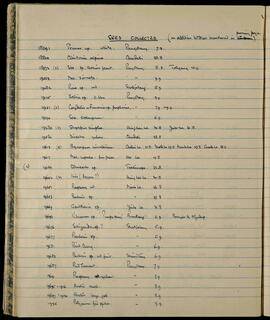
SEED COLLECTED (in addition to that mentioned in previous pages.)

18691 Prunus sp. white. Pangotang. 7.9.
18800 Clintonia alpina Chendebi 28.8
18972 (2) Sax. sp. cushion plant. Pangotang. 8.9. Toligang 10.9.
19052 Mec. sinuata. Pangotang. 9.9
19082 Rosa sp. red. Sharietang. 5.9.
19125 Salvia sp. d. blue Pangotang. 9.9
19151 (2) Corydalis or Fumaria sp. purplish. Pangotang. 7.9 + 9.9.
19270 Sax. stolonifera. Pangotang. 6.9
19280 (2) Streptopus simplex. Hinglai La 24.8 Yuto La 31.8.
19580 Dicentra yellow. Chendebi 28.8
19613 (4) Bryocarpum himalaicum. Chulai La 21.8. Shole La 27.8. Monle La 27.8. Chale La 28.8
19617 Mec. superba from press. Ha La 17.8
(2) 19632 Cotoneaster sp. Tsalimape. 23.8.
19642 (2) Iris (decora?) Hinglai La. 24.8.
19651 Raspberry red. Monle La. 26.8
19653 Berberis sp. Monle La. 27.8
19669 Gaultheria sp. Yuto La. 31.8
19693 Viburnum sp. "Pampashing" Bumthang 2.9. Brought by Ngudup.
19676 Schizandra sp.? Sharietang 5.9.
19677 Berberis sp. Sharietang 5.9.
19681 Bird Cherry. Sharietang 6.9.
19683 Berberis sp. red fruit. Shimitang 6.9
19687 Red Currant. Pangotang. 7.9
19691 Raspberry yellow. Pangotang. 7.9
19695 = 19126 Arabis small. Pangotang. 8.9
19697 = 19130 Arabis large pod. Pangotang. 8.9
19715 Polygonum fine spikes. Pangotang. 9.9.

LSH/1/1/9/1/133 · Part · 1933-09-01
Part of The Ludlow & Sherriff Collection

SUMMARY:
At Pangtang, the diarist reports improved weather after night rain, limited seed readiness, and observations of several plants in flower or seed, while Ngudup arranged a new zareba to shield the tent from strong winds. The following day was a halt with morning sun and afternoon rain; seed collecting yielded mixed results due to grazing and insect damage, and the diarist photographed an ibis bill at a nearby spring.

CONTENT:
7th September. Pangtang. Heavy rain in the night, but fine all day today, with much more of a feeling of dryness. We got a few seed on the way up, but again found most things were not ready. In fact we got Primula umbratilis in perfect flower on a cliff where no sun reaches. Here I have not yet looked round, except to see Mec. simplicifolia, seed of which has mostly been thrown. My zareba here had been disposed of, but Ngudup ordered another, and it really is rather nice because it keeps the very strong wind off the tent. It blows very strongly all day long here.

8th Sept. Halt. Fine all morning. Rain all afternoon. We only went up the hillside opposite camp to look for seed. Some were over - like the nice little Daphne; but we got about 60 seed in the end. The nice Aster that was everywhere is not to be found - all eaten by yaks. On the other hand we got two Arabis in very ripe seed, and the cushion saxifrage, whose seed were nearly all thrown. I could not find a single Anemone rupicola. Mec. horridula seed is ripe, but the plant here is so poor that it is not worth taking. P. umbratilis is not yet ready, but should not take more than 10 days or so in places. As usual the worst enemy to seed collecting is caterpillars or little bugs of some kind. There was not a ripe seed of Salvia to be found, though lots of unripe ones. As soon as they showed any colour at all, a bug got into them. The prettiest flower we got was a fine annual Gentian, with a minute root, but sometimes as many as 25 flowers on the plant, each about 5/8" across. It is worth trying to get seed of, and a white Sax still in full flower is also worth while. We have a nice ibis bill at the spring beside us. He seems quite happy, and I took a cute picture of him last evening. I hope permanent residents at his spring won't frighten him away.

LSH/1/1/10/1/8 · Part · 1949-09-14
Part of The Ludlow & Sherriff Collection

SUMMARY:
Seed collecting was limited by pests and grazing yaks; noted species include P. elongata, Arabis, Gueldenstaedtia, Cypripedium tibeticum, Sorbus ursina, and an Aconite bulbifera with bulbils in leaf axils. After rain and colder weather, the party planned to go to the pass; on 20th September they halted, dug roots of P. strumosa, photographed Gentiana veitchiorum, and admired a green lake below the pass with snowy peaks.

CONTENT:
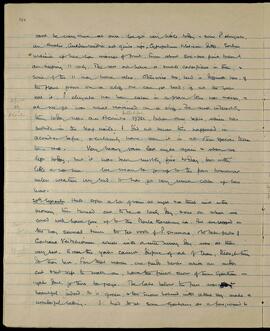
can be everywhere at once. We got very little today - some P. elongata, an Arabis, Gueldenstaedtia not quite ripe, Cypripedium tibeticum ditto. Sorbus ursina up here has masses of fruit. From about 500-600 fruit taken I am keeping 11 only. The rest all have a small caterpillar in them, & some of the 11 may have also. Otherwise too, seed is difficult here. If the plant grows on a cliff, one can get seed; if not the yaks eat it. P. elongata has been eaten in a place there was masses, & all we got was what remained on a cliff. The most interesting thing today was an Aconite bulbifera 19752, taken once before, which has bulbils in the leaf axils. I did not know this happened in aconites before, & certainly have seen it in no other species than this one. Very heavy rain last night again & when we left today, but it has been mostly fine today, but with little or no sun. We mean to go up to the pass tomorrow unless weather very bad. It has got very much colder up here now.

20th September. Halt. After a lot of rain at night & a thick mist in the morning, this turned out to be a lovely day, one on which we could well have gone up to the Mula Karchung La. But we stopped on the way several times to get roots of P. strumosa, & to take photos of Gentiana Veitchiorum, which with a nice sunny day, were at their very best. Even the yaks cannot dispose of all of them, though they do their best. For that reason, one finds banks which are undercut and safe to walk on, have the finest show of this Gentian - yaks don't go there to graze. The lake below the pass was beautiful indeed. It is green, & the snows behind with a blue sky make a wonderful setting. I tried to get some Gentians as a foreground to