Showing 4 results

Archival description
4 results with digital objects Show results with digital objects
LSH/1/1/1/1/161 · Part · 1933-09-24
Part of The Ludlow & Sherriff Collection

SUMMARY:
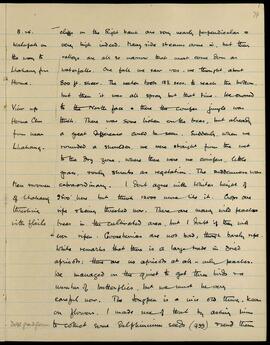
Describes sheer cliffs and numerous waterfalls en route to Lhahang from Homa, including a measured 13.5-second drop, and a sudden shift from wet conifer jungle to a dry shrub zone near Homa Chu. Notes disagreement with White’s elevation, local threshing and fruit (peaches and gooseberries; no apricots), discreet collecting of birds and butterflies, and a request to the Jongpen to collect Delphinium seeds (499).

CONTENT:
79

B. 26.
Waterfalls on the way to Lhahang from Homa.

Cliffs on the right bank are very nearly perpendicular and very high indeed. Many side streams come in, but their valleys are all so narrow that most come down as waterfalls. One fall we saw was, we thought, about 800 ft. sheer. The water took 13 1/2 secs. to reach the bottom, but then it was all spray by that time. We crossed

View up Homa Chu from near Lhahang.

to the North face and there the conifer jungle was thick. There was some lichen on the trees, but already a great difference could be seen. Suddenly, when we rounded a shoulder, we were straight from the wet to the dry zone, where there were no conifers, little grass, and only shrubs as vegetation. The suddenness was extraordinary. I don't agree with White's height of

Men and women of Lhahang threshing with flails

9,500' here but think 12,000 more like it. Crops are ripe and being threshed now. There are many wild peach trees in the cultivated area, but I doubt if they will ever ripen. Gooseberries are not bad, though barely ripe. White remarks that there is a large trade in dried apricots: there are no apricots at all - only peaches. We managed on the quiet to get three birds and a number of butterflies, but we must be very careful now. The Jongpen is a nice old thing, keen on flowers. I made use of that by asking him

Delph. grandiflorum

to collect some Delphinium seeds (499) and send them
LSH/1/1/1/1/175 · Part · 1933-09-05
Part of The Ludlow & Sherriff Collection

SUMMARY:
The party halts at Towa, where the Jongpen, newly returned from Lhasa, invites them to stay another day for dinner. They plan to travel to Nangartse by the route between Pomo and the Yamdrok Tsos, arrange transport changes at Lalung, Monda La, Ling, and Nangartse, and note local transport rates between Singhi Dzong, Lala, and Towa.

CONTENT:
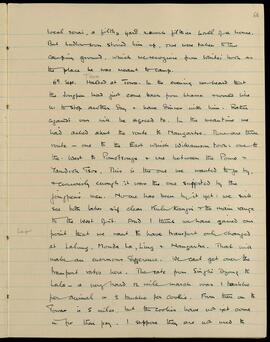
local serai, a filthy yard and much filthier hovel of a home. But Ludlow soon stirred him up, and we were taken to this camping ground, which we recognize from White's book as the place he was meant to camp.

6th Sept. Halted at Towa. In the evening we heard that the Jongpen had just come back from Lhasa and would like us to stop another day and have dinner with him. Rather against our will we agreed to. In the meantime we had asked about the route to Nangartse. There are three routes — one to the East which Williamson took: one to the West to Pomotsongo and one between the Pomo and Yamdrok Tsos. This is the one we wanted to go by, and curiously enough it was the one suggested by the Jongpen's men. No one has been by it yet: we will see both lakes and if clear Kulu Kangri and the main range to the West of it. And I think we have gained our point that we want to have transport only changed at Lalung, Monda La, Ling and Nangartse. That will make an enormous difference. We can't get over the transport rates here. The rate from Singhi Dzong to Lala — a very hard 12 mile march was 1 tanka per animal or 1/2 tanka per coolie. From there on to Towa is 5 miles, but the coolies have not yet come in for their pay. I suppose they are not used to

LSH/1/1/1/1/176 · Part · 1933-09-05
Part of The Ludlow & Sherriff Collection

SUMMARY:
A local guide led the party to their campsite at Lachen and reported that the last European to camp there was 27 years earlier, when White, the P.O., camped shortly after the Tibetan War.

CONTENT:
Lachen. - The man who conducted
us to our camping site informed
us that the last time a European
had camped here was 27 years ago,
when White the P.O. had camped
here shortly after the Tibetan War.

LSH/1/1/1/1/141 · Part · 1933-08-17
Part of The Ludlow & Sherriff Collection

SUMMARY:
The writer describes a steep, tiring march to Singhi Dzong, noting a small monastery, shelter, fir wood, water, and grazing, as well as river confluences from Khuma Chu and the Kangha–Narim Thang direction. They dispute an official route description from 1907 and mention that without road work the approach would have been difficult. Singhi Dzong is noted as a puja center, with special ceremonies ordered due to Dorji’s illness, attended by the Maharaja’s brother and the Lhuentse zimpon.

CONTENT:
69
East
miles there is a precipitous cliff on the right hand side. At Singhi Dzong there is a small monastery & a small pukka built shelter of sorts. The main Khuma Chu river comes in from a valley to the North West, while another smaller river enters from the Kangha - Narim Thang direction. There are plenty of fir wood at Singhi Dzong & water, & fair grazing. This was a longish day & a steep tiring climb. We walked most of it although we have two mules of the Lhuentse zimpons. A Tibetan proverb says "A horse is no horse unless it can carry a man up hills, & a man is no man unless he gets off his horse & walks downhill". But we could hardly blame any animals for not carrying a man up today's march. The funny thing is that the official route book says "There is an excellent riding path the whole way to Narim Thang". That was written from White's description in 1907, when it may possibly have been true. If we hadn't had the road "made" for us, I don't know how we should have reached here. Singhi Dzong is a place of some importance as a centre of puja (worship). With Dorji's illness, orders have come here for special puja to be made. A brother of the Maharaja's is also here for puja; & the zimpon of Lhuentse has come too, with that as his excuse. It is a bleak, desolate place, with huge