Showing 12 results

Archival description
12 results with digital objects Show results with digital objects
LSH/1/1/3/3/153 · Part · 1983-05-05
Part of The Ludlow & Sherriff Collection

SUMMARY:
The party marches down the Tsari valley, noting profuse P. calderianum on grassy flats and in forest glades near Yarap, crossing a three-span bridge to a good campsite; Pinto is ill with pain and fever. On 19th May they halt, observe typical weather, split up to mark flowers including a fritillaria (No. 1611) and a rhododendron (No. 1612).

CONTENT:
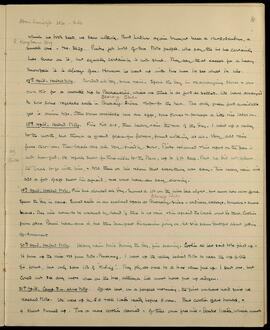
L.p. 92 This march down the Tsari valley mostly on level flats. P. calderianum in profusion both on grassy flats and in shade of Juniper forest.

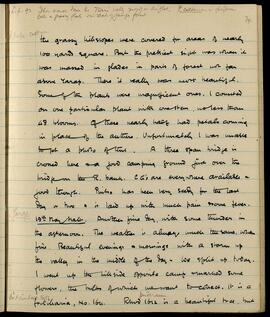
The grassy hillslopes were covered for areas of nearly 100 yards square. But the prettiest sight was when it was massed in glades in parts of forest not far above Yarap. There it really was most beautiful. Some of the plants were magnificent ones. I counted on one particular plant with one stem, no less than 48 blooms. Of these nearly half had petals coming in place of the anthers. Unfortunately I was unable to get a photo of this. A three span bridge is crossed here and a good camping ground just over the bridge on the R. bank. C.G.'s are everywhere available and good though. Pinto has been very seedy for the last day or two and is laid up with much pain and some fever.

19th May Halt. Another fine day, with some thunder in the afternoon. The weather is always much the same, when fine. Beautiful evenings and mornings with a storm up the valley in the middle of the day. We split up today. I went up the hillside opposite camp and marked some flowers, the bulbs of which we want to collect. It is a fritillaria, No. 1611. Rhod 1612 (pudorosum) is a beautiful tree, but...
LSH/1/1/3/3/99 · Part · 1933-04-09
Part of The Ludlow & Sherriff Collection

SUMMARY:
Notes a possible plumbago like one found near Lhakhang Dzong in 1933 and a new Trochalopteron (perhaps henrici), with locals described as helpful unlike those at Tsona. At Tro Shika on 20 April, the writer describes a picturesque, cultivated valley and recounts a passport exchange with the Dzongpen handled by Pinto, who returned with apologies.

CONTENT:
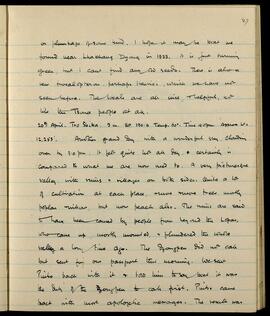
or plumbago of some kind. I hope it may be that we found near Lhakhang Dzong in 1933. It is just turning green, but I can't find any old seeds. There is also a new Trochalopteron, perhaps Henrici, which we have not seen before. The locals are all nice and helpful, not like the Tsona people at all.

20th April. Tro Shika. 9 m. BP. 190.6 Temp. 60°. Time 4:00 pm. Approx Ht. 12,253'. Another grand day, with a wonderful sky, clouding over by 3:00 pm. It felt quite hot all day, and certainly is compared to what we are now used to. A very picturesque valley, with ruins and villages on both sides. Quite a lot of cultivation at each place, some more trees, mostly poplar and willow, but now peach also. The ruins are said to have been caused by people from beyond the Lopas, who came up, mostly mounted, and plundered the whole valley a long time ago. The Dzongpen did not call but sent for our passport this morning. We sent Pinto back with it and told him to say that it was the duty of the Dzongpen to call first. Pinto came back with most apologetic messages. The result was

LSH/1/1/2/1/219 · Part · 1934-10-14
Part of The Ludlow & Sherriff Collection

SUMMARY:
The author reports that missing mail appears irretrievable after a visit from the cheerful Dzongpon, and notes differing beliefs among companions about a mantra causing a Tibetan companion’s illness. On 15 October they travel to Rungzyung in persistent rain, carrying the ailing Tibetan by stretcher, while also listing several collected plants.

CONTENT:
lost mail is not to be found. I'm afraid it must be regarded as a complete loss, not to be traced anywhere. The Dzongpon was very cheerful and kind, though he took up a lot of our time, when we wanted to read our mail soon. But he's a good soul. The poor Tibetan is in a bad way again. He has quite recovered from the original abscess in the shoulder, but now has an even worse one near the artery in the thigh. We will carry him by stretcher with us and hope the thing will come to a head soon. Poor man he has had a rotten time. He says, as usual, that someone has put a mantra on him and is rather fatalistic. Purbo & Co rather favour that idea. They all believe in it, even Pinto, educated though he is.

Trashigang
Strobilanthes glutinosus 1061
Leptodermis 1062
" steppiana 1063
Oxyspora paniculata 1064
Daphne Shillong 1065

15th October. To RUNGZYUNG. 8 m. 4050'. Rained all day. The foul weather has again come just as we start up to a collecting area, as usual. Carried the Tibetan on a stretcher, much to the locals' astonishment. His new abscess will I think come to a head tomorrow evening. It's pretty bad now. The air is simply soaking wet here - all day, in or out

LSH/1/1/2/1/165 · Part · 1933-08-30
Part of The Ludlow & Sherriff Collection

SUMMARY:
Camped at Tobrang with persistent rain, the party continued collecting, including several 'badal rats', and birding near a marsh on the Pang La route. Notes mention primulas by the marsh, illness of Kurtip, Ramzana and companions remaining well, and a misdirected mail reportedly sent to Sahden after a message from Pinto. Leeches and dense jungle hindered hunting despite a spell of fine weather.

CONTENT:
81

about 100 lbs, a good test on a path like the Me La - Cho La one.

Tobrang
31st August Halt Tobrang. Bad day: rain from morning till night. Very wet work collecting.

1st September Halt Tobrang. Rain mist all day, but we did surprisingly well, getting three or four "badal rats". Saw a star in the evening which promises well for tomorrow!

2nd September Tobrang. Quite a good day. Rode up the Pang La route to a marshy flat, where there were any number of good birds about. Got nothing new, but several wanted birds. There are some primulas growing on the edge of the marsh, but they have no flowers or stalks—probably the common yellow one. Kurtip again down with fever, fairly badly. Ramzana & Co. all quite fit though.

3rd September Tobrang. Fine all day. It almost makes one hope the monsoon may be over. In spite of the good day though, we got a poor bag, losing several, & not managing to get a shot at others through the denseness of the jungle, or because of armies of leeches. A note came by devious ways from Pinto today. Some BF has sent our mail up to Sahden again. It

LSH/1/1/3/3/129 · Part · 1933-04-09
Part of The Ludlow & Sherriff Collection

SUMMARY:
Travel to Kap and then Chayul Dzong, including difficulty lowering the Tibetan mastiff Tumshu down a stone ladder, with Pinto assisting. Notes children peeling rhododendron leaf indumentum to sell as Bané for lamp wicks and observes currants, irises, and early paraquilegia and rhododendrons; an outing up the nala SE of Kap with Tsongpen and Tendup found few flowers fully out.

CONTENT:
have found. He shows it below Lung on the way to the Chupung La, whereas it is above Dotrang on the way to the Kashong La.

4th May. To Kap. 7 miles. Fine. Some difficulty in getting the dog Tumshu—the Tibetan mastiff, a useless beast really (G.)—down the stone ladder today. He was eventually carried on one man's shoulders, while Pinto came down next, holding a rope round Tumshu's neck, to keep his head up, so that he could not bite the carrier. Currants in flower and pretty numerous. The irises here are lovely, every spare inch covered with them. We noticed the children yesterday pulling the thick indumentum off the underside of a rhododendron leaf. They do this when the leaf is more or less dry, then roll up the indumentum, which comes off in one piece, and sell it to the treasury. It is extensively used as a wick in an oil lamp, and goes by the name of Bané.

5th May. Chayul Dzong. 6 miles. Tsongpen, Tendup and I went up the nala SE of Kap, leaving at 5.0 am. I was disappointed to find flowers had hardly come on at all. Paraquilegia, however, is everywhere just on the point of flowering. One or two rhododendrons were just out, but nothing new. Camped

LSH/1/1/4/1/179 · Part · 1933-11-09
Part of The Ludlow & Sherriff Collection

SUMMARY:
Brief stop at Tawang before dark where lamas promised coolies; evening spent sorting seeds amid cloudy, misty weather. On 12 November the party marched about 10 miles to Muktur (c. 8000'), with Pinto successfully managing multiple transport changes after assurances from the Dzongpen's budli; arrival was at 1:30 pm and rhododendron seeds were collected.

CONTENT:
From Milakatong La. Primula P. jigmediana 2840, purella 2841, gambeliana aff. 2829. (50)

Tawang. We were only in a short time before dark. Three men - 2 lamas - called & promised that coolies would be here in the early morning. A busy evening sorting seeds. Very cloudy, misty, but no rain - pleasantly warm after high camps.

12th November. Muktur. 8000'(?). 10 miles. It rained most of the night and all this morning till 10 am, after which it was fine till 4.0 pm. Clouds down all day, & raining again this evening. Pinto did wonders to get everything off by 8.0 am. He had considerable difficulty. At the first change, I saw the Dzongpen's “budli” who promised there would be no further changing. I was very grateful, & gave him odd presents of money. We insisted on his two headmen coming with us. It was lucky we did, as actually we changed transport 4 or 5 times more. But there was never any delay, & we arrived, much to my astonishment, at Muktur at 1.30 pm. I saw nothing of interest on the way down: got a campanula on the way up, then went out here to look for rhododendrons. This must be a wonderful place for them. We got capsules, but no ripe seed, of Rhod. rhabdotum, seed of a R. maddenii, which is everywhere, the commonest shrub near here. Also seed of what

LSH/1/1/4/1/111 · Part · 1933-09-24
Part of The Ludlow & Sherriff Collection

SUMMARY:
A previously collected Sikkimensis form proved to be nivalis with only a few doubtful capsules, and Pinto obtained 150 sheets of paper to allow packing. At Sanga Choling on the 25th and 26th of September, the diarist visited a jovial head official who provided lunch, hosted lunch and tea gatherings with local officials and ladies (including an old lama), and noted Lumsden's sulking likely due to prolonged high altitude.

CONTENT:
165

Sikkimensis form which I had taken before seed were ripe near Shirab camp, turned out to be a nivalis, of which he got a few doubtful capsules. Pinto in some way of his own got 150 sheets of paper, so I can now pack everything up.

Sanga Choling
25th Sept. Halt. A good deal of rain at night & through the day. Called on the head official here, a jovial man who gave us a large enough excellent lunch. He ate little, but drank copious draughts of chang.

Sanga Choling
26th Sept. Halt. Fine most of the day, some thunder. Had a lunch party for three officials, followed by a tea party for three ladies. Both were quite successful I think, an old lama being the guest who enjoyed himself most. I produced some darts, they got quite excited throwing them. The old lady, mother of the two girls, was in good form, & although she ate little, she was thoroughly happy. She has been awfully kind to us, always sending along small things, providing a man for our mail & doing everything she could to make us comfortable. Her daughters too, especially this Incarnation, the unmarried one. In the evening Lumsden rather flew off the handle: he had hardly uttered a word all day & was obviously sulking, & at dinner let go. The cause was probably chiefly prolonged high altitude, mixed with

LSH/1/1/6/1/37 · Part · 1933-05-17
Part of The Ludlow & Sherriff Collection

SUMMARY:
Halted at Molo for several days amid frequent rain; Ludlow brought back a small rhododendron and seeds were collected. Pinto reconnoitred the Lo La and reported deep snow though the pass was open; vegetable seeds were sown at Bharang Shika, coolie arrangements proved difficult, and the party finally set out to camp above Molo.

CONTENT:
Adonis brevistyla 3630. - Molo.

which we took seed, we saw nothing. But Ludlow again brought back a Rhododendron, a small one - No. 3629. Pinto got word of two people, who say the Lo La certainly has snow on it, but equally certainly is not shut. They say that except for a heavy snowfall it is always open. However he went up with two men to see what it was.

17th April. Halted Molo. Clouded all day, some rain. Spent the day in rearranging stores & our own kit for a month's trip to Bharang Shika, which we think is as good as settled. We have arranged to sow some vegetable seeds in Bharang Shika & hope for the best. The only green food available yet is onion tops. Other stores available here are eggs, some flour & perhaps a little rice later on.

18th April. Halted Molo. Fine till 11.0, then heavy rain the rest of the day. I went up a valley to the north, but though a grand place for flowers, found nothing at all. Very cold rain from 12.0 on. The locals are all very friendly now. Pinto returned with report that the pass is not too good. He reports snow for three miles to the Pass, up to 4 ft deep. But he did not allow the locals to go with him, & told them on his return that everything was easy. This heavy rain will add a foot of soft snow, I'm afraid, & we won't have an easy crossing.

19th April. Halted Molo. Fine but clouded all day. Snowed a lot on the hills last night, but most has now gone. Spent the day in camp. Sowed seeds in an enclosed space at Bharang Shika - radishes, cabbage, tomatoes & small beans. They will have to be watered by hand if there is no rain, & I'm afraid the locals won't do that. Coolies from above Pansi have come in, but there are great discussions going on, & it still seems doubtful about getting off tomorrow.

20th April. Halted Molo. Heavy rain twice during the day, fine evening. Coolies at last said to be fixed up - 16 from up the river & 16 from Molo - Bharang. I went up the valley behind Molo to near the top of the fir forest, but only saw lots of "Kuling". They fly at once to a tree when put up. I shot one, but could not see any more when on the tree, although I'm sure I must have put up a dozen.

21st April. Camp. 8 m. above Molo. Off at last, on a perfect morning, the first we have had since we reached Molo. We were up by 5.0 & all loads ready before 6.0 am. But coolies gave trouble, & 4 short turned up. Two or more coolies carried - of their own free will - double loads, which must

LSH/1/1/1/1/213 · Part · 1933-10-04
Part of The Ludlow & Sherriff Collection

SUMMARY:
Diary notes describe travel from Kipup to Sedonchen and Rhenock with misty weather, high passes, and tiring stone paths. The party reunites with Pinto and Danong; notes mention bird collecting, scarce Bhutan lily bulbs, and bird boxes dispatched from Yatung with one possibly near Salimapo. A glimpse of Kanchenjunga and return to a leech-prone zone are recorded.

CONTENT:
105

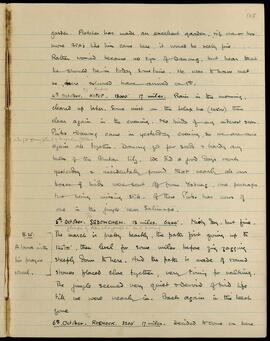
garden. Fletcher has made an excellent garden, if one or two more BIA's like him came here, it would be really fine. Rather worried because no sign of Danong, but hear that he should be in today sometime. He was to have met us, should have arrived on 1st.

4th October. TO KIPUP. 13000' 17 miles. Rain in the morning, cleared up later. Some mist on the Jelap La (14500) then clear again in the evening. No birds of any interest seen. Pinto & Danong came in yesterday evening, so we are once again all together. (also for young plants of Magnolia Globosa) Danong got few seeds & hardly any bulbs of the Bhutan lily. We did a good day's work yesterday & incidentally found that nearly all our boxes of birds were sent off from Yatung, one perhaps two being missing still. Of these Pinto has news of one in the jungle near Salimapo.

5th October. TO SEDONCHEN. 13 miles. 6400'. Misty day, but fine. (glimpse of Kanchenjunga in early morning) The march is pretty beastly, the path first going up to 13500', then level for some miles before zig zagging steeply down to here. And the path is made of round stones placed close together, very tiring for walking. The jungle seemed very quiet & devoid of bird life till we were nearly in. Back again in the leech zone. (B.35. A lama with his prayer wheel.)

6th October. TO RHENOCK. 3200' 17 miles. Decided to come on here

LSH/1/1/6/1/31 · Part · 1938-03-31
Part of The Ludlow & Sherriff Collection

SUMMARY:
The party halts at Kyimdong Dzong for several days due to transport delays, washing and repairing gear, developing photographs, and interacting with local officials; the Tsongpen scouts a snowy pass and brings back a rhododendron, while the Dzongpen visits and provides provisions. Kyimdong is noted as the source of Lhasa note paper and has villages under it (Shu, Langong, Sumbatse); later they move to a camp below Taktsa after Pinto assembles animals, with Ludlow not yet following, and note coniferous forest along the route.

CONTENT:
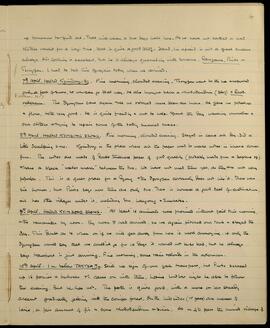
up tomorrow to find one. That will mean a two days halt here. As we have not bathed or had clothes washed for a long time, that is quite a good thing. Daud, I'm afraid is not a great success always. His cooking is excellent, but he is always quarrelling with someone, Ramzana, Pinto or Tsongpen. I had to tell him off again today when we arrived.

7th April. Halted Kyimdong Dzong. Fine morning, clouded evening. Tsongpen went to the la and reported only a foot of snow, so we can go that way. He also brought back a rhododendron (3607) = Rhod. vellereum. The Dzongpen came again to see us and stayed more than an hour. He gave us potatoes and flour, both very good. He is quite friendly and out to help. Spent the day washing ourselves and our clothes and trying to repair some of the badly smashed boxes.

8th April. Halted KYIMDONG DZONG. Fine morning, clouded evening. Stayed in camp all day. Did a little developing etc. Kyimdong is the place where all the paper used to make notes in Lhasa comes from. The notes are made of double thickness paper of good quality (probably made from a Daphne sp.) and have a black "water mark" between the two. We have not used them yet, as they are not very popular. This is a queer place for a Dzong and this Dzongpen certainly does not like it. There were six houses, but Pinto says now there are only two. There is however a good deal of cultivation, and it has other villages under it, including Shu, Langong and Sumbatse.

9th April. Halted KYIMDONG DZONG. "At least" 16 animals were promised without fail this morning, and the remainder by noon. By noon 8 had arrived, so we again pitched our tents and stayed the day. This doubt as to when or if we will get away from here is most annoying. If only the Dzongpen would say that we couldn't go for 10 days it would not be so bad, but he always says transport is just arriving. Fine morning, some rain clouds in the afternoon.

10th April. 1 m. below TAKTSA. Still no sign of our yak transport, but Pinto scraped up 16 ponies and bullocks and came on with them, hoping Ludlow might be able to follow this evening. But he has not. The path is quite good, with a more or less steady ascent gradually getting into the conifer forest. On the hillsides (N face) are masses of larix, a fair amount of fir and some rhododendron and birch. At m 4 1/2 pass the ruined village of