Showing 35 results

Archival description
35 results with digital objects Show results with digital objects
LSH/1/1/9/1/132 · Part · 1933-09-01
Part of The Ludlow & Sherriff Collection

SUMMARY:
Heavy traffic on the route is attributed to HH’s fair in Bumthang beginning on the 7th, alongside plans for reforms such as cash payment for work. At Sumitang, the party had fine weather but a delayed start (likely due to Ngudup); the writer prefers Changchuk managing transport, and with most seed still unripe, Pasang will return in a month to collect target species from beyond Sharitang and around Bumthang/Kyikyi La, after noting a jelly-coated aquatic plant and cooler conditions than Bumthang.

CONTENT:
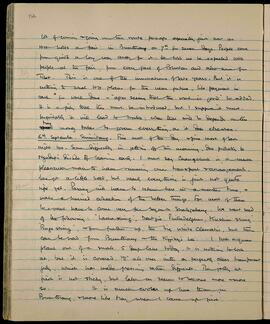
Lot of coming and going on this route, perhaps especially just now as HH holds a fair in Bumthang on the 7th for seven days. People come from quite a long way away for it. He told me he expected 1,000 people at the fair, from every part of Bhutan and also some from Tibet. This is one of the innovations of late years. But it is nothing to what HH plans for the near future, like payment in cash for work done - "after seeing that the work is good" he added. It is a pity that this must be introduced, but I suppose it must. Inevitably it will lead to trouble; when that will be depends on the time money takes to govern everything, as it does elsewhere.

6th September. Sumitang. Fine most of the day, and fine most of last night too. Some difficulty in getting off this morning, due probably to Ngudup's dislike of leaving early. I must say Changchuk is a much pleasanter man to have running one's transport arrangements. We got a little seed, but nearly everything is just not quite ripe yet. Pasang will have to return here in a month's time, and make a hurried collection of the better things. For most of these we would have to come very far beyond Sharitang. We want seed of the following: "Lachasung", Deutzia, Philadelphus, "Kushim sung", "Rugosung", and from further up, the big white Clematis, but this can be had from Bumthang or the Kyikyi La. I took a queer plant out of a small 5' deep lake today. It is nothing to look at, but it is covered, 1/8" all over with a perfectly clear transparent jelly, which has made pressing rather difficult. The jelly at first is not sticky, but later on seems to become more and more so. It is much cooler up here than in Bumthang, and more like May when I came up first.
LSH/1/1/9/1/55 · Part · 1933-05-22
Part of The Ludlow & Sherriff Collection

SUMMARY:
Notes on supplies being sent to Betty, followed by travel from Shimitang to Pangotang with excellent weather and a favorable campsite under Tsuga trees. The party observed a river gorge and collected several Primula species on the Pudo La.

CONTENT:
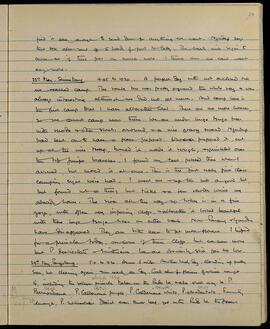
find it easy enough to send down for anything we want. Ngudup says
that H.H. also sent off 5 loads of food to Betty. The bears will begin to
curse us if this goes on much more. I think now we can't want
any more.

23rd May. Shimitang. 4.45 to 10.30. A perfect day with not a cloud till
we reached camp. The route too was pretty grand the whole way & was
always interesting, although we did not see much. And camp here is
the first camp that I have altogether liked. There are no more houses,
so we cannot camp near them. We are under huge Tsuga trees,
with rhodo & other shrubs around & a nice grassy sward. Ngudup
had sent on to have a place prepared. Whoever prepared it, cut
up all the nice turf, turned it, made it rough, & sprinkled over
the top juniper branches. I found my tent pitched there when I
arrived, but moved it at once. This is the first really first class
camping site we've had. I went out up the hill a good bit,
but found not a thing but ticks & a few rhodos which we
already have. The river all the way up today is in a fine
gorge, with often very imposing cliffs, & altogether it looked beautiful
with these huge Tsuga trees on either bank. Now Pasang & Nyundru
have disappeared. They are both keen to see more flowers. I hoped
for a primula today, on some of these cliffs, but we saw none
but P. denticulata & Smithiana. We are obviously still far too low.

24th May. Pangotang. 5.0 to 9.30. About 6 miles. Another lovely day, clouding up pretty
soon, but clearing again, sun nearly all day. Good also for flowers of which we got
16, including the yellow primula elongata (18946) taken on the Pudo La, & also what may be P.
Barnardiana (18946). P. Calderiana purple (18947), P. Calderiana white (18954), P. atrodentata (18957). Funny
enough, P. sikkimensis doesn't even show leaf yet on the Pudo La the flowers

NB
Concerning
seeds

LSH/1/1/9/1/71 · Part · 1949-06-15
Part of The Ludlow & Sherriff Collection

SUMMARY:
The diarist rebukes Ngudup for overeating and refusing to shoot a monal due to the 15th, deciding to shoot and donate Rs 1 to the Gompa. Seed is collected for Pasang, Lhakpa, and Yundru; Primula taxa are noted, a white-throated dipper nest is found by a waterfall, and a blood pheasant is filmed, with a prior nest recalled at Thampa Tso in 1937.

CONTENT:
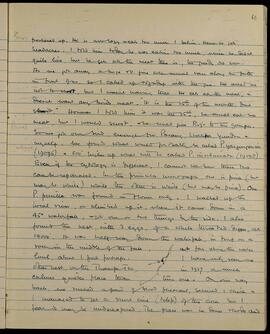
freshened up. He is now lazy and eats too much, I believe. Hence he gets headaches. I told him today he was eating too much, which he didn't quite like, but he gets all the meat there is, too greedy too soon. As we got away, a huge and fine cock monal ran along the path in front of us, so I called up Ngudup with the gun. He asked me not to shoot, but I wasn't having that. He eats all the meat, and doesn't want any bird's meat. "It is the 15th of the month, don't shoot." However, I told him it was the 15th, he should eat no meat, but I would shoot, and he could give Rs 1/- to the Gompa.

So we got our seed, enough for Pasang, Lhakpa, Yundru, and myself. We found what would probably be called P. yargongensis (19096) and 500' higher up what will be called P. involucrata (19098). Even if the cytology is different, I cannot see how these two can be separated. In the Primula monograph, one is pink (but maybe white) while the other is white (but maybe pink). One P. pusilla was found in flower only. I walked up the local river, or climbed up it, where it came down in a 45° waterfall, got one or two things by the side. I also found the nest, with 3 eggs, of a white-throated dipper, at 14,000'. It was halfway down the waterfall, in turf on a rock in the middle of the fall, not far above the water level, about 1 foot perhaps. I have only seen one other nest, on the Thampa Tso, in 1937, a much calmer, quieter place than this one. On our way back, we rushed a pair of blood pheasant, secured 1 chick, and I managed to get a short cine (telep.) of the cock, but I fear it may be underexposed. The place was in dense rhodo and

LSH/1/1/9/1/31 · Part · 1949-05-06
Part of The Ludlow & Sherriff Collection

SUMMARY:
The diarist describes traversing Rip La down to a river and up to Khoma Kang, noting abundant rhododendrons including R. edgeworthii and a Maddenii-type on cliff faces. They compare the Sissi La and Pau La routes, plan to send Pasang to Sulu, complain of midges, recall standing in cookhouse smoke with Ludlow, and suggest Betty move from T'yangsi to Tobrang for better altitude.

CONTENT:
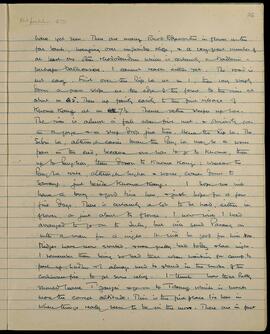
have yet seen. There are many Rhod. Edgeworthii in flower on the far bank, hanging over impossible cliffs, and a very great number of at least one other Rhododendron which is certainly a Maddenii - perhaps Dalhousiae. I cannot reach either yet. The road is not easy. First over the Rip La at m 1, then very steeply down a grass slope at the edge of the forest, to the river at about m 4.5. Then up fairly easily to the first village of Khoma Kang at m 7.5. Thence rather steeper up here. The river is almost a fall when first met, and boils over in a gorge and a steep drop just there. Hence the Rip La. The Sissi La, although easier than the Pau La, may be a worse pass in the end, because one has to go to Khoma, then up to Pangkar, then down to Khoma Kang: whereas the Pau La route, although higher and worse, comes down to Sawang, just beside Khoma Kang. I hope we will have a busy and good time here, and just hope for a few fine days. There is certainly a lot to be had, either in flower, or just about to flower. I now wish I had arranged to go on to Sulu, but will send Pasang on with a man for a night. It will be good for him too. Midges have now started, and were pretty bad today and last night. I remember them being so bad that when waiting for camp to pack up, Ludlow and I always used to stand in the smoke of the cookhouse fire, to get some relief. I think now that Betty should leave T'yangsi and go on to Tobrang which is much more the correct altitude. This is the first place I've been in where things really seem to be on the move. There are in fact

LSH/1/1/9/1/75 · Part · 1949-06-15
Part of The Ludlow & Sherriff Collection

SUMMARY:
The diarist notes finding dormant roots of a Soldanelloid primula and discusses potential primula sightings mentioned by Pasang and Gyundon. After days of heavy rain that swelled the river and left rhododendrons mostly over, they describe trader activity, including Bhutanese and Tibetan caravans and a report about Tasho Pumbo Wangdi’s smallest son. On 14 June, during a local halt, they collected Primula umbratilis in full flower on a nearby cliff.

CONTENT:
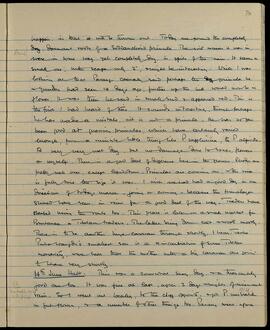
happen, is that it will be known one. Today we found the completely dry, dormant roots of a Soldanelloid primula. The soil it was in was in some way yet completely dry, in spite of the rain. It seems a small one, with scape only 2", might be interesting. While I was looking at that Pasang casually said perhaps the primula he & Gyundon had seen 14 days ago, further up the hill would now be in flower. It was then he said in small bud & appeared red. This is the first I had heard of this. It sounds interesting, though perhaps he has made a mistake, and it is not a primula. He has so far been good at guessing primulas, which have certainly varied enough, from a minute little thing like P. sapphirina, to P. alpicola.

A very very wet day, but no damage done to boxes, flowers or myself. There is a good deal of difference here in the flowers. Rhodos are pretty well over, except lepidotum. Primulas are coming on, the river is fully twice the size it was. I wish we had had a good day in one direction of today's march - going or coming - because the Himalayas should have been in view for a good deal of the way. Traders have started using the route too. This place is later on a small market for Bhutanese & Tibetan traders. The latter bring down salt & wool mostly. There is to be another huge caravan through shortly, I hear. Tasho Pumbo Wangdi's smallest son is a reincarnation from some Tibetan monastery, & we hear that the mother with a big caravan are going to Lhasa very shortly.

14th June Halt. This was a somewhat sunny day, & a thoroughly good one too. It was fine at last, after 3 days & nights of ceaseless rain. So I went out locally, to the cliff opposite, & got P. umbratilis in full flower, & a number of other things too. Pasang went up a

LSH/1/1/9/1/130 · Part · 1933-09-01
Part of The Ludlow & Sherriff Collection

SUMMARY:
Log of black-and-white and Kodachrome photographs and associated plant specimens from Bumthang and nearby areas including Phobsukha, Bumthang Chu below Sumitang, and wildlife observations at Pangotang and Tolegang. Mentions G.S., Pasang, and a guide near Chachu La, with a consignment noted as sent on 12/9.

CONTENT:
124

BW 13 Ludlow F.P. from Bumthang.

  1. Houses in Phobsukha village. mist 28/8 1. Incarvillea grandiflora 16722 1000.
  2. View up Bumthang Chu below Sumitang 6/9 2. Rhod. sp. 16752 "
  3. Gentiana sp. 19706 8/9 3. Potentilla sp. 16792 "
  4. Aconitum sp. 19710 10/9 4. Cushion plant. 16784 "
  5. " " 19710 " 5. Prim. umbratilis. 16811 "
  6. Pleurogyne sp. 19728 " 6. Mec. horridula, all colour forms. "
  7. Gentiana amoena 19721 " 7. Prim. uniflora. 17106. No good
  8. " " " in camp. flos. open. 11.9. 8. Lychnis sp. 17154 (or)
  9. G.S., Pasang + Guide nr Chachu La. 13/9 9. Mec. horridula. red issue. "
  10. Polygonum vacciniifolia 19689 16/9 10. Prim. tsariensis v. alba. 17140 "
  11. Allardia sp. 19716 16/9 11. " " " " 17140 "
  12. All V.S. 12. " umbratilis v. alba. 17161 "

Kodachrome 29
Buckwheat fields at Bumthang. 3/9.
Ibis bill at Pangotang. Tele. 7/9.
Gentiana 19706 8/9
Aconitum sp. 19710 10/9
Pleurogyne sp. 19728 "
Burhel at Tolegang "
Sent 12/9.

LSH/1/1/10/1/5 · Part · 1949-09-14
Part of The Ludlow & Sherriff Collection

SUMMARY:
Halted at Pangotang due to persistent rain while Pasang and Mundon went to Kantanang for Primula reticulata seed; H.H. sent a Bhutanese blanket, causing concern about excess baggage. The camp was crowded with Drogpas and Tibetans returning from the Mela via the Monlakarchung La; Danang is unfit and may join later instead of going to Ludlow, and lack of yak prevented a planned trip to Tolegang.

CONTENT:
14th September. Halt at Pangotang. Wet all day. Pasang & Mundon went off for 3 days to Kantanang. The only thing I know I want from there is seed of a primula called reticulata, which was very pretty. But it will likely not be ready yet. We can wait longer though for Kantanang. It is not important, & the other places must take preference. H.H. is making me very embarrassed. He has now sent a very fine Bhutanese blanket. I don't know what to do with it & had told him I did not need any bedding at all. I fear Hicks & I may have to carry a good many unwanted things away with us - unwanted by me anyway. Pangotang is a regular Piccadilly Circus today, with all the Drogpas coming back from the Mela. Tibetans too are camped beside me on their way back over the Monlakarchung La. H.H. said it was a success, they had good weather. He tells me Danang is still not fit, which presumably means that he cannot go to Ludlow now, but will have to join me when he is alright. It will be a sad blow to Ludlow, although I believe Ramzana has seen almost all that Danang saw on their way East.

15th Sept. Halt. No yak turned up today, so I did not go out to Tolegang as intended. Very heavy rain again last night, & a good deal today too. Sat in camp all day practically, & did nothing but write a

LSH/1/1/10/1/11 · Part · 1949-09-14
Part of The Ludlow & Sherriff Collection

SUMMARY:
Diary notes from Pangotang describe ongoing rains, plans to visit Marlung before turning back, and requests regarding taking Yundru and Ngudup to Kalimpong, with preference for Yundru. The writer develops Hicks’ photos, comments on Thompson’s image of P. eburnea, sends Dorji with airmail to Hicks and HH, and packs a ‘tsang’ of rooted plants for shipment to London, hoping to add more from Marlung and Ritang.

CONTENT:
147

Air mail plants
more specimens and also some roots. I have now so many roots to send home by air, that I wonder how many loads there will be, also how much it will all cost!

24th Sept. Pangotang. Fine morning, and a bit of rain after midday. There really is precious little sign of the end of the rains, although I keep on hoping there is. We are, in a way, on our way back home now. But still there is one place, Marlung, to visit, before we can say we have turned round and started back. But everyone obviously feels that things are winding up. I had a request today from Pasang, from Ngudup and Yundru that I should take both to Kalimpong. I don't mind taking Yundru, who is a good and cheery lad and a good worker, but I hope I won't have to take Ngudup one day beyond Bumthang. I do not like him, and except to arrange transport, he is useless. I am writing to HH tomorrow to ask for Changchuk, and to give him our final dates. Today I developed Hicks' photos. If only he had taken my advice at first, all his photos would have been like these which are good. But he would not, and considered he knew better. Thompson's photo of P. eburnea is quite good, much better than Hicks' first efforts. It is a real disappointment to me that in 6 months he has only taken 48 photos altogether, in spite of having lots of film packs available. There were so many photos he could have taken.

25th September. Sent off Dorji and with airmail to Hicks, HH and Kalimpong and paid him Rs 24/-. We then packed up a 'tsang' with rooted plants, each rooted plant in its own little basket inside the big one. The whole thing now is ready to go to London, except that I hope there will be a few more plants added from Marlung, and then more again at Ritang.
roots

LSH/1/1/10/1/17 · Part · 1933-10-05 - 1933-10-01
Part of The Ludlow & Sherriff Collection

SUMMARY:
The diarist receives letters from Betty and outlines plans: Hicks will arrive in Bumthang on 5 Oct, they hope to leave about the 13th and reach Tashigang on 3 Nov; the party will include Ludlow, the diarist, Betty, Virginia, Tess, and Tasho. Entries for 30 September at Pangotang and 1 October at Tolegang note wet weather, seed collecting (including Primula umbratilis), Pasang and Mundru’s work continuing until 17 October, a visit from the Sokpon who received gifts, and mail sent to HH for Kalimpong.

CONTENT:
To cheer me up today—I was feeling very miserable—a mail came in, with letters from Betty in Calcutta at last, and also from her in London. Nothing from HH at all for the first time when a mail has been sent. Hicks confirms that he will arrive in Bumthang on 5th Oct. So we should be able to leave on 13th about, and reach Tashigang on 3 Nov. Ludlow has got a passage, Betty says, and also she and I, Virginia, Tess, and Tasho. So we should have a good time, 6 of us from Bhutan.

30th September. Pangotang. It rained all night again, but was fine when Pasang and Mundru went off about 6:00 am. We were off just after them, and had a day half rain half fine, but no sun. It doesn't look yet like clearing up, but I do most sincerely hope it is fine now for four days. There is a lot to be got in Tolegang and quite a lot on the other side. After that it doesn't matter so much, except for Pasang and Mundru, whose work won't finish until 17 October. Primula umbratilis here is nearly ripe, and I got some seed, but the big Androsace is still green. This is our last of many halts in Pangotang. The Sokpon came to call and I gave him a little bottle of saffron and a torch, which is doing him very well. But we've been in his district for a long time now, ever since 23rd of May. Sent off a small mail to HH for Kalimpong. I shall only be able to send off one more after this, except for Ha.

1st October. Tolegang. Fine till 10:00 then rain and snow off and on the rest of the day. We are camped about 14,000-14,500' and it is raw and chilly. We got some seed of Primula umbratilis, the very pale form which occurs here, and a few other things. But the Phlomis (19716) I particularly wanted, is still in flower; seeds are not nearly ripe. Neither are seeds of the interesting Gentian 19721. But I took roots of

LSH/1/1/9/1/29 · Part · 1949-05-06
Part of The Ludlow & Sherriff Collection

SUMMARY:
Cold, clear halt day in camp plagued by ticks and foul water. Betty was to cross the Dongala la while the diarist and Pasang attempted collections, securing Primula listeri filipes and noting seven primula species so far. Wind scattered drying papers, later recovered by Bhutanese from the camp.

CONTENT:
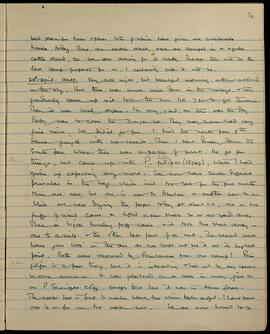
bad place for ticks and fleas, both of which have given me considerable trouble today. There are cattle about, and we are camped in a regular cattle stand, so we are asking for it really. Perhaps this will be the last camp prepared for us. I certainly hope it will be.

24th April. Halt. Very cold night, but beautiful morning, without a cloud in the sky. But there was much mist down in the valleys, and this gradually came up and it took the sun till 7.30 to get through. Then it was lovely again. I'm very glad, as this was the day Betty was to cross the Dongala la. They may have had very fine views. We didn't go far. I tried the north face of the dense jungle with no result. Then I sent Pasang down the south face where there was a patch of forest. He got few things, but came up with P. listeri filipes (18749), which I had given up expecting any more. We now have seven different primulas in the bag, which isn't too bad for the first month. None are new, but one is new to Bhutan, and another new to us.

While we were drying the paper today at about 1.0, one or two puffs of wind came and lifted a few sheets 30 or 40 yards away. Then a bigger twirling puff came, and it took two sheets away — one 1/2 a mile and the other best part of a mile. The second must have gone 1000' in the air, as we could not see it at its highest point. Both were recovered by Bhutanese from our camp!

Prim. listeri filipes is a poor thing, but it is interesting that it has not by any means become common. It was plastered on a rock in moss, just as on P. Sherriffae cliff, except that here it was in dense forest.

The water here is foul. It makes black tea which tastes awful. I have sent over 1/2 mile for our tea water now. We are now bound to go