Mostrar 15 resultados

Descrição arquivística
15 resultados com objetos digitais Mostrar resultados com objetos digitais
LSH/1/1/5/1/101 · Part · 1928-06-02
Parte de The Ludlow & Sherriff Collection

SUMMARY:
The diarist travels down from the Lao La to Ritang and on to Trashidinka in the Tang Chu valley, noting dense forest, steep side valleys, masses of Lilium giganteum, rain, leeches, and a painful leg. At Ritang there is a mail mix-up involving a box of tankhas exchanged by the Maharaja, and later the party camps on the Pele La Range east of the Tang Chu; the Tang Chu area is noted as rich in Primulas.

CONTENT:
NB. Tang Chu area rich in Primulas (nos 5-10).

5th June. Camp in Tang Chu valley at Trashidinka, 9 miles. Ht. approx 9000'. (Trashidinka).

Fine till 3.0pm, then rain. Path drops pretty steeply on north side of the Lao La, and continues through dense forest. At m 3 it reaches the main E to W route 1/2 m to the E of Ritang. This is followed down to Ritang at m 3 1/2. Thence path keeps up the L bank of the Tang Chu, winding about a good deal and climbing up and down. Two side valleys are crossed, the second a very steep sided one, and the path keeps gradually up to the village of Trashidinka. Just opposite this, a big valley enters the R. bank of the Tang Chu. // We had a long wait at Ritang, and while there a mail arrived, having taken 18 days I believe. There we heard another mail had gone on "for the Gangtok sahibs". Pimbo thought it was not right, so called the man back, and it turned out to be a box with tankhas which the Maharaja had exchanged for my rupees. It was addressed clearly enough to the "flower collecting sahib wherever he may be", but no one could read the writing. Beyond Ritang we saw masses of Lilium giganteum. Rain came on here, so did leeches, flies and dimdams. It's a pretty foul place, but ahead looks excellent. My left leg has been very painful for three days now, but I don't know any reason for it, so can do nothing. Very glad to get news of Ludlow again.

6th June. Camp on Pele La Range E of Tang Chu. B.P. 190.5 T. 54°. 5.0pm. (up to 15,000 ft)

To Trongsa; weather observations and meeting the Zimpon
LSH/1/1/5/1/165 · Part · 1937-07-14
Parte de The Ludlow & Sherriff Collection

SUMMARY:
Records continued fine mornings following a Bhutanese 'St. Swithin's Day' weather rule. On 19th July the party traveled 8 miles to Trongsa in leech-ridden conditions, found a single campanula flower, and stayed in HH's summer house above the dzong; the Zimpon recounted his trip to Calcutta with HH and his heavy duties at Damthang arranging salaams and gifts for visitors to the Maharaja.

CONTENT:
back to Chendebi again. The Bhutanese St. Swithin's Day rule is holding good. We had awful rain for the last 10 days of the last Bhutanese month. But if the 30th was fine, we were to have 15 days fine, if wet, then bad weather for a month. It was not fine, but there was comparatively little rain and we had sun in the afternoon. Since then all mornings have been fine.

19th July. To Trongsa. 8 miles. Very heavy rain all last evening and night. Fine this morning, leeches very bad, got 5 or 6 on my feet and some on my hands which weren't seen till too late. Found only one flower of a nice campanula, but otherwise nothing of interest. Here we are staying in a very nice kind of summer house which HH uses, above the dzong. It is pleasantly cool and a breeze blows all day. The Zimpon seems a very nice man. I had met him before in Bumthang, where we had competed at archery. He was down in Calcutta with HH last year, and has been telling me all about his experiences there. His work was light, he got all the fun there was, and thoroughly enjoyed himself. But at Damthang on the way back, he had to work hard, as everyone who came to salaam the Maharaja had to do so through him, he had to give presents to them all. So that of the 8 or 9 maunds of things he had brought

Bela La to Paro, Aug 10
LSH/1/1/5/1/187 · Part · 1933-08-14
Parte de The Ludlow & Sherriff Collection

SUMMARY:
Slight rain on the descent from Bela La to Paro; arrival about 1 pm, followed by a visit from Paro from 2 pm to 6 pm, whose over-familiar manner and open dislike of the Maharaja are noted, with mention of the death of his mother Ashi Palden and inquiries about floating logs down the Wangde Chu. Botanical notes record Cyananthus incanus (3564), Cyananthus lobatus (3565), Codonopsis convolvulacea (3568), and a Codonopsis resembling C. vinciflora with a wine-red ring at the corolla base and hairs to the ring.

CONTENT:
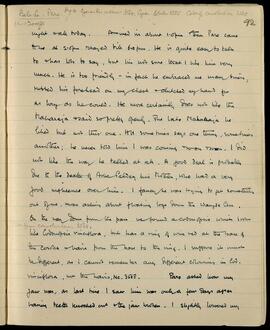
The text extracted complete text corrected version from the image followsThe text extracted text corrected version from the image follows:

Bela La - Paro. Aug 10 Cyananthus incanus 3564, Cyananthus lobatus 3565 Codonopsis convolvulacea 3568
11-12000ft.
92

Slight rain today. Arrived in about 1.0pm. Then Paro came to me at 2.0pm stayed till 6.0pm. He is quite easy to talk to and has lots to say, but I'm not sure that I like him very much. He is too friendly - in fact he embraced me many times, rubbed his forehead on my chest and clutched my hand for as long as he could. He most certainly does not like the Maharaja and said so pretty openly. The late Maharaja he liked but not this one. He sometimes says one thing, sometimes another; he never told him I was coming so on and so on. I did not like the way he talked at all. A good deal is probably due to the death of Ashi Palden his Mother, who had a very good influence over him. I fancy he was trying to get something out of me, and was asking about floating logs down the Wangde Chu.

On the way down from the pass we found a Codonopsis which looks like Codonopsis vinciflora, but has a ring of wine red at the base of the corolla and hairs from the base to the ring

LSH/1/1/1/1/75 · Part · 1933-06-30
Parte de The Ludlow & Sherriff Collection

SUMMARY:
Notes on the death of the Thimbu penlop and Tobgye’s sending of English medicine, causing concern with the Maharaja. On 30th June Ludlow and the author travelled to Lomi-Tsa-wa via Do Kyong La in clearing weather, collecting flowers including Magnolia globosa and observing that vegetation in the Trashi-cho-dzong valley and at the pass resembled Sikkim.

CONTENT:
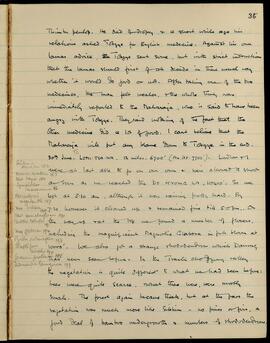
35

Thimbu penlop. He died of dropsy & a short while ago his
relations asked Tobgye for English medicine. Against his own
lamas advice, Tobgye sent some, but with strict instructions
that the lamas should first of all decide in their usual way
whether it would do good or not. After taking one of the two
medicines, the man felt weaker, & the whole thing was
immediately reported to the Maharaja, who is said to have been
angry with Tobgye. They said nothing of the fact that the
other medicine did a lot of good. I can't believe that the
Maharaja will put any blame down to Tobgye in the end.

30th June. TO LOMI-TSA-WA. 12 miles - 6700' (An. Ht. 7700'). Ludlow & I
Embelia oleracea 182
Anemone rivularis 183 were at last able to go on our own & were allowed to shoot
Rhod. Keysii 184
Symplocos ramosissima 186 as soon as we reached the DO KYONG LA, 10410'. So we
Pedicularis megalantha 187
left at 5.30 am, although it was raining pretty hard. By
Meconopsis villosa 189
Rhod. camelliaeflorum 190 7.30 however it cleared up & remained fine till 5.0 pm. On
Berberis celestina 191
the way up & at the top we found a number of flowers,
Mag. globosa 192
Pyrola rotundifolia 193 including the magnificent Magnolia Globosa in full bloom at
Streptopus simplex 194
10000'. We also got a strange rhododendron which Dawang
Geranium pratense 198
Didissandra lanuginosa 199 has never seen before. In the Trashi-cho-dzong valley
the vegetation is quite different to what we had seen before:
trees were quite scarce, & what there were, were mostly
small. The forest again became thick, but at the pass the
vegetation was much more like Sikkim - no pines or firs, a
good deal of bamboo undergrowth & numbers of rhododendrons.

1st July: To Wangdupotrang via jungle path from Lomitsawa
LSH/1/1/1/1/77 · Part · 1933-07-01
Parte de The Ludlow & Sherriff Collection

SUMMARY:
The party splits as W and Mrs W go to Punakha while the diarist and Ludlow, on Tobgye's advice, take a dense leech-infested jungle path from below Lomitsawa towards Wangdupotrang. They avoid shooting due to sensitivities in the late Shabdrung’s area near Thimbu, collect some birds, butterflies, and plants, and after a tiring nine-hour trek reach the Punakha Chu/Mo Chu; camp conditions are filthy with flies, mud, and fleas.

CONTENT:
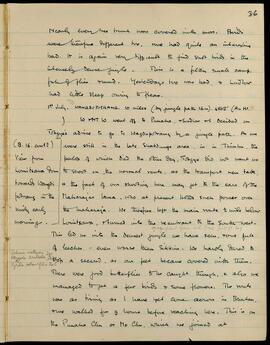
36

Nearly every tree trunk was covered with moss. Birds were therefore different too, and we had quite an interesting bag. It is again very difficult to find shot birds in the intensely dense jungle. This is a filthy small camp, full of flies and mud. Yesterday too was bad, and Ludlow had little sleep owing to fleas.

70
1st July. TO WANGDUPOTRANG. 10 miles (by jungle path 16 miles). 4508' (An Ht. ). W and Mrs W went off to Punakha, and Ludlow and I decided on Tobgye's advice to go to Wangdupotrang by a jungle path. As we

(B. 16. contd) View from Lomitsawa down towards Wangdi Potrang in the misty early morning.

were still in the late Shabdrung's area, in Thimbu, the Penlop of which died the other day, Tobgye did not want us to shoot on the normal route, as the transport men talk, and the fact of our shooting here may get to the ears of the Maharaja's lama, who at present holds such power over the Maharaja. We therefore left the main route ½ mile below Lomitsawa, and turned into the re-entrant to the South West.

magnificent fern with fronds 3-5 ft long
This led us into the densest jungle we have seen, and full of leeches - even worse than Sikkim. We hardly dared to stop a second, as our feet became covered with them.

Schima wallichii 201
Polygala arillata 202
Pyrola rotundifolia 203

There were good butterflies to be caught though, and also we managed to get a few birds and some flowers. The route was as tiring as I have yet come across in Bhutan, and we walked for 9 hours before reaching here. This is on the Punakha Chu or Mo Chu, which we joined at

23rd July: To Lhuentse Dzong (Lingtsi)
LSH/1/1/1/1/101 · Part · 1935-07-22
Parte de The Ludlow & Sherriff Collection

SUMMARY:
Notes describe receiving naive letters and small gifts from Ashe Wangmo, including permission to use her garden at Lingtsi. The page details the route from Takyela to Lhuentse Dzong (Lingtsi), terrain and mileage, mentions that the Kuru Chu route to Lhakang Dzong is impassable in summer and that mapped hot baths are unknown, and remarks on a very hot camp and being met by the zumpin's son.

CONTENT:
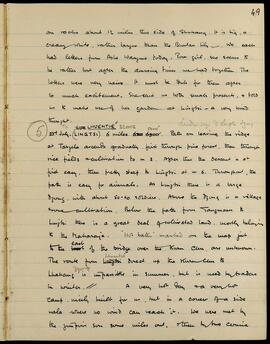
49

on rocks about 1 1/2 miles this side of Shukang. It is big, a
creamy white, rather larger than the Bhutan lily. We each
had letters from Ashe Wangmo today. Poor girl, she seems to
be rather lost after the amusing times we had together. The
letters were very naive. It must be dull for them after
so much excitement. She sent us both small presents, & told
us to make use of her garden at Lingtsi - a very kind
thought.

Lendraw says "to Leightse Dzong"
(5) 23rd July. To LHUENTSE DZONG (LINGTSI) 6 miles. 5000' 6900. Path on leaving the ridge
at Takyela ascends gradually, first through pine forest, then through
rice fields & cultivation to m 3. After this the descent is at
first easy, then pretty steep to Lingtsi at m 6. Throughout, the
path is easy for animals. At Lingtsi there is a large
Dzong, with about 50-60 soldiers. Above the Dzong is a village
& some cultivation. Below the path from Tangmasu to
Lingtsi there is a great deal of cultivated land, mostly belonging
to the Maharaja. "Hot baths" marked on the map just
east of the bridge over the Kuru Chu are unknown.
The route from Lhuentse direct up the Kuru Chu to
Lhakang Dzong is impassable in summer, but is used by traders
in winter. // A very hot day & a very hot
camp, nicely built for us, but in a corner of a side
nala where no wind can reach it. We were met by
the zumpin's son some miles out, others by two comic

LSH/1/1/1/1/109 · Part · 1933-07-27
Parte de The Ludlow & Sherriff Collection

SUMMARY:
The entry describes a steep descent from the Donga La, crossing the Lichi Chu and reaching the clearing at Sana, with notes on pine–fir forest and abundant fuel and water. Blood pheasants were encountered near the pass and two females collected, but mist obscured wider views. Letters and provisions arrived from Tobgye, Dorji, the Maharaja and Maharani, with H.H. apologizing for arrangements at Pinia; bamboo shelters for the men are noted at several camps.

CONTENT:
large number of Blood Pheasant

the descent is easy at first, becoming steeper to m. 10, where the path leaves the forest & emerges on to meadow land. After a steep descent over grassy hillside for ½ mile, it re-enters the forest & descends steeply to m. 11, where the LICHI CHU (map Tongdala Chu) is crossed by a bridge. A further easy descent of a mile over a muddy path, & SANA, a clearing in the jungle, is reached at m. 12½. Fuel & water ample, no leeches. The forest here is mainly pine & fir. // A good day. The road was pretty awful to the top of the pass, near which we were lucky to find blood pheasant, & to get two females, which have never been collected before. From the top of the pass we should have

B. 23.
Panorama from the Donga La to North west & North, with cloudy valleys.

had a magnificent view, but as we got there the mist came down, & only allowed us glimpses of the cloud-filled valleys on all sides. Sana is delightful & we should like to stay here a day or two, but must get on & let our coolies return to Lingitse. Last night letters arrived from Tobgye, Dorji, the Maharaja & Maharani. Each sent presents - ham, sausages, bread, cakes, vegetables & fruit, & with them came a welcome mail. H.H. apologized for bad arrangements at Pinia, the only place a campsite was not prepared & shelters built for the coolies & our men. Here, as at Donga, Pinia, Lhuentse, Shakhang, we have had good bamboo shelters for the men. They are quickly

Journey to Singhi Dzong and puja activities
LSH/1/1/1/1/141 · Part · 1933-08-17
Parte de The Ludlow & Sherriff Collection

SUMMARY:
The writer describes a steep, tiring march to Singhi Dzong, noting a small monastery, shelter, fir wood, water, and grazing, as well as river confluences from Khuma Chu and the Kangha–Narim Thang direction. They dispute an official route description from 1907 and mention that without road work the approach would have been difficult. Singhi Dzong is noted as a puja center, with special ceremonies ordered due to Dorji’s illness, attended by the Maharaja’s brother and the Lhuentse zimpon.

CONTENT:
69
East
miles there is a precipitous cliff on the right hand side. At Singhi Dzong there is a small monastery & a small pukka built shelter of sorts. The main Khuma Chu river comes in from a valley to the North West, while another smaller river enters from the Kangha - Narim Thang direction. There are plenty of fir wood at Singhi Dzong & water, & fair grazing. This was a longish day & a steep tiring climb. We walked most of it although we have two mules of the Lhuentse zimpons. A Tibetan proverb says "A horse is no horse unless it can carry a man up hills, & a man is no man unless he gets off his horse & walks downhill". But we could hardly blame any animals for not carrying a man up today's march. The funny thing is that the official route book says "There is an excellent riding path the whole way to Narim Thang". That was written from White's description in 1907, when it may possibly have been true. If we hadn't had the road "made" for us, I don't know how we should have reached here. Singhi Dzong is a place of some importance as a centre of puja (worship). With Dorji's illness, orders have come here for special puja to be made. A brother of the Maharaja's is also here for puja; & the zimpon of Lhuentse has come too, with that as his excuse. It is a bleak, desolate place, with huge

Kang La letters and Narim Thang: visit to Kang La pass
LSH/1/1/1/1/151 · Part · 1933-08-27
Parte de The Ludlow & Sherriff Collection

SUMMARY:
Farewell letters with small gifts were dispatched, and several boxes of bird specimens were sent off amid improving but still rainy weather. At Narim Thang, the writer went to the Kang La pass, saw little view, and collected snow partridge, including specimens for Inglis in Darjeeling.

CONTENT:
Kang La morning we sent back our last bunch of letters. It was
an awful job writing no less than nine farewell letters
in one day, to the Maharaja, Maharani, Tobgye, Ashe
Pedon, Ashe Wangmo, Tashi Dorji, Tashi Naku and Pintso
Wangdu. Helped by two hot toddies, we finished up in
good style just before dinner. This morning we did the
letters up in parcels with a scarf in each with a
small bottle of scent to the ladies. We also packed
three boxes of birds and got them off too, leaving only a
very few which we must take through Tibet with us.
Yesterday was fine for quite a number of hours, and
this morning has been the best for some time. But now
at 9:30, it is again raining and mist is low down. It
does appear to be getting gradually better though, and we
hope for a decent day yet.

27th August. Narim Thang. Fairly fine till the afternoon. I left at 6:00 am
and went to the Kang La (16,300') for the first time. Took two
hours. Practically no view, but it looks sunnier and
drier on the other side. In fact I did see sunshine
there. No birds or flowers seen near the pass which
is a knife edge ridge of broken rock. Saw 50-60
snow partridge on the way up and shot three: one for
a skeleton and one for Inglis in Darjeeling. The
other day I "bagged" 22 more P. eburnea at the

Gifts from the Maharaja in Bumthang and hot springs visit
LSH/1/1/2/1/107 · Part · 1933-07-18
Parte de The Ludlow & Sherriff Collection

SUMMARY:
After bathing at the hot springs, the party received gifts from the Maharaja via eight men from Bumthang, including rice, butter, cloth, a dagger, silver lime boxes, and potatoes, with plans to return the cloth to Trashigang. Flower collecting has been modest, and they expect to write multiple letters of thanks. Pimbo probed why locals discouraged their movements, learning it may be due to fears of them digging for valuables and disturbing earth spirits.

CONTENT:
a bath at the hot springs. There are several places banked up to make it possible to sit in water 2 ft deep, just as hot, or hotter, than one likes. I felt much better after a good bath. When we came back we found that a party of 8 men had arrived with presents from the Maharaja & Co in Bumthang. They brought 2 maunds of rice, 2 maunds of butter(!), about 3 maunds of cloth of various kinds, a dagger, silver lime boxes and a maund of potatoes. We kept all but will return the cloth to Trashigang by the same people. We have not done much in the way of flower collecting between us. I think we have perhaps 6 or 8 good things collected in these six days. However we have found out a good deal about the country and something of the people. The worst about the presents is that they mean that tomorrow we must write to Bumthang no less than seven letters of thanks each! Pimbo has been trying to get to the bottom of why these people have been doing their utmost to put us off wandering about the countryside. The only likely true answer he can get, is that they were afraid we would try to dig up 'pearls' or gold or other valuable stones, and so, of course disturb the earth spirits. Beyond that I think