Showing 8 results

Archival description
8 results with digital objects Show results with digital objects
LSH/1/1/6/1/160 · Part · 1936-11-07
Part of The Ludlow & Sherriff Collection

SUMMARY:
The diarist describes violent winds near Tre that wrecked tents, forcing a camp beside a house, and a difficult march with wildlife sightings before nearing Tsona. On 9 November they reached Tsona amid snow, found Pinbo ill with malaria, settled arrangements for ponies, paid off Kusho and Kesang, and noted correspondence from Ludlow at Shakti.

CONTENT:
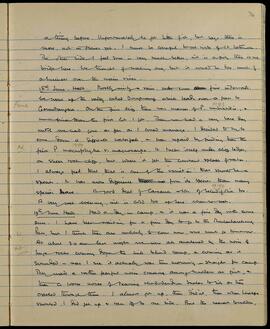
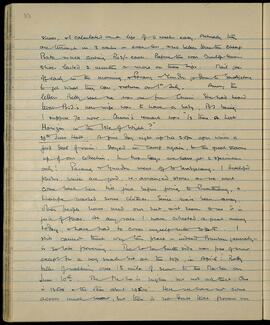
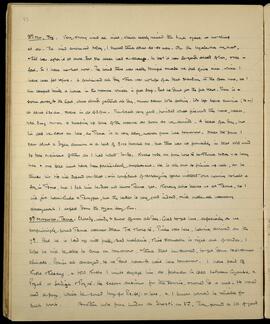
8th Nov, Tre. Very strong wind all night, which nearly ruined the tents and gave us no sleep at all. The wind continued today, I should think about 40-50 mph. On the Nyalaha Malwat, Jill was after it at once. But she never had a chance. In 100s it was 50 yards ahead of her, 1000 in fact. So I have no hat now. The wind there was really terrific and made me feel quite sick, which I have never felt before. It continued all day and there was no hope of a tent standing in the open here, so I am camped beside a house in the manure which is feet deep. But we drive for the full blast. There is a storm away to the East, where clouds gathered all day; snow seems to be falling. We left before sunrise (to us) at about 6:30 am, were in at 4:30 pm. The locals very good, provided what firewood they have, water, yak dung and soon were sweeping up some of the manure as soon as we arrived. A beast of a day, but I'm glad we came on here, as Tsona is a very easy march from here tomorrow. Near the pass I saw about a dozen ammon and a herd of 8-10 burhel too, but there was no possibility in that cold wind to take a cinema of them as I had hoped to do. Kusho rode on from here to Tsona today - a long trek and one that must have been particularly unpleasant. He is all out to finish up well, as he thinks his tip will depend on that: is confident of arranging yaks without our having to halt a day in Tsona, but I tell him he does not know Tsona yet. Kesang also leaves us at Tsona, so I will just have Lhakpa and Tsongpen, but the latter is very good indeed, will make all necessary arrangements I expect down the Nyam Jang Chu.

9th November. Tsona. Cloudy, windy and snow off and on all day. Glad to get here, especially as we surprisingly found Tsona warmer than Tre or Shoto. Pinbo was here, having arrived on the 7th. But he is laid up with pretty bad malaria; his stomach is right out of order. I hope he will be able to come on tomorrow; I think that he should, to get down to a warmer climate. Ponies all arranged, so we don't have to wait here tomorrow. I have paid off Kusho and Kesang, and told Kusho I might engage him as postman in 1940 between Gyantse and Poyal or Sadiya and Poyal. He seems anxious for the service, and would do it well. He would need a pony, which he could buy for Rs. 40/- or less, and I know would be reliable for such work. Another note from Ludlow at Shakti on 3rd. They found a lot of food.
LSH/1/1/9/1/71 · Part · 1949-06-15
Part of The Ludlow & Sherriff Collection

SUMMARY:
The diarist rebukes Ngudup for overeating and refusing to shoot a monal due to the 15th, deciding to shoot and donate Rs 1 to the Gompa. Seed is collected for Pasang, Lhakpa, and Yundru; Primula taxa are noted, a white-throated dipper nest is found by a waterfall, and a blood pheasant is filmed, with a prior nest recalled at Thampa Tso in 1937.

CONTENT:
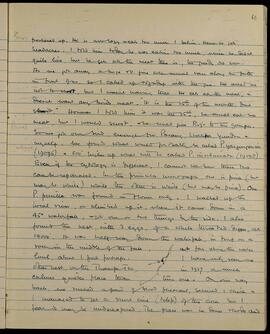
freshened up. He is now lazy and eats too much, I believe. Hence he gets headaches. I told him today he was eating too much, which he didn't quite like, but he gets all the meat there is, too greedy too soon. As we got away, a huge and fine cock monal ran along the path in front of us, so I called up Ngudup with the gun. He asked me not to shoot, but I wasn't having that. He eats all the meat, and doesn't want any bird's meat. "It is the 15th of the month, don't shoot." However, I told him it was the 15th, he should eat no meat, but I would shoot, and he could give Rs 1/- to the Gompa.

So we got our seed, enough for Pasang, Lhakpa, Yundru, and myself. We found what would probably be called P. yargongensis (19096) and 500' higher up what will be called P. involucrata (19098). Even if the cytology is different, I cannot see how these two can be separated. In the Primula monograph, one is pink (but maybe white) while the other is white (but maybe pink). One P. pusilla was found in flower only. I walked up the local river, or climbed up it, where it came down in a 45° waterfall, got one or two things by the side. I also found the nest, with 3 eggs, of a white-throated dipper, at 14,000'. It was halfway down the waterfall, in turf on a rock in the middle of the fall, not far above the water level, about 1 foot perhaps. I have only seen one other nest, on the Thampa Tso, in 1937, a much calmer, quieter place than this one. On our way back, we rushed a pair of blood pheasant, secured 1 chick, and I managed to get a short cine (telep.) of the cock, but I fear it may be underexposed. The place was in dense rhodo and

LSH/1/1/9/1/68 · Part · 1949-06-15
Part of The Ludlow & Sherriff Collection

SUMMARY:
The diarist sends the lads to Sharietang and notes target plants to collect, then observes blood pheasant chicks and attempts cine shots of the female. On 8 June, with Lhakpa and Ngudup, they make a rapid early trip to Hubsing La hoping to see Kula Kangri, viewing Kankarpunsum instead, with fine weather until evening.

CONTENT:
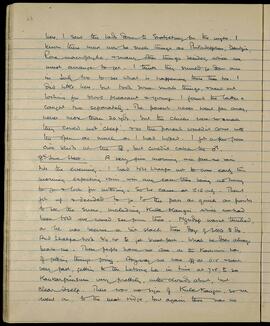
here, I sent the lads down to Sharietang for the night. I know there must now be such things as Philadelphus, Deutzia, Rosa macrophylla, and many other things besides, which we must arrange to get. I think they should go down once in July too to see what is happening there then too. I did little here, but took some small things, and went out looking for blood pheasant and young. I found the latter and caught two separately. The parents never went far away, never more than 20 yards, but the chicks were so small they could not 'cheep', and so the parents would not come into the open as much as I had hoped. I got a few poor cine shots at the ♀, but could not catch the ♂.

8th June Halt. A very fine morning, in fact no rain till the evening. I had told Lhakpa not to come early this morning, expecting rain, and in any case there being no hurry to go and look for nothing. So he came at 5.15 only. Then I got up and decided to go to the pass as quick as possible to see the snow, including Kula Kangri which we had been told we would see from there. Ngudup was not thrilled, as he has become a bit slack these days of little to do. And Lhakpa took 3/4 hour to get breakfast. What he does always beats me. These people have no idea, as the Kashmiri has, of getting things going. Anyway we were off at 6.15 and went very fast, getting to the Hubsing La in time at 7.15, to see Kankarpunsum very prettily, with clouds around, but clear itself. There was no sign of Kula Kangri, so we went on, to the next ridge, but again there was no

LSH/1/1/9/1/79 · Part · 1933-06-18 - 1933-06-19
Part of The Ludlow & Sherriff Collection

SUMMARY:
From Ha-li on 18 June, the party explored the Dirupnang valley toward a pass to Geormotangka, finding notable Primula and Cassiope on wet cliff ledges in mist and rain. On 19 June they remained in camp at Ha-li, planning for the Rhularkarchung Pass, and were awakened at night by a rockfall that came toward the camp, with Lhakpa alerting the party.

CONTENT:
a thing before. Unfortunately he got little seed, but says there is more, not in flower yet. I must be careful to get roots of it later on. The other side I feel sure is very much better, but it is a pity there is no bridge here. We thought of making one, but it would be too much of a business over the main river.

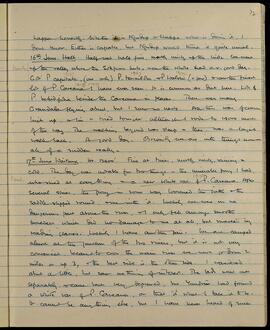
18th June. Ha-li. Mostly misty & rain, with some fine intervals. We went up the valley called Dirupnang which leads over a pass to Geormotangka. On the first cliff there were masses of P. umbratilis (19183), much finer than the first lot I got. Then we had a very bare day until we had gone as far as I could manage. I decided to try to come down a difficult waterfall, & was repaid by finding then the fine P. macrophylla v. macrocarpa (19189). It tucks itself under cliff ledges, on sheer rock cliffs, but where it gets the constant splash of water. I always feel that that is one of the varieties that should be a species. It has more difference from its species than many species have. A good deal of Cassiope also, of bellidifolia (19190) too. A very wet evening, & it is cold too up here when so wet.

19th June Ha-li. Had a day in camp, & it was a fine day with some sun. I have been waiting for a fine day to go to the Rhularkarchung Pass, but I think they are unlikely to come now, so we must go tomorrow. At about 3.0 am last night we were all awakened by the noise of huge rocks coming down the hill behind camp, & coming as it sounded — as I see it actually was this morning — straight for camp. They made a rather fearful noise crashing among boulders at first, & then a worse noise of tearing rhododendron bushes to bits as they crashed through them. I almost got up, then didn't, then when Lhakpa shouted I did get up & ran off to one side. But the nearest boulder,

LSH/1/1/9/1/77 · Part · 1933-06-16 - 1933-06-17
Part of The Ludlow & Sherriff Collection

SUMMARY:
The diarist worked high above the Sokpon's huts near Haeth on 16 June, collecting several Primula species and observing many Grandala. On 17 June at Waitang, after a mishap with a shying pony that broke the diarist's glasses, Lundrup found a white variety of Primula caveana near the junction of two rivers.

CONTENT:
happen honestly. Whether it is Ngudup or Lhakpa who is doing it, I don't know. Either is capable, but Ngudup would think it quite usual.

16th June. Haeth. Half wet half fine, mostly misty up the hills. We went up the valley above the Sokpon's huts, and on the whole had a good day. Got Primula capitata (one only), P. tenuifolia, P. walshii (very few) and saw the finest lot of P. caveana I have ever seen. It is common as dirt here. Lots of P. bellidifolia beside the caveana in places. There were many Grandala flying about, but I saw no nests. All this was of course high up, and I'm very tired tonight, although I rode to 14,000' most of the way. The walking beyond was steep and there was a longish walk back. A good day. Obviously we are into things now all of a sudden really.

17th June Waitang. Height 13,400'. Fine at times, mostly misty, raining and cold. The day was notable for two things - the miserable pony I had, who shied at everything and a new white variety of P. caveana. After several shies, the pony in some way loosened the girth and the saddle slipped round, and me with it. Luckily we were on no dangerous part above the river, and I only fell among smooth boulders which did no damage to me at all, but smashed my reading glasses. Luckily I have another pair. We are camped almost at the junction of the two rivers, but it is not very convenient because to cross the main river we must go down 2 miles or up 3, and the best side is the other side. I wandered about a little, but saw nothing of interest. The lads went out separately, and came back very depressed, but Lundrup had found a white variety of P. caveana, or that is what I take it to be. It cannot be anything else, but I have never heard of such

LSH/1/1/9/1/151 · Part · 1949-04-09 - 1949-09-05
Part of The Ludlow & Sherriff Collection

SUMMARY:
Page records advances made to families of workers and details ration allowances. It also notes staff joining dates and payment arrangements in 1949, including amounts advanced and recipients such as spouses, brothers, and friends.

CONTENT:
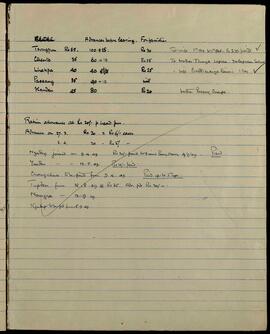
Advances before leaving. For families
Tsongpon Rs 55. 100 + 15. Rs 30 To wife 1st Apr to 1st Oct - Rs 210 paid
Chento 35 60 + 10 Rs 15 To brother Thage Lepcha. Dalapchen School
Lhakpa 40 40 Rs 25 - wife Buddhimaiya Raini 1 May
Passang 35 40 + 10 nil
Kanden 45 80 Rs 20 brother Pasang Sherpa.

Ration allowance at Rs 20/- per head per month.
Advance on 27.3. Rs 30 = Rs 6/- each
5.4. 20 = Rs 4/-
Ngudup joined on 9.4.49. Rs 30/- paid to friend Pasang 4/7/49. Paid.
Yunden joined on 12.5.49. Rs 10/- paid.
Changchun to be paid from 9.4.49. Paid up to 5 Sept.
Tupden from 15.8.49 @ Rs 35. Advance paid Rs 30/-.
Namgye from 13.9.49.
Ngudup to be paid from 5.9.49.

LSH/1/1/9/1/99 · Part · 1933-07-11
Part of The Ludlow & Sherriff Collection

SUMMARY:
The party crossed a pass and lakes into another valley but found few flowers, noting several Primula species and plants of “Pasang's Abardia” without bloom. The writer criticizes Lhakpa and Ngudup for damaging collections and considers asking Holt to replace Ngudup; on the 9th a fresh Yertsa-gumbu was found by the pony man and taken by Ngudup for rheumatic pains.

CONTENT:
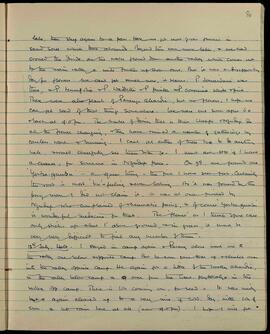
lake, then steep again to a pass. Here we got more prim flowers in sand scree which there abound. Beyond this were more lakes, and we had crossed the divide, as the water flowed down another valley which comes out to the main valley a mile further up than ours. But it was a disappointing day for flowers. We can't get much now, it seems. P. jonarduni was there, and P. tenuifolia and P. waddellii and P. pusilla and P. concinna white and pink. There were also plants of Pasang's Abardia, but no flowers. I hope we can get seed of that thing somewhere. We were out soon after 6:00 and back at 4:00 pm. The trouble of doing that is that Lhakpa and Ngudup do all the flower changing, and they have ruined a number of gatherings by careless work and burning. I can't get either of those two to do anything well, and would cheerfully see them both go. I must ask Holt if I have a chance for someone in Ngudup's place. On 9th, we found one 'Yertsa-gumbu' - a queer thing - the first I have seen fresh. Certainly the root is most 'bug'-feeling and even looking. As it was found by the pony man I did not claim it. It was at once pinched by Ngudup who complained of rheumatic pains, and of course 'Yertsa-gumbu' is wonderful medicine for that. The 'flower' or

LSH/1/1/9/1/88 · Part · 1933-06-11
Part of The Ludlow & Sherriff Collection

SUMMARY:
The author reports rapid wear of shoes, sends mail, and has Pasang and Mundra go to Shasjebang, expecting their return on 1 July; letters from Betty include Chuni’s quip about B.J.’s impending child. On 29 June a halt is kept with some rain; photos are developed, stores rearranged ahead of moving toward Bumthang, Lhakpa washes clothes, fleas are dealt with using DDT, and observations are made on late flowering and snow conditions near Me La.

CONTENT:
shoes, I calculated on a life of 6 weeks easy. Actually they are through in 3 weeks or even less, and better than the cheap Bata muck costing Rs 2/- each. Before the war Dunlop tennis shoes lasted 2 months or more on these trips. Mail went off early in the morning, Pasang & Mundra go down to Shasjebang to get what they can, return on 1st July. Among the letters Betty sent me was one from Chuni. She had heard that B.J.'s new wife was to have a baby, B.J. being I suppose 70 now. Chuni's remark was "Is there a Lost Horizon in the Isle of Wight?"

29th June Halt. A fine day right up till 2.0pm, after which a good deal of rain. Stayed in camp again, to the great showing up of our collection. In two days we have got 2 specimens only! Pasang & Mundra went off to Shasjebang. I developed photos, which are good, re-arranged stores, as we won't come back here till just before going to Bumthang, & Lhakpa washed some clothes. Since we've been away, other people have used our hut, so it seems to me it is full of fleas. At any rate I have collected a great many today, & have had to cover myself with DDT. I still cannot think why this place - indeed Bhutan generally - is so late flowering. The Lola Smith side was free of snow except for a very small bit at the top, in April. Betty talks of walking over 1 1/2 miles of snow to the Me La on June 10th. The Me La is higher, but not all that. One is 13500 & the other about 14500'. Here we have not come across much snow, but there is no doubt that flowers on