SUMMARY:
At Dur Chutsen on the Mangde Chu, the diarist met Ludlow and identified his Meconopsis as Meconopsis sherriffii, noting abundant Androsace globifera. A letter reported Betty’s injury, requiring travel to Calcutta and forcing a return to Bumthang before proceeding to Ripong; the next day was a halt during which Dorong returned with a large haul, noted as more effective than Pasang and Gunden.
CONTENT:
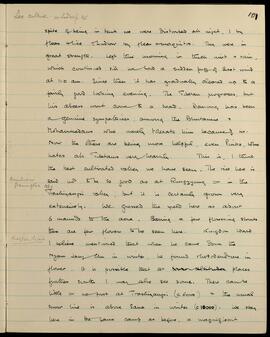
so happy here, completely absent only a few miles away over the divide. The white Androsace globifera which grows in huge vertical clumps, which I've only seen once before, in the Chachhu Valley, was here in masses - for about 200-300'. But there's nothing else of much interest. An answer is in from Ludlow, so go down to meet him tomorrow at the hot springs, Dur Chutsen, which are right on the bank of the Mangde Chu, somewhere near where the map shows. Ludlow got a new Meconopsis, in masses, pink, one flowered very fine.
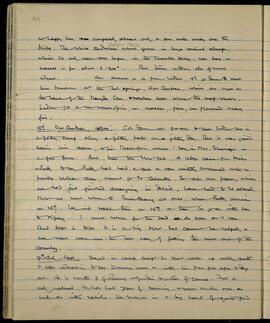
18th - Dur Chutsen 10800'. Got down at 9:00 am to meet Ludlow in a filthy camp, along a filthy path on a filthy day. But it was grand seeing him again, and his Meconopsis, which I see is Meconopsis sherriffii in a fine form. But then the blow fell. A letter came for Hicks and Betty, to say Betty had had a fall and was mildly concussed with a possible broken arm, must go to Calcutta. So all our plans, which we had just finished arranging in detail, have had to be altered. Now we must return to Bumthang at once, where Betty arrives on the 26th. We will reach there on the 25th and then go on with her to Ripong. I must return for the seed as soon as I can. And that is that. It is a big blow, but cannot be helped, and we must work out the best way of getting the most out of the country.
19th July Halt. Stayed in camp, except for short walks up muddy paths. It was interesting to see Dorong come in with his press full after 2 days out. He is worth 3 of Pasang and Gunden together of course. That is only natural. He has had years of training, and years on his own as well as with sahibs. He brought in a big haul of quite good