Angiosperms

Elements area

Taxonomy

Code

Scope note(s)

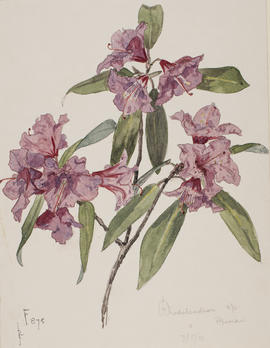
  • flowering plants, the largest and most diverse group within the kingdom Plantae. Angiosperms represent approximately 80 percent of all the known green plants now living.

  • The angiosperms are vascular seed plants in which the ovule (egg) is fertilized and develops into a seed in an enclosed hollow ovary.

Source note(s)

Display note(s)

    Equivalent terms

    Angiosperms

    • UF Flowering plants

    Associated terms

    Angiosperms

      72 Archival description results for Angiosperms

      GB 235 FRG/1/1/1/1905/9i · Item · 13/02/1905
      Part of George Forrest Collection

      Letter from Isaac Bayley Balfour, Royal Botanic Garden Edinburgh, to George Forrest in Yunnan dated 13 February 1905.
      Balfour apologises for not writing earlier. "Today I am happy in being able to tell you that your case of plants has arrived - and what a treat you have given me! I know something of the difficulties of collecting but my experience of obstacles pales before your description of the conditions under which you have had to work. Yet what a result! Yous specimens are splendid and their interest botanically intense."
      Balfour goes on to discuss some Primulas, including Primula japonica and Primula muscarioides (new to Balfour); Rhododendrons, including Rhododendron campylocarpum, and others unknown to Balfour. Saxifraga, Cassiope, Gentians, Corydalis, Clematis, Viburnum, Lonicera, Eukianthes, Pieris, Plumbago, Fritillaria, Lilium, Berberis, Polygonum, Trollius, Cornus, and Orchids including Cypripedium.
      Balfour reassures Forrest that his collecting and accounts are all excellent, and finishes with a small update from Edinburgh: Tagg has just returned from a trip to Australia and the Treasury is appointing a committee to go into the whole question of our Herbarium and the necessary accomodation there and this I hope will result in immediate action. Mr. Jeffrey, Miss Traill and others continue to work there as heretofore.

      Forrest, George
      GB 235 FRG/1/1/1/1906/12 · Item · 20/08/1906
      Part of George Forrest Collection

      Copy letter from Isaac Bayley Balfour, Edinburgh, to A.K. Bulley, Ness, dated 20 August 1906.
      Balfour writes to explain his reasons for rejecting a proposal by The Co-operative Bees Ltd. for a system of plant exchange. Balfour prefers that the Royal Botanic Garden Edinburgh be treated as a purchasing customer. He will send Meconopsis bella and Primula reidii once the former has flowered.
      Plants referenced: Meconopsis; Primula
      Letter fire damaged and paper is very brittle; handle with care.

      Balfour, Sir Isaac Bayley
      GB 235 FRG/1/1/1/1906/17 · Item · 19/11/1906
      Part of George Forrest Collection

      Copy letter from Isaac Bayley Balfour, Edinburgh, to A.K. Bulley, Ness, dated 19 November 1906.
      Balfour writes to thank Bulley for his testimony in favour of Mr Besant [of Bees Ltd, see letter to Balfour dated 2nd October 1904, Forrest file. GB235 FRG/1/1/1/1904/9. L.P.]. Balfour will keep this in mind when filling vacant post. He is finding it difficult to work out Forrest’s plants because so many are new and for described plants from the region it is difficult to get at the type specimens. Balfour undertakes to employ Forrest on his return until he finds something better. ‘He is about the best collector I know of. His specimens are splendid and his notes excellent.’
      Plants referenced: Adenophora; Crawfurdia; Gentian; Potentilla
      Letter is fire damaged with some loss.

      Balfour, Sir Isaac Bayley
      GB 235 CRE · Collection · 1935 - 1964

      1 photo album marked 'Vol 2' containing 42 prints of alpine plants; 2 separate prints mounted on card (Cyclamen repandum and Primula reidii); and 3 RHS certificates dated 1947, 1959, and 1964

      Crewdson, Cicely Maud
      Chromosome Counts (tables)
      GB 235 GBY/7/1/7 · Item · n.d.
      Part of Professor Mary Gibby Collection

      5 pages, typed.

      Appears to be from a larger document, page numbers 27-31. Printed and annotated in red and blue ink. Consists of 2 documents:

      • "Table 1. Chromosome numbers of the plants investigated" [4 pages]
      • "Table 2. Analysis of meiosis in hybrids involving P. alchemilloides (III = Trivalents, II = bivalents, I = univalents." [1 page]

      Table 1 lists species, collection number, & chromosome count
      Table 2 lists: species (hybrid), collection number, Diakinesis, and number of cells. There are only 2 specimens listed: STEU 2718 & CPG 5602a

      GB 235 GBY/7/1/8 · Item · n.d.
      Part of Professor Mary Gibby Collection

      15 pages. Typed & Handwritten. Chromosome Count comparison tables from various sections.

      Titles of the tables:

      • Section Eumorpha (1 page)
      • Section Hybrids (1 page)
      • Section Otidia
      • Section Cortusina
      • Section Dibrachya
      • Section Glaucophyllum
      • Section Jenkinsonia
      • Section Myrrhidium
      • Section Ligularia (2 pages)
      • Section Pelargonium (3 pages)
      • Section Ciconium

      Comparing chromosome counts between:

      • Coetzee (1981)
      • Albers (1983)
      • Gibby (1983)
      • Gauger (1937)
      • Daker (1959)
      • Knicely (1964)
      • Demarne (1980)
      • Motohashi (1982)

      Each table lists: species, STEU Project number (collection number), and each botanist named above

      Gibby, Mary