Showing 6828 results

Archival description
2091 results with digital objects Show results with digital objects
LSH/1/1/3/3/167 · Part · 1983-05-05
Part of The Ludlow & Sherriff Collection

SUMMARY:
The party set up the wireless and clearly heard England for the first time since Puntsogong, likely aided by monsoon conditions, with generally fine weather though cloudy on the hills. On 27 May they halted in camp due to rain, and on 28 May they went about seven miles down the valley along a difficult river path; Ludlow crossed the river, and they noted abundant Rhododendron lindleyi, a magnolia about to flower, and mixed jungle of bamboo, rhododendron, birch, larch, Tsuga dumosa and deciduous trees.

CONTENT:
Schisandra grandiflora 1704
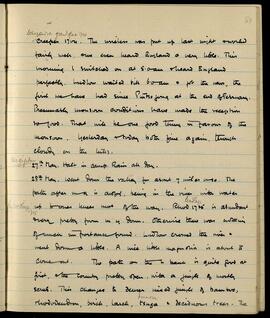
Creeper 1704. The wireless was put up last night and worked fairly well; we even heard England a very little. This morning I switched on at 5:00 am and heard England perfectly. Ludlow waited till 6:00 am and got the news, the first we have had since Puntsogong at the end of February. Presumably monsoon conditions have made the reception so good. That will be one good thing in favour of the monsoon. Yesterday and today both fine again, though cloudy on the hills.

Meigiptan 1714
27th May. Halt in camp. Rain all day.

28th May. Went down the valley for about 7 miles or so. The path after mile 4 is awful, being in the river with water up to one's knees most of the way. Rhododendron lindleyi 1715 is abundant and very pretty from mile 4 down. Otherwise there was nothing of much importance found. Ludlow crossed the river and went down a little. A nice little magnolia is about to come out. The path on the left bank is quite good at first, the country pretty open, with a jungle of mostly scrub. This changes to denser mixed jungle of bamboo, rhododendron, birch, larch, Tsuga dumosa and deciduous trees.
Woods, Patrick (Paddy)
GB 235 RBG/2/WOO · Collection · 1952 - 1985
Part of Royal Botanic Garden Edinburgh Institutional Archives

•Box containing a photocopy of his diary from 1962 (the original copy is with his family), transcript of his, diary from 1952 when he was an apprentice at Mount Stewart Gardens, Co. Down, and correspondence (1973-1985)
•Box containing correspondence and recollections of Henry Howden (Harry) Bryce, former gardener at RBGE, collection dating 1913-1990
•Box containing folder of photos (negatives and contact prints), possibly New Guinea in 1962? (includes two photos of Canon Norman Cruttwell) Photos are mainly of local people, events, villages, mountains and scenery.

Woods, Patrick (Paddy)
Woodward, F.L
GB 235 WFL · Item · 1917

•Notebook containing an article for ‘Theosophist’ Aug – Nov 1917, titled “Francis Bacon and the Cipher Story”

Woodward, F.L
Wright, [A.A.]
GB 235 WRI · Item · 1904

•Letter to P. Neill Fraser (7 Nov 1904)

Wright, [A.A.]
LSH/1/1/1/1/199 · Part · 1933-09-15
Part of The Ludlow & Sherriff Collection

SUMMARY:
Notes describe difficulties using yaks for transport, observations of the green Tibetan plateau with abundant sheep and yaks, and that Bailey had found the area interesting for flowers though the party seems too late. On 16th September they marched 12 miles to GOBSHI (14,000'), after snow and cold, reaching what is described as their last camp before the route with dak bungalows to Kalimpong.

CONTENT:
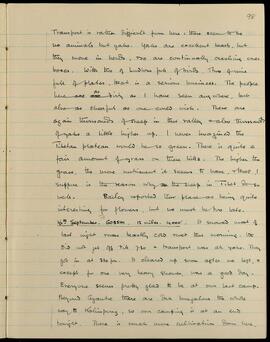
Transport is rather difficult from here: there seem to be no animals but yaks. Yaks are excellent beasts, but they move in herds, and so are continually crashing one's boxes. With two of Ludlow's full of birds, and two of mine full of plates, that is a serious business. The people here are as dirty as I have seen anywhere, but also as cheerful as one could wish. There are again thousands of sheep in this valley and also thousands of yaks a little higher up. I never imagined the Tibetan plateau would be so green. There is quite a fair amount of grass on these hills. The higher the grass, the more nutriment it seems to have, and that, I suppose is the reason why the sheep in Tibet do so well. Bailey reported this place as being quite interesting for flowers, but we must be too late.

16th September. GOBSHI. 12 miles. 14,000'. It snowed most of last night and was beastly cold and wet this morning. We did not get off till 7:30 and transport was all yaks. They got in at 3:30 pm. It cleared up soon after we left, and except for one very heavy shower, was a good day. Everyone seems pretty glad to be at our last camp. Beyond Gyantse there are dak bungalows the whole way to Kalimpong, so our camping is at an end tonight. There is much more cultivation down here,

LSH/1/1/5/1/79 · Part · 1937-05-22
Part of The Ludlow & Sherriff Collection

SUMMARY:
The diarist describes descending over soft snow by sliding, returning to camp by midday after a pleasant day of photography, with a local companion amused by the snow-sliding. On 22nd May at Yakchung (approximate height as Chapepusa), after a rainy night with hail, they collected a tree at 12,500 ft (3093) and an abundant, beautiful anemone (3094) near camp.

CONTENT:
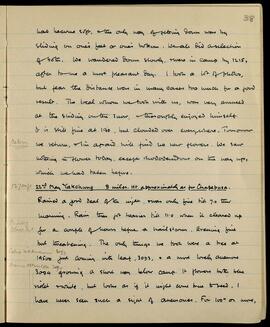
had become soft, and the only way of getting down was by sliding on one's feet or one's bottom. We all did a selection of both. We wandered down slowly, were in camp by 12:15, after to me a most pleasant day. I took a lot of photos, but fear the distance was in many cases too much for a good result. The local whom we took with us, was very amused at the sliding on the snow, and thoroughly enjoyed himself. It is still fine at 1:30, but clouded over everywhere. Tomorrow we return, and I'm afraid will find no new flowers. We saw nothing in flower today, except rhododendrons on the way up, which we had taken before.

22nd May Yakchung 8 miles. Ht. approximately as for Chapepusa.
Rained a good deal of the night, and was only fine till 7:00 this morning. Rain then got heavier till 11:00 when it cleared up for a couple of hours before a hailstorm. Evening fine but threatening. The only things we took were a tree at 12,500 just coming into leaf, 3093, and a most lovely anemone 3094 growing a short way below camp. It flowers both blue violet and white, but looks as if it might come true to seed. I have never seen such a sight of anemones. For 100 yards or more,

LSH/1/1/6/1/15 · Part · 1938-03-21
Part of The Ludlow & Sherriff Collection

SUMMARY:
The party travels along the Yamdrok Tso via Pede toward Kamba Padze and on to Gorkar Dzong, enjoying mostly fine weather, abundant birdlife, and striking lake and mountain scenery. They change transport at Tamalung, collect seeds of several plants, and cross the Khamba La after a brief blizzard; Daud struggles with the rigors of the journey while Puitro secures animals for the pass.

CONTENT:
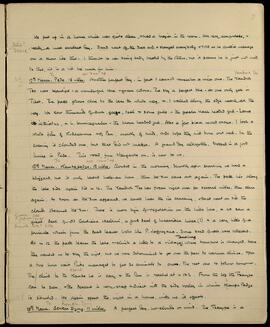
We put up in a house which was quite clean, and had a brazier in the room. All very comfortable, and really a most excellent day. Daud went off the deep end, and staggered everybody; he told us he couldn't manage on a show like this. I thought he was being badly treated by the others, but it seems he is just not used to this, and it is a bit too much for him.

17th March. Pede. 15 miles. To alt 14400' ap. Another perfect day: in fact I cannot remember a nicer one. The Yamdrok Tso was beautiful—a wonderful blue-green colour. The sky a perfect blue—as one only gets in Tibet. The path follows close to the lake the whole way, and I walked along the edge nearly all the way. We saw thousands of duck, geese, teal & some gulls—the greater black-headed gull, Larus ichthyaetus, & L. brunnicephalus, the brown-headed gull. Also a few black-necked cranes. I took a whole film of Kodachrome for Pan, mostly of birds, and hope they will turn out well. In the evening it clouded over, but that did not matter. A grand day altogether. Stopped in a poor house in Pede. This road, from Nangartse on, is new to us.

18th March. Kamba Padze. 18 miles. To alt 12000' ap. Clouded in the morning. Shortly after starting we had a blizzard, but it only lasted half an hour, then the sun came out again. The path lies along the lake side again till 12. The Yamdrok Tso was frozen right over for several miles, then clear again. As soon as the sun appeared, we could hear the ice cracking, and that went on till the clouds obscured the sun. There is more sign of vegetation on the hills here, & we saw a great deal of Gentiana waltonii, a good deal of Incarvillea lutea (?) & a very little of a primula which from the dead leaves looks like P. jaffreyana. Some seed of all were collected. At 12 the path leaves the lake & climbs a little to a village, Tamalung, where transport is changed. Here they wanted us to stay the night, but we were determined to get over the pass to warmer climes. After a two hour wait Puitro managed to get 20 animals to cross. The rest are to follow tomorrow. The climb to the Khamba La is easy & the Pass is reached at 13 1/2. From the top the Tsangpo can be seen, the descent is very steep & direct into the side valley in which Kampa Padze is situated. We again spent the night in a house, with no ill effects.

19th March. Gorkar Dzong. 11 miles. To Kongka Dzong. A perfect day, no clouds or wind. The Tsangpo is a

LSH/1/1/6/1/14 · Part · 1938-03-21
Part of The Ludlow & Sherriff Collection

SUMMARY:
Notes on seed collections of Incarvillea sp., Primula sp., and Gentiana waltonii near Yamdrok Tso, including locations between Pede and a nearby village. Seeds were packed on 21/03/1938, handed to Bunkaneer at Chira, and sent to R.B.G Edin.

CONTENT:
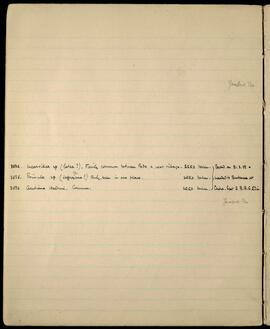
Yamdrok Tso

  1. Incarvillea sp (lutea?). Fairly common between Pede & next village. SEED taken. } Packed on 21.3.38 &
  2. Primula sp (jaffreyana?). Only seen in one place. SEED taken. } handed to Bunkaneer at
  3. Gentiana waltonii. Common. SEED taken. } Chira. Sent to R.B.G Edin.

Yamdrok Tso

LSH/1/1/1/1/193 · Part · 1933-09-24
Part of The Ludlow & Sherriff Collection

SUMMARY:
Notes describe passing Yamdrok Tso at Talung with views from Cho Dzong, an easy ascent and descent over the Ta La pass to the plain and Nangartse, and fording the Karo Chu, with fine weather and filming tame ravens. From camp at Nangartse they mention the monastery of Dorji Phamo, report failed telephone contact with Williamson in Lhasa and that they will not meet at Gyantse; the item was sent from Gyantse to Calcutta on 24/09/1933.

CONTENT:
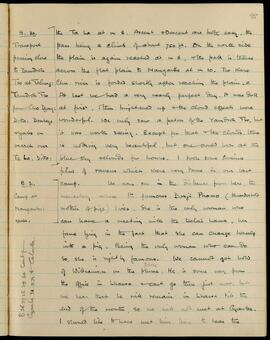
95

B. 30.
Transport passing close to Yamdrok Tso at Talung:
Yamdrok Tso from Cho Dzong:
Ditto: Donkeys & yaks on march over Ta La. Ditto:

the Ta La at m 5. Ascent & descent are both easy, the pass being a climb of about 750 ft. On the north side the plain is again reached at m 6, & the path is thence across the flat plain to Nangartse at m 10. The Karo Chu river is forded shortly after reaching the plain.

At last we had a very nearly perfect day. It was dull at first, then brightened up & the cloud effects were wonderful. We only saw a patch of the Yamdrok Tso, but it was worth seeing. Except for that & the clouds, there is nothing very beautiful, but one could look at the blue sky & clouds for hours. I took some Cinema films of ravens which were very tame in our last camp.

B. 31.
Camp at Nangartse:
raven.

We can see in the distance from here, the monastery where the famous Dorji Phamo (thunderbolt mother of pigs) lives. She is the only woman who can have a meeting with the Dalai Lama, her fame lying in the fact that she can change herself into a pig. Being the only woman who can do so, she is rightly famous. We cannot get hold of Williamson on the phone. He is some way from the office in Lhasa & can't go there just now, but we hear that he will remain in Lhasa till the end of the month, so we will not meet at Gyantse. I should like to have met him there to hear the

B 26 27 28 29 30 Sent from Gyantse 24.9.33 to Calcutta.

LSH/1/1/6/1/159 · Part · 1936-11-05 - 1936-11-07
Part of The Ludlow & Sherriff Collection

SUMMARY:
Diary entries describe travel from Yar Shika to Loro Tö, including a visit with the Dzongpen (gifted silk and saffron) and discussion of missing photographs from Sanga Chöling, scenic views, and lost/damaged film rolls previously entrusted to Bhutanese couriers. Subsequent days note severe transport disruptions with drunk porters fighting, the Dzongpen demanding a passport, Kusho struggling to arrange transport, strong valley winds, and observations of hares and the absence of partridges.

CONTENT:
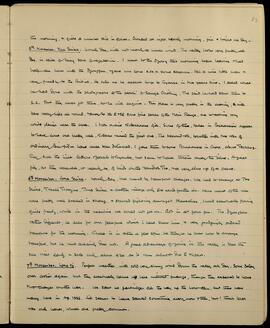
this morning, & quite a number still in flower. Clouded at night & early morning, fine & bright all day.

5th November. Yar Shika. Lovely day, with not nearly so much wind. The valley looks very pretty all day, in spite of being bare of vegetation. I went to the Dzong this morning before leaving & had half an hour with the Dzongpen, & gave him some silk & some saffron. He's a nice little man & very friendly to the British. He tells me he expects to go to Gyantse in two years time. I asked what he had done with the photographs of the 'peach' of Sanga Chöling. He said he had sent them to S.C. But they never got there, so he will enquire. This place is very pretty in the evening, with bare rocky hills all round, & away to the ESE some fine peaks of the Main Range, & a retreating very white glacier near the crest. I took a few Kodachrome of it. Some of these, taken in Pachakshiri appear to have come out pretty well. Kodak ruined the first one. The second roll, together with two rolls of ordinary Pan film have never been delivered. I gave them to some Bhutanese in Chura, above Tsetang. They took the line letters & parcels to Gyantse, but seem to have thrown away the films. A great pity, as they were all, or nearly so, of birds on the Yamdrok Tso, & a very close up of a crane.

6th November. Jora Shika. Lovely day, but ruined by transport changes. We had to change at Tro Shika, Trashi Trongme, Timp Shika & another village only 500 yards further on. Here most of the men were pretty well soaked in chang, & started fighting amongst themselves, blood eventually flowing quite freely, while in the meantime we cursed our fate. Got in at four p.m. The Dzongpen rather difficult; he asks for our passport which I can't show him, & very grudgingly ordered transport for the morning. Kusho is in rather a flat spin. He thought he knew how to arrange transport, but he most certainly does not. A great advantage of going in this valley is that the sun rises early & sets only about 4.30, as it runs almost due E & West.

7th November. Loro Tö. Perfect weather, with cold very strong wind down the valley all day. Some delay over coolies again, but they eventually came up here without change, though they expected to have two changes on the way. We saw no partridges all the way up the Loro chu, but there were many here in Ap. 1936. Jill seems to have scented something every now & then, but I think that was only hares, which are pretty common.