Showing 6828 results

Archival description
2091 results with digital objects Show results with digital objects
LSH/1/1/3/3/19 · Part · 1936-02-09
Part of The Ludlow & Sherriff Collection

SUMMARY:
Notes botanical observations including rhododendrons and Agapetes; arranged seed collection of Primula filipes near Kheri Gompa and received mail from Darrang amid concerns over dwindling stores. Marched to Demri and then camped below Balfai in the Jiri Chu valley, tested Lumière films (spoiled by hot water), and found little of botanical interest in hot weather.

CONTENT:
7

Rhododendron grande 1134 at 7000 ft
Agapetes serpens 1136 at 6000 ft
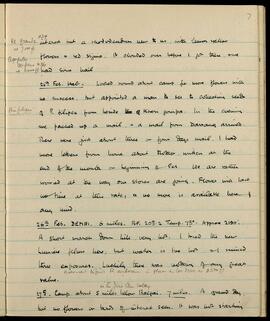
...interest but a rhododendron new to us, with lemon yellow flowers & red stigma. It clouded over before I got there, and had some hail.

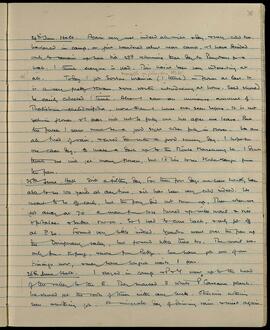
25th Feb. Hab. - Looked round about camp for more flowers with no success, but appointed a man to see to collecting seeds of Primula filipes from beside Kheri Gompa. In the evening we packed up a mail, - a mail from Darrang arrived. There were just about three or four days' mail. I had more letters from home about Mother, written at the end of the month or beginning of Feb. We are rather worried at the way our stores are going. Flour will last no time at this rate, & no more is available here of any kind.

26th Feb. DEMRI. 6 miles. BP. 208.2 Temp. 78°. Approx 2190'.
A short march down hill, very hot. I tried the new Lumière films here, but water is too hot, & ruined three exposures. Luckily there was nothing of any great value.
(astonished to find Rhododendron arboreum in flower as low down as 2500 ft)

27th. Camp. about 5 miles below Balfai in the Jiri Chu valley. 7 miles. A grand day, but no flowers or birds of interest seen. It was hot starting.
LSH/1/1/3/3/165 · Part · 1983-05-05
Part of The Ludlow & Sherriff Collection

SUMMARY:
The diary records a halt with a flea outbreak at a disused hut, clearing weather that revealed steep surrounding hills, and exploration up the valley NE of Migitun. Several Primula species and a pretty heath were found on avalanche-swept slopes, while Buddhow discovered a scarce white Rhododendron maddenii (lindleyi) further down the valley.

CONTENT:
a disused hut where some yaks were grazing. Within half a minute or less, Tenduk's legs were covered with fleas - so were my stockings.

25th May. Halt. Stayed more or less in camp till the evening. It cleared up after the last few days of rain, - let us see the country, which is very grand looking, with precipitous sided hills almost all round. Only down here in the valley is it at all open.

26th May Halt. I went up the valley NE of Migitun, - found Prim. 1662 (Yargong-chu) in quantities about 2000 ft up. Nothing else very interesting except a heath 1713 which is very pretty & should do well at home. I hope we get seeds. Prim 1711 (tsariensis) & 1712 (micropila) were both very beautiful. They both grow on slopes swept by snow avalanches & are the first to come out, with that queer little white prim which we found at Chichchar. Buddhow went straight down the valley & at about 5 m. down, found a fine white Maddenii (lindleyi) rhododendron 1702, which unfortunately was very scarce. I hope we can find some more of it. There was another too, which was not in flower. He also got a pretty

LSH/1/1/3/3/163 · Part · 1983-05-05
Part of The Ludlow & Sherriff Collection

SUMMARY:
The party halted and went up the valley to the North (E) of Migitun in heavy rain and mist, noting two waterfalls and abundant primulas. Finds included Danong's little yellow primula (1658), a plant thought to be P. violacea (1685), and a new primula (1686); leeches and midges were troublesome. An earlier note mentions an old man with a huge goitre and concerns about being carted about.

CONTENT:
huge goitre of a lifetime's standing by one old man. All seem reasonably pleased, but I don't suppose they will like carting us about very much.

24th May. Halt. Went up the valley to the North (E) of Migitun. It was too misty to see much. About 2 miles up on the R. are two waterfalls. On the way to these we found Danong's little yellow primula 1658, in masses, growing on the now free course of a perennial snow avalanche. Beside these were also a few of what I think is 1621, two other primulas of the sikkimensis section, one reddish the other yellow. I take the former 1685, to be P. violacea. Danong also found a new primula, but very little of it 1686, which is a pretty thing, though whether really it is white or should have some colour I rather doubt. On the whole a pretty good day for flowers, but otherwise foul, as it rained hard all day, and could not see where likely places were, the mist being right down the hillside. There are leeches here, but as yet not very many. The chief pest are midges, which are very trying. I went into

LSH/1/1/9/1/83 · Part · 1937-06-23
Part of The Ludlow & Sherriff Collection

SUMMARY:
Persistent cold rain kept the party in camp. The diarist noted Sorbus ursina in flower and extensive but unflowered Thalictrum chelidonifolia, hoped for a clear day to reach the Monla Karchung La to see Kula Kangri, and on the 25th a delayed pony and arrival of mail and supplies forced a return to camp.

CONTENT:
24th June. Halt. Again very wet indeed all night and day, and very cold too. We stayed in camp, or just wandered about near camp, and I have decided only to remain up here till 28th returning that day to Pangotang for a week. I think everyone is glad. This hasn't been very interesting at all. Today I found Sorbus ursina (I think) in flower at last. It is a very pretty rowan, well worth introducing at home. Seed should be easily collected I think. Also I saw an immense amount of Thalictrum chelidonifolia, more than I have ever seen before. It is not yet in flower, and I fear will not be fully out till after we leave. But the patch I saw must be a good sight when fully in flower. We are all tired of rain, and would do with a good sunny day. I hope for one clear day, to make a dash up to the Monla Karchung La. I don't think we will get many flowers, but I'd like to see Kula Kangri from the pass.

25th June. Halt. Still a filthy day. For these four days we have hardly been able to see 100 yards at any time, and it has been very cold indeed. We meant to be off early, but the pony did not turn up. Then when we got away at 7.0 a man from HH turned up with mail and rice and potatoes and butter and so on. So I had to come back,

LSH/1/1/3/3/211 · Part · 1996-06-18
Part of The Ludlow & Sherriff Collection

SUMMARY:
Wet, misty march of 9 miles to Simoneri at about 13,500 ft; few new plants noted except a gentian (no. 2209) and Meconopsis bella near a large swamp, which proved disappointing. Notes on local pass and rest house names (Karkyu La, Taktsang, Tomtsang, Shao ngu La), including a tale of a lama pacifying tigers and bears, and fatigue from repeated 4,000 ft climbs since the 14th.

CONTENT:
Not a good day, spoilt by a headache.

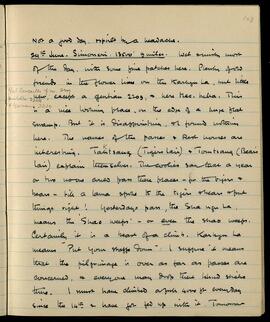
24th June. Simoneri. 13500' 9 miles. Wet, misty most of the day, with some fine patches here. Plenty of old friends in the flower line on the Karkyu La, but little new, except a gentian 2209, & here Mec. bella. This is a nice looking place, on the edge of a huge flat swamp. But it is disappointing, as I found nothing here.

The names of the passes & Rest houses are interesting. Taktsang (Tiger's lair) & Tomtsang (Bear's lair) explain themselves. The coolies say that a year or two ago none dared pass these places—for the tigers & bears—till a lama spoke to the tigers & bears & put things right!

Yesterday's pass, the Shao ngu La, means the 'Shao weeps'—or even the shao weeps. Certainly it is a beast of a climb. Karkyu La means "Put your staffs down": I suppose it means that the pilgrimage is over as far as passes are concerned, & everyone may drop their climbing sticks there. I must have climbed about 4000 ft everyday since the 14th & have got fed up with it. Tomorrow

LSH/1/1/1/1/103 · Part · 1933-07-24
Part of The Ludlow & Sherriff Collection

SUMMARY:
Arrival at Lingtsi was marked by a musical welcome, with songs contrasted to those of Ha Paro; the landscape is compared to Trunza with the Kuru Chu below the Dzong, in very hot but fine weather. The page details the route from Lingitse down to the Kuru Chu with bamboo bridges over the Kuru Chu and Khoma Chu (ponies possible), passing the Ngarigong Chu, and includes notes on views of Tangnam, Lingtsi road, Lingtsi Dzong, and the Kuru Chu bridge.

CONTENT:
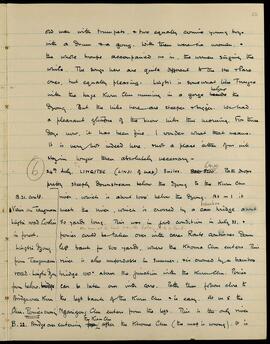
old men with trumpets, & two equally comic young boys with a drum & a gong. With them were six women, & the whole troupe accompanied us in, the women singing the while. The songs here are quite different to the Ha Paro ones, but equally pleasing. Lingtsi is somewhat like Trunza with the huge Kuru Chu running in a gorge below the Dzong. But the hills here are steeper & bigger. We had a pleasant glimpse of the snow hills this morning. For three days now, it has been fine. I wonder what that means. It is very hot indeed here, not a place either of us will stay in longer than absolutely necessary -

24th July. LINGITSE (LINSI of map.) 8 miles. 6400'. Path drops pretty steeply downstream below the Dzong to the Kuru Chu river, which is about 1000' below the Dzong. At m 1 it meets the river, which is crossed by a bamboo bridge about 50 yards long. This was in good condition in July 33, & ponies could be taken over with care. Route continues down left bank for 500 yards, where the Khoma Chu enters. This river is also unfordable in summer, & is crossed by a bamboo bridge 100x above the junction with the Kuru Chu. Ponies can be taken over with care. Path then follows close to the left bank of the Kuru Chu & is easy. At m 5 the Ngarigong Chu enters from the left. This is the only river entering the Kuru Chu after the Khoma Chu (the map is wrong). It is

B.21. Contd.
Views on Tangnam
Lingtsi road. Coolies
in forest.
Lingtsi Dzong
from Tangnam
road. Lingtsi Dzong
from below. Bridge
over Kuru
Chu. Ponies crossing
B.22. Bridge over

LSH/1/1/1/1/101 · Part · 1935-07-22
Part of The Ludlow & Sherriff Collection

SUMMARY:
Notes describe receiving naive letters and small gifts from Ashe Wangmo, including permission to use her garden at Lingtsi. The page details the route from Takyela to Lhuentse Dzong (Lingtsi), terrain and mileage, mentions that the Kuru Chu route to Lhakang Dzong is impassable in summer and that mapped hot baths are unknown, and remarks on a very hot camp and being met by the zumpin's son.

CONTENT:
49

on rocks about 1 1/2 miles this side of Shukang. It is big, a
creamy white, rather larger than the Bhutan lily. We each
had letters from Ashe Wangmo today. Poor girl, she seems to
be rather lost after the amusing times we had together. The
letters were very naive. It must be dull for them after
so much excitement. She sent us both small presents, & told
us to make use of her garden at Lingtsi - a very kind
thought.

Lendraw says "to Leightse Dzong"
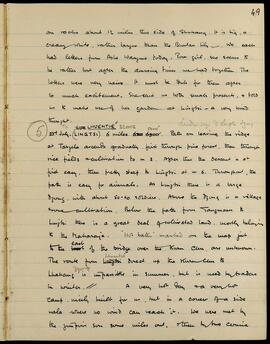
(5) 23rd July. To LHUENTSE DZONG (LINGTSI) 6 miles. 5000' 6900. Path on leaving the ridge
at Takyela ascends gradually, first through pine forest, then through
rice fields & cultivation to m 3. After this the descent is at
first easy, then pretty steep to Lingtsi at m 6. Throughout, the
path is easy for animals. At Lingtsi there is a large
Dzong, with about 50-60 soldiers. Above the Dzong is a village
& some cultivation. Below the path from Tangmasu to
Lingtsi there is a great deal of cultivated land, mostly belonging
to the Maharaja. "Hot baths" marked on the map just
east of the bridge over the Kuru Chu are unknown.
The route from Lhuentse direct up the Kuru Chu to
Lhakang Dzong is impassable in summer, but is used by traders
in winter. // A very hot day & a very hot
camp, nicely built for us, but in a corner of a side
nala where no wind can reach it. We were met by
the zumpin's son some miles out, others by two comic

LSH/1/1/3/3/65 · Part · 1936-03-10
Part of The Ludlow & Sherriff Collection

SUMMARY:
Notes include an Albizzia odoratissima tree near camp and confirmation that a primula matched Primula denticulata seen at Tauktoo Garden. On 23 March the party crosses the Myam Sang Chu by a bamboo bridge and climbs via Karteng and Sharteng to Gyipu with coolie changes; Pinto goes to Tawang with presents to the Dzongpen, and the day turns cloudy with rain from noon and low snow levels.

CONTENT:
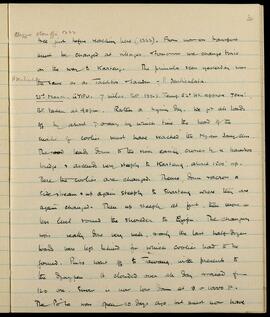
Albizzia odoratissima 1222 tree just before reaching here (1222). From now on transport must be changed at villages. Tomorrow we change twice on the way to Karteng. The primula seen yesterday was the same as at Tauktoo Garden - P. denticulata.

23rd March. GYIPU. 7 miles. B.P. 199.3. Temp 52° Ht. approx 7044'.
B.P. taken at 4.0 p.m. Rather a trying day. We got all loads off by about 7.0 a.m., by which time the head of the snake of coolies must have reached the Myam Sang Chu. The road leads down to the river easily, crosses by a bamboo bridge & ascends very steeply to Karteng, about 1500' up. There the coolies are changed. Thence down & across a side stream & up again steeply to Sharteng where they are again changed. Then up steeply at first, then more or less level round the shoulder to Gyipu. The changing was really done very well, only the last half dozen loads were left behind for which coolies had to be found. Pinto went off to Tawang with presents to the Dzongpen. It clouded over all day & rained from 12.0 on. Snow is now low down at 9 or 10,000 ft. The Pöla was open 10 days ago, but must now have

LSH/1/1/8/1/15 · Part · 1946-11-14
Part of The Ludlow & Sherriff Collection

SUMMARY:
The diary records a march from Rapdang to Tromda, followed by several halt days due to missing transport and delays, during which repairs were made and a cold bath taken in the Tsangpo. Samduprup was sent to Guru Namgyel Dz. and returned with orders to wait three days, and the Dzongpon’s envoy asked for the lamyig. A report is noted about an earlier plane crash near Langong (Langong Phu Chu), including details of four deceased men and insignia on the aircraft.

CONTENT:
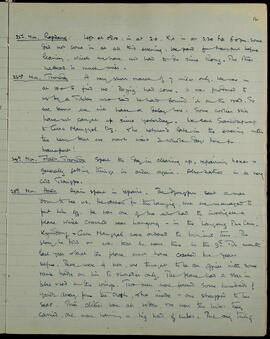
22nd Nov. Rapdang. Left at 0800: in at 2.0. Kit in at 2.30 till 6.0pm: some did not come in at all this evening. We paid for transport before leaving, which we have not had to do since Rong. The other method is much nicer.

23rd Nov. Tromda. A very short march of 7 miles only. We were in at 10.0 to find no 'dayig' had come. It was produced to us by a Tibetan who said he had found it on the road. So we know we will have a delay here. Some coolies still have not caught up since yesterday. We sent Samduprup to Guru Namgyel Dz. He returned late in the evening with the news that we must wait 3 whole days here for transport!

24th Nov. Halt. Tromda. Spent the day in clearing up, repairing boxes & generally getting things in order again. Also bathed in a very cold Tsangpo.

25th Nov. Halt. Again spent in repairs. The Dzongpon sent a man down to see us. He asked for the lamyig, but we managed to put him off. He was one of two who had to investigate a plane which crashed near Langong - in the 'Langong Phu Chu'. Kyindong & Guru Namgyel were ordered to look into this. The story he told us was that he went there in the 9th Tib month last year & that the plane must have crashed two years before. There were 4 men, one thought to be an officer with some rank badge on his R shoulder only. The plane had a star in blue & red on the wings. Two men were found some hundreds of yards away from the crash, two inside - one strapped to his seat. Their clothes were all rotten, so were the notes they carried, one man having a big wad of notes. The only thing...

LSH/1/1/6/1/83 · Part · 1938-06-22
Part of The Ludlow & Sherriff Collection

SUMMARY:
Travel notes record heavy rain, difficult marching, and a camp on the Gyara Phu Chu, followed by a fine day reaching Gyara (Nepar). Common Primula species were noted, Lerwa with young were observed, and there is disappointment at few notable finds, with hopes to visit passes east of Lilung; transport delays prevent moving on to Pamse.

CONTENT:
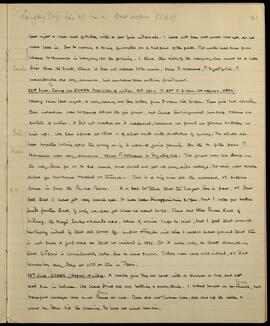
Langong Trip has not been a great success (S. 647)

Last night and rain most of today with a few fine intervals. I have not been out much here yet, as we were late in, due to meeting a string of mules on a bad part of the path. The mules had come from Lhasa to summer in Langong for the grazing. I think this side of the Langong Chu must be a little drier than the south, though it does not appear to be much. Here P. hopeana, P. dryadifolia, P. macrophylla are very common, but we have seen nothing of interest.

To
22nd June. Camp on GYARA PHU CHU. 6 miles. BP. 191.1 T. 55° T. 3.0pm. Ht approx. 11832'.
Heavy rain last night, and very heavy all day today from 8.0am till 2.0pm. Then fine but cloudy. Our intention was to camp above the fir forest, but Chulla distinguished himself and came on another 4 miles. It did not matter as it happened, because we found no flowers to delay us high up. We saw Lerwa at 15,000 - 4 adult birds with a clutch of young. The adults all kept together looking after the young as if it were a joint family. On the N. of the pass P. kansuensis was very common, and some P. hopeana and dryadifolia. The forest was too dense on the way down for us to see much, and we could not see up any side valleys. The rain was really awful for two hours and soaked us through. This is a big river at the moment, and I suppose comes in from the Pacha Peaks. It is sad to think that the longest day is past, and I don't feel that I have got very much yet. It has been disappointing so far, but I hope for better finds further East, if only we can get where we want to go. There are three Passes East of Lilung, the Magu, Shoka and Namdo Las, each of which I hope to visit, but I feel that we will be lucky indeed if that all comes off. Ludlow and Sherriff will also I expect have found that this is not such a good area as that we visited in 1936. Or it may only be that everything in East Tsari is considerably later, due to more snow. Today was very cold indeed, and I don't remember any days as cold as this in Tsari.

To
23rd June. GYARA (Nepar). 4 miles. A really fine day at last, with a shower or two, but hot real sun in between. We have dried all our bedding and everything. I hoped to get on to Pamse, but transport changes here and at Pamse as well. There are no horses here, all are up the valley and won't be down till the evening. So here we must remain.