Showing 6828 results

Archival description
2091 results with digital objects Show results with digital objects
Arthur Humble Evans Ephemera
GB 235 EAH · Series · 1855 - 1943

• Obituary, reprinted from "The North Western Naturalist" September 1943; a 3 page obituary by George Taylor which includes a portrait of A.H. Evans.
• Three items from Botanical Society of Edinburgh archives relating to Evans’s biography and bibliography – correspondence between William Wright Smith, George Taylor, Alex Cowan and J.T. Johnstone including a typed letter from George Taylor to Professor William Wright Smith (6 April 1943) regarding Evans's biography and bibliography; a handwritten note from Alex Cowan to Professor William Wright Smith (12 April 1943) regarding Evans's notification of death and clarification of a date; and a cover note from William Wright Smith to librarian J.T. Johnstone.

Evans, Arthur Humble
GB 235 KER · File · 1921 - 1931

• 3 hand drawn maps & 1 printed map of an Expedition in Siam (1921), Chengmai district, N. Thailand, to be found in Archive Box I-K. 2 expeditions were taken during 1921. Routes followed day by day marked in red. Jan-April and late April –Jun. Printed map of the Kingdom of Siam and neighbouring states pre-1939
• Hand written list of plants extracted from a copy of J.G. Koenig's ‘Journal of a Voyage from India to Siam and Malacca in 1779’ (April 26th 1931), in folder in Archive Box I-K. Plants noted at Ban Pak nam, Siam. Some plants introduced since his visit.

Kerr, Arthur Francis George
LSH/1/1/9/1/61 · Part · 1949-06-01
Part of The Ludlow & Sherriff Collection

SUMMARY:
After an early start the party reached Weitang, noting Primula bellidifolia in bud, P. crispata, and particularly P. calderiana in white, yellow, and hybrid forms, while other expected species were absent, possibly due to heavy yak grazing. News arrived that the Druk Locha (Bumthang Representative) from Lhasa is en route to Bumthang and expected shortly; the diarist recalls meeting him previously in Lhasa with Betty.

CONTENT:
Signs of clearing and we left at 5:30 for Weitang. Weitang at last! The day turned out to be lovely, but again we saw nothing of interest. I did at last see P. bellidifolia in bud, and P. crispata was there too. But no gracilipes, no whitei, no macrophylla, or macrocarpa, glabra or puella. Either none of them exist here, or yaks eat them all. Perhaps there are so many yaks that we will find this area very poor indeed. It almost looks like it. The only interesting thing was to find P. Calderiana becoming more common in a white or yellow form than in its true violet purple form. I took a good many variations, and called them P. Calderiana, hybrid white, hybrid powder blue violet, hybrid yellow, and P. strumosa. I am sure that is what it is, and had the same times in central Bhutan in 1937 at a later date and more profuse. The great news today is that the Druk Locha (Bumthang Representative) in Lhasa, is on his way to Bumthang, will be here tomorrow or next day. He has 8 mounted people, 11 in all and 120 animals of kit, stores etc. It is the same Locha as was there when Betty and I were in Lhasa, so I must meet him and talk to him I suppose. He was always very pleasant to us in Lhasa. His son—the spoilt brat as we called

LSH/1/1/1/1/179 · Part · 1933-09-05
Part of The Ludlow & Sherriff Collection

SUMMARY:
The writer describes Tibetan superstitions, particularly the aversion to shooting hares due to their donkey-like ears. After delays at Lala and slow transport with yaks and donkeys, they arrived late at Towa, where a curry made overly hot by Ahmad Sheikh left Ludlow unable to eat, though strawberries and cream from H.H. were excellent.

CONTENT:
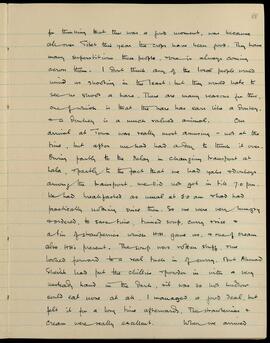
for thinking that this was a good moment, was because
all over Tibet this year the crops have been good. They have
many superstitions these people, one is always coming
across them. I don't think any of the local people would
mind us shooting in the least: but they would hate to
see us shoot a hare. There are many reasons for this,
one of which is that the hare has ears like a donkey,
and a donkey is a much valued animal. Our
arrival at Towa was really most amusing - not at the
time, but after we had had a day to think it over.
Owing partly to the delay in changing transport at
Lala, and partly to the fact that we had yaks and donkeys
among the transport, we did not get in till 7.0 pm.
We had breakfasted as usual at 5.0 am and had had
practically nothing since then. So we were very hungry
and ordered, to save time, tinned soup, curry and rice and
a tin of strawberries which H.H. gave us, and one of cream
also H.H.'s present. The soup was rotten stuff, and we
looked forward to a real tuck in of curry. But Ahmad
Sheikh had put the chillies and powder in with a very
unsteady hand in the dark, and it was so hot Ludlow
could eat none at all. I managed a good deal, but
felt it for a long time afterwards. The strawberries and
cream were really excellent. When we arrived

LSH/1/1/8/1/33 · Part · 1946-12-23
Part of The Ludlow & Sherriff Collection

SUMMARY:
The party trekked through spruce, oak, pine, and larch forest, passed below Chunyima, obtained butter and fresh milk from herdsmen with yaks, and noted several plants including Primula atrodentata and Lilium wardii. They reached Tongkyuk Dzong after 68 days, glimpsing the Po Yigrong Range and collecting limited seed of an unidentified Rhododendron, a Gaultheria, and an evergreen Berberis.

CONTENT:
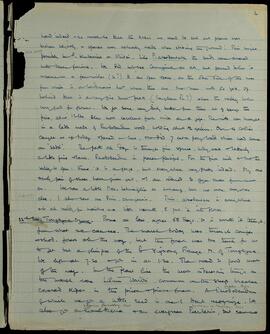
hard indeed - so much so that the kukri we used to cut out plants was broken slightly, & sparks were actually made when striking the ground! This might possibly be P. bhutanica or Whitei. Like P. atrodentata the buds were covered with dense farina. We did not see Chunyima at all, but passed below it scarcely a few miles (2?) to an open space, on the other side of the river from which is a herdsman's hut where there are two men with 50 yaks. Up behind that is a very fine snow peak (Sangdam Pu?) where the valley looks very good for flowers. We got some very dirty butter from them at 9 sangs the piece, about 1 1/2 lbs. Also most excellent fresh milk as a gift. The milk was brought in a ladle made of Rhododendron wood, holding about 1/2 gallon. Our 4 coolies caught us up today joined us here, so did 7 extra pony loads which had come on "sadsi". The path all day is through fine spruce, holly oak & latterly a little pine larch. Rhododendron in places plentiful. For the first mile or two the valley is open: thence it is a gorge, but everywhere very pretty indeed. My one only pair of shoes have given out, & am reduced to gym shoes from now on. We saw a little Mec. betonicifolia at Lunang, but no more anywhere else. I also saw one Prim. chungensis. Prim. atrodentata is everywhere & is all ready for moisture & a little warmth, to put it into flower.

22nd Dec. Tongkyuk Dzong. Home at last, after 68 days. It is worth it though, from what we can see. The march today was through conifer & rhod. forest all the way, but the forest was too thick for us to get but a glimpse of the Po Yigrong Range N. of Tongkyuk. We left at 7.30 & got in at 1.30. The road is good most of the way. In the plant line the most interesting things on the march were Lilium Wardii, common on the steep bracken covered slopes in the picea & pinus forest. A Rhododendron of which we got a little seed is one I don't recognize. We also got a Gaultheria & an evergreen Berberis, but saw no...

LSH/1/1/2/1/49 · Part · 1933-07-08
Part of The Ludlow & Sherriff Collection

SUMMARY:
The party arrived at Tawang in heavy rain after their horses gave out, with baggage arriving late or not at all. An acting body in place of a Dzongpen failed to assist, while a lama from another Bhutan-affiliated monastery offered help that was declined. The entry notes Tawang’s large gompa community and cultivation, a glimpse of the Tawang Chu, and a halt on 13 July with further discussions with Tibetans who were willing but unable to help.

CONTENT:
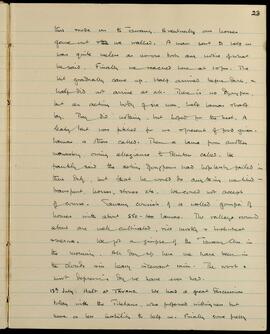
23

Then rode on to Tawang. Eventually our horses gave out and we walked. A man sent to help us was quite useless as no one took any notice of what he said. Finally we reached here at 1.0 p.m. The kit gradually came up. Half arrived before dark, and half did not arrive at all. There is no Dzongpen, but an acting body of six men, half lamas and half lay. They did nothing, but hoped for the best. A leaky tent was pitched for us and presents of food given. Lamas and others called. Then a lama from another monastery, owing allegiance to Bhutan called. He frankly said the acting Dzongpens had hopelessly failed in their duty, but that he would do anything we liked - transport, horses, stores etc. We could not accept of course. Tawang consists of a walled gompa of houses with about 550-600 lamas. The valleys round about are well cultivated, rice mostly and buckwheat over. We got a glimpse of the Tawang Chu in the morning. All day up here we have been in the clouds in heavy incessant rain. The worst and most depressing day we have ever had.

13th July. Halt at TAWANG. We had a great discussion today with the Tibetans, who professed willingness but more or less inability to help us. Finally some pretty

LSH/1/1/1/1/87 · Part · 1933-07-14 - 1933-07-11
Part of The Ludlow & Sherriff Collection

SUMMARY:
Notes on film sent from Bumthang and exposure issues; shooting was limited due to Tobgye’s concern about H.H.’s views on filming in E. Bhutan. Describes arrival at Bumthang with a pompous musical welcome by H.H.’s trained band, mentions groups on the Kykji Pass, and the march to Bumthang (9 miles, alt. 9900').

CONTENT:
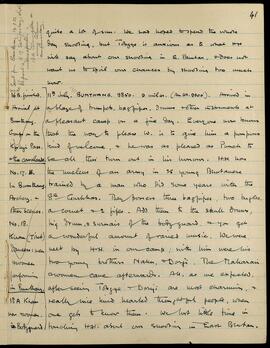
41

14.7.33
Sent from Bumthang on Report 2 to 17 satisfactory, slightly underexposed.
18A colour filter on wrong column complimentary.

Quite a lot of sun. We had hoped to spend the whole day shooting, but Tobgye is anxious as to what H.H. will say about our shooting in E. Bhutan, and does not want us to spoil our chances by shooting too much now.

16 B. finished. 11th July. To BUMTHANG. 9850. 9 miles. (Alt. 9900').
Arrival at Bumthang. Arrived in a blaze of trumpets, bagpipes, drums and other instruments at Bumthang. A pleasant camp on a fine day. Everyone now knows
Groups on the Kykji Pass. that the way to please W. is to give him a pompous kind of welcome, and he was as pleased as Punch to
the cavalcade. see all this turn out in his honour. H.H. has
No. 17. B. the nucleus of an army in 25 young Bhutanese
In Bumthang. trained by a man who did some years with the
Archery and 8th Gurkhas. They possess three bagpipes, two bugles,
other scenes. a cornet and 2 fifes. Add them to the kettle drums,
No. 18. big drum, and surnais of the bodyguard, and you get

LSH/1/1/4/1/52 · Part · 1933-07-23
Part of The Ludlow & Sherriff Collection

SUMMARY:
A young male prisoner was remanded and removed to the lock-up after being arrested at Mrs. Smith's Little Bourke-street lodging by Detective Main, who found a pistol and ammunition on him. The account notes his age, appearance, U.S. origin, employment history including time with Mr. J. P. Fawkner, and mentions a person named George Watson.

CONTENT:
would say that he had not seen her for several months
ago. Then as to George Watson, he said he knew of
him, but I saw in a paper that some one by that
name had been arrested.
At the conclusion of the examination, the prisoner
was remanded until Saturday next at 12 o'clock.
The prisoner was then removed to the lock-up.
The prisoner is a young man, about 22 years of age,
and about 5 feet 8 inches in height. He has a
dark complexion, dark hair, and whiskers, and
was dressed in a dark coat and trousers, and
a black hat. He is a native of the United States,
and has been in this colony about two years.
He has been employed as a clerk in several
offices in Melbourne, and was for some time
in the employment of Mr. J. P. Fawkner.
The prisoner was arrested on Tuesday last, at
the house of a person named Mrs. Smith, in
Little Bourke-street, where he had been lodging
for some time. He was arrested by Detective
Main, who had been on the look-out for him
for some time. The prisoner was taken to the
lock-up, and on being searched, a small
pistol was found in his possession, and also a
small quantity of powder and shot. He was
also found to have in his possession a small

LSH/1/1/2/1/23 · Part · 1924-06-23
Part of The Ludlow & Sherriff Collection

SUMMARY:
The party stays in the Dzongpen’s guest quarters, sends presents to Bumthang, and arranges future mail to India via Neoli instead of Dewangiri to avoid the wet march to Darrang Mela; the Dzongpen is very hospitable and even takes up shooting sparrows. On 29 June they make a short, mostly downhill march to Trashigong with the Jongpen, passing cultivated hills near Pinhogong (Rongtung) and noting the Dangme Chu (Trashiyangsi Chu) below.

CONTENT:
boxes and stores. The Dzongpen has two quite pleasant quarters for guests, and had made a place for our servants. We sent off all presents for Bumthang and arranged for the first mail to go to India today. It will go by Dewangiri, but we are arranging that in future it should go by Neoli, so as to miss the wet march from Dewangiri to Darrang Mela. The Dzongpen is not likely to worry us for shooting birds, as he saw my two rifles yesterday and immediately took both out and started potting sparrows himself. He is being as kind as Bhutan officials always have been, and provides everything. In fact he provides far too much, and we are not allowed to pay for anything if he can help it.

29th June TO TRASHIGONG 5 miles. (205.2° = 3574'. Temp. 81°.

Sent off all loads about 10 am and followed with the Jongpen at 11.30. A very short march, steep down for the first mile over a small side valley. Then the road is well graded, slightly downhill, through open hillside. The hills are cultivated here and there, but there are signs that formerly there used to be a great deal of cultivation near here. Pinhogong is the RONGTUNG of the map, or near it. Below Trashigong flows the Dangme Chu (Trashiyangsi Chu) a fine big swift