7 boxes containing -
•Photographic notes (1965-1966)
•Trek diaries
•Field notes
•correspondence
•Immigration papers and trekking permits
•Notes on living plants and herbarium material sent to Royal Botanic Garden Kew (1965-1966)
•List of publications and papers
•Folders of articles
•Bowl made from leaves
•2 ceremonial Ghurkha knives (access restrictions apply - the scabbards are in poor condition, and in one case has split, making the knives extremely dangerous to handle)
1 page letter. Typed.
UnknownSUMMARY:
Introductory text outlines 1990s automotive trends and begins a top-10 list, highlighting the McLaren F1 (launched in 1992) and its engineering achievements, alongside the Toyota Supra (A80) and Mazda RX-7 (FD).
CONTENT:
<p>The 1990s was a decade of significant change for the automotive industry, marked by a shift towards more aerodynamic designs, improved safety features, and the rise of the SUV. This era produced some of the most iconic and beloved cars in history, many of which are now considered classics. From high-performance sports cars to reliable family sedans, the 90s had something for everyone. In this article, we'll take a look at the top 10 cars of the 90s that have left a lasting impact on the automotive world.</p>
<h2>1. McLaren F1</h2>
<p>The McLaren F1 is often considered the greatest supercar of all time. Launched in 1992, it held the record for the world's fastest production car for over a decade, with a top speed of 240.1 mph. Its unique three-seat configuration, with the driver in the center, and its gold-lined engine bay for heat reflection, made it a marvel of engineering.</p>
<h2>2. Toyota Supra (A80)</h2>
<p>The fourth-generation Toyota Supra, particularly the Turbo model, became a legend in the tuner scene. Its 2JZ-GTE engine was famous for its reliability and potential for massive power gains. The Supra's sleek design and performance capabilities have made it a highly sought-after classic today.</p>
<h2>3. Mazda RX-7 (FD)</h2>
<p>The third-generation Mazda RX-7 is renowned for its beautiful,
SUMMARY:
Travelled about 9 miles down the valley near Tora under fine weather that later brought hail, noting Iris lactea in flower and likely matching K. Ward's 'Karta' iris, with poplars, willows, and buckthorn near a hillside monastery. Sheep were seen struggling for forage during lambing season, six partridges were shot, and a possible Ceratostigma was observed.
CONTENT:
Locals say they are white.
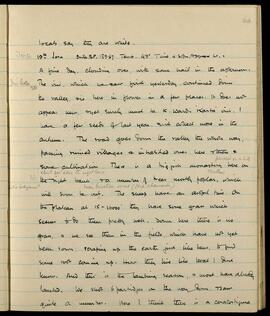
Tora 19th Tora 9 miles B.P. 189.47 Temp. 49° Time 4.30pm. Approx ht. :
A fine day, clouding over, with some hail in the afternoon.
The iris (Iris lactea), which we saw first yesterday, continued down the valley, is here in flower in a few places. It does not appear new, and yet surely must be K. Ward's 'Karta' iris. I have a few seeds of last year, will collect more in the autumn. The road goes down the valley the whole way, passing ruined villages and inhabited ones here and there and some cultivation. There is a biggish monastery here, perched on a hill on the right bank about 300' above the bank, and a number of trees, mostly poplar and willow (Salix babylonica?), which will soon be out. There is also some buckthorn scrub (Hippophae rhamnoides). The sheep have an awful time. On the plateau at 15,000–16,000' they have some grass which seems to do them pretty well. Down here there is no grass, and we see them in the fields, which have not yet been sown, scraping up the earth just like hens, to find some roots coming up. How they live like that I don't know. And this is the lambing season, and most have already lambed. We shot 6 partridges on the way down, and saw quite a number. Here I think there is a Ceratostigma.
SUMMARY:
The party halts at Towa, where the Jongpen, newly returned from Lhasa, invites them to stay another day for dinner. They plan to travel to Nangartse by the route between Pomo and the Yamdrok Tsos, arrange transport changes at Lalung, Monda La, Ling, and Nangartse, and note local transport rates between Singhi Dzong, Lala, and Towa.
CONTENT:
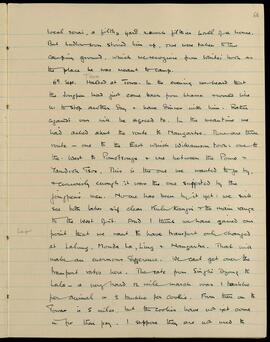
local serai, a filthy yard and much filthier hovel of a home. But Ludlow soon stirred him up, and we were taken to this camping ground, which we recognize from White's book as the place he was meant to camp.
6th Sept. Halted at Towa. In the evening we heard that the Jongpen had just come back from Lhasa and would like us to stop another day and have dinner with him. Rather against our will we agreed to. In the meantime we had asked about the route to Nangartse. There are three routes — one to the East which Williamson took: one to the West to Pomotsongo and one between the Pomo and Yamdrok Tsos. This is the one we wanted to go by, and curiously enough it was the one suggested by the Jongpen's men. No one has been by it yet: we will see both lakes and if clear Kulu Kangri and the main range to the West of it. And I think we have gained our point that we want to have transport only changed at Lalung, Monda La, Ling and Nangartse. That will make an enormous difference. We can't get over the transport rates here. The rate from Singhi Dzong to Lala — a very hard 12 mile march was 1 tanka per animal or 1/2 tanka per coolie. From there on to Towa is 5 miles, but the coolies have not yet come in for their pay. I suppose they are not used to
•A revised copy of ‘The Scottish Naturalist: Revision of the Uredineae and of the Ustilagineae of Scotland’ (1899) submitted to the Scottish Cryptogamic Society,
• Some correspondence and information regarding a proposed memorial for him.
Typed transcript of Forrest’s letters and notes.
- Pages 1-28 describe Forrest's journey from Bhamo to Teng Yueh and corresponds closely with a handwritten letter to his fiancée Clementina Traill [GB 235 FRG/1/1/2].
Pages 29-94 contain ‘extractions’ from letters written to Mrs Forrest [either his mother, or Clementina, as she would likely have been Mrs Forrest at the time the letters were transcribed], Edinburgh, from Yunnan and Tibet [1904]-1905. These deal more with descriptions of the country and people rather than botanical matters. The copy letters, which have been typed out of order, are detailed as follows:
-
Pages 29-42. G. Forrest to Mrs Forrest from China Inland Mission, Talifu, 24 March 1905. Describes the valley from Hsia Kuan to Shang Kuan, and gives detailed description of Tali [Dali], its chiefs, main buildings and commerce.
-
Pages 43-53. G. Forrest to Mrs Forrest from China Inland Mission, Talifu, 28 March 1905. Gives further detailed information about Tali. Description of marble quarrying, trades, city buildings, female foot binding, clothing, food, education and customs.
-
Pages 54-63. G. Forrest to Mrs Forrest, November 1904. Describes journey from Tali to Chong Ku on the Chung Tien plateau. ‘I left Tali on the 14th with the intention of going to Lichiang, and from there up to the top of the great Yangtse bend to work the base of the glacier there.’ Includes manuscript sketch of a kitchen or family room of a Tibetan house in which he spent two nights. Detailed description of the house and its use by the Tibetans in winter.
-
Pages 64-67. G. Forrest to Mrs Forrest, November/December 1904. Describes journey from Chung Tien back to Tali, with itinerary.
-
Pages 68-87. G. Forrest to Mrs Forrest, October 1904. Describes a 53-day journey from Tali north into Tibet, covering around 900 miles. Itinerary: Tali, Sha Kai, Shang Ying-pu, Tai Ho Tsun, Sung Kwei, Hoching, Chi Ho, Lichiang, Pei Sha, La Shi Pa, Mu Pi Wan, Na Le, Hsia So Yi, Ke Lo Wan, Mao Niu Chang, Hsia Chung Tien, Yong Ku, Chung Tien, Tang Tien, Chiao Tou, Pung Tzu-la, Kari Pass, Shi zo, Hsia zo, Shih Pa, Yeh Chih, Ba Ti, Tse Kou, Ba Ti, and again Yeh Chih, Ta Chiao, Hsiao Wei Hsi, Ka Ka, Wei Hsia, Lu Tien, Chu Tien, Tzu Ko, Shih Ku, Chia Ho, Chien Chuan-sho, Jiu Kai, Teng Chuan-sho and back to Tali.
-
Pages 88-94. g. Forrest to Mrs Forrest, from Mission Apostolique, Tsekou, Tibet, 28 April 1905. Describes journey from Talifu going north by Chien Chuan and ending at Tsekou. Gives news of a revolt among the lamas in the north, ‘Tsekou is practically in a state of siege.’
Plants referenced:
Bamboo (pp.1,5); Mango (p.1); Orchid (p.6); Rice (pp. 3,16, 20); Teak (p.1)
Cotton (p.41)
Apricot (p.52); Bean (p.52); Cabbage (p.52); Carrot (p.52); Fig (p.52); Filbert (p.52); Gladitschia (p.53); Grape (p.53); Lemon (p.52); Mandarin orange (p.52); Pea (p.52); Peach (p.52); Pear (p.52); Persimmon (p.52); Pomegranate (p.52); Potato (p.52); Rice (p.52); Sapindus (p.53); Turnip (p.52); Walnut (pp.44, 52)
Allium (p.56); Azalea (pp.55, 56, 60); Gentian (pp.55, 56, 60); Lychnis (p.56); Lily (p.58); Paeonia (p.56); Pine (pp.54, 55, 56); Primula (p.60); Rhododendron (pp.55, 56, 60); Saxifrage (pp.56, 57, 60); Senecio (p.57)
Pine (p.66)
Azalea (pp. 77, 82, 85); Carduus (p.77); Clematis (p.80); Fritillaria (p.76); Gentian (pp.76, 77, 85, 87); Lily (p.85); Pine (pp.76, 77); Polygonum (p.77); Primula (pp.76, 82, 85, 86); Rhododendron (pp.77,82, 85); Rice (p.70); Saxifrage (pp.76, 77)
Pine (pp.90, 91)

Transcript of Rock’s Diary, Vol. 3, 1925
The transcript is unannotated, but spaces have been left for Rock to make additions.
Diary of J.F. Rock Volume 2; Ch’eng-tu to Choni, 1925
Arnold Arboretum Expedition from Chengtu to Choni, March 17th to May 23rd 1925.
The transcript was prepared for Rock but is not annotated, although space has been left for Rock to add annotations and Chinese script.
Transcript of Rock’s Diary, Vol. 8, 1927 entitled 'Cho-ni to Sung-Pan; Journey from Cho-ni via The-wu country to Chung-Cheng, Director Arnold Arboretum, Harvard Expedition. From March 9 to April 22 1927, Volume No. VIII (8)'
Transcript has been prepared for Rock and includes the corrections made in his annotated copy and although space has been left for him to add Chinese / Tibetan characters, this was not done.