Showing 6828 results

Archival description
2091 results with digital objects Show results with digital objects
LSH/1/1/9/1/35 · Part · 1949-05-06
Part of The Ludlow & Sherriff Collection

SUMMARY:
The diarist walks alone while Ngundup asks about Delhi, London, and the King; the writer reflects on the Maharaja’s authority in Bhutan and warns of leeches on routes toward Tobrang and between Denchume and Jula. During halts on 30 April and 1 May near Sulu, Pasang returns with few specimens (no primulas) and a possible Rhododendron magnificum, and the diarist notes the scarcity of dogs and consults 1937 field notes.

CONTENT:
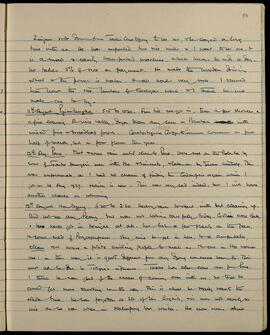
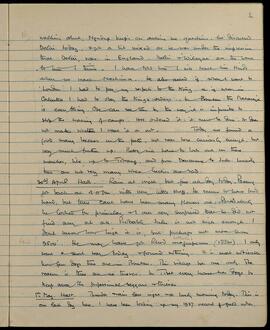
Walking alone, Ngundup keeps on asking me questions. We discussed Delhi today, and got a bit mixed as he was under the impression that Delhi was in England. Delhi and 'Wilayat' are the same to him I think. I have told him I will teach him Hindi when we reach Nashima. He also asked if when I went to 'London' I had to pay my respects to the King, and if when in Calcutta I had to obey the King's orders. In Bhutan the Maharaja is everything. One can see this by the way it is impossible to stop the making of camps. H.H. ordered it: it must be done. It does not matter whether I want it or not. Today we found a good many leeches on the path, not near here curiously enough, but very much further up. Betty will have to look out on these marches, like up to Tobrang, and from Denchume to Jula. Luckily there are not very many where leeches are bad.

30th April Halt. Rain at night, but fine all day today. Pasang got back at 4.0 pm, with very little stuff. He seems to have tried hard, but there can't have been many flowers out. Particularly he looked for primulas, and I am very surprised that he did not find any at all. Probably Sulu is not high enough. I don't know how high it is, but perhaps not more than 9500'. He may have got Rhod. magnificum (18801). I only went a short way today, and found nothing. It is most noticeable how few dogs there are in Bhutan. This village has one only. The reason is there are no thieves. In Tibet every house has dogs to keep away the professional beggars and thieves.

1st May. Halt. Thunder and rain last night, a lovely morning today. This is our last day here. I have been looking up my 1937 record of field notes,
LSH/1/1/2/1/176 · Part · 1933-09-08
Part of The Ludlow & Sherriff Collection

SUMMARY:
Notes describe a pervasive small biting fly in Bhutan, abundant around camp, and a lack of birds on the eastern side of a pass compared to the western side. It reports continuous heavy rain through night and day, and very dense, steep jungle with short visibility where the best birds are found.

CONTENT:
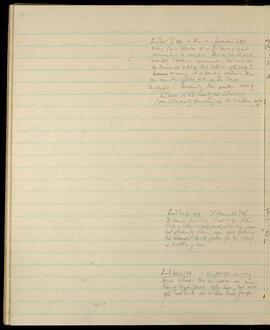
Ludlow 118 - There is a peculiar little biting fly in Bhutan which is the cause of great annoyance to everyone. It is as small as a sandfly, it bites one vehemently, not noticed so much at midday, but late in afternoon and early morning it is particularly active. There are numbers of these flies in the camp.
No birds - evidently this eastern side of the pass is not nearly so interesting (ornithologically speaking) as the western side.

Ludlow 119 'A damnable day'
It rained the whole of last night and the whole of today - not just ordinary rain but streaming rain, rain that falls from the clouds as it falls from the rose of a watering can.

Ludlow 120 - the jungles are very dense and steep. One can seldom see more than a dozen yards, often less, but most of the best birds are in these thick jungles.

LSH/1/1/2/1/18 · Part · 1924-06-23
Part of The Ludlow & Sherriff Collection

SUMMARY:
Lists bird specimens 2416–2420 with sexes and identifications, and notes the exhausting climbs, gaining 3000 ft and losing it the next day. Remarks that in Bhutan low temperatures are not felt below 8,500 ft during summer.

CONTENT:
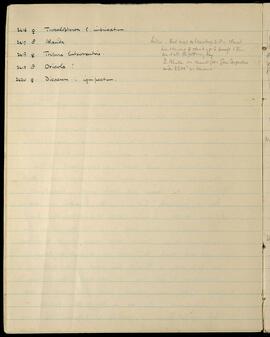
2416 ♀ Trochalopteron l. imbricatum.
2417 ♂ Alauda Indeed that most exhausting & it is almost
2418 ♀ Tesia luteoventris. heartbreaking to climb up to 3000ft & then
2419 ♂ Oriolus ? lose it all the following day.
In Bhutan one cannot feel low temperature
2420 ♀ Dicaeum i. ignipectum. under 8500' in summer.

LSH/1/1/9/1/115 · Part · 1937-08-14
Part of The Ludlow & Sherriff Collection

SUMMARY:
Zimpon visits from Tashi Cho Dzong and demonstrates imported rice mills, with the diarist comparing Kashgar huskers. The party travels through Pyimitangha to Paro and Ha Dzong amid variable weather, meets Tasho and his men near the Belaka, and laments missing a Codonopsis previously collected on 14 Aug 1937.

CONTENT:
Zimpon rode down from Tashi Cho Dzong to see us, he stayed a long time with us. He has imported two rice mills & I went to see one. It is a small & easily transported machine, which husks 30 mds a day. He takes 5% of rice as payment. He made the wooden driving wheel & the power is water. It all works very well. I showed him how the rice huskers of Kashgar work, & think he will make one to try.

11th August. Pyimitangha. 5.15 to 10.30. Fine till we got in, then a few showers, & a fine evening. A nice valley, dryer than any seen in Bhutan, with mixed pine & broadleaf forest. Ceratostigma griffithianum common on first half of March, but in poor flower this year.

12th Aug. Paro. Mist & some rain until close to Paro. Were met on the Belaka by some of Tasho Drugyel's men with tea & biscuits, & later on by Tasho himself. This was unfortunate, as I had no chance of finding the Codonopsis again, which I got on 14 Aug 1937, & which is new. This was very sad indeed, but I will have another chance on returning.

13th August Ha Dzong. 6.30 to 2.30 Heavy rain to start with but clearing up. Did not see any Peony, but was not looking carefully

GB 235 CHB · File · 1905 - 1915
  • Bertha Chandler's thesis, 1913, "The Theory and Practice of Vegetative Propagation in the Flowering Plants", illustrated by Bertha's drawings and photographs, and photographs by Robert Moyes Adam.
  • 4 notebooks; Botany, May 1905 - Bertha's University of Edinburgh lecture notes; Practical Botany sketch book, Winter 1907-08, drawings and notes; Hardy Shrubs, drawings, notes and literature references, plus numerous enclosure, including partial notes for a talk on plant luminescence; and 'Where is it?' - an indexed book containing an alphabetical list of plants experimented with for Callus formation and Propagation with numerical list at end of book.
  • Reprint - Utricularia emarginata by Chandler, Annals of Botany, vol. XXIV, No., XCV, July 1910, owned by Chandler.
  • 7 copies of Chandler's biography for the RBGE Guild journal.
Chandler, Bertha
LSH/1/1/3/3/174 · Part · 1983-05-05
Part of The Ludlow & Sherriff Collection

SUMMARY:
Brief description of the Bembi La valley’s wooded sides and steep left-bank cliffs, with plant collections recorded at Bembi La and Migyitun on 2 and 3 June. Numerous taxa and specimen numbers are listed, including Rhododendron, Primula, Cassiope, Androsace, Polygonatum, Berberis, and Meconopsis.

CONTENT:
188.9
190.0 11872 Bembi La
54 1.0438 Migyitun 2 June
L.p. 107. The Bembi La valley is a pretty one. 11872 Rho. micromeres 1751
Both sides are wooded. The cliffs on the 47488 (4100)
left bank tower almost vertically upwards. 93966 Bembi La 2 June
On the right bank not so steep. 12440.85 P. calderiana 1754
Bembi La 3 June
Rho. calostrotum 1757
aganniphum 1760
agglutinatum 1761
Sp no. lanatum v. luciferum 1762
Prim. sikkimensis 1758
caveana 1768
macrocarpa 1769
Cassiope fastigiata 1759
Androsace adenocephala var. 1765
Polygonatum hookeri 1764
Berberis tsariensis
Mec. horridula

LSH/1/1/3/3/131 · Part · 1933-04-09
Part of The Ludlow & Sherriff Collection

SUMMARY:
Camped below the Dzong, the diarist notes abundant irises and Primula tibetica and receives a very old walnut wooden tea pot from the Gompa via the Dzongpen. On 6th May (halt day) the Dzongpen lunched with them, abstained from certain foods, accepted liqueurs and cigarettes, and related the decline of Karuha temple’s lamas.

CONTENT:
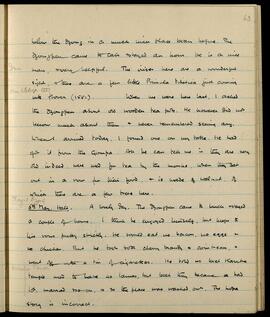
63

below the Dzong in a much nicer place than before. The Dzongpen came to call and stayed an hour. He is a nice man, very helpful. The irises here are a wonderful sight, and there are a few little Primula tibetica just coming into flower (1551). When we were here last, I asked the Dzongpen about old wooden tea pots. He however did not know much about them, and never remembered seeing any. When I arrived today, I found one on my table. He had got it from the Gompa. All he can tell me is they are very old indeed, were used for tea by the monks, when they sat out in a row for their food, and it is made of walnut, of which there are a few trees here.

6th May. Halt. A lovely day. The Dzongpen came to lunch and stayed a couple of hours. I think he enjoyed himself, but keeps to his vows pretty strictly. He would eat no bacon, no eggs - no chicken. But he took both cherry brandy and Cointreau, and went off with a tin of cigarettes. He told us that Karuha temple used to have 40 lamas, but that they became a bad lot, married and so on, and so the place was washed out. The Lopa story is incorrect.

LSH/1/1/3/3/148 · Part · 1983-05-05
Part of The Ludlow & Sherriff Collection

SUMMARY:
Ascent from below Chozan over a spur and descent to the magnificent Sengate plain, where the Tsari Chu meanders across a broad area with dense forests of juniper, rhododendron, and silver fir. Notes include BP 188.4, temperature 48°, time 4:30 pm, and a remark on the Takpashiri group of peaks.

CONTENT:
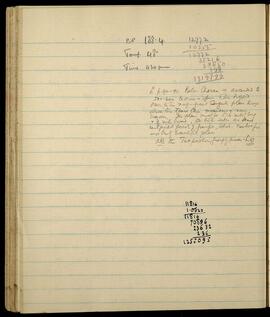
BP 188.4
Temp 48°
Time 4:30 pm

12772
1.0333
12772
382.16
39.85
3.98
13197.99

L p. 90-91. Below Chozan we ascended to 500-600 to cross a spur and then dropped down to the magnificent Sengate plain through which the Tsari Chu meanders in many branches. The plain must be 5-6 miles long x 3 miles broad. On both sides are dense and rich forests of Juniper, Rhododendron, Silver fir — a truly beautiful place.
NB the Takpashiri group of peaks — L.G.

11816
1.0622
11816
708.96
23.632
2.36
12550.95