Mostrar 6828 resultados

Descrição arquivística
2091 resultados com objetos digitais Mostrar resultados com objetos digitais
Pangtang diary entries on seed collecting and weather
LSH/1/1/9/1/133 · Part · 1933-09-01
Parte de The Ludlow & Sherriff Collection

SUMMARY:
At Pangtang, the diarist reports improved weather after night rain, limited seed readiness, and observations of several plants in flower or seed, while Ngudup arranged a new zareba to shield the tent from strong winds. The following day was a halt with morning sun and afternoon rain; seed collecting yielded mixed results due to grazing and insect damage, and the diarist photographed an ibis bill at a nearby spring.

CONTENT:
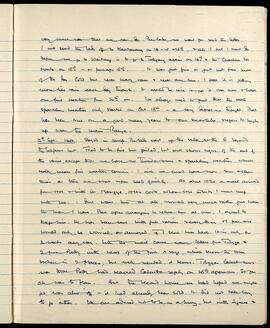
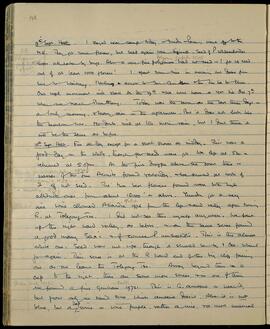
7th September. Pangtang. Heavy rain in the night, but fine all day today, with much more of a feeling of dryness. We got a few seed on the way up, but again found most things were not ready. In fact we got Primula umbratilis in perfect flower on a cliff where no sun reaches. Here I have not yet looked round, except to see Mec. simplicifolia, seed of which has mostly been thrown. My zareba here had been disposed of, but Ngudup ordered another, and it really is rather nice because it keeps the very strong wind off the tent. It blows very strongly all day long here.

8th Sept. Halt. Fine all morning. Rain all afternoon. We only went up the hillside opposite camp to look for seed. Some were over - like the nice little Daphne; but we got about 60 seed in the end. The nice Aster that was everywhere is not to be found - all eaten by yaks. On the other hand we got two Arabis in very ripe seed, and the cushion saxifrage, whose seed were nearly all thrown. I could not find a single Anemone rupicola. Mec. horridula seed is ripe, but the plant here is so poor that it is not worth taking. P. umbratilis is not yet ready, but should not take more than 10 days or so in places. As usual the worst enemy to seed collecting is caterpillars or little bugs of some kind. There was not a ripe seed of Salvia to be found, though lots of unripe ones. As soon as they showed any colour at all, a bug got into them. The prettiest flower we got was a fine annual Gentian, with a minute root, but sometimes as many as 25 flowers on the plant, each about 5/8" across. It is worth trying to get seed of, and a white Sax still in full flower is also worth while. We have a nice ibis bill at the spring beside us. He seems quite happy, and I took a cute picture of him last evening. I hope permanent residents at his spring won't frighten him away.
Haat, 9–10 September: field notes and route planning
LSH/1/1/9/1/134 · Part · 1933-09-01
Parte de The Ludlow & Sherriff Collection

SUMMARY:
At Haat, the author stayed near camp while Tundru and Pasang collected flowers, noting scarce seed and planning routes toward Waitang, Marlung, Chu doen, Sin La, Dhen, and an arrival at Bumthang, with shifting weather. The next day they made a long excursion from Haat; Tundru collected Allardia glabra near Tolepong Tso, and they found P. umbellata and a wine-purple Gentiana on screes, though seeds were mostly unripe.

CONTENT:
138

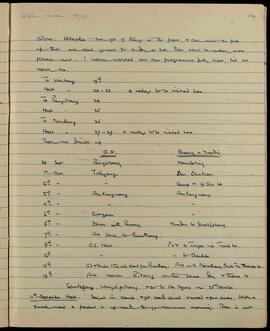
9th Sept. Haat. I stayed near camp today, Tundru and Pasang went off to the N.E. They got some flowers, but seed again were difficult. Seed of P. sphaerostachyum was all eaten by bugs. Also a very fine Polygonum (Polygonum griffithii 19715) had no seed - I got 14 seed out of at least 1000 flowers! I spent some time in making out dates from here to Waitang, Marlung and across to the Chu doen and the Sin La to Dhen. Our real movement will start on the 19th and we will have a very full Oct 7th when we reach Bumthang. Today was the same as the last three days - a lovely morning, and heavy rain in the afternoon. But it does not look like the monsoon rain. No doubt we'll get lots more rain, but I don't think it will be the same as before.

10th Sept. Haat. Fine all day except for a short shower at midday. This was a good day on the whole, though few seeds were got. We left at 5.30 and returned at 5.0pm. At the first drogpa above the forest there is masses of the fine Aconite found yesterday, and we should get roots of it if not seed. The two best flowers found were both high altitude ones, from about 15000' or above. Tundru got a very nice wine coloured Allardia (Allardia glabra 19716) from the left hand valley after turning R. at Tolepong Tso. I did not see this myself anywhere. We went up the right hand valley, as before, and on the same scree found a good many Sax's of course P. umbellata. This is the almost white one. Seed was not ripe, though it should be by 1 Oct. want to go again. This scree is at the right hand end of the big cliff facing one, as one leaves the Tolepong Tso. Away behind this in a cup to the right there are some more screes, and in one of them we found a fine Gentian (Gentiana amoena 19721). This is G. amoena or near it, but grows only in sand scree, which amoena doesn't. Also it is not blue, but a deep wine or wine purple, rather a nice, or more unusual

Blank lined page
LSH/1/1/9/1/136 · Part · 1933-09-01
Parte de The Ludlow & Sherriff Collection

SUMMARY:
This page is blank and contains no diary content.

CONTENT:
The provided image is a blank page of lined paper and contains no text to extract.

LSH/1/1/9/1/137 · Part · 1933-09-01
Parte de The Ludlow & Sherriff Collection

SUMMARY:
Plans are made for visits to Kantanang, Tolgang, and the Chachhu La route while hoping for improving weather. On 12th Sept. they halt in camp; mail arrives from H.H. along with his cook Namgye, whom the writer reluctantly keeps, and letters from T. Bagge and Betty report on Betty’s arm x-rays and her safe arrival in Calcutta, while a hoped-for house falls through.

CONTENT:
very much now that we can do. The later we wait for seed the better. I will send the lads off to Kantanang on 14-15 or 16th, and all I feel I must do before we go to Waitang is to go to Tolgang again on 14th and the Chachhu La route on 18th - or perhaps 16th. It was just fine or just not fine most of the day. Cold but never heavy rain and never any sun. I fear it is getting more like rain each day though. It would be nice to get it over now and have our fine weather from 20th on. We always used to find that the real sparkling weather only started on Oct. 18th - a very depressing thought. That has been true on a good many years to our knowledge, refers to high up near the main Range.

12th Sept. Halt. Stayed in camp. The lads went up the valley to the E beyond the Serpens hut. Tried to be fine but failed, but still shows signs of the end of the rains, except that we have no thunderstorms and sparkling weather, which really mean fine weather coming. I wish we could have more sun and clear skies, as these are what ripen seed quickly. At about 10.30 a mail arrived from H.H. and with it Namgye, H.H.'s cook, whom H.H. insists I must keep with me. I don't want him at all, would very much rather just have the man I have. But after arranging to return him at once, I agreed to keep him. He has been sent with full rations nevertheless and I fear H.H. would only be worried, or annoyed, if I sent him back. It is only for 3 weeks anyway. With the mail came many letters from T. Bagge and 2 from Betty with news of the first x-rays, which show the arm broken in 2 places, but well mended, it seems. T. Bagge's latest news was that Betty had reached Calcutta safely on 26th afternoon. So far all was to plan. But the second house we had hoped we might get, was also 'off' - it had already been sold. It did not take long to go either. We are advised not to be in a hurry, but with Tinnie and

LSH/1/1/9/1/138 · Part · 1933-09-01
Parte de The Ludlow & Sherriff Collection

SUMMARY:
Notes a fine Aconite in flower but seeds largely unripe; mail arrived quickly from Kalimpong. On 13 September, after heavy rain and new snow down to 14,500 ft, the party halted and went up the Chachhu La route toward Nanda La to seek Notholirion bulbs and possible seed, planning to take roots on return from Waitang.

CONTENT:
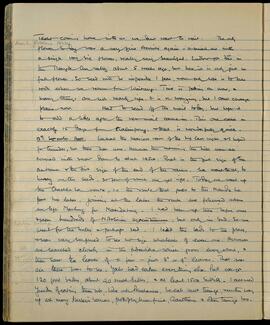
Tashi coming home with us, we don't want to wait. The only flower today was a very fine Aconite again - a small one with a single very big flower, really very beautiful. Ludlow got this in the Rongde Chu valley about 5 weeks ago, but here it is only just in full flower. So seed will be impossible I fear, and our only hope is to take roots when we return from Waitang. Time is getting on now, and many things are not nearly ripe. It is very worrying, but I can't change plans now. Had to send off the mail today, but kept it to add a little after the new mail came in. This one came in exactly 15 days from Kalimpong, that is wonderfully quick.

13th September. Halt. We had the heaviest rain of the trip last night, and hoped for thunder, but there was none. However this morning the hills were all covered with snow down to about 14500. That is the first sign of the autumn and the first sign of the end of the rains. We want that, to hurry on the seeds, so few of which are yet ripe. Today we went up the Chachhu La route, i.e. the route that goes to the Nanda La past two lakes, joining at the lakes the route we followed when we left Marlung for Mandating. I had been up there before once and seen hundreds of Notholirion hyacinthinum, but only in bud. So we went for the bulbs and perhaps seed. I

Primula collections and localities in Bhutan, 1949
LSH/1/1/9/1/140 · Part · 1933-09-01
Parte de The Ludlow & Sherriff Collection

SUMMARY:
List of Primula specimens with collection numbers and notes on abundance, elevation, and localities across Bhutan in 1949. Mentions collectors identified by initials (B.S, J.H., G.S.) and notes presence or absence around passes and places such as Rip La, Shambling, Tomtom, Sergung La, Takhung, Rudu La, Chenbi Rongang, Dunkhar-Nashima, and Tsampa; notes that some species were not previously collected by L+S.

CONTENT:
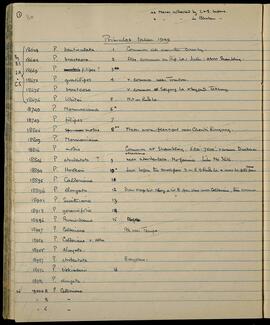
xx Never collected by L+S. before.

  • .. .. .. in Bhutan ..

Primulas taken 1949

By 18614 P. denticulata. 1 Common all over the country.
B.S 18644 P. bracteosa. 2 Also common on Rip La: Julu: above Shambling:
J.H. 18669 P. filipes? 3xx
G.S. 18673 P. gracilipes 4 v. common near Tomtom.
18675 P. bracteosa v. common at Sergung La beyond Takhung.
18676 P. whitei 5 Not on Rudu La.
18740 P. Normaniana 6
18749 P. filipes 7
18806 P. sp. non mollis 8xx Much more plentiful near Chenbi Rongang.
18809 P. Normaniana
18816 P. mollis Common at Shambling. 6500'-7500'. v. common Dunkhar-Nashima.
18846 P. atrodentata? 9 near atrodentata. No farina. Like No 3636.
18894 P. Hookeri 10
Just before the small pass 2 m E of Rudu La & more W. of the same pass.
18895 P. Calderiana 11
18896 P. elongata. 12 Down steep bit. Along a bit to open where much Calderiana, then common.
18901 P. Smithiana 13
18913 P. geraniifolia 14
18946 P. Barnardoana 15
18947 P. Calderiana All over Tsampa.
18954 P. Calderiana v. alba
18955 P. elongata.
18957 P. atrodentata Everywhere.
18976 P. sikkimensis 16
18981 P. elongata.
19000 A. P. Calderiana
B "
C "

LSH/1/1/9/1/141 · Part · 1933-09-01
Parte de The Ludlow & Sherriff Collection

SUMMARY:
Notes on Primulas from Karponang grown at 4500', highlighting unusual rose coloration, leaf variation, and difficulty matching key characters; possible identification as elongata is questioned. Field observations report local abundance up to about 8500' near Sergong La, and above 12500' white forms of P. calderiana and natural hybrids become more common than the deep violet true P. calderiana.

CONTENT:
133

Primulas from Karponang in our garden at 4500' have grown leaves like bracteosa. Due to low altitude?
Never seen the rich rose colour before.

Locally quite common.

Eventually found very common, highest altitude about 8500' near Sergong La.

This does not answer the key 'tube 3 times as long as calyx'. It is nothing like it.

Might be elongata, but leaves are pretty rotund.

Not common.
This seemed to be the same as 18946, but leaf varies. Probably both are the same thing.

A gathering with very few old capsules even some old seed.
These three are all natural hybrids. As one gets above 12500', so white forms of P. Calderiana become more & more common until at 13000 & a little above - just at the top edge of the abies zone - these hybrids become much more common than the true P. Calderiana, which here is deep violet. What are the parents?
P.T.O.

Primula field notes at Kantanang
LSH/1/1/9/1/142 · Part · 1933-09-01
Parte de The Ludlow & Sherriff Collection

SUMMARY:
The page lists numerous Primula taxa with specimen numbers and brief notes on abundance and flowering, many recorded as common at Kantanang on 10/6. It mentions elevation comparison within the same valley, white forms of P. glabra, a hybrid (P. sikkimensis × hopeana), and comments on varieties such as caveana var. alba and macrophylla var. macrocarpa.

CONTENT:
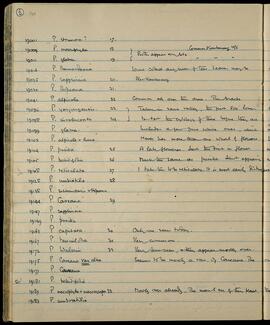
(2) 134

  1. P. strumosa? 17.
    19009 P. macrophylla 18 } Both appear very late. Common Kantanang 10/6
    19011 P. glabra 19 } Common Kantanang 10/6
  2. P. barnardoana Won't collect any more of this. Leaves may be
    19025 P. sapphirina 20. Also Kantanang
    19030 P. hopeana 21.
    19041 P. alpicola 22 Common all over this area. The bracts
    19096 P. yarongensis. 23. } Taken in same valley, the first 500' lower
    19098 P. involucrata 24. } to test the cytology of these before they are
    19099 P. glabra. Includes a few pure white ones, which
    19103 P. alpicola var. luna Never has more than one whorl of flowers
    19104 P. pusilla. 25 A late flowerer. Just the first in flower
    19105 P. bellidifolia 26 Much the same as pusilla. Just appearing
    19108 P. reticulata 27 I take this to be reticulata. It is most easily distinguished
    19128 P. umbratilis 28
    19138 P. sikkimensis x hopeana
    19144 P. caveana 29
    19147 P. sapphirina
    19149 P. pusilla
    19163 P. capitata. 30 Only one seen today.
    19167 P. tenuiloba 31 Very common.
    19172 P. walshii 32 Very few seen, & they appear mostly over.
    19175 P. caveana var. alba Seems to be merely a var. of caveana. The
    19177 P. caveana
    50) 19181 P. bellidifolia.
    19189 P. macrophylla var. macrocarpa 33. Mostly over already. The more I see of this plant, the
    19183 P. umbratilis