Showing 6828 results

Archival description
2091 results with digital objects Show results with digital objects
LSH/1/1/3/3/189 · Part · 1936-06-13
Part of The Ludlow & Sherriff Collection

SUMMARY:
Notes skepticism about a report of Kingdon Ward shooting near the gompa and mention that he went up the diarist’s nala likely finding primulas. Records two halts at Sumbatse with weather details, Tsongpen’s excursion with little of interest, searches for blood pheasant, a visit to Yarap with vegetables growing well, and abundant primulas above a small loch, with plant species listed.

CONTENT:
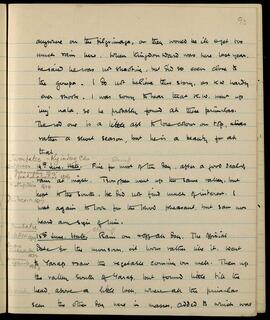
anywhere on the pilgrimage, or they would be ill after too much rain here. When Kingdon Ward was here last year, he said he was not shooting, but did so even close to the gompa. I do not believe this story, as K.W. hardly ever shoots. I was sorry to hear that K.W. went up 'my' nala, so he probably found all these primulas. The red one is a little apt to lose colour on top, and has rather a short season, but he is a beauty for all that.

Sumbatse - Kyimdong Chu Sherriff
14th June. Halt. Fine for most of the day, after a good deal of rain at night. Tsongpen went up the same valley, but kept to the south. He did not find much of interest. I went again to look for the blood pheasant, but saw nor heard any sign of him.
(Androsace graminifolia 1815, brahma-putrae 1816, strigillosa 1814, Iris decora 1817)

Sumbatse Sherriff
15th June. Halt. Rain on and off all day. The official date for the monsoon, and it looks rather like it. Went to Yarap and saw the vegetables coming on well. Then up the valley south of Yarap, but found little till the head, above a little loch, where all the primulas seen the other day were in masses, added to which was
(L. tibetica 1819, Primula trichosanthes 1832, Primula officinalis 1823)
LSH/1/1/4/1/101 · Part · 1933-08-15
Part of The Ludlow & Sherriff Collection

SUMMARY:
From Sumbatse, the diarist records seed collections and transport delays due to a troublesome headman, then stays overnight en route to Choram. Plans are outlined for a future trip to the Black Mountain in Bhutan and exploration of Pemako via Sadiya, and at Choram they meet Tsongpen, collect more Adonis seed, and note heavy showers and his reports from Tsari.

CONTENT:
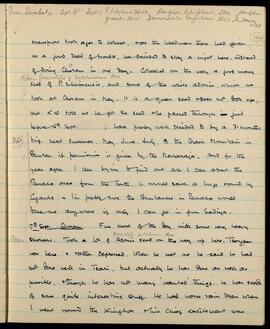
From Sumbatse. Sept. 16th Seeds: Primula tibetica 2602, Adenophora liliifolia 2604, Adenophora gracilis 2605, Dracocephalum tanguticum 2607, Saussurea 2608.

Transport took ages to collect, as the headman there had given us a good deal of trouble; we decided to stay a night here, instead of doing Choram in one day. Collected on the way a good many seeds of Primula sikkimensis, and some of the white Adonis (Adonis brevistyla var. dutchuensis 1600), which we took at Choram in May. It is a queer seed and does not look ripe, but K.W. told us he got the seed, and he passed through just before 15th Sept. I have pretty well decided to try a 3-month trip next summer, May, June, July, to the Black Mountain in Bhutan if permission is given by the Maharaja. And for the year after, I am trying to find out all I can about the Pemako area from the South. It would save a huge round by Gyantse, and I'm pretty sure the Bhutanese in Pemako would take me anywhere if only I can get in from Sadiya.

17th Sept. Choram. Fine most of the day, with some very heavy showers. Took a lot of Adonis seed (Adonis brevistyla var. dutchuensis 1600) on the way up here. Tsongpen was here and rather depressed. When he met me he said he had not done well in Tsari, but actually he has done as well as possible; although he has not many 'wanted' things, he has seeds of some quite interesting stuff. He had worse rain than when I went round the Kingkor. His chief excitement was...

LSH/1/1/9/1/132 · Part · 1933-09-01
Part of The Ludlow & Sherriff Collection

SUMMARY:
Heavy traffic on the route is attributed to HH’s fair in Bumthang beginning on the 7th, alongside plans for reforms such as cash payment for work. At Sumitang, the party had fine weather but a delayed start (likely due to Ngudup); the writer prefers Changchuk managing transport, and with most seed still unripe, Pasang will return in a month to collect target species from beyond Sharitang and around Bumthang/Kyikyi La, after noting a jelly-coated aquatic plant and cooler conditions than Bumthang.

CONTENT:
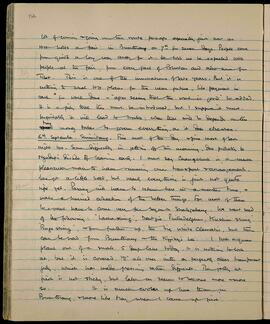
Lot of coming and going on this route, perhaps especially just now as HH holds a fair in Bumthang on the 7th for seven days. People come from quite a long way away for it. He told me he expected 1,000 people at the fair, from every part of Bhutan and also some from Tibet. This is one of the innovations of late years. But it is nothing to what HH plans for the near future, like payment in cash for work done - "after seeing that the work is good" he added. It is a pity that this must be introduced, but I suppose it must. Inevitably it will lead to trouble; when that will be depends on the time money takes to govern everything, as it does elsewhere.

6th September. Sumitang. Fine most of the day, and fine most of last night too. Some difficulty in getting off this morning, due probably to Ngudup's dislike of leaving early. I must say Changchuk is a much pleasanter man to have running one's transport arrangements. We got a little seed, but nearly everything is just not quite ripe yet. Pasang will have to return here in a month's time, and make a hurried collection of the better things. For most of these we would have to come very far beyond Sharitang. We want seed of the following: "Lachasung", Deutzia, Philadelphus, "Kushim sung", "Rugosung", and from further up, the big white Clematis, but this can be had from Bumthang or the Kyikyi La. I took a queer plant out of a small 5' deep lake today. It is nothing to look at, but it is covered, 1/8" all over with a perfectly clear transparent jelly, which has made pressing rather difficult. The jelly at first is not sticky, but later on seems to become more and more so. It is much cooler up here than in Bumthang, and more like May when I came up first.

LSH/1/1/3/3/7 · Part · 1936-02-15 - 1936-02-09
Part of The Ludlow & Sherriff Collection

SUMMARY:
Entry dated 15 February 1936 records logistics for the expedition: Lumsden joined in January, suffered bouts of illness after dinners, and brought numerous stores including medical supplies. Kit and stores were dispatched via Bombay and Pindi to Ranguja; the party left Srinagar on 9 February by car and lorry, reaching Tret and then Pindi before catching a train.

CONTENT:
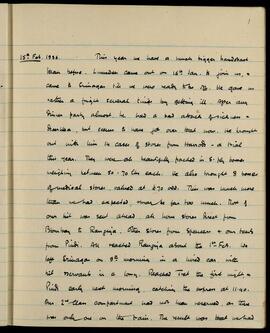
15th Feb. 1936. This year we have a much bigger bandobast
than before. Lumsden came out on 16th Jan. to join us, &
came to Srinagar till we were ready to be off. He gave us
rather a fright several times by getting ill. After any
dinner party almost, he had a bad attack of sickness &
diarrhoea, but seems to have got over that now. He brought
out with him 14 cases of stores from Harrods - a trial
this year. They were all beautifully packed in 5-ply boxes
weighing between 50 - 70 lbs each. He also brought 8 boxes
of medical stores, valued at £70 odd. This was much more
than we had expected, maybe far too much. Most of
our kit was sent ahead, all home stores direct from
Bombay to Ranguja. Other stores from Spencers & our tents
from Pindi. All reached Ranguja about the 1st Feb. We
left Srinagar on 9th morning in a hired car, with
kit & servants in a lorry. Reached Tret the first night, &
Pindi early next morning, catching the express at 11.40.
Our 2nd class compartment had not been reserved, as there
was only one on the train. The result was that we had

LSH/1/1/5/1/11 · Part · 1935-11-27
Part of The Ludlow & Sherriff Collection

SUMMARY:
The writer describes a steep forested path to the clearing at Surelakha, notes the absence of rhododendrons, and seeks directions to the Black Mt. Locals suggest Shamgong Dzong and mention the name Dungshigon; Puibo explains that 'gon' means a range. The headman proposes reaching Nabsigaon or Nabsikorbhu in two days and then the Black Mt. in another two, though transport may be difficult, with only shepherds operating in the area.

CONTENT:
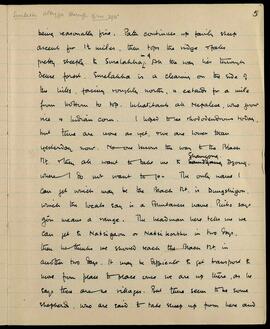
Surelakha Albizzia Sherriff 27 Nov 1935

being reasonably fine. Path continues up fairly steep ascent for 1 1/2 miles, then tops the ridge and falls pretty steeply to Surelakha. All the way lies through dense forest. Surelakha is a clearing on the side of the hills, facing roughly north, and extends for a mile from bottom to top. Inhabitants all Nepalese, who grow rice and Indian corn. I hoped to see rhododendrons today, but there are none as yet, we are lower than yesterday now. No one knows the way to the Black Mt. They all want to take me to Shamgong Dzong, where I do not want to go. The only name I can get which may be the Black Mt. is Dungshigon, which the locals say is a Bhutanese name. Puibo says gon means a range. The headman here tells me we can get to Nabsigaon or Nabsikorbhu in two days, then he thinks we should reach the Black Mt. in another two days. It may be difficult to get transport to move from place to place once we are up there, as he says there are no villages. But there seem to be some shepherds, who are said to take sheep up from here and