Showing 6828 results

Archivistische beschrijving
2091 results with digital objects Show results with digital objects
LSH/1/1/9/1/43 · Part · 1933-05-07
Part of The Ludlow & Sherriff Collection

SUMMARY:
The writer considers westward routes toward Weitsang without recrossing the Rudu La, noting options from Serdua or via Guru Rinpoche's place toward Bumthang, while describing severe insect troubles. On 9th May they start early, climb to the Sergung La (10,027'), reach Tin, then push on toward Tomtom over the difficult Timunggang pass in snow, where a laden coolie falls and injures his head.

CONTENT:
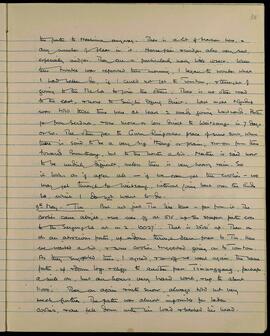
the path to Tashina anyway. There is a lot of bracken here, and any number of fleas in it. Horseflies and midges also very bad, especially midges. They are a particularly nasty little insect. When this trouble was reported this morning, I began to wonder what I had better do, if I could not get to Tomtom, and thought of going to the Me La to join the others. There is no other road to the east, and none to Singhi Dzong direct. Last night Ngudup was told that there were at least 2 roads going westward. Both go from Serdua, one more or less direct to Weitsang in 7 days or so. The other goes to Guru Rinpoche's place of some sort, where there is said to be a very big 'thang' or plain, and so on from there towards Bumthang, but to the north a bit. Neither is said now to be unduly difficult, unless there is very heavy rain. So it looks as if after all — if we can get the coolies — we may get through to Weitsang, without going back over the Rudu La, which I do not want to do.

9th May. Tin. But not just Tin like that — far from it. The coolies came alright, and we were off at 5.15, up the steepest path ever to the Sergung La at 10,027'. That is 2500' up. Then on, on an atrocious path, up and down through dense forest to Tin. Here we waited a bit, and some coolies suggested going on to Tomtom. As they suggested this, I agreed, and so off we went again, the same path, up and down logs and cliffs to another pass Timunggang, perhaps a mile on, but an hour's very hard work, and up to about 11,000'. Then on again into snow, always cold but not very much further. The path was almost impossible for laden coolies, and one fell down with his load and bashed his head.
LSH/1/1/9/1/44 · Part · 1933-05-07
Part of The Ludlow & Sherriff Collection

SUMMARY:
The diarist finds the Tomtom valley too narrow and snowbound for camping and decides to return to Dunkhar, weighing options between Singhi Dzong and Waitsang via Bumthang. On the morning of the 10th May, they decide to go to Waitang/Waitsang on the Bumthang Chu, noting advice from Ngudup and the prospect of Betty joining in July.

CONTENT:
Eventually we saw Tomtom, & it is far too tight a valley, besides being in deep snow yet. They said originally there would be snow, so I can't grouse there, but they said it was only a short way beyond Tin. The hills are so steep there is no possibility of camping other than in Tin or Tomtom. Tin has room for 2 tents, none can get up anywhere. It is a very real disappointment now I have to return to Dunkhar, & from there - when? I can go to a choice of two places I think - one to Singhi Dzong, the other back to Bumthang & so to the Menlarkarchung, to Waitsang where I intended to go in July. Betty pulls me to Singhi Dzong, as there I would see her in July. But perhaps Waitsang would be the best place of all. I must do some careful thinking these next two days. The decision must be made in Dunkhar, & that means by tomorrow evening. It is all a real disappointment to me. Ngudup has been in with various suggestions, but as no one knows anything about paths, passes or places, it does not help. I must just decide & stick to whatever I do decide. Bumthang seems to have more places to which one could go, but what a waste of time to go all round by the Rudola again.

10th May - morning. I have decided definitely to go to Waitang or Waitsang on the Bumthang Chu. It would be easier to go to Singhi Dzong, & lovely to think I had only a month & 3 quarters till Betty joined me. But from all I can hear, Waitsang will be an area in which I can get around more. Were I younger & fitter, I wouldn't mind trying this Tomtom so much. With very hard work, one might get good stuff. But after yesterday, I had a

LSH/1/1/9/1/45 · Part · 1933-05-07
Part of The Ludlow & Sherriff Collection

SUMMARY:
The diarist, ill with bronchitis, outlines a staged route through multiple settlements, then reaches Mashina and pushes the coolies on to Dunkhar, revising planned departure dates. Many people are sick, including a man of Wangmoo who was injured, and the writer discusses difficulties securing coolies due to local allegiances to H.H., Wangmoo, Ani Choden, and Pema Dechen, before deciding to move on.

CONTENT:
Bad night & Bronchitis. I cannot manage hills as they are here. They are too hard work now for me. I got no sleep at all. We are all having a late start this morning, which I hate, but the coolies are so damn tired. Our plans must now be: 11 Dunkhar, 12 Halt, 13 Shambling, 14 a camp on Kuru Chu R bank, 15 Lhumbe, 16 Halt, 17 Takila, 18 Ungar, 19 Pimi, 20 Tang, 21 Halt, 22 Shabjetang on the Bumthang Chu, 23 Halt, 24, 25, 26 northwards, 27th Waitsang. That is a lot of good time wasted, though the Rudu La may be good via Tang; the route is new & fairly high, so should be of interest.

Later. We got to Mashina in very good time, so I asked the coolies to go on to Dunkhar, which they did, but were all in, tired, at 3.0 p.m., having come very steeply down over 5000' & up nearly 2000'. We have altered dates a little, & will leave here on 12th, and Lhumbe 14th, Ungar 16th, Tang 18th, Shabjetang 20th & halt there. Many sick people here, as I was specially tired, including one of Wangmoo's men who fell off his horse & made a hole right through into his mouth with a stone.

In some ways, it may be well to leave this area. Coolies might have been difficult. They have to come from here, & would have to come 3 days' march before reaching me to move me 1 day's march. And then to Waitsang would have taken, I'm told, no less than 8 nights on the way, besides going into Tibet. All the men up the Kuru Chu valley are not available as coolies. Here, nearly all are H.H.'s subjects, personal servants: so they would come with me. At Shambling, all are Wangmoo's, Ani Choden & Pema Dechen's. At Tungyang they are Wangmoo's. These people do not do the ordinary coolie work, except for their owners. Anyway we are off now, for better or worse; it does not matter what happens here.

LSH/1/1/9/1/46 · Part · 1933-05-07
Part of The Ludlow & Sherriff Collection

SUMMARY:
The diarist halts at Dungkar, plans to cross the Rudo La, and writes to HH, Wangmoo, and Lhuntse about arrangements. Botanical notes mention a primula (18846) from Tim resembling earlier Lo La material and a likely Cochlearia (18847) previously seen in 1937 at Tang Chu, Central Bhutan. Yundru, servant of the Nyerchen Trepa, arrives from forced labour at Sam Choling monastery and is taken on permanently for the journey to Tomtem.

CONTENT:
I must now write to HH & give him the new programme, & to Wangmoo to say I will see her on the way, & to Lhuntse to say I want transport.

11th May. Halt Dungkar. Another fine day after rain at night, but only a little. It is nice to think that, all being well, we should be over the Rudo La before having to halt again. It would be nice to halt on the pass itself, but coolie difficulty makes that out of the question. Now there are five days to get through as best we may before anything of interest is likely to be seen. At Tim we got one interesting primula 18846, which will no doubt be put down as P. atrodentata, but which is more like one of the ones put aside last year for discussion, & which is like my 3636 from the Lo La. With the primula was one other plant 18847, which I have only seen once before, & that in Bhutan. I think it was number 3209, taken in Cent. Bhutan, Tang Chu, in 1937. I rather think that was probably a sp. nov. of Cochlearia but has not yet been named. Unfortunately there was but one specimen here to be found, & it, like the primula, had come down from a good deal higher, near 13-14000'.

Today the Nyerchen Trepa's servant, Yundru, arrived. He was one of the many forced labourers at Sam Choling monastery, the new monastery being built by Ashe Wangmoo where Tasho Haku died. One man per household from this area has to go, & has been there for months. I got him leave to get away from that, so as to come to Tomtem with me. Now we are in fact there, I have not been sure what to do, but decided to take him with us as permanent.

LSH/1/1/9/1/47 · Part · 1933-05-07
Part of The Ludlow & Sherriff Collection

SUMMARY:
Notes a new rucksack carrier named Taphirk and heavy local demand for worm medicine and remedies for stomach and 'heart' complaints. On 12 May at Shamshering, after rain and mist, two messengers arrived (one from Wanguco and one from Lhumbe Dzongpen) while the writer awaited letters from Betty via Holt's man; strawberries and possibly raspberries were sought for dinner. On 13 May at Timyung Dzong, very short marches are described and Ngudup is blamed for misjudging distances.

CONTENT:
Taphirk, a rucksack carrier. He is a nice looking lad, and I think he will be useful. Here there is great demand for 'worm' medicine. Everyone has them, tape or round, usually the latter. Everyone also complains of 'heart' situated remarkably near the stomach, cured usually with stomach powder. A few have come for gonorrhoea, but not so many as one would have expected. How grand it will be eventually to get to a place we can expect food, flowers, and above all air. Here we have been shut in, in low, hot valleys. But there are only 5 more days of that now.

12th May. Shamshering. Last night rain, mist all today. Our fine weather is over for the winter, but it was lovely while it lasted, and made everything look very pretty. Back again in this place. The march only takes 4 1/2 hours, which means one is in by 9:30, and there are no flowers to collect or look for here. Two messengers have arrived - one from Wanguco, and another from Lhumbe Dzongpen. I hope for a third, the only one I want, which would be with letters from Betty, sent back by Holt's man who took her the box of stores. He should be back by now. As a change of diet, I am having strawberries for dinner, with raspberries if they can be found. The latter are really good, but we haven't seen any bushes near camp yet.

13th May. Timyung Dzong. 4 miles. Ngudup slipped up about these two marches. He told me that from Dumahan to Lhumbe was for Bhutanese more than 2 days march. So I thought 3 for us would be just right. Yesterday we were in at 9:30, today at 7:15! And tomorrow we should be in by 7:15 too I think, as we can see the Dzong. What a waste of good time in the foulest of

LSH/1/1/9/1/48 · Part · 1933-05-07
Part of The Ludlow & Sherriff Collection

SUMMARY:
Notes describe intense heat in lowland Bhutan and a fine bridge over the Kuru Chu, followed by return to camp at Lhuntse Dzong. Yundru requests medicine for syphilis, mentioning prior injections by Kapo. The Tinnymu Bridge is described in detail, with no notable flowers observed.

CONTENT:
43

places, the lowest part of Bhutan. They won't ask questions, perhaps because they know they won't get a very good answer. But it can't be helped, one must fill in these two days as best we can. The Dzong here is very well worth looking at, I should say old. There is a fine bridge over the Kuru Chu about 1 mile downstream - one of the finest I've seen in Bhutan, a bit bigger than the Trashigangsi Chu bridge by a good bit. I would certainly not like to live down here. It is very hot indeed. But the Bhutanese say there is no fever. Yundru, our new slave, has just come to ask for medicine for syphilis. I'm sorry he has that, though nearly all seem to have some kind of V.D. He tells me Kapo injected him three times a year ago, but with no result. He says it was done one in each shoulder or in the vein of the forearm, and that it hurts a great deal. I don't wonder.

14th May. Lhuntse Dzong. Back again here, but this time camped in a nice quiet place beneath some cypresses above the Dzong, rather shut in, but pleasant. Ludlow and I must have been here in 1933. We were in by 8:30 this morning. Very wet last night, and cloudy this morning, but just fine. I had a very disturbed night, with water fleas in my pyjamas which I couldn't catch. They come in off the coolies' clothes, when he is carrying the bedding, or so I imagine. The Tinnymu Bridge is a fine one, 42 yards from built up pier to pier, with at each end 4 cantilevers. It is quite recently built, only 6-7 years ago, the last one having been washed away in a flood. Nothing interesting in the flower line.

LSH/1/1/9/1/49 · Part · 1933-05-07
Part of The Ludlow & Sherriff Collection

SUMMARY:
After a 10-mile march to Menjisi in windy weather, the writer receives letters from Betty via Trinley and notes serious delays to H.H.'s stores sent from Lhuntse, affecting travel plans to Bumthang. Kapo is treating many syphilis patients with limited drugs, while reports mention Tshering doing well, Hicks being tired, the finding of P. Normaniana, a planned route via Ungar and Pimi, concerns from Tobgye about the Treaty and the Maharaj Kumar, and news from Norman regarding a problematic sale to Mintri.

CONTENT:
15th May Menjisi. 10 miles. Wet in the night, but fine today locally and with a very strong wind. I had a long talk with Kapo yesterday, who came in the morning and again for dinner. He gave me a letter from Betty, brought by Wangmo's Trinley. Incidentally H.H.'s large box of stores, sent off from Lhuntse on 4th to Betty, had only got 1 day's march from Lhuntse by May 11th. I don't know what had happened. That has held up other things too, as H.H.'s man cannot return to Bumthang till he has an answer from Betty. Kapo seems to be busy with his syphilis patients, who are a great many. But he finds difficulty in keeping them in Lhuntse. Also he cannot get other drugs for H.H. for other diseases. I gave him what I could spare. It was grand to hear again from Betty, though her letter was written some time ago. They seem to have done fairly well, and have also found P. Normaniana. Tshering doing well, and Hicks seemingly tired. I hope he can stand it all. We left at 5:15 this morning and got in about 10:30. This is a much better division of the marches - Lhuntse, Menjisi - Ungar - Pimi, and I must tell Betty to do the same. We passed another dak today and took ours out on Betty's unopened. This was a bigger one and was sent from K'pong on 29th April. I had several letters from Tobgye, worried about the Treaty and also the Maharaj Kumar's behaviour to him. He has not been at all kind, and his behaviour towards Tobgye is disgusting and disgraceful. I hope now that he will not get Kaysang, who is far too good for him. Norman's letter says that he is off, and he also thinks there may be difficulty about selling Crocket to Mintri, who is a slimy individual. Among other things sent to me is a will which I witnessed many years ago. It is sent in original, and I have to

LSH/1/1/9/1/50 · Part · 1933-05-07
Part of The Ludlow & Sherriff Collection

SUMMARY:
Notes discuss arranging a witnessed statement in Bhutan, with Ludlow as the other witness. Diary entries for 16 and 17 May describe heavy rain, mail passing through, letters for Betty, travel by mule from Ungar to Pimi, and plant observations including Rhododendron rhabdotum and a small Anemone noted by Hicks; Ngudup and Damdum are mentioned.

CONTENT:
sign a statement that it is all in order etc before a Notary Public. What a hope, in Bhutan. Ludlow is the other witness, so I don't know what the widow of the deceased will do.

16 May Ungar 5.15 to 11.15. Fine till 11.0 and then very heavy rain indeed all evening. Another mail from H.H. passed through. One letter to me and one to Betty. I added a bunch of letters for Betty, others have gone on. A nasty place and a nasty day. Nudup and Damdum very sad indeed.

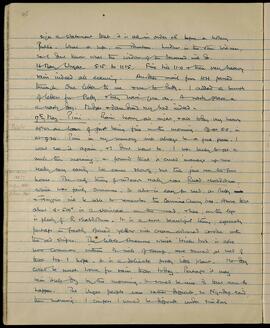
17th May. Pimi. Rain heavy all night, and all today very heavy after an hour of just being fine in the morning. Off at 5.15, in at 9.30. Pimi in my memory will always be a fine place. I won't see it again, or don't want to. I was lucky to get a mule this morning, and found that it could manage up here really very easily. We came slowly, but took just over the four hours. The only thing of interest really was Rhod. rhabdotum, which was fairly common. It also is easy to seed, as Betty will be able to remember the Carmine Cherry tree. Above that about 4-500' is a staircase on the road, there, on the left is plenty of R. rhabdotum. It is a most beautiful thing, especially perhaps in freshly opened yellow rich cream coloured corolla with the red stripes. The little Anemone which Hicks took is also now common, within 1/2 mile of camp, and we should get seed of that too I hope. It is a delicate pretty little plant. No day could be much worse for rain than today. Perhaps it may rain itself dry by the morning. It would be nice if that were to happen. The Ungar people were rather difficult, so Ngudup said, this morning. I confess I would be difficult under similar

LSH/1/1/9/1/51 · Part · 1933-05-07
Part of The Ludlow & Sherriff Collection

SUMMARY:
From Ganju Tang, the writer records a long march over the Rudo La from 5:00 am to 2:00 pm, with rain and mist on the east side and dry conditions on the west. They note more rhododendrons on the east and report collecting about 21 alpine flowers, including several Primula species and Diapensia.

CONTENT:
18th Rhod. list. sp. 18887.
glaucophyllum 18887
pendulum 18888
cinnabarinum 18889

circumstances.

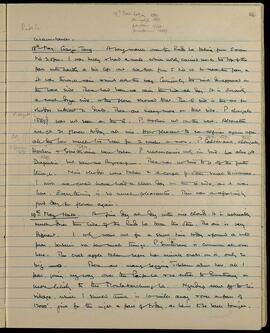
18th May Ganju Tang. A long march over the Rudo La taking from 5:00 am till 2:00 pm. I was lucky I had a mule which nobly carried me to the top of the pass with hardly a bit left out. We took from 5:00 till 10:00 to reach the pass, and it was through rain and mist all the way. Curiously, the mist disappeared on the west side. There had been no rain this side all day. It is obviously a much drier side, as the flora showed that. The East side is the one for Rhododendrons without a doubt. There are many more on that side. Primula elongata (18897) was not seen on the East. Primula hookeri not on the west. Altogether we got 21 flowers today, all nice. How pleasant to see alpines again after all the low muck I've seen for 2 weeks or more. Primula calderana (18890), elongata (18895), hookeri (18896) and smithiana (18900) were taken. Primula sikkimensis only in bud. We also got Diapensia (18891), but saw no Bry

LSH/1/1/9/1/52 · Part · 1949-05-17 - 1949-05-28
Part of The Ludlow & Sherriff Collection

SUMMARY:
Notes of Kodachrome, Dufaycolour and B.W. photographs of Primula, Rhododendron, Enkianthus, Clematis, Saxifraga, and landscape subjects across late May 1949. Mentions sending Dufay films 5 and 6 from Tang on 19/05/1949 and includes scenes such as an old man at Ngang Lhakang, rain on rose leaves, a river below Pang Sang, and a view towards Kankar Punsum from Pangotang.

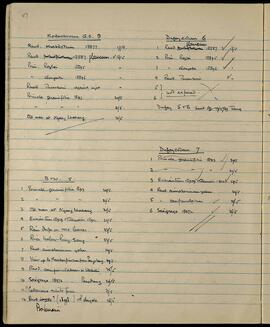
CONTENT: Kodachrome G.S. 9 Dufaycolour 6
Rhod. rhabdotum 18877. 17/5. 1 Rhod. glaucum 18887 18/5.
Rhod. glaucum 18887 18/5. 2 Prim. Roylei 18895 18/5.
Prim. Roylei 18895 18/5. 3 Prim. elongata 18896 18/5.
Prim. elongata 18896 18/5. 4 Rhod. Thomsonii 18/5.
Rhod. Thomsonii against light 18/5. 5 } not exposed.
Primula geraniifolia 18913 20/5. 6 }
Primula geraniifolia 18913 21/5. Dufay 5 & 6 sent off 19/5/49 Tang
Old man at Ngang Lhakang. 21/5.

Dufaycolour 7
1 Primula geraniifolia 18913 20/5.
2 Primula geraniifolia 18913 21/5. B.W. 5. 3 Enkianthus 18909 & Clematis 18912 22/5.
1 Primula geraniifolia 18913 20/5. 4 Rhod. cinnabarinum yellow. 24/5.
2 Primula geraniifolia 18913 21/5. 5 Rhod. campanulatum 25/5.
3 Old man at Ngang Lhakang 21/5. 6 Saxifraga 18972 26/5.
4 Enkianthus 18909 & Clematis 18912 22/5.
5 Rain drops on rose leaves. 23/5.
6 River below Pang Sang. 25/5.
7 Rhod. cinnabarinum yellow. 24/5.
8 View up to Kankar Punsum from Pangotang. 24/5.
9 Rhod. campanulatum or Wallichii 25/5.
10 Saxifraga 18972 Pangotang 26/5.
11 P. Calderiana white form. 27/5.
12 Rhod. Wightii? (18998) & elongata 28/5.
Batemanii