Affichage de 6828 résultats

Description archivistique
2091 résultats avec objets numériques Afficher les résultats avec des objets numériques
LSH/1/1/8/1/63 · Part · 1947-02-20
Fait partie de The Ludlow & Sherriff Collection

SUMMARY:
Hunting continues and a Kalij is taken; tensions erupt between the Loto and Lome headmen, causing fights among coolies until Thompson calms the situation. The party travels toward Lubong and then Dzama in perfect weather, noting pine forests, landslides, seeds of Gaultheria, and views toward Gyala Peri and Namcha Barwa from near the Karma La.

CONTENT:
Hunting goes on here; one is constantly hearing the sound of a gun. I got one of Kalij this afternoon. There are two districts in this part of the Po Tsangpo below Trulung—Loto and Lome, divided at Dzama, each having a headman.

21st Feb. LUBONG 5 1/2 m. The day started badly. Some coolies came early, some did not come. The headman of Loto, who was in charge, started cursing the coolies of the Lome headman and hit one. This started a regular fight with fists and sticks and a hell of a noise. We eventually got off, the headman staying behind shouting at everyone. He caught us up later, saying 3 men were after him with knives. But the trouble seemed to have settled till we got here, when it flared up again between the two headmen, who tried to throttle each other. Thompson did good work in quieting them down. The day was good, and the views fine. But we badly want a clear day tomorrow, as from the Karma La, both Gyala Peri and Namcha Barwa are visible, I'm told. It looks promising for tomorrow at present. We got seed of two Gaultherias, one with white fruit, locally called Sülü, which we have not seen before. The people here are nice, but the day has been somewhat spoilt by this awful row going on all the time. There is still very little to see of flowers of any kind, and I don't think we will get much either. Mostly the path is through pine forest, and there have been many landslides on both sides of the river. We saw a few Luculia trees, perhaps Luculia Pinceana, but in unripe fruit. From about 300' above camp, two very high snow mountains appear, one at bearing approx 170° (Namcha Barwa?) the other at approx 205° (Gyala Peri?). In the evening the headmen's quarrel was made up, and both were perfectly happy together. I prefer the Lome headman, who takes us on from tomorrow.

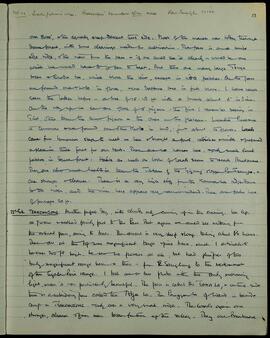
22nd Feb. Dzama Left at 7.15. In at 1.30. A perfect day. Cold at night, but not a cloud all day, and the views astonishingly lovely. This is no easy route, but one well worth coming, especially if one gets weather like we are now having. It is absolutely perfect. Both of us are tired this evening, after the very steep ascent to the Karma La, which is a little
LSH/1/1/8/1/64 · Part · 1947-02-20
Fait partie de The Ludlow & Sherriff Collection

SUMMARY:
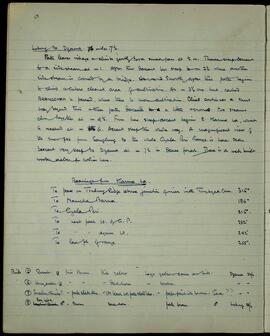
Detailed route description from Lubong to Dzama, including streams, cultivation areas, the hut BRANGCHAM, and a steep ascent to Karma La with extensive views of the Gyala Peri Range. Bearings to nearby peaks and landmarks are recorded from Karma La, and bird observations are noted at Dzama and Lubong on 22/2.

CONTENT:
58

Lubong to Dzama. 7½ miles.

Path leaves village and climbs gently to a small pass at ½ m. Thence steep descent to a side stream at m 1. After this descent less steep to m 2½ where another side stream is crossed by a bridge. Shortly after this, path begins to climb, enters cleared area of cultivation. At m 3½ one hut, called BRANGCHAM, is passed, where there is more cultivation. Climb continues a short way beyond this, then path descends a little and crosses two streams close together at m 4½. From here steep ascent begins to Karma La, which is reached at m 6. Ascent steep the whole way. A magnificent view of the snow peaks from Sanglung to the whole Gyala Peri Range is here seen. Descent very steep to Dzama at m 7½ in dense forest. There is a well-built wooden shelter for coolies here.

Bearings from Karma La.
To pass on Trulung Ridge above junction of river into Tsangpo Canyon. 315°.
To Namcha Barwa. 186°.
To Gyala Peri. 215°.
To next peak West of Gyala Peri. 232°.
To next peak again West. 242°.
To last peak of range. 255°.

Birds

  1. Thrush. Female. Iris Brown. Bill yellow. Legs yellow same as bill. Dzama 22/2.
  2. Honeysucker. Female. Iris Brown. Bill dark horn. Legs brown. Dzama 22/2.
  3. Swallow Shrike? - pale slate blue. Upper Mandible black, Lower Mandible pale slate blue. Legs pale pinkish brown. Sex ?? Dzama 22/2.
  4. Bar-winged Laughing Thrush. Male - Brown. Bill dark horn. Legs pale brown. Male. Lubong 22/2.
LSH/1/1/8/1/65 · Part · 1947-02-20
Fait partie de The Ludlow & Sherriff Collection

SUMMARY:
Steep ascents and descents through dense forest with limited views due to Tsuga and rhododendrons; a Daphne tree in full bloom and a flock of pigeons are noted. Locals bring a fowl, radishes, and milk and prepare a camp; the party crosses TANA LA and HOJA LA to TSAKCHUGONG with glimpses from R. Sanglung to the Gyala Peri range, and the locals are described as Bhutanese and healthier than upper Po-Tsangpo Tibetans.

CONTENT:
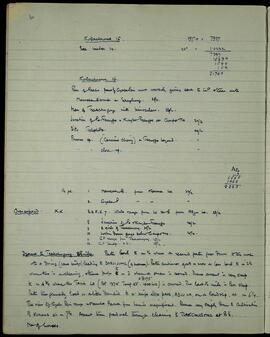
Feb. 22. Luculia pinceana 12240. Brassaiopsis karmelane sp. nov. 12244 Rhod. tanastylum 12246. 59

over 8000', then equally steep descent this side. Most of the march was today through dense forest, with some clearings made for cultivation. The pass is on a knife edge ridge, the view from the pass - if one could see it clearly - would be one which we would have to go far to beat. But there are many large Tsuga trees & Rhodos too, which block the view, except in little patches. On the pass we found one Rhodo in flower, one Daphne tree in full bloom. I have never seen the latter before - a tree of 15-18 ft with a trunk about 6" in diam. On the way up we saw one flock of 6 pigeons - the first I remember seeing in Tibet, other than the snow pigeons & the ones on the plateau. Luculia pinceana is common & we found one other Rhodo in bud, just about to flower. Locals came from tomorrow's stage to meet us here & brought a fowl, radishes & milk & prepared a place in thick forest for our tents. There are no houses here, only small level patches in dense forest. Habits as well as looks of locals seem to recall Bhutanese. They are also much healthier than the Tibetans of the Kigong upper Po-Tsangpo, & are stronger & cleaner. There is a very high cliff from the Karmala ridge down to the river, and the river here appears very narrow indeed. There are falls here of perhaps 20 ft.

23rd Feb. TSAKCHUGONG. Another perfect day, with clouds only coming up in the evening. We left at 7.00 am & walked fairly fast to the Pass. But again we could see nothing from the actual pass, owing to trees. The ascent is very steep & long taking about 1 1/2 hours. There are at the top some magnificent Tsuga & pine trees, which I estimate to be over 200 ft high. We saw no flowers at all, but had glimpses of the truly magnificent range here & there - from R. Sanglung to the westernmost of the Gyala Peri range. I took one or two photos with the early morning light, when it was particularly beautiful. The pass is called the TANA LA, & on this side there is a subsidiary pass called the HOJA LA. The Pangyuta of Ward is beside camp in TSAKCHUGONG only over a very small ridge. The locals again are stronger, cleaner & finer men than further up the valley. They are Bhutanese.

LSH/1/1/8/1/66 · Part · 1947-02-20
Fait partie de The Ludlow & Sherriff Collection

SUMMARY:
The page lists Kodachrome photo subjects around Gyala Peri, Namcha Barwa, Sanglung, and the junction of the Po and Kongbo Tsangpo near Gompo Ne, including scenes and local people at Tsakchungong. It also describes the route from Dzama to Tsakchungong with distances, passes (Tana La, Adju La), a cane bridge to Dorji Jung, gradients, and elevations, noting a magnificent view of the Gyala Peri range and Namcha Barwa.

CONTENT:
60

Kodachrome 15. 197.0 = 7997
See under 14. 42° : 1.0222
7997
15994
1599
159
8174.5

Kodachrome 16.
Pan of peaks from Gyala Peri most westerly going east to G.P. then onto
Namcha Barwa & Sanglung. 22/2.
Men of Tsakchungong with binoculars. 22/2.
Junction of Po Tsangpo & Kongbo Tsangpo at Gompo Ne 24/2
Ditto Telephoto. 24/2
Prunus sp. ("Carmine Cherry") & Tsangpo beyond. "
" close up. "

3280
2
6560
1663
8223

1/4 pl. 1 Namcha B. from Karma La 22/2
2 Gyala P. " " "
Overexposed. XX 3, 4, 5, 6, 7. Whole range from W to E from Adju La. 23/2
8 Junction of Po & Kongbo Tsangpo 24/2
9 2 girls of Tsakchungong. 25/2
10 Looking down gorge below Gompo Ne. 25/2.
11 G.P. range from Tsakchungong. 25/2
12 G.P. " x 2. 25/2

Dzama to Tsakchungong. 8 1/2 miles. Path level to m 1/2 where a second path goes down to the river to a dring (cane bridge) leading to DORJI JUNG (4 houses). Path continues good & more or less level to m 2 1/2 where there is a clearing, thence drops to m 3 where a stream is crossed. Thence ascent is very steep = 8175' to m 4 3/4 where the TANA LA (BP 197.0° Temp 42°. 1000 hrs.) is crossed. The last 1/2 mile is less steep. Path then generally level or a little downhill to a knife edge pass, ADJU LA, on a landslip, at m 6 1/4. The view of Gyala Peri range & Namcha Barwa from here is magnificent. Runs very steeply down to cultivation of KUNONG at m 7 1/4. Ascent then gradual through clearing to TSAKCHUNGONG at 8 1/2.
No of houses.

LSH/1/1/8/1/67 · Part · 1947-02-20
Fait partie de The Ludlow & Sherriff Collection

SUMMARY:
The diarist describes settlements and mani stones near Dzama in the Pemako region, attempts to trace the Kongbo Tsangpo from Adju la, and notes forests of pines along the Tsangpo with a sighting of a quail and Carmine Cherry in bloom near Chanzam. The following day is a halt due to cloud, snow on the Gyala Peri–Namcha side, and evening rain.

CONTENT:
Feb 23. Vaccinium leucobotryum 12251
Prunus cerasoides var. rubra 12252
Rhod. scopulorum 12248
61

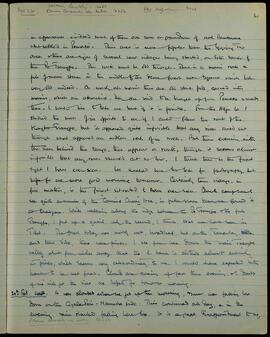
in appearance, indeed some of them are sons or grandsons of real Bhutanese who settled in Pemako. This area is more popular than the Yigrong Chu area. There are signs of several new villages being started on both banks of the Po Tsangpo. This route must be old though. There is a mani rock, a pile of mani stones in the middle of the dense forest near Dzama which looks very old indeed. On nearly all manis there are old stone pots, carved with manis, which are attractive. They are said to be brought up from Pemako & made there. I would like to take one back if it is possible. From the Adju la I studied the mass face opposite to see if I could follow the route of the Kongbo Tsangpo, but it appeared quite impossible that any river could cut through what appeared an endless wall of ice & rock. But this evening, with the sun behind the range, there appears a route, though it seems almost impossible that any river should cut so low. I think this is the finest sight I have ever seen. We reached here too late for photography, but hope for one more good morning tomorrow. Certainly this village, in fine weather, is the finest situated I have ever seen. Close to camp here I see quite a number of the Carmine Cherry tree, in fuller bloom than we found it at Chanzam. While walking along the ridge between the Po Tsangpo & the Guh Tsangpo, I put up a quail, only the second, I think, that we have seen in Tibet. The forest today was mostly wet, broadleaf, but on the Tsangpo, there and this side, there were pines. I see from here down the main Tsangpo valley about four miles away that the l. bank is clothed almost entirely in pines, which seems very extraordinary to me. I would have expected both banks to be wet forest. Clouds are coming up fast this evening, & I doubt if we will get the view we hoped for tomorrow morning.

24th Feb. Halt. It was clouded when we got up this morning, snow was falling low down on the Gyala Peri - Namcha side. This continued all day, & in the evening rain started falling here too. It is a great disappointment to us.
Prunus cerasoides var. rubra 12252

LSH/1/1/8/1/68 · Part · 1947-02-20
Fait partie de The Ludlow & Sherriff Collection

SUMMARY:
Records daily temperatures and weather at Tsakchungong for late February, noting cloud, rain, and snow on high peaks. Also lists several bird specimens from Tsakchungong with sex, iris, bill, and leg colors alongside specimen numbers dated 23–25 February.

CONTENT:
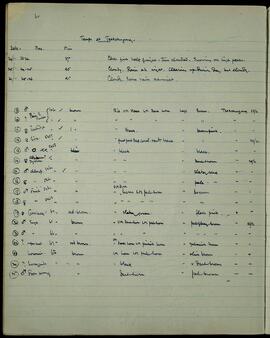
Temps at Tsakchungong.

Date. Max. Min
24/2 23-24. 37° Clear first half of night: then clouded. Snowing on high peaks.
25/2 24-25 40° Cloudy. Rain all night. Clearing up during day, but cloudy.
26/2 25-26 41° Cloudy. Some rain at night.

(9) ♂ Pair of Finches Iris brown Bill UM black LM dark horn Legs Brown. Tsakchungong 23/2
(10) ? " " " " " " " " "
(11) ♀ Partridge " " " Black. " brown pink. " "
(12) ♀ Siva. 5457 " " " front part deep coral. remdr black " " " 24/2
(13) ♂ O XX 5458 " " " black " black. " "
(14) ♀ Sibia? / Dycom. " " " " " dark brown " 25/2
(15) ♂ Chlorosp. 5460 " " " " " slaty blue " "
(16) ♀ " 5461 " " " " " pale " " "
(17) ♂ Finch 5462 " " UM dark horn LM pale horn " brown " "
(18) ♀ " 546

Page 69
LSH/1/1/8/1/69 · Part · 1947-02-20
Fait partie de The Ludlow & Sherriff Collection

CONTENT:
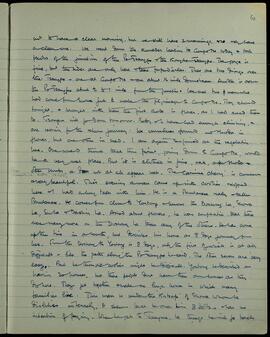
not to have a clear morning, but we still have 3 mornings, so may have a clear one. We went down the staircase leading to Gompo Ne today & took photos of the junction of the Po Tsangpo & the Kongbo Tsangpo. The gorge is fine, but the sides are only here & there perpendicular. There are two bridges over the Tsangpo - one at Gompo Ne & one about 1/2 mile downstream. Another is across the Po Tsangpo about 1/2 to 1 mile from the junction. We met two men who had come from Showa just to make the pilgrimage to Gompo Ne. They returned tonight, & brought with them the first rhodo. in flower, as I had asked them to. Tsompon will go down tomorrow. Betty & I have had enough climbing, & are resting for the return journey.

We ourselves found no rhodos in flower, but one other in seed.

I am again surprised at the vegetation here. One would think that this point, going down to Gompo Ne, would be a very wet place. But it is clothed in pine, oak, a few rhodos & other shrubs, & does not at all appear wet. The 'Carmine Cherry' is common & very beautiful.

This evening a man came up with coolies & stopped here & I had a long talk with him. He is a Bhutanese really & talks Bhutanese. He comes from close to Yortong & knows the Doshong La, Showa La, Sula & Dashing La. Asked about flowers, he was emphatic that there were many more on the Doshong La than any of the others. He has come up this time in a month, but describes his home as 8 days journey from here.

From the Doshong to Yortong is 8 days, only the first of which is at all difficult - like the path along the Po Tsangpo he said. The other seven are very easy. But he thought coolies might be difficult. Yortong he described as having 30 houses, but these people don't have their own houses as they do here. They get together & make one huge house in which many families live.

This man is under the 'Kutsap' of Showa whom he dislikes intensely. It seems that he owes him 8 dots & has no intention of paying. When he gets to Tangme, he thinks he will go back.

LSH/1/1/8/1/70 · Part · 1947-02-20
Fait partie de The Ludlow & Sherriff Collection

SUMMARY:
Notes record sex/age and coloration details (bill, iris, legs) for B. finch, barwing, and thrush specimens. Localities include Tsakchungung (27/2), Lubong (28/2), and Tamdong (1/3). The page concludes with numerical calculations.

CONTENT:
64

547
26 ♂ 0 Bill u.m. greeney slate, l.m. Dk horny slate Iris Dark brown. Legs. Brown. Tsakchungung 27/2
B. finch 27 ♂ 0 u.m. greeney slate, l.m. Dk horny slate. Dark brown Brown. " "
28 ♀ " " " " " " " "
29 ? 1y " " " " " " " "
Barwing 30 ♂ 1y Dark horn Brown brown. " "
Thrush 31 Yellow " " yellow. Lubong. 28/2.
32 Juv. " " " " " " Tamdong. 1/3.

203.0° = 4749
48° = 1.0355

4749
14247
23745
2374

4917.5

LSH/1/1/8/1/71 · Part · 1947-02-20
Fait partie de The Ludlow & Sherriff Collection

SUMMARY:
Notes describe worries about a Kutsap at Showa, poor birding and fatigue, and at Hall a hypsometer reading, Tsongpen’s trip to Gampo Ne, and pilgrims circling a boulder. Further notes list local crops and livestock with reliance on takin across the Po Tsangpo. On 27 Feb the party moved to Dzama with fine views of Namcha Barwa and the Gyala peaks, crossing the Adju La, with arrangements made by the Dingpon of Lome and a wild peach observed.

CONTENT:
to Kongbo out onto Showa, where he is afraid what will happen to him. The 'Kutsap' there apparently holds a wife of his as hostage. This doesn't make him feel any more friendly to the Tibetan official. We found no birds this afternoon, a disappointment after what we saw yesterday. Both of us feel very tired today.

25 Feb. Hall. Fine, but cloudy, with some sun. It rained hard last night, and was very misty this morning, but cleared considerably and looked as if it would clear altogether. Tsongpen went down to Gampo Ne today, but got little or nothing, just one rhodo which had been brought in yesterday. He took the hypsometer with him and got readings: - BP 203.0° F. Temp 48° F. (Ht = 4917') B and I looked for birds and saw very few indeed. There are interesting birds here, but there seem to be very few of them. No sign of any more quail. Nor have I found a skulker which I heard the first day - Horaites, I think. Tsongpen again saw a big green woodpecker with orange buff crest or mantle. There is a big flat, with a large boulder in the middle, round which pilgrims walk.

26th Feb. Hall. Rain again last night and clouded all day today, but just fine. We have got some wheat here, tsatse (millet) and onions. Indian corn is also grown and barley and buckwheat. There does not seem to be a great surplus of anything though. Crops are autumn sown, and are now 10" high. Peas are also autumn sown. A fair number of good cattle, with mithun blood, are kept, but I don't think are ever eaten. The locals depend on wild game, mostly takin, for meat. Takin seem plentiful on the other side of the Po Tsangpo on the left bank of the Tsangpo.

27th Feb. Dzama. Cleared up to a fine day. Views of the Namcha Barwa - Gyala peaks were quite magnificent again and lasted till we had passed the Adju La and got into the forest. All arrangements were well made by the Dingpon. I thought he was a Gyimpon, but he is Dingpon of Lome. A Dingpon has 4-6 gyimpons under him. The only interesting flower seen today was a peach, apparently wild, growing on the edge of a small clearing in the forest, with very fine

LSH/1/1/8/1/72 · Part · 1947-02-20
Fait partie de The Ludlow & Sherriff Collection

SUMMARY:
Daily weather notes from 26 February to 6 March are recorded, followed by a note on the impassable road to Gompo Ne and the limited supplies available in villages. The writer lists staple foods and remarks on numerous large and small landslides in the lower Po Tsangpo valley.

CONTENT:
66.

26-27th Feb: Cleared at night. 27th sparklingly bright.
27-28th Feb: Rain at night. 28th cloudy with sunny patches.
28-1st March: Little rain at night. 1st a clear bright day.
1-2nd March: - - - 2nd mostly clear sky.
2-3rd March: Min 41°. Lightly clouded night. Sun clouded day. Hot. Max about 78°.
3-4th March: Min 46°. Some rain at night. Cloudy day.
4-5th March: Min 46°. Rain all night, rained hard all day 5th.
5-6th March: ? Rain all night + rain all 6th.

Note about road to Gompo Ne ship line.
Road is impassable everywhere for ponies. Supplies in very limited quantities are available at nearly every village, and consist of barley, wheat, maize, millet, fowls, barking deer + takin meat, milk. In summer to these could be added eggs. Some turnips + radishes, probably dried, are also available. The road is not easy: 1st + 2nd days could be made into one march perhaps, but the others are long in time + effort. A most noticeable thing about the lower Po Tsangpo valley is the number of very large landslides + small ones too, on both sides. Some of them have come down 2000 or