Showing 6828 results

Archival description
2091 results with digital objects Show results with digital objects
LSH/1/1/2/1/223 · Part · 1934-10-14
Part of The Ludlow & Sherriff Collection

SUMMARY:
The diarist describes comfortable bamboo hut accommodations and stages from Samri Chu to Taktu and then to Sakden over the Munda La, noting fine weather and elevations. At the first village over the pass, they observe papermaking driven by a waterwheel and efficient turning of wooden drinking bowls; Danang suggests the wood is a kind of Prunus.

CONTENT:
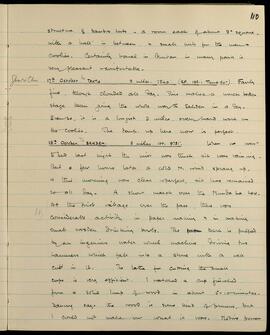
110

structure of bamboo huts - a room each of about 8' square, with a 'hall' in between, and small huts for the men coolies. Certainly travel in Bhutan in many parts is very pleasant and comfortable.

Samri Chu
17th October. to TAKTU 9 miles. 7840' (B.P. 18.1 Temp 60°). Fairly fine, though clouded all day. This makes a much better stage than doing the whole way to Sakden in a day. Even so, it is a longish 9 miles, and very hard work on the coolies. The temp. up here now is perfect.

18th October. To SAKDEN. 5 miles. Ht. 9731'. When we went to bed last night the mist was thick and it was raining. But a few hours later a cold N. wind sprang up, and this morning was clear and perfect, and it has remained so all day. A short march over the Munda La here.

FB
At the first village over the pass, there was considerable activity in paper making and in making small wooden drinking bowls. The paper bark is pulped by an ingenious water wheel machine, driving two hammers which fall into a stone with a well cut in it. The lathe for cutting the small cups is very efficient. I watched a cup finished from a solid lump of wood in about 5-10 minutes. Danang says the wood is some kind of prunus, but I could not make out what it was. Motive power

LSH/1/1/9/1/113 · Part · 1949-08-21
Part of The Ludlow & Sherriff Collection

SUMMARY:
The party marches in persistent rain from Samtegang to Wangdipotrang and over Hinglai La to Tsalimape, with a halt day due to wet weather. They encounter an unprepared Ritang headman, receive a protracted visit from a local Dzongpon, and have slow coolies over the pass. Few flowers are seen, but seeds of Streptopus simplex, Vaccinium, and a Cotoneaster are collected; Lilium nepalense is noted as common.

CONTENT:
We hear Raja Dorji lost 160 cattle there lately.

6th August - Samtegang. Rain at night, rain and mist most of the way here. Nothing of interest on the way, except Lilium nepalense, which is fairly common, and in unripe seed just now. We took from 5:30 to 12:45, the longest march so far. The Ritang headman was no good. He was not ready for our arrival, had no wood or supplies, and then failed to have any coolies in the morning, and did not turn up himself. Samtegang was very different, everything there was ready and well done.

7th August - Wangdipotrang. Thick mist and rain - on the one day I thought we could certainly expect to be fine. But it cleared up later and was bright for a while. The local Dzongpon came and called and he caused us some consternation by staying for an hour and a half. At last I thought he was waiting for me to tell him he could go, so I got up and induced him to get up too. Then I led him out of the room and showed him the steps down. But not a bit - he led me through two other rooms and then said "Here you are - here is the lavatory." I told him I did not want that, and then reluctantly had to lead him back to our room, where Betty was very surprised to see him again. A pleasant, polite man, but very little use, one would think.

8th August - Halt. Wet all day.

9th August - Camp Hinglai La. Off at 5:15 in heavy rain. We reached the pass at 1:00 pm, and coolies not till 4:00 pm. They were very slow. Cleared up in the evening. Little of interest seen.

10th August - Tsalimape. A little over 3 hours. No flowers except one Pyrola. But we got very good seed of Streptopus simplex, and also of Vaccinium and a Cotoneaster. Here a very pleasant camp-fire.

LSH/1/1/2/1/207 · Part · 1933-10-08 - 1933-10-09
Part of The Ludlow & Sherriff Collection

SUMMARY:
The party halts at Sana amid heavy rain that floods the tent; a Tibetan patient improves as more pus and cores are expelled. Their taphon begs for trousers and is promised pyjamas, and the next day they march to Trashiyangsi Dzong before rain sets in, with Danong and Kurtip returning.

CONTENT:
walk a little and in much less pain. There is still a lot of pus and two cores came out today. With the bright sun leeches have vanished as quickly as they come with the rain. Evening again heavy rain. I'm afraid I shall get no chance of a view from the Donger La, as tomorrow is our last day. I shan't be sorry to leave this place; it has not been very exciting.

8th October. Halted Sana. Very heavy rain last night flooded my tent. A good sunny morning. The Tibetan is very much better, though a lot of pus still comes out, and another core was squeezed out this morning. We sent him off at 1.0pm to get down to the next hut, a mile or two down the hill. Our excellent 'taphon' has just been prostrating himself in front of our tent. When cursed by Ludlow, he came to me. Eventually we found that what he was begging for was a pair of pants. These aren't generally worn in Bhutan, but he seems to think he has risen to them now. I have promised him my pyjamas in two days time, but they won't last him long.

Quercus griffithii 1053
Pleione praecox 1056
9th Oct. TO TRASHIYANGSI DZONG. 11 miles Ht. 5883' (BP. 20.17) Temp 68° A beautiful day until about 2.30 when the rain came on. Danong and Kurtip returned.

LSH/1/1/2/1/205 · Part · 1933-10-05
Part of The Ludlow & Sherriff Collection

SUMMARY:
The diarist reports a serious epidemic to the south in Shinga Dzong, thought by Puibo to be influenza though possibly typhoid. While halted at Sana, Ludlow treated a Tibetan man's abscess and ongoing dressings improved his condition amid rainy weather and delays awaiting mail.

CONTENT:
101

to be a serious outbreak of some epidemic to
the south in Shinga Dzong. Two hundred or
more are said to have died already. Puibo
says it is influenza, though typhoid is more
likely.

6th October. Halted Sana. Fair morning, rain the rest
of the day. Yesterday Ludlow cut the Tibetan's
abscess with a razor blade. Pus just poured out
and the man was obviously greatly relieved. We
dress it four times a day, and still any amount
of stuff pours out. The hand is a little less
swollen, but still big and very painful. I wonder
if he will be able to walk down with us in
two days' time. We cannot leave him here, or
the whole thing will just start off again. I
wish the next mail would arrive. With all this
rain, one feels the need of reading matter. It is
little or no use going out in misty dull weather,
as birds are not on the move then. We should
know definitely next mail whether all our mails
have been delivered or not.

7th Oct. Halted Sana. The first good day since we
have been here. Cloudy, but sun bright in the
valleys. The Tibetan is much better, able to

Phylloscopus affinis wallichiana 10000

LSH/1/1/2/1/203 · Part · 1933-10-03 - 1933-10-05
Part of The Ludlow & Sherriff Collection

SUMMARY:
Three halt days at Sana with rain, mist, and leeches are described. Ludlow shot a Kalij pheasant; later they saw a tragopan but had no food birds, and meat supplies fluctuated with two hens, two pheasants, and a sheep. A sick Tibetan companion with an abscess was treated with hot compresses, some pus discharged, and they planned to cut it with a razor.

CONTENT:
100

3rd October. Halt Sana. A poor day, rain or mist most of the day, therefore leeches rather in evidence. Found nothing new. Ludlow shot a very fine cock Kalij pheasant. The Tibetan is no better today: in fact the poison has gone down to his right arm and hand, and left leg too it seems. We have put on four large hot compresses today, but there is still no sign of the abscess coming to a head. A Mohammedan is a rotten man when it comes to helping a fellow creature. Our people get all food and ample practically free. They said of course they would feed him. When we looked to see what he was getting, it was dry rice alone. Ma, the sheep has been found and is now no more. The Tibetan will get a piece of him, or her. Meat comes in rushes. We had none for some time; now we have two hens, two pheasant and a sheep.

4th Oct. Halted Sana. Reasonably fine, but cloudy. No food birds: saw a tragopan.

5th Oct. Halted Sana. Rain off and on all day. Mist very low. The Tibetan is rather better today, and some pus came out of the abscess this morning. We intend to cut it this evening, with a razor blade. There seems

LSH/1/1/4/1/56 · Part · 1933-07-23
Part of The Ludlow & Sherriff Collection

SUMMARY:
The diarist travels over the Cha La to Sanga Chöling and finds Sherriff already there. They note that splitting their collecting efforts during peak flowering was very successful, especially with Primulas, yielding about 50 species between them. The last six weeks were strenuous, and a week’s rest at Sanga Chöling was beneficial.

CONTENT:
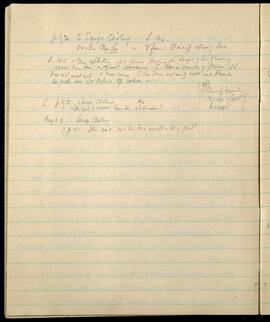
July 30. to Sanga Chöling - L. 164.
Over the Cha La - I found Sherriff already there.

L. 165 "The splitting up of forces during the height of the flowering season has been a great success. S. has a number of flowers I did not meet with: & vice versa. S. has done extremely well with Primulas. We prob. have 50 different sp. between us."

L. July 31. Sanga Chöling 165.
"The last 6 weeks have been strenuous"

Aug. 1-5. Sanga Chöling
L. p. 165 "This week's rest has done us all a lot of good"

NB
Sherriff records
remains of last
6 weeks

LSH/1/1/4/1/55 · Part · 1933-07-23
Part of The Ludlow & Sherriff Collection

SUMMARY:
The diarist notes a slip into a river at camp without injury, records observations of Delphinium and gentians with altitude ranges, and recovers a previously lost fountain pen at Cyandro. A local couple visits, requests a photograph, and gives six eggs in return. The entry is set at Sanga Choling.

CONTENT:
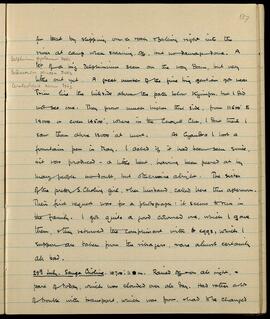
for that by slipping on a rock and falling right into the
river at camp when starting off, but no damage done. A Delphinium gyalanum 7461
lot of a big Delphinium seen on the way down, but very Didissandra sericea 7462
little out yet. A great number of the fine big gentian grow near Ceratostigma minus 7463
Prims line the hillside above the path below Kyimpu, but I did
not see one. They grow much higher this side, from 11500' to
14000' or even 14500', whereas in the Changu Chu, I don't think I
saw them above 12000' at most. At Cyandro I lost a
fountain pen in May. I asked if it had been seen since,
and it was produced - a little bent, having been peered at by
many people no doubt, but otherwise all right. The sister
of the pretty S. Choling girl, and her husband, called here this afternoon.
Their first request was for a photograph: it seems to run in
the family. I got quite a good coloured one, which I gave
them, and they returned the compliment with 6 eggs, which I
suppose are taken from the villagers, and are almost certainly
all bad.

29th July. Sanga Choling. 10700'. 1

LSH/1/1/4/1/109 · Part · 1933-09-23 - 1933-09-24
Part of The Ludlow & Sherriff Collection

SUMMARY:
The diarists halt at Sanga Choling, receiving hospitality from a local mother and later sending mail via a young lama to Chague. The head lama visits and speaks of a recent scare in Lhasa involving Russians or Chinese Communists; Tsongpen returns with seeds from Karpo and the Trakan la, though the sought red Primula nivalis was not found.

CONTENT:
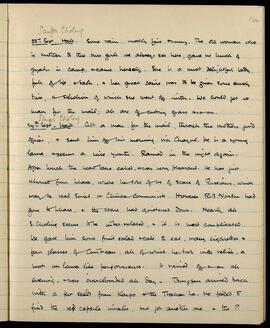
Sanga Choling
23rd Sept. Halt. Some rain, mostly fine and sunny. The old woman who is mother to the two girls we always see here, gave us lunch of guatu in camp, and came herself. She is a most delightful lady, full of life and talk, and her great desire was to be given some embroidery silk, a selection of which she went off with. We could get no man for the mail; all are off cutting grass and so on.

Sanga Choling
24th Sept. Halt. Got a man for the mail, through the mother's good offices, and sent him off this morning via Chague. He is a young lama and seems a nice youth. Rained in the night again. After lunch the head lama called, and was very pleasant. He has just returned from Lhasa, where he told us of scare of Russians, which may be real Soviet or Chinese Communists. However R.B. Norbu had gone to Lhasa, and the scare had quietened down. Nearly all S. Choling seems to be inter-related, and it is most complicated. We gave him some fruit salad and cake to eat, many cigarettes and four glasses of Cointreau, all of which he took with relish, a most un-lama like performance. It rained off and on all evening, and was overclouded all day. Tsongpen arrived back with a few seeds from Karpo and the Trakan la. He failed to find the red Primula nivalis, but got another one, and the P.