
GB 235 MCW/4/3/12
·
Item
·
undated
Part of John MacWatt Primula papers
2091 results with digital objects
Show results with digital objects
GB 235 MCW/4/3/13
·
Item
·
1921
Part of John MacWatt Primula papers
GB 235 MCW/4/3/14
·
Item
·
undated
Part of John MacWatt Primula papers
GB 235 MCW/4/3/15
·
Item
·
undated
Part of John MacWatt Primula papers
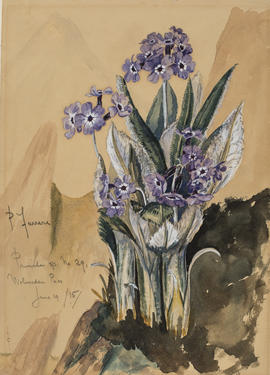
GB 235 MCW/4/3/16
·
Item
·
1921
Part of John MacWatt Primula papers
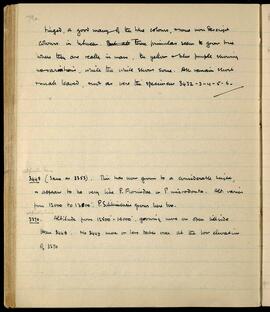
LSH/1/1/5/1/160
·
Part
·
1937-07-14
Part of The Ludlow & Sherriff Collection
SUMMARY:
Notes on Primula populations with yellow, blue-purple, and white forms; whites show some variation, and all remain short and small-leaved as in specimens 3432–3436. Specimens 3449 and 3370 (alpicola luna) are compared, with 3449 resembling P. florindae or P. microdonta, P. sikkimensis present, and distributions between about 12,000–14,000 ft, with 3449 taking over at lower elevations than 3370.
CONTENT:
79a
tinged, a good many of the blue colours, and some nondescript
colours in between. But all these primulas seem to grow true
where they are really in mass, the yellow and blue purple showing
no variations, while the white shows some. All remain short
small leaved, just as were the specimens 3432-3-4-5-6.
alpicola luna
3449 (Same as 3353). This has now grown to a considerable height,
and appears to be very like P. florindae or P. microdonta. Alt. varies
from 12,000 to 13,000'. P. sikkimensis grows here too.
alpicola luna
- Altitude from 12,500' - 14,000', growing more on open hillside
than 3449. No. 3449 more or less takes over at the low elevation
of 3370.
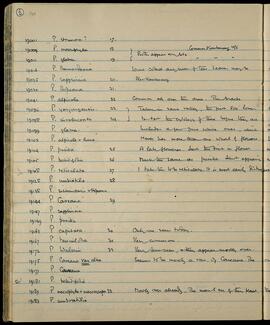
LSH/1/1/9/1/142
·
Part
·
1933-09-01
Part of The Ludlow & Sherriff Collection
SUMMARY:
The page lists numerous Primula taxa with specimen numbers and brief notes on abundance and flowering, many recorded as common at Kantanang on 10/6. It mentions elevation comparison within the same valley, white forms of P. glabra, a hybrid (P. sikkimensis × hopeana), and comments on varieties such as caveana var. alba and macrophylla var. macrocarpa.
CONTENT:
(2) 134
- P. strumosa? 17.
19009 P. macrophylla 18 } Both appear very late. Common Kantanang 10/6
19011 P. glabra 19 } Common Kantanang 10/6 - P. barnardoana Won't collect any more of this. Leaves may be
19025 P. sapphirina 20. Also Kantanang
19030 P. hopeana 21.
19041 P. alpicola 22 Common all over this area. The bracts
19096 P. yarongensis. 23. } Taken in same valley, the first 500' lower
19098 P. involucrata 24. } to test the cytology of these before they are
19099 P. glabra. Includes a few pure white ones, which
19103 P. alpicola var. luna Never has more than one whorl of flowers
19104 P. pusilla. 25 A late flowerer. Just the first in flower
19105 P. bellidifolia 26 Much the same as pusilla. Just appearing
19108 P. reticulata 27 I take this to be reticulata. It is most easily distinguished
19128 P. umbratilis 28
19138 P. sikkimensis x hopeana
19144 P. caveana 29
19147 P. sapphirina
19149 P. pusilla
19163 P. capitata. 30 Only one seen today.
19167 P. tenuiloba 31 Very common.
19172 P. walshii 32 Very few seen, & they appear mostly over.
19175 P. caveana var. alba Seems to be merely a var. of caveana. The
19177 P. caveana
50) 19181 P. bellidifolia.
19189 P. macrophylla var. macrocarpa 33. Mostly over already. The more I see of this plant, the
19183 P. umbratilis
GB 235 MCW/4/3/17
·
Item
·
1915
Part of John MacWatt Primula papers
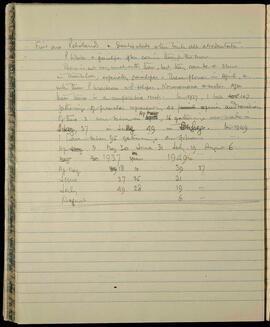
LSH/1/1/10/1/122
·
Part
·
1933-10-10
Part of The Ludlow & Sherriff Collection
SUMMARY:
Notes on Petiolarid primulas, with early flowering in April by P. winteri, P. gracilipes, P. bracteosa, P. filipes, and P. normaniana. The author summarizes collection efforts: 107 gatherings across 44 taxa in 1937 and 95 gatherings in 1949, with monthly breakdowns showing peaks in June and July. A comparative table contrasts monthly totals for 1937 and 1949.
CONTENT:
First are Petiolarids - Denticulate & the like all atrodentata.
P. winteri & gracilipes often coming through the snow.
There is not very much in them, but they cause a show in themselves, especially gracilipes. These flower in April, & with them P. bracteosa & P. filipes, normaniana & others. After them there is a comparative rush. In 1937, I took 107 gatherings of primulas representing 44 species and varieties. Of these 2 were taken in April, 16 gatherings were made in May, 37 in June, 49 in July. In 1949 I have taken 95 gatherings as follows: April 9, May 30, June 31, July 19, August 6.
1937 species 1949
April/May 18 10 39 27
June 37 25 31
July 49 28 19
August 6